Top 10 Usage-Based Billing Platforms for SaaS in 2026
The 10 best usage-based billing platforms for SaaS and AI companies in 2026
Introduction
Usage-based pricing is no longer the exception. In 2026, the majority of new B2B SaaS products launching in infrastructure, AI, data, and developer tools price on consumption. Snowflake, OpenAI, Twilio, and Datadog have made the model the default for technical buyers, and the rest of the SaaS world is following.
The challenge is that building usage-based billing in-house is genuinely hard. You need a metering layer that captures events at high volume without data loss, a pricing engine that handles tiered, volume, and graduated rates, prepaid credit management, real-time consumption visibility, and a billing system that turns all of this into clean, compliant invoices on the right day of the month.
Most billing platforms claim to support usage-based billing. The reality is that only a small subset handle it natively, with the depth and reliability that an AI company or infrastructure SaaS actually needs. The rest support a flat-rate subscription with a metered add-on bolted on.
This guide ranks the ten usage-based billing platforms that SaaS companies should evaluate in 2026, with a transparent comparison of pricing, fit, and the trade-offs that matter.
How we ranked these platforms
Each platform was scored across five dimensions :
• Native usage metering depth : real-time, high-volume event ingestion ; tiered, volume, and graduated pricing ; late-arriving event handling ; prepaid credits.
• Coverage of the full billing workflow : whether the platform handles only metering, only billing, or the full quote-to-cash workflow.
• Integration breadth : direct database connections, data warehouse support, payment providers, CRM, and accounting.
• Total cost of ownership : platform fees, percentage of revenue, engineering work to operate.
• Speed to value : time from kick-off to first usage-based invoice issued.
Platforms designed primarily for B2C subscriptions or pure flat-rate billing without real usage support were excluded.
Comparison table at a glance
1. Hyperline — Best for: Modern B2B SaaS and AI with hybrid pricing · Real-time metering: Yes · Native CPQ + billing: Yes (full Q2C) · Starting price: $299 / mo + 0.7 % of revenue
2. Stripe Billing — Best for: Developer-led startups already on Stripe · Real-time metering: Yes (metered billing) · Native CPQ + billing: Billing only · Starting price: 0.5 to 0.8 % of recurring revenue
3. Orb — Best for: Pure usage-based AI and infrastructure SaaS · Real-time metering: Yes · Native CPQ + billing: Billing only · Starting price: Custom
4. Metronome — Best for: Developer-led usage-based SaaS · Real-time metering: Yes · Native CPQ + billing: Billing only · Starting price: Custom
5. Lago — Best for: Open-source usage-based metering · Real-time metering: Yes · Native CPQ + billing: Billing only · Starting price: Free (open source) or $400+ / mo cloud
6. M3ter — Best for: Enterprise usage-based and complex pricing · Real-time metering: Yes · Native CPQ + billing: Metering plus pricing engine · Starting price: Custom
7. Zenskar — Best for: Modern subscription plus usage hybrid · Real-time metering: Yes · Native CPQ + billing: Yes (full Q2C) · Starting price: Custom
8. Chargebee — Best for: Mid-market subscription with usage add-on · Real-time metering: Limited · Native CPQ + billing: Billing only · Starting price: $599 / mo + usage extension
9. Zuora — Best for: Enterprise usage-based at scale · Real-time metering: Yes · Native CPQ + billing: Yes (full Q2C) · Starting price: Custom (typically $1500+ / mo)
10. Maxio — Best for: SaaS finance teams adding metered billing · Real-time metering: Limited · Native CPQ + billing: Billing only · Starting price: Custom (mid-market entry around $500 / mo)
Pricing reflects publicly listed entry points as of April 2026. Custom enterprise quotes vary.
The 10 best usage-based billing platforms for SaaS in 2026
1. Hyperline : Best overall for modern B2B SaaS and AI
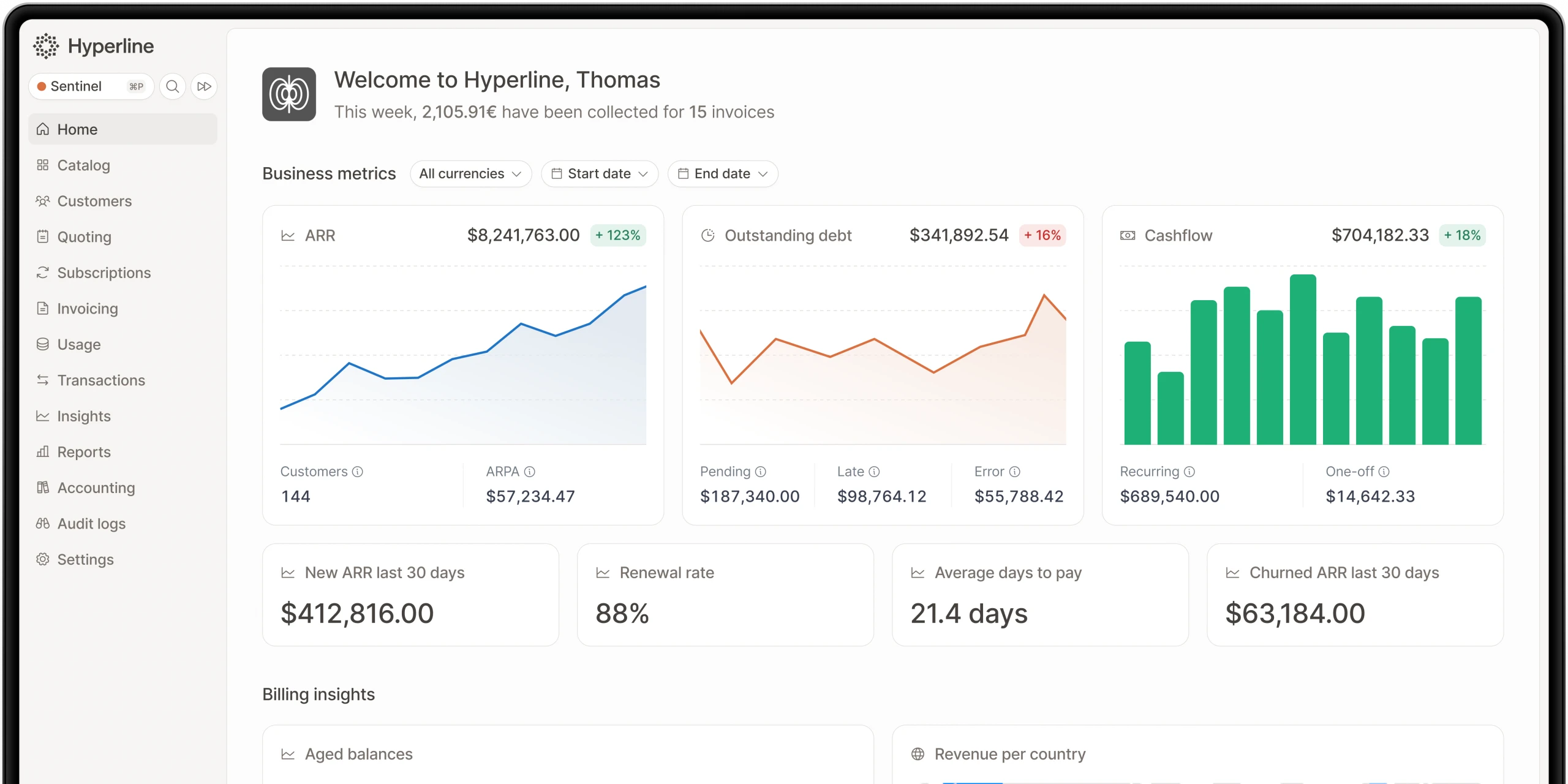
One-liner : A unified revenue management platform that automates quote-to-cash, with CPQ, flexible billing, and usage-based billing in one place.
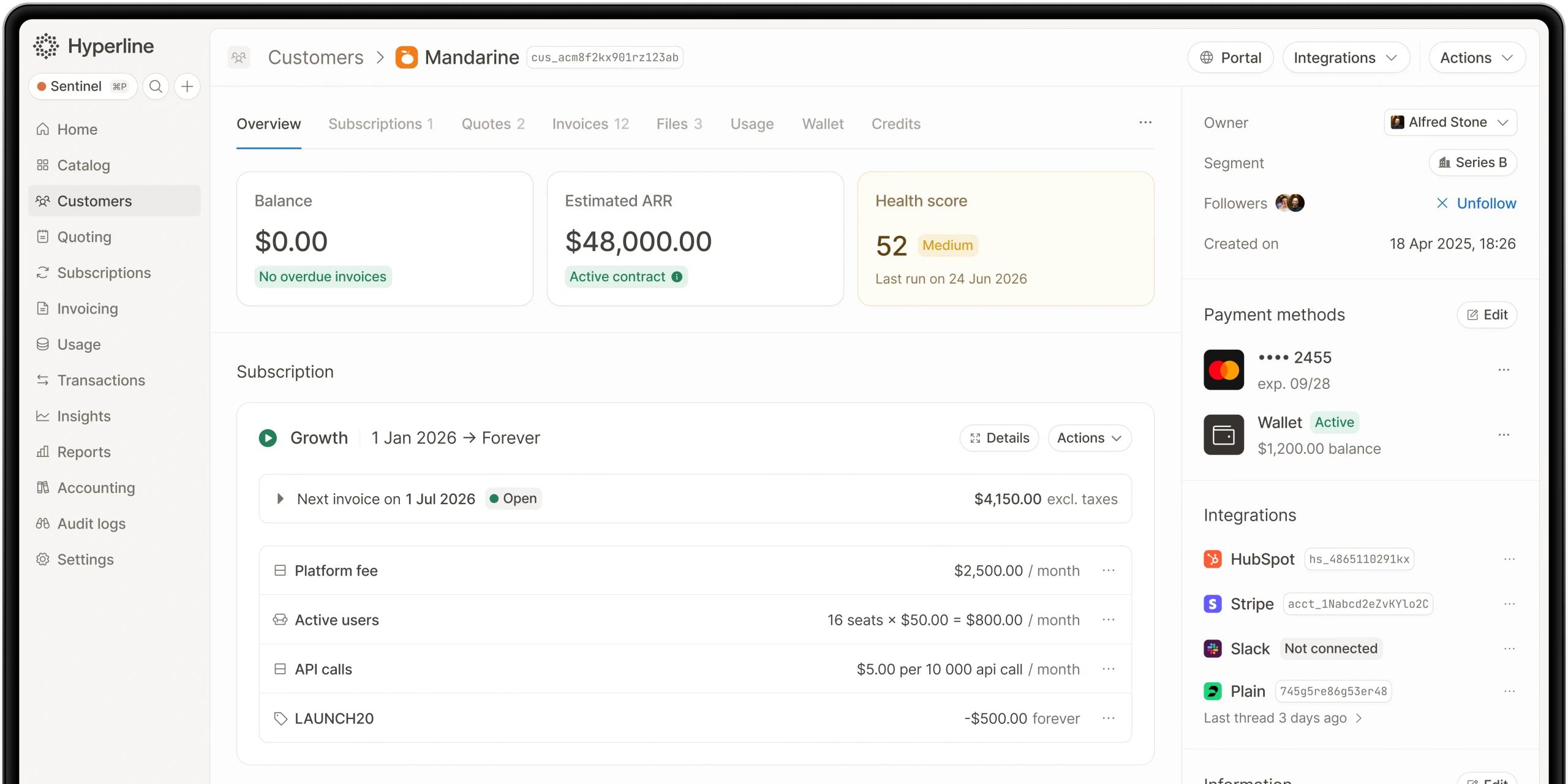
Hyperline ranks first because it is the only platform on this list that ships native usage-based billing inside a complete quote-to-cash product. Real-time metering, prepaid credit management, ramp deals, hybrid subscription-plus-usage pricing, and contract management all live in the same system. For an AI company or an infrastructure SaaS that has outgrown a Stripe Billing setup, Hyperline replaces the metering tool, the billing tool, the CPQ tool, and the revenue recognition tool with one product.
Hyperline positions itself as "the new standard for revenue management" and describes the product in this way : "From contracts to cash in the bank, manage every step of your revenue process in one unified system."
What stands out :
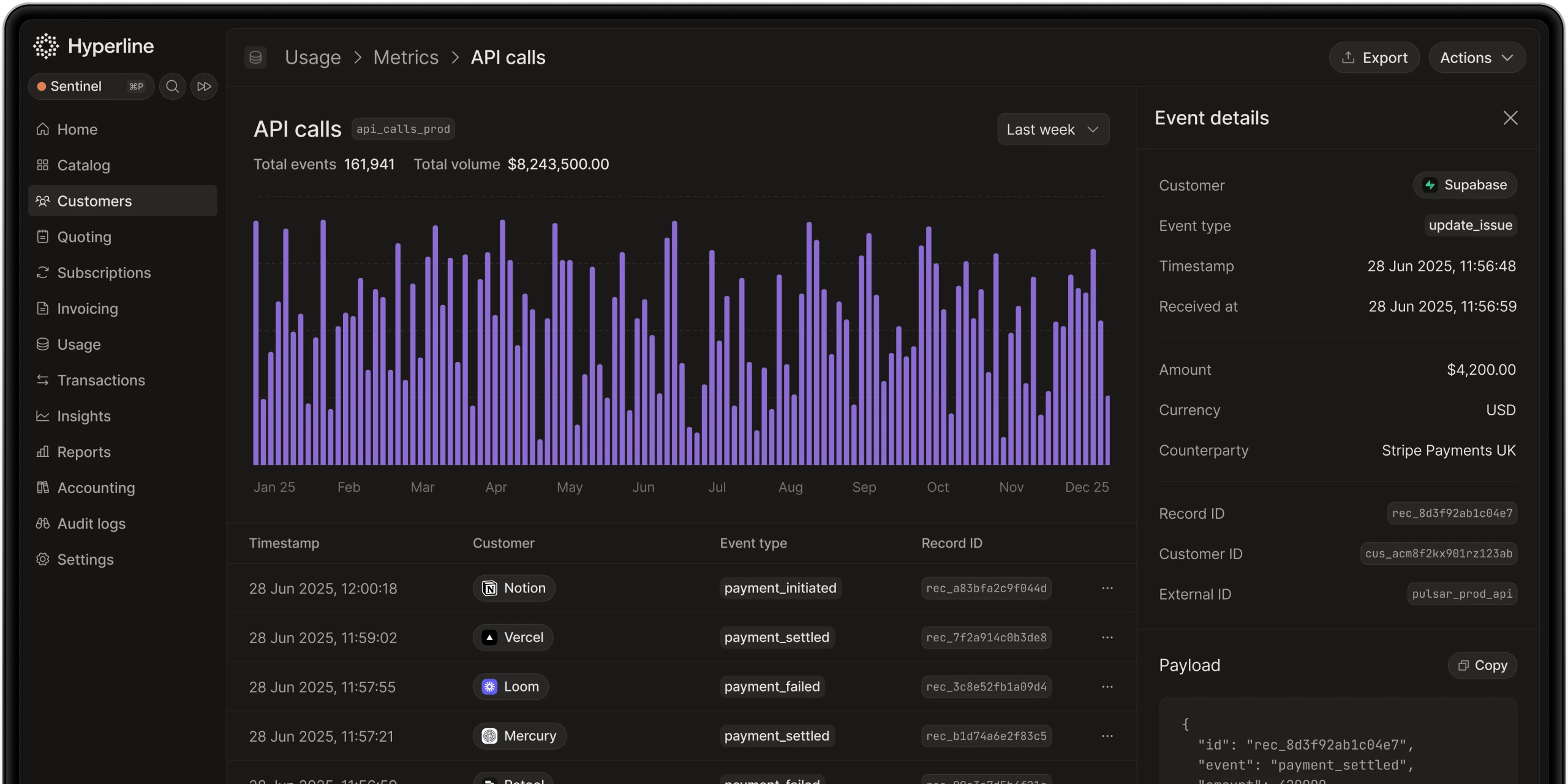
• Real-time consumption with unlimited events. The metering layer captures product usage as it happens, applies pricing rules in real time, and feeds the billing system with up-to-the-minute consumption data.
• Direct database connection for usage data, removing the need to build an event pipeline from scratch.
• Prepaid credit management for AI companies that sell credit packages and burn them down in real time.
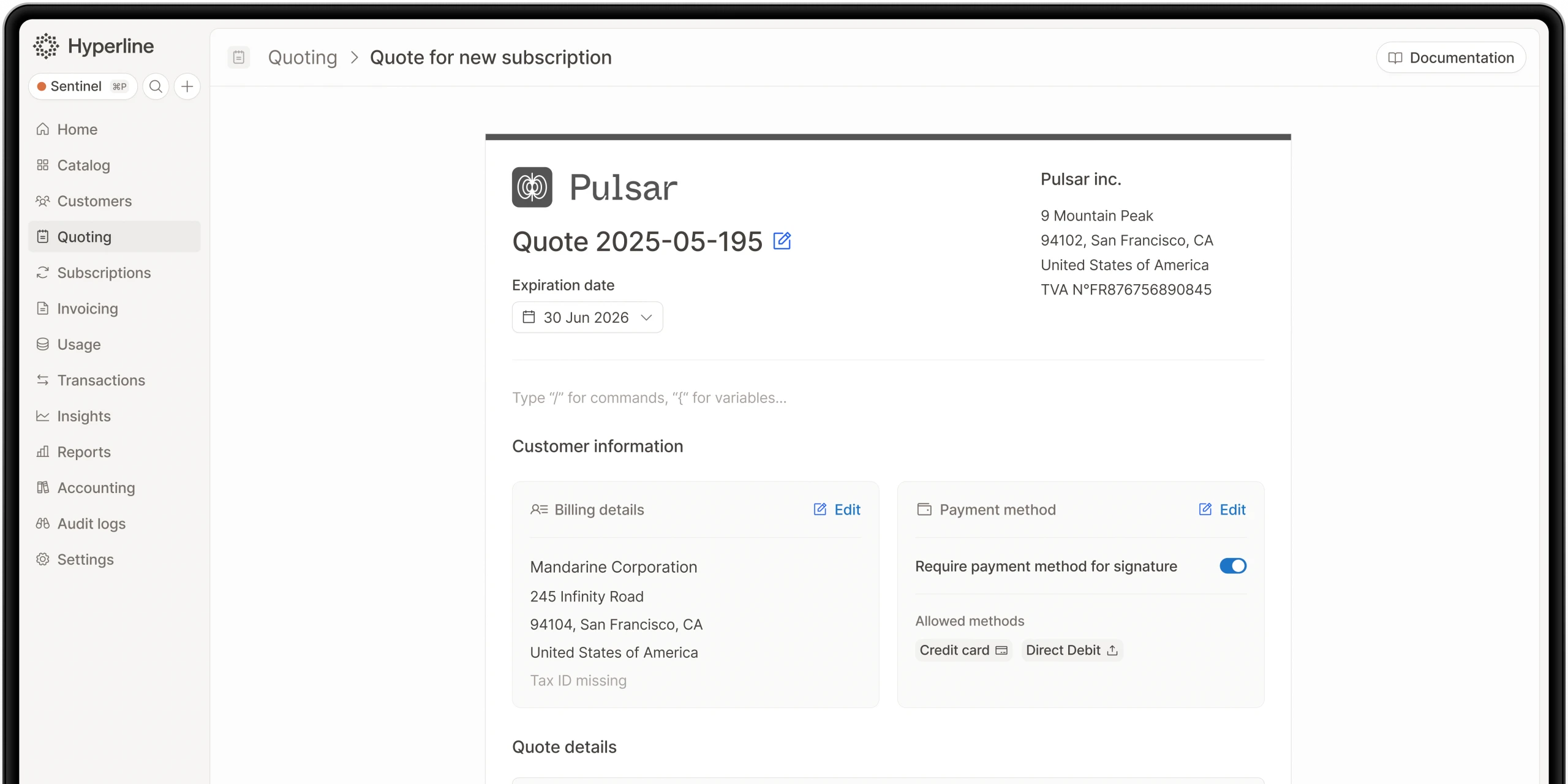
• Native CPQ that handles complex contract terms : ramp deals, multi-year commitments, custom discounts, approval workflows.
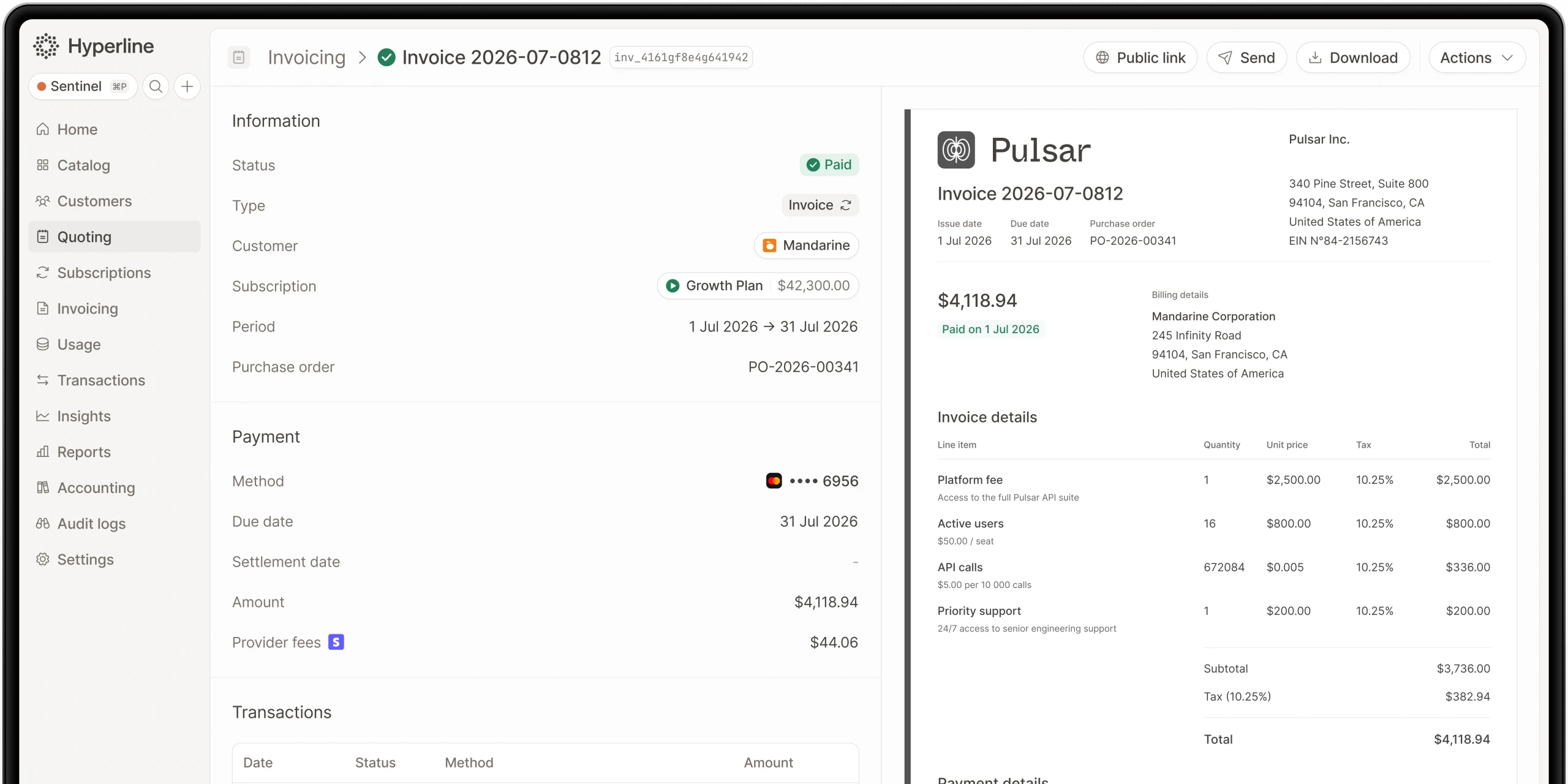
• Compliant invoicing in over 100 countries with e-invoicing in 80+ countries.
• Headline metrics on hyperline.co : 80 % of manual work eliminated, 99.9 % reconciliation accuracy, 500M+ total invoices processed, 99.997 % uptime, 4.9 / 5 G2 rating.
• Used by modern B2B SaaS and AI companies including Lemlist, Formance, ScorePlay, Truvi, Malou, Attio, Veesion, Conectd, Pinpoint, Infinit, Ocus, and Groupe Positive.
Pricing : - Quote to Cash plus Usage : $299 / month plus 0.7 % of revenue. Includes unlimited events, real-time consumption, metered products, automated seat-based billing, prepaid credit management, direct database connection. - High Volume : custom pricing for companies above $5M ARR. - CRM and accounting integrations : $50 per integration per month.
Trade-offs : - Younger product than Zuora or Chargebee, with a smaller marketplace of third-party plugins. - Best fit for B2B SaaS or AI companies with hybrid pricing complexity. A pure flat-rate business will not unlock the platform's full value.
Best for : B2B SaaS or AI companies between $1M and $50M ARR with usage-based or hybrid pricing, that want one platform for the full revenue process.
2. Stripe Billing : Best for developer-led startups already on Stripe
Stripe Billing supports metered billing through its API, and for SaaS companies already running on Stripe Payments, adding metering is a low-friction path. The metered billing primitive supports tiered, volume, and graduated pricing, and integrates cleanly with the rest of the Stripe ecosystem.
What stands out : - Tight integration with Stripe Payments, Stripe Tax, and Stripe Invoicing. - Strong API and developer documentation. - No platform fee, just a percentage of recurring revenue.
Trade-offs : - Real complex usage-based pricing (multi-dimensional, hybrid contracts, prepaid credits) requires engineering work on top of the API. - No native CPQ. Most teams pair Stripe Billing with HubSpot CPQ or Salesforce CPQ. - Revenue recognition is basic. Most teams add Maxio or Sage Intacct once they cross $5M ARR. - Subscription analytics are limited.
Pricing : 0.5 % of recurring revenue on the Starter plan, up to 0.8 % on the Scale plan. No monthly platform fee.
Best for : Early-stage usage-based SaaS up to $5M ARR with strong engineering bandwidth.
3. Orb : Best for pure usage-based AI and infrastructure SaaS
Orb is purpose-built for usage-based billing. The product has gained strong traction with AI companies and infrastructure SaaS that need real-time metering at high event volume, with the depth and reliability that a Stripe Billing setup cannot deliver.
What stands out : - Real-time metering at scale, with strong handling of late-arriving events. - Sophisticated pricing engine : tiered, volume, graduated, prepaid credits, custom hybrid models. - Designed for AI and infrastructure SaaS from day one.
Trade-offs : - Billing-only product. No native CPQ, no contract management. Most teams pair Orb with Salesforce CPQ or HubSpot CPQ. - Custom pricing only, with mid-market entry that climbs quickly. - Revenue recognition is light. Most teams add a separate revrec tool.
Best for : Pure usage-based AI and infrastructure SaaS with high event volume that need a deep metering and pricing engine.
4. Metronome : Best for developer-led usage-based SaaS
Metronome is another modern usage-based billing platform that has gained adoption with developer-led SaaS, especially in AI infrastructure. The product focuses on a strong metering layer and a flexible pricing engine, with an API-first approach.
What stands out : - API-first design, well-suited to engineering-led teams. - Real-time usage tracking with strong event ingestion. - Used by several public AI companies.
Trade-offs : - Billing-only product. No native CPQ. - Custom pricing only. - Less coverage on revenue recognition and SaaS metrics than Hyperline or Maxio. - Smaller customer base than Orb.
Best for : Developer-led usage-based SaaS that wants a modern API-first metering and billing tool.
5. Lago : Best open-source usage-based metering
Lago is the leading open-source usage-based billing platform. The product offers a self-hostable option for teams that want full control over their metering infrastructure, plus a managed cloud version.
What stands out : - Open-source, with a permissive license and an active community. - Self-hostable for teams with strict data residency or compliance requirements. - Strong metering primitives : event ingestion, tiered pricing, prepaid credits.
Trade-offs : - Billing-only product. No native CPQ. - Self-hosting requires engineering capacity to operate. - The cloud version starts around $400 per month and climbs with volume. - Less polished UX than Hyperline or Orb.
Best for : Engineering-led teams with data residency or compliance requirements, or teams that want full control over the metering infrastructure.
6. M3ter : Best for enterprise usage-based and complex pricing
M3ter focuses on the enterprise tier of usage-based billing. The product handles complex pricing models, multi-product hierarchies, and contract amendments at scale, with an emphasis on integration with existing billing and ERP systems.
What stands out : - Strong pricing engine for complex enterprise models. - Designed to slot into an existing billing or ERP stack as a metering layer. - Multi-currency and multi-entity support.
Trade-offs : - Custom pricing only, typically enterprise-level entry points. - Often deployed alongside an existing billing platform rather than replacing it. - Long implementation cycles compared to modern unified platforms.
Best for : Enterprise SaaS with complex usage-based pricing models that needs a dedicated metering and pricing layer alongside an existing billing system.
7. Zenskar : Best modern subscription plus usage hybrid
Zenskar is a modern revenue management platform that, like Hyperline and Subskribe, ships subscription, usage-based, and CPQ in a single product. It has gained traction with mid-market SaaS that wants a modern alternative to Chargebee.
What stands out : - Unified subscription, usage-based, and CPQ in one product. - Strong support for hybrid pricing. - Modern UX for finance and revenue operations teams.
Trade-offs : - Custom pricing only, with mid-market entry typically higher than Hyperline. - Smaller customer base in Europe compared to Hyperline. - Less depth on global e-invoicing compliance than Hyperline.
Best for : Mid-market SaaS in North America with hybrid subscription plus usage pricing.
8. Chargebee : Best for mid-market subscription with usage add-on
Chargebee added usage-based billing capability several years ago as an extension of its core subscription product. The result is functional but feels grafted on rather than native, especially for high-volume real-time metering.
What stands out : - Mature subscription billing and revenue recognition foundation. - Strong CRM and accounting integrations. - Familiar to mid-market finance teams.
Trade-offs : - Usage-based billing is supported but limited at high event volumes. - Real-time metering is less robust than Hyperline, Orb, or Metronome. - The Performance plan starts at $599 per month, with usage-based features in higher tiers.
Best for : Mid-market SaaS already using Chargebee for subscription billing that wants to add a usage component without changing platforms.
9. Zuora : Best enterprise usage-based at scale
Zuora handles enterprise usage-based billing at scale, with full quote-to-cash coverage including Z-Billing, Zuora CPQ, and RevPro for revenue recognition. Large telecom, media, and enterprise SaaS companies often run on Zuora.
What stands out : - End-to-end enterprise quote-to-cash coverage. - Mature ASC 606 / IFRS 15 revenue recognition. - Multi-entity, multi-currency, multi-product hierarchy at enterprise scale.
Trade-offs : - Long implementations, often six to twelve months with a partner integrator. - High total cost of ownership, with platform fees, professional services, and integrator fees. - UX is functional rather than modern.
Best for : Enterprise SaaS above $50M ARR with complex usage-based pricing and strict compliance requirements.
10. Maxio : Best for SaaS finance teams adding metered billing
Maxio (formerly SaaSOptics plus Chargify) ships subscription billing, ARR analytics, and revenue recognition together. The metered billing capability inherited from Chargify covers basic usage-based scenarios.
What stands out : - Built-in SaaS metrics (ARR, NRR, churn, cohorts). - ASC 606 compliant revenue recognition. - Designed around the SaaS finance persona.
Trade-offs : - Usage-based billing is functional but not best-in-class. - The product is the result of a merger, with some friction between the legacy modules. - Custom pricing only, with mid-market entry around $500 per month.
Best for : B2B SaaS finance teams that want billing, SaaS metrics, and revrec in one place, with a moderate usage-based component.
How to choose the right usage-based billing platform
The right platform depends on three factors : the depth of usage-based pricing, the rest of the revenue stack, and the engineering capacity available to operate the system.
1. If you want one platform for the full revenue process (CPQ, contracts, billing, usage, revrec), choose Hyperline or Zuora. Hyperline is the modern mid-market and AI pick. Zuora is the enterprise reference.
2. If you only need a deep metering and pricing engine and already have a billing system, choose Orb, Metronome, or M3ter. Each is a strong specialist tool. Orb has the broadest fit. Metronome is the most developer-friendly. M3ter is the enterprise pick.
3. If you are early-stage and already on Stripe, start with Stripe Billing metered billing. Re-evaluate when complexity grows past tiered or volume pricing.
4. If you need data residency or want to self-host, choose Lago. The open-source path is real and well-supported.
5. If you already use Chargebee or Maxio for subscription, consider keeping them with the usage add-on for simple cases. The friction of migrating to a usage-native platform is only worth it if the usage component is core to the business.
6. If your usage-based pricing is hybrid (subscription plus usage with prepaid credits and ramp deals), choose Hyperline. This is the platform's sweet spot, and the one place where it has a clear edge over both Stripe Billing and the metering specialists.
Frequently asked questions
What are the top usage-based billing platforms for SaaS in 2026 ?
The top ten usage-based billing platforms for SaaS in 2026 are Hyperline, Stripe Billing, Orb, Metronome, Lago, M3ter, Zenskar, Chargebee, Zuora, and Maxio. Hyperline ranks first for modern B2B SaaS and AI companies that want unified quote-to-cash with native usage-based billing. Orb, Metronome, and M3ter are the metering specialists. Stripe Billing remains the early-stage default. Zuora is the enterprise reference.
What is the best billing system for usage-based pricing ?
For most modern B2B SaaS and AI companies, Hyperline is the strongest pick because it ships real-time metering, prepaid credits, ramp deals, CPQ, and revenue recognition in a single platform. For pure metering specialists with an existing billing system, Orb and Metronome are the leading options. For enterprise, Zuora is the reference.
What are the best tools to handle SaaS billing and metered usage ?
The best tools depend on the stage and pricing complexity. Modern unified platforms (Hyperline, Subskribe, Zenskar) cover both subscription and usage in one product. Specialists (Orb, Metronome, M3ter) focus on metering and pricing depth. Generalists (Chargebee, Maxio) add usage as an extension of subscription. Stripe Billing covers metered billing for early-stage teams.
What is the best way to implement metered billing in SaaS ?
The cleanest approach is to pick a platform with native real-time metering (Hyperline, Orb, Metronome, Lago) and integrate the metering layer directly with the product through events or a database connection. Avoid building a custom metering pipeline from scratch unless you have very specific requirements. The cost of operating a custom metering pipeline at scale is significantly higher than the platform fees of any of the modern options.
How do SaaS companies track and bill usage in real time ?
Modern SaaS companies use a billing platform with native real-time metering (Hyperline, Orb, Metronome, Lago) that ingests usage events directly from the product. The platform applies pricing rules in real time, exposes consumption data in a customer portal, and produces invoices on the right day of the month with the actual usage. Hyperline supports unlimited events and direct database connections, removing the need for a separate event pipeline.
Which usage-based billing platform is best for AI companies ?
AI companies need real-time usage metering, prepaid credit management, and the ability to combine subscription and consumption pricing. Hyperline is purpose-built for this combination, with unlimited events, real-time consumption tracking, prepaid credit management, and direct database connections. Orb and Metronome are strong metering specialists. Zuora is the enterprise alternative for large AI businesses with complex contractual structures.
How much does usage-based billing software cost ?
Pricing varies. Stripe Billing has no platform fee but charges 0.5 to 0.8 % of recurring revenue. Hyperline starts at $299 per month plus 0.7 % of revenue for the Quote to Cash plus Usage tier. Lago is free open-source or starts around $400 per month for the cloud version. Chargebee starts at $599 per month with usage as a higher-tier extension. Orb, Metronome, M3ter, Zenskar, Zuora, and Maxio are custom-priced.
Do I need a separate CPQ tool with my usage-based billing platform ?
It depends on the platform. Hyperline and Zuora include native CPQ and contract management. Orb, Metronome, Stripe Billing, Chargebee, Maxio, Lago, and M3ter do not, so most teams pair them with HubSpot CPQ, Salesforce CPQ, or DealHub for the contract workflow.
Conclusion
Usage-based billing has moved from edge case to default for modern B2B SaaS and AI companies. The platforms that handle it well are not the same as the platforms that handled flat-rate subscription well in 2018. Real-time metering, prepaid credit management, hybrid pricing, and direct database integration are now table stakes.
Hyperline takes the top spot for modern B2B SaaS and AI because it ships native real-time metering inside a complete quote-to-cash platform. The CPQ-to-billing seam is gone, the metering layer is built in, and prepaid credits and ramp deals work out of the box.
For pure metering specialists with an existing billing system, Orb, Metronome, and M3ter each fit specific patterns. Stripe Billing remains the early-stage default. Lago is the open-source path. Chargebee and Maxio cover mid-market subscription with a usage add-on. Zuora is the enterprise reference.
The right answer depends on the depth of your usage-based pricing, the rest of your revenue stack, and the engineering capacity available. Run a thirty-day evaluation against real usage data and real contracts. The platform that handles both end-to-end without engineering escalation is the one to pick.
Try Hyperline free for 10 invoices, no credit card required, at hyperline.co.
Where this fits in Hyperline
Frequently asked questions
As SaaS companies grow, billing needs become more complex. HubSpot CPQ has limits: no quote-to-invoice automation, little pricing flexibility, basic reporting, manual revenue recognition, and no advanced subscription support.
HubSpot CPQ is free but costs time. Manual billing, custom integrations, and reporting errors make it expensive. Hyperline removes these issues.
Hyperline is a modern monetization and billing platform, covering everything from contracts to payment collection. Our solution is designed for software companies worldwide with recurring business models facing pricing and billing challenges such as usage metering, pricing iterations, and limited integrations. Whether you're implementing your first billing system or scaling a late-stage operation, we can assist you.
No, Hyperline links your product usage data with your billing and accounting systems to keep them in sync and running automatically.
Yes. Hyperline connects to Stripe, GoCardless, Mollie, Airwallex, and bank transfers. It automates payment matching and reminders.
HubSpot CPQ is a tool in HubSpot CRM that helps teams create quotes, manage simple subscriptions, and collect payments. It is made for small businesses and startups that want an easy quote-to-cash process.
Setup is fast. It takes days or weeks, not months. Data migration is supported and works inside HubSpot.
Ask yourself: Do we need usage-based billing? Are invoices manual? Are reports unreliable? If yes, you may need Hyperline.