Billing and revenue management, reimagined for the AI era
Finance and operations teams, augmented by agents and built for scale.
Trusted by 500+ ambitious companies leaving legacy systems behind
From AI startups to global software companies, finance teams rely on Hyperline to manage complex revenue operations at scale



With Hyperline, you get time back and focus on the work that actually creates value
Stan Rymkiewicz, Head of Growth @ Default
The intelligent billing platform powering every stage of quote-to-cash
Designed for businesses where pricing, contracts, and finance operations can no longer live in separate systems

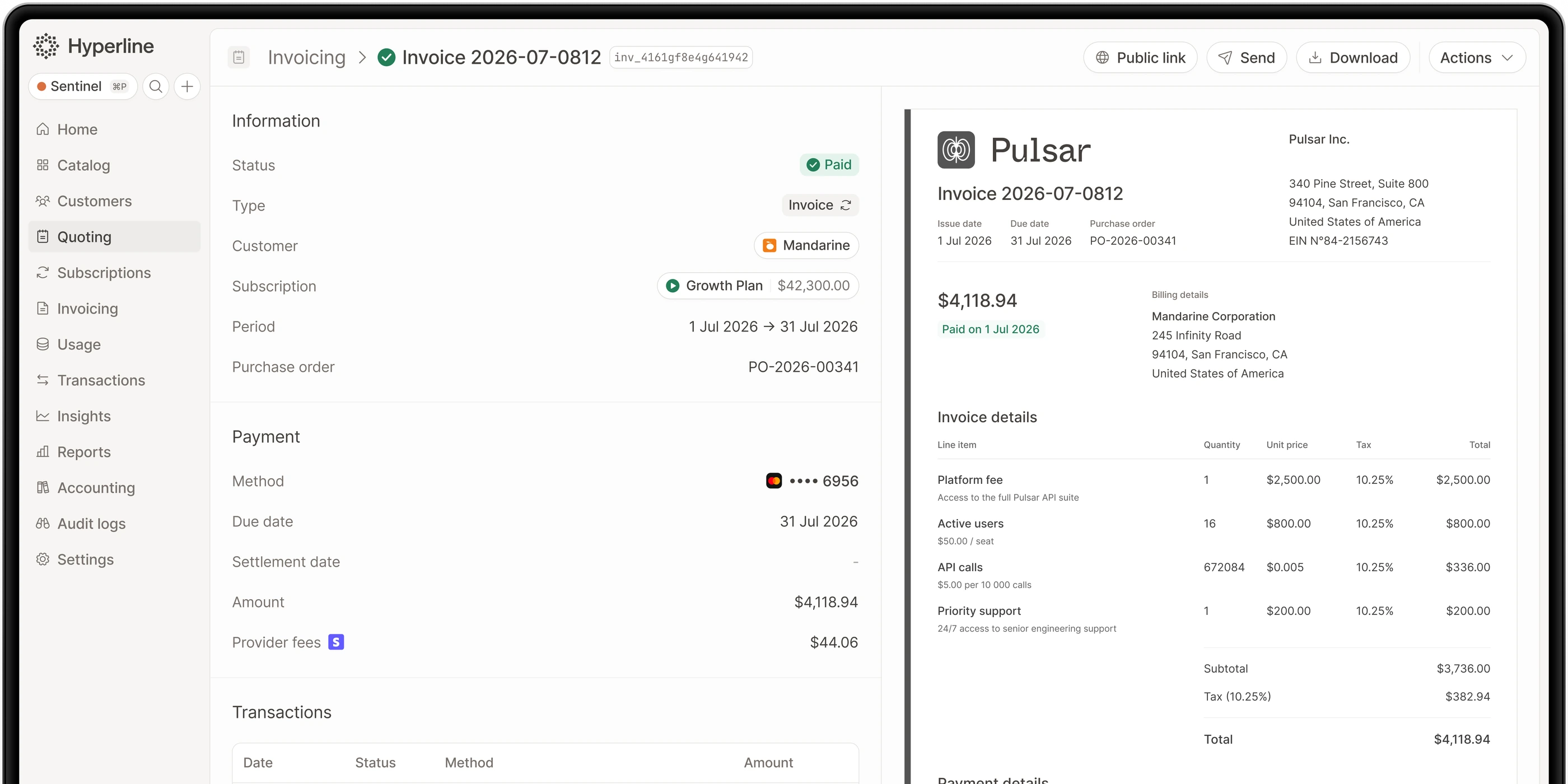
Subscriptions, usage-based and hybrid pricing. Every model your customers ask for, without engineering intervention.

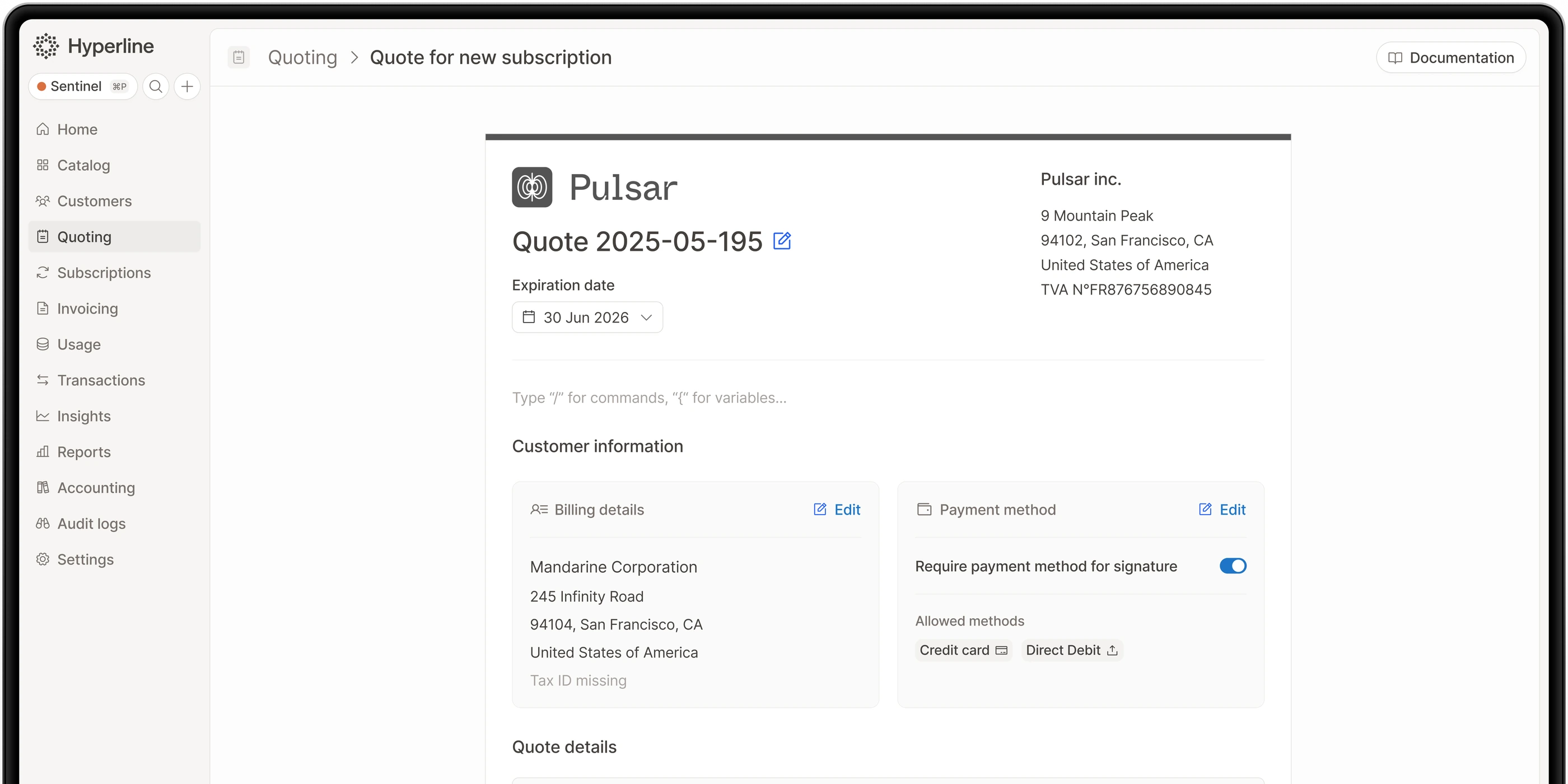
Configure complex contracts and close faster. Go from the first quote to the signed deal, without slowing down your sales team.



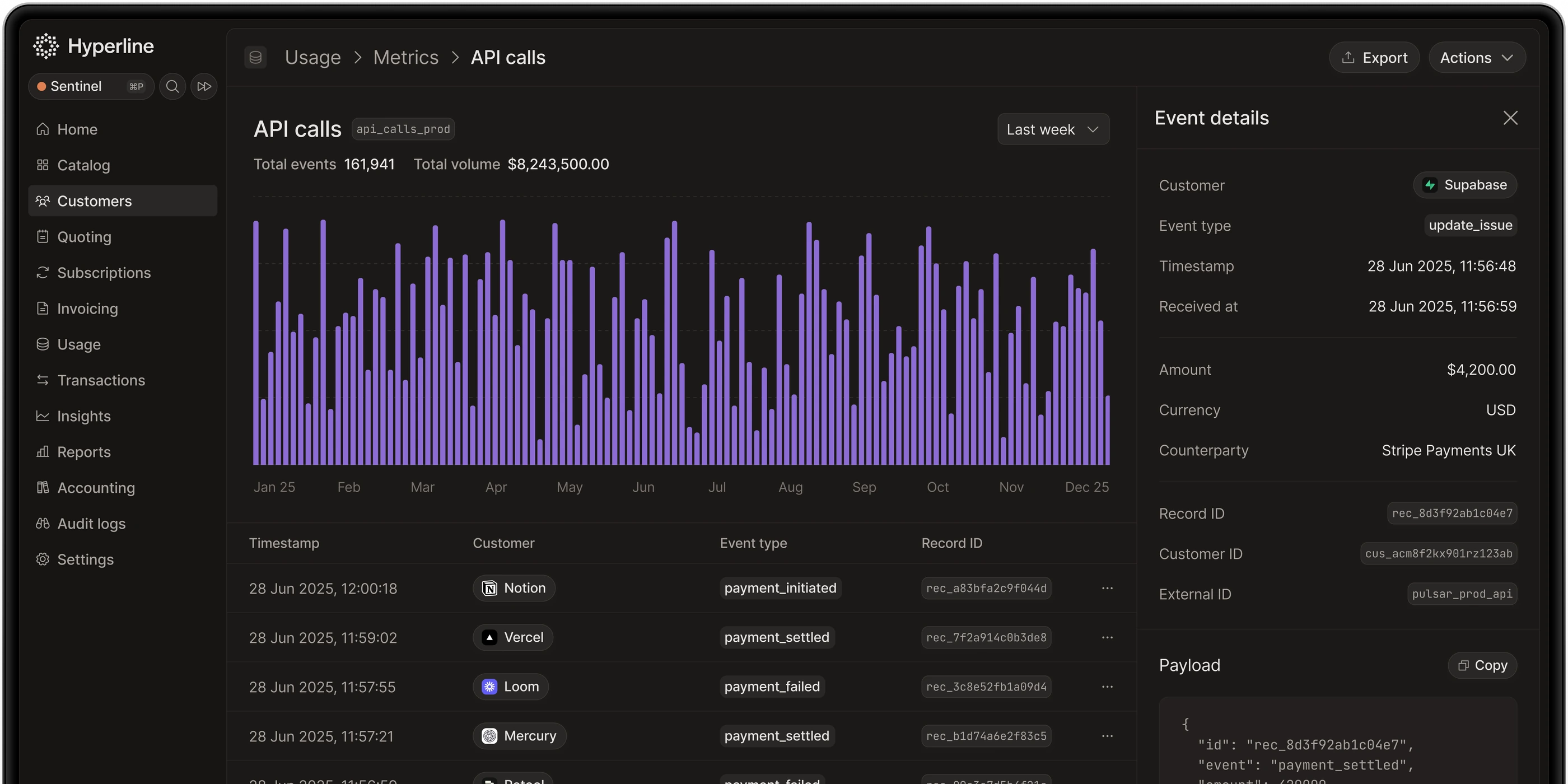
Real-time metering plugged straight into your stack. A billion events a month, 99.97% uptime, no nightly batches.



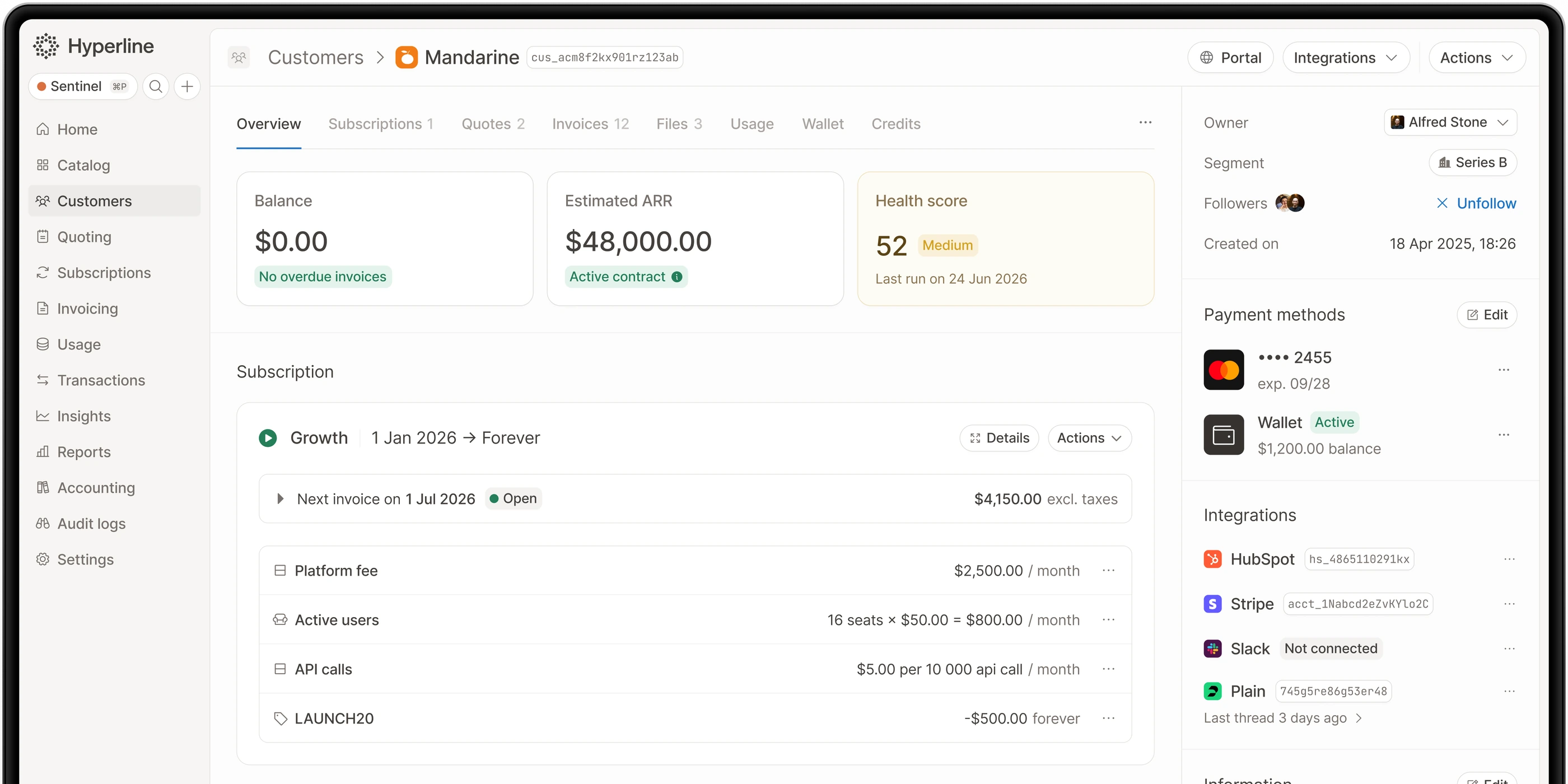
A live operating profile for every customer: payment behavior, contract value, support, emails, meetings and risk signals, connected in one place.

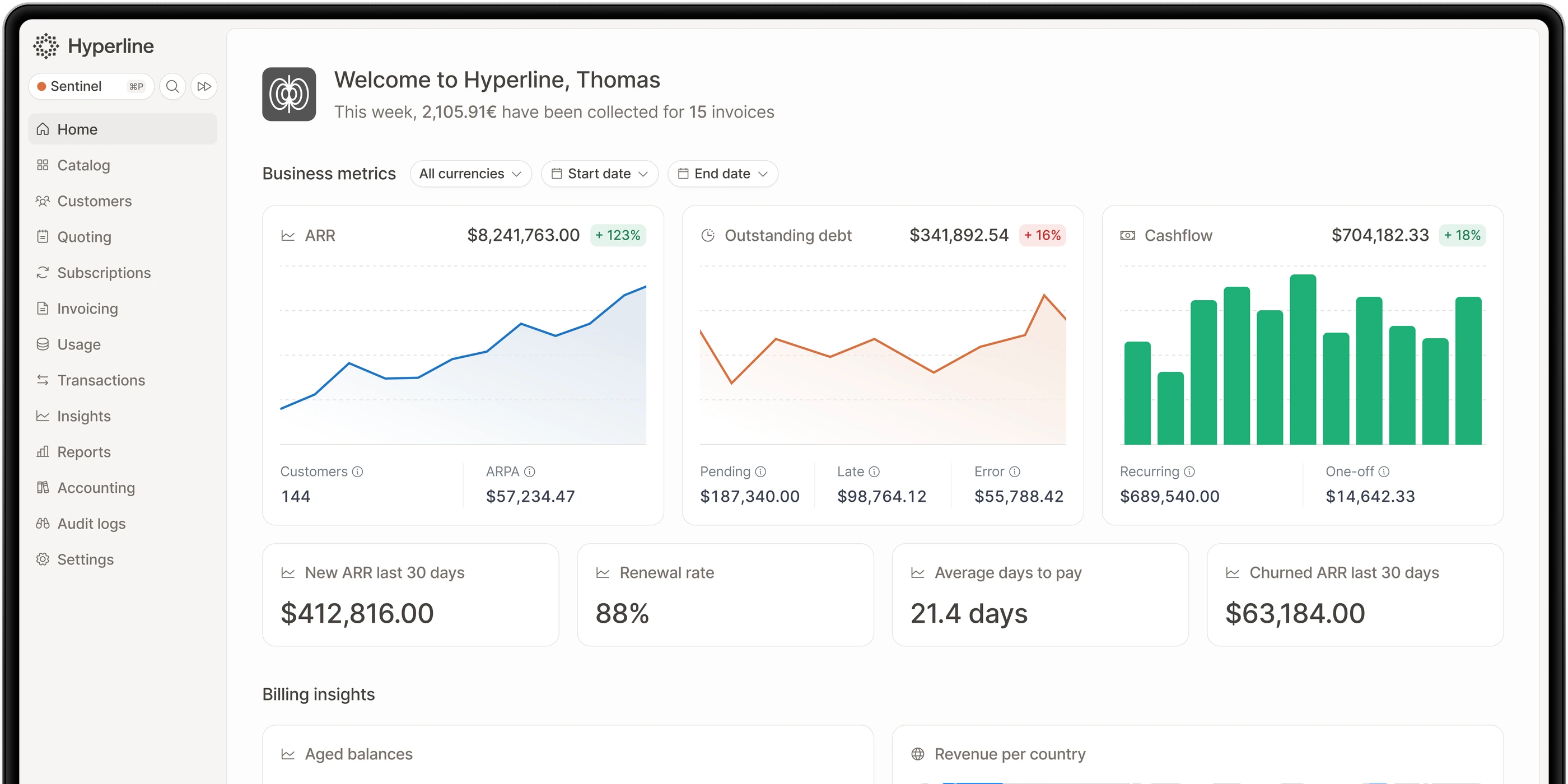
Collections, payments and cash visibility within a single platform. Your team steps in only for the outliers.
Billing, reimagined for the AI era

Enhance your finance team with AI
Designed to handle repetitive tasks with the context, controls and accuracy that finance teams require

Recover overdue invoices on autopilot. Your agent decides who to chase, when and how, all in your brand's voice. No manual follow-ups
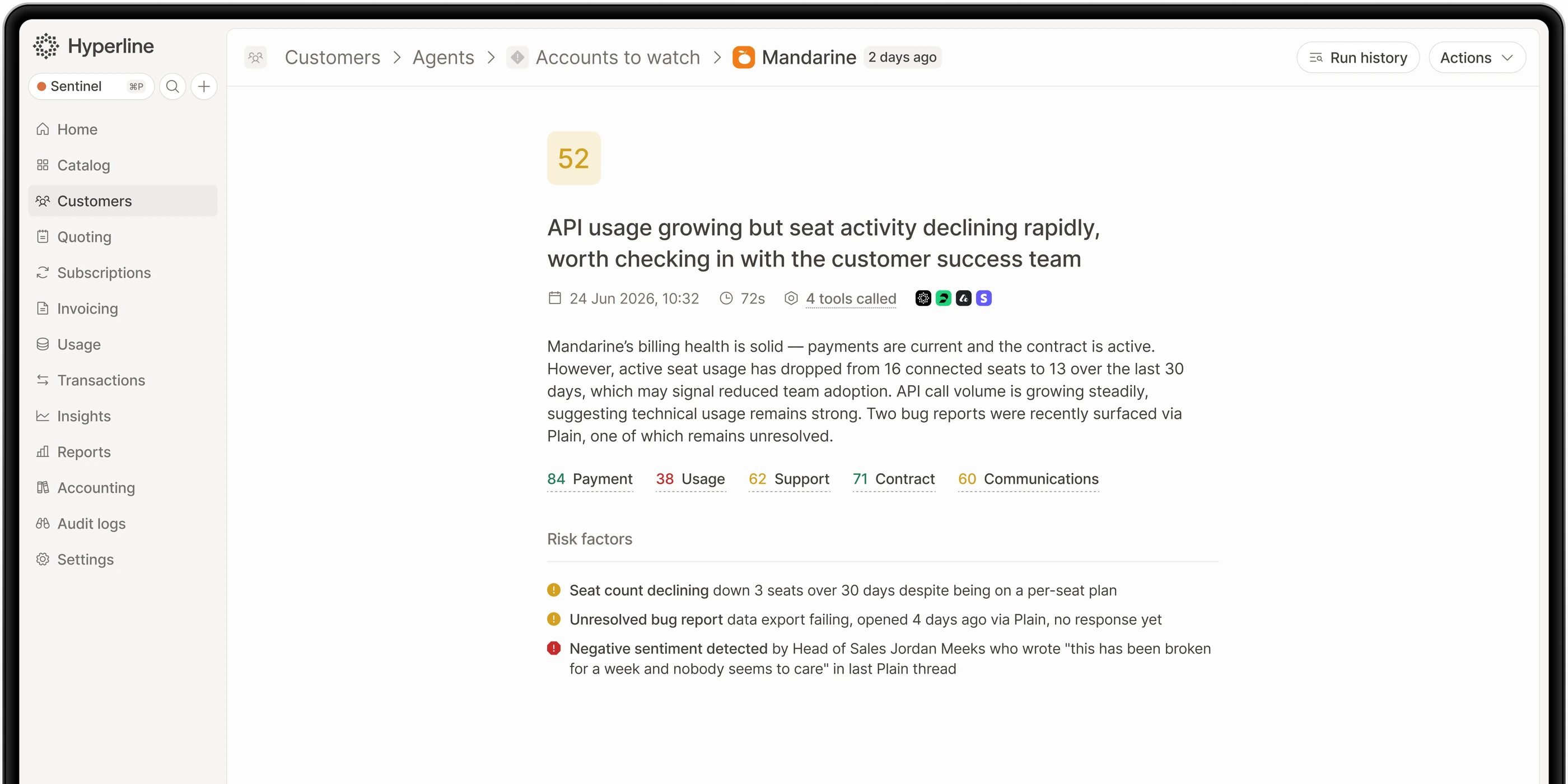
Score every customer in real time and flag anomalies before they hit your P&L. Your finance team finally sees risk coming.
Sentinel watches your operations, not your customers. It catches the misconfigurations and anomalies that quietly leak revenue, before they reach your P&L.
No more exports or BI tickets. Ask Hyperline a question in plain English and get the analysis straight from your live revenue data.
Build anything around billing and revenue
Open infrastructure to connect systems, automate workflows, and build the revenue stack around how the business operates


Built for the AI era
Connect any tool, automate any workflow, and let AI act on your revenue data. Everything in Hyperline is open and programmable.
The platform built for finance, adopted by the entire company
Hyperline is where GTM, operations, and finance teams work from the same foundation




Engineered for scale, trusted for reliability
Trusted by finance teams processing billions in revenue across complex pricing models and global operations



Independently audited. Hyperline holds SOC 2 Type II and ISO 27001:2022 certification, and complies with GDPR.
Questions about Hyperline, answered
Hyperline is the usage-based billing and quote-to-cash platform for AI companies: from the first quote to recognized revenue, with real-time metering, credits and commits, CPQ, invoicing, collections and revenue recognition in one place. 500+ companies run billing on it, and Hyperline is SOC 2 Type II and ISO 27001:2022 certified.
Yes. Hyperline bills the way AI companies sell: tokens, prepaid credits, usage and outcome-based pricing, metered in real time and billed alongside seats and subscriptions. Credits and tokens go on the quote, then draw down as customers consume.
Yes. Hyperline meters and prices every event in real time, from the first API call to millions per minute, with no batch jobs. It processes 1B+ events a month with 99.97% uptime, and every billable unit traces back to its raw events. Usage is streamed through the events API or synced from BigQuery, Snowflake and Postgres, as described on the usage-based billing page.
Yes. Prepaid credits and token-based usage run on a native credit ledger with balance checks, top-up flows, auto-reload and projected-balance webhooks. Contracts carry committed units and minimum amounts, usage is billed against the commitment as events arrive, and overages are rated in real time.
Yes. Hyperline runs the six quote-to-cash steps on one contract: quote, sign, subscribe, invoice, collect and recognize. Invoices include tax in 80+ countries, collections cover dunning, payment retries and reconciliation, and revenue recognition follows ASC 606 and IFRS 15. Nothing is re-keyed between tools.
Yes. Reps build quotes in Salesforce, HubSpot or Attio and add metered products, prepaid credits and tokens next to seats and flat fees. Hyperline CPQ handles ramps, multi-year terms, multi-step approvals and native e-signature. The signed quote becomes the subscription, with no re-keying into billing.
Hyperline covers the full quote-to-cash cycle, where Stripe Billing focuses on simple subscriptions and Metronome on usage metering. Stripe Billing works well for simple subscriptions, and Hyperline adds CPQ, usage-based billing, revenue recognition and reporting in one platform. Metronome, now part of Stripe, is usage metering built for engineers, and Hyperline delivers the same real-time usage billing plus CPQ, revenue recognition and a finance-owned UI.
Hyperline puts usage-based billing, CPQ, collections and revenue recognition in one platform, which is the main difference with each of them. Orb does usage-based billing well but does not include CPQ. Chargebee covers subscription billing broadly, with usage-based pricing, CPQ and revenue recognition in separate modules. Lago is open source and run by your own team, while Hyperline is a managed platform.
Hyperline carries the same quote through billing, collections and revenue recognition, while DealHub and Salesforce CPQ need separate billing products. DealHub does CPQ and contract management well, but it is not a billing platform. Salesforce CPQ quotes inside Salesforce, with billing and revenue recognition sold as separate products. Hyperline also quotes inside Salesforce, through a native widget with two-way sync.
No. Hyperline is not a payment processor: it orchestrates collection through Stripe, Adyen, GoCardless, Mollie and Airwallex, and reconciles the payments it does not process itself. Teams that bill in Stripe can also keep it and add CPQ for Stripe Billing, with both sides in two-way sync.
Yes. One Hyperline subscription can combine flat fees, seats and metered usage, and invoices show actual usage next to any commitment. Billing supports prepaid credits with drawdown, ramps, tiered and volume prices, proration, coupons and wallets. Sales quote the same mix, so the signed quote becomes the hybrid subscription with no re-keying.
Hyperline pricing depends on the plan and on your billing volume, and the team quotes it for you. Plans cover CPQ, billing, usage, collections and reporting, and modules such as accounts receivable and customer intelligence can be added to any plan. Plans and modules are listed on the pricing page.