Run quote-to-cash in one system
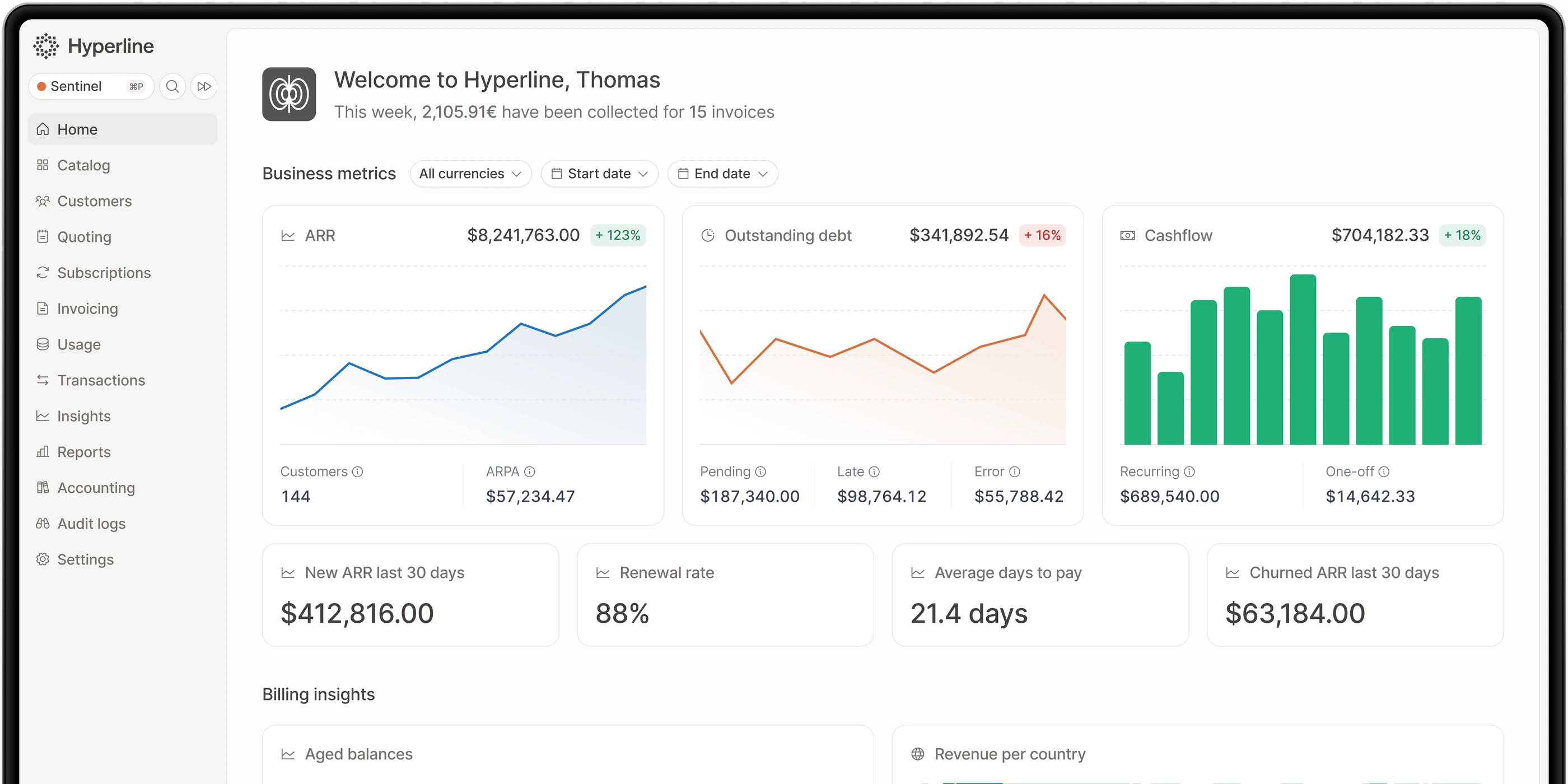
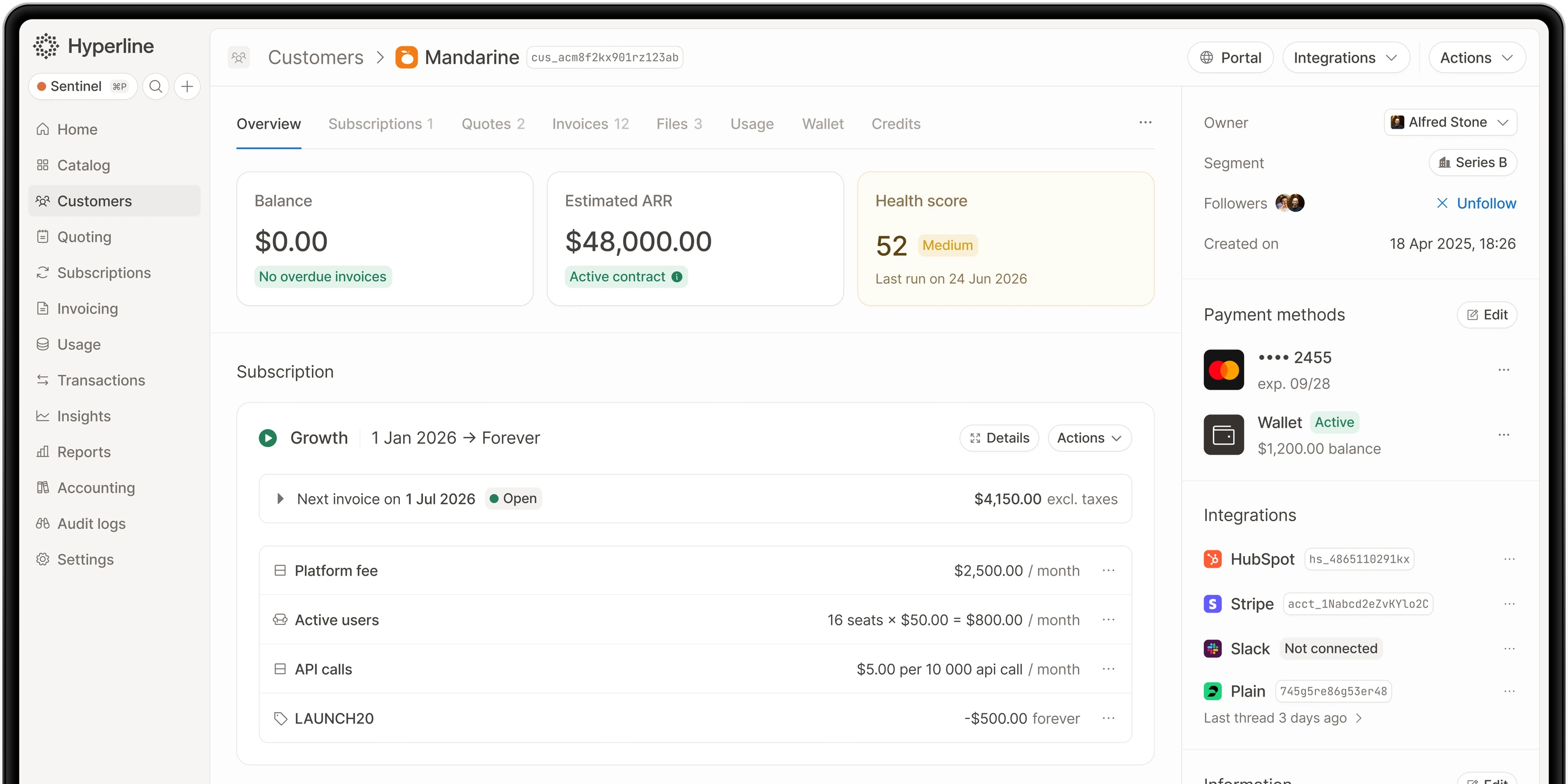
Hyperline runs a deal from quote to signature, subscription, invoice, payment and recognized revenue in one system, for companies with usage-based or hybrid pricing



Fight chaos by running quote-to-cash on Hyperline
Quoting in one tool, billing in another and collecting payments in a third creates data gaps and delays the close

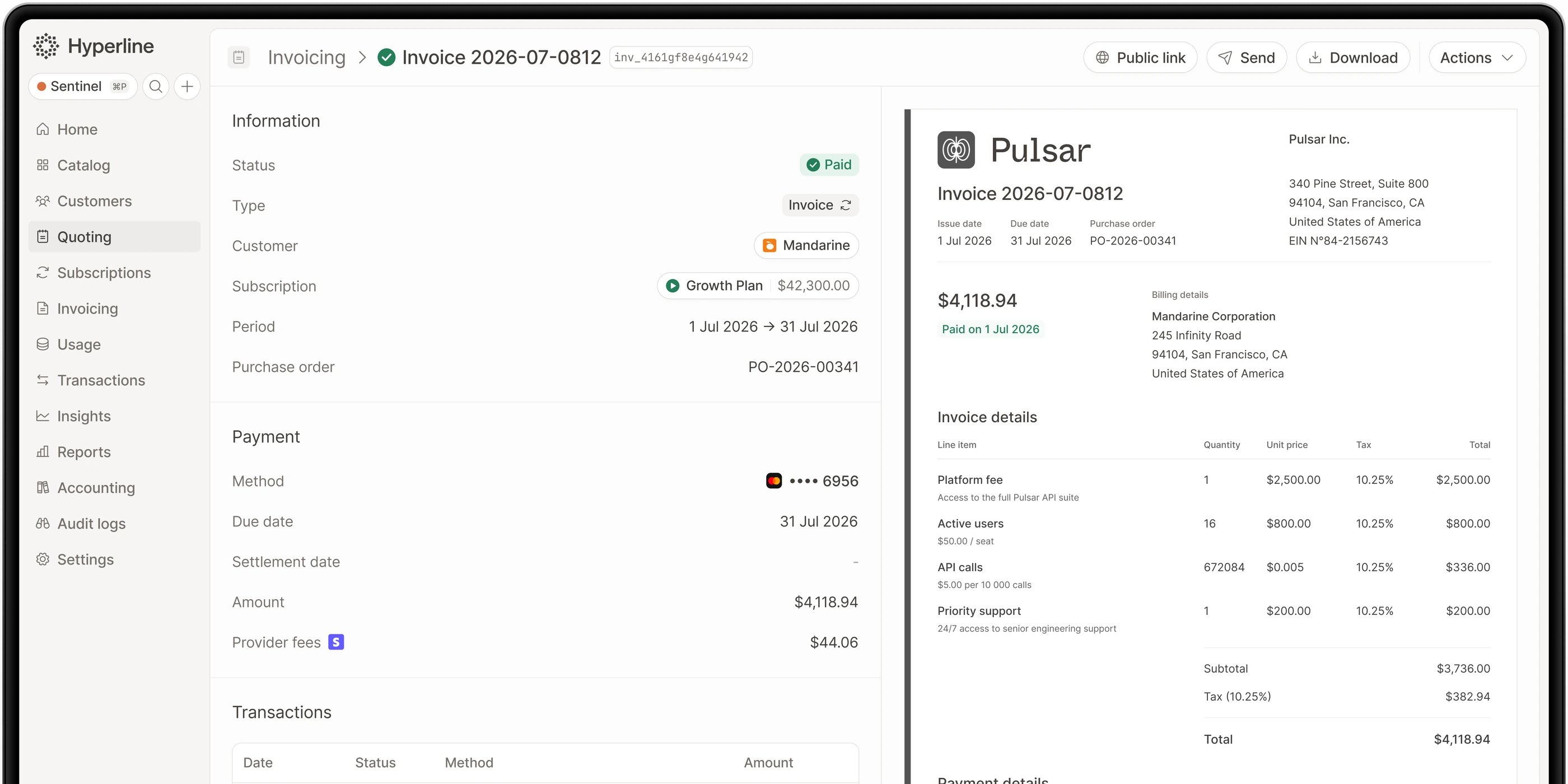
Quotes, subscriptions, invoices and revenue schedules read from one contract, so nobody reconciles two versions of the same deal.

Every deal bills exactly as it was quoted, on infrastructure with 99.97% uptime, SOC 2 Type II and ISO 27001 certification, and GDPR compliance.

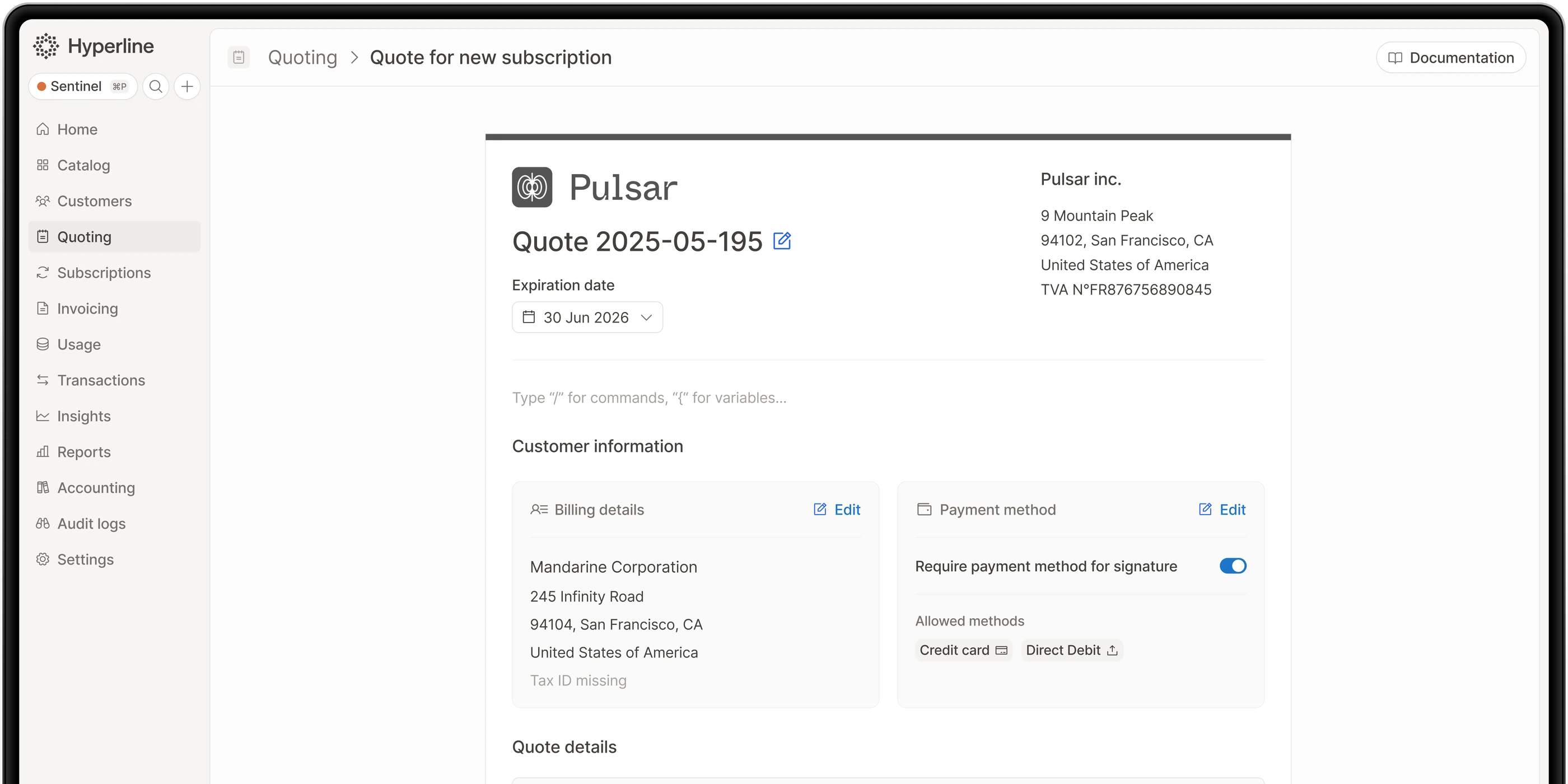
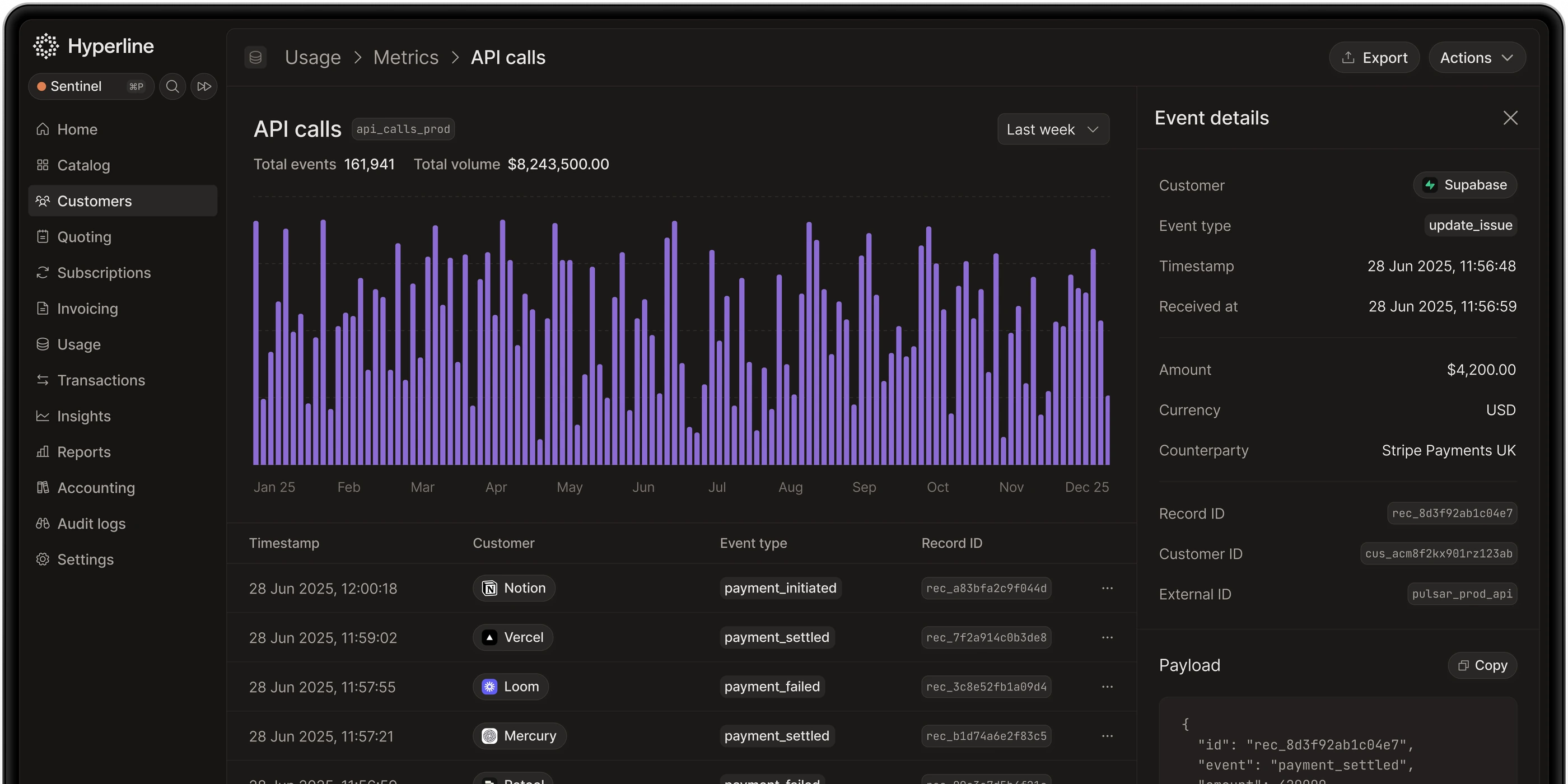
Prepaid credits, token-based usage and auto top-ups go on the quote, the way AI companies sell, then draw down as customers consume.
The quote-to-cash process, step by step
What happens to a deal between the first quote and the revenue on your books
Reps quote from the CRM. Build the quote from the Hyperline widget in Salesforce, HubSpot or Attio, with products and price books set once. Advanced approval rules make sure no quote goes out without the right sign-off.






See what changes between quote and cash
The same deal, run across separate tools or in one system
With Hyperline
Without Hyperline
Drag to compare

For the first time, Finance truly partnered with Sales, no more bad cop. The system finally supported both teams and Hyperline became the foundation of our entire quote-to-cash stack.Read customer story
Quote-to-cash questions, answered
Quote-to-cash (also written QTC or Q2C) is the process that takes a deal from the first priced quote to collected cash and recognized revenue. It covers quoting, approval, signature, subscription, invoicing, payment collection and revenue recognition, and it is shared by sales, RevOps and finance.
Six steps: quote (configure products and pricing, with approvals), sign (the customer signs the quote), subscribe (the signed deal becomes a subscription), invoice (invoices and tax follow the contract), collect (payments are charged, matched and chased) and recognize (revenue is recognized and posted to the ledger). In Hyperline, all six run on the same contract.
No single team. Sales owns the quote and the signature, RevOps owns pricing, approvals and the CRM setup, and finance owns invoicing, collection and revenue recognition. That shared ownership is why quote-to-cash breaks at the handoffs: each team works in its own tool. Running every step on one contract gives all three teams the same record of the deal.
CPQ (configure, price, quote) is the first stage of quote-to-cash. It ends at an approved, signed quote, and sales and RevOps usually own it. Quote-to-cash continues through billing, collection and revenue recognition, where finance takes over. In Hyperline, CPQ is the quoting stage of the same system that bills, collects and books the deal.
Order-to-cash starts at a confirmed order and ends when cash is collected and recorded, and finance usually owns it. Quote-to-cash starts one step earlier, at the priced quote, and goes one step further, to recognized revenue, so sales, RevOps and finance share it. For subscription businesses, where the quote defines what gets billed for years, the quote-to-cash scope is the one that matters.
Billing software converts an existing subscription or contract into invoices. Quote-to-cash software covers the full process before and after that: configuring a quote, getting it approved and signed, billing it correctly (including usage-based components), collecting payment, and recognizing revenue. A billing tool can be one part of a quote-to-cash stack; on its own, it isn't the whole thing.
The handoffs. A signed deal is re-keyed from the CRM into billing, invoices drift from what the contract says, payments are matched to invoices by hand, and revenue schedules are rebuilt in spreadsheets at month-end. Each handoff is a place where a number can change. Usage-based and hybrid pricing make it worse, because the quote, the invoice and the revenue schedule all depend on the same commitment.
Faster deals, fewer billing errors and a faster close. lemlist cut enterprise deal turnaround from days to hours once signed quotes activated subscriptions automatically. Truvi went from a 12-week month-end close with 8 people to 4 days with 4 people after automating billing. Connectd's finance director describes Hyperline as the foundation of its entire quote-to-cash stack.
Quote inside the CRM with a tool that turns the signed quote into the subscription, so nobody re-keys it into billing. In Hyperline, reps quote from the widget in Salesforce, HubSpot or Attio, and quotes, subscriptions and invoices sync back to the CRM. HubSpot custom objects require its Enterprise plan.
It does when quotes and invoices read from the same contract. Hyperline quotes committed units, minimum and maximum amounts, credits and wallets, and bills usage against them as events arrive. The quote value includes committed amounts, and usage beyond the commitment is not estimated on the quote.
Yes, through the Hyperline API, the MCP server or the CLI, which tools like Claude, ChatGPT and Cursor can call. An assistant can create a quote from a template, and a person should confirm it before it is finalized or sent to the customer.
It depends on pricing complexity. Simple, flat subscription pricing can run acceptably on separate best-of-breed tools connected by integrations. Once pricing includes usage-based or hybrid components, or deal sizes require approval workflows and e-signature, the reconciliation cost of stitched-together tools tends to outweigh the flexibility of picking each piece independently.
It varies widely by platform and by how much configuration a business needs. Enterprise-grade, highly configurable platforms like Zuora, Oracle CPQ, or Salesforce Revenue Cloud commonly run several months. Platforms built around a narrower, more opinionated setup, including Hyperline's roughly two-month target, tend to move faster because there's less to configure from scratch.
Hyperline is the strongest fit for B2B SaaS companies with usage-based, tiered, or hybrid pricing that need CPQ, billing, and revenue recognition unified in one platform instead of three separate systems. For simple, seat-based pricing already running on Salesforce, or if the only need is post-signature contract handoff automation like LedgerUp provides, a different platform is a better starting point.