Best Usage-Based Billing Software for AI Companies in 2026
How AI companies bill for tokens, credits and hybrid plans, what AI billing actually requires, and how six usage-based billing platforms compare in 2026: Hyperline, Orb, Metronome, Stripe Billing, Lago and Solvimon.

Updated October 2026.
The best usage-based billing software for an AI company depends on how you sell. Orb and Metronome are built for engineering-led products with very high event volumes, Lago is the open-source option, Stripe Billing is the simplest start for pay-as-you-go pricing, Solvimon is built around credit pools, and Hyperline fits B2B AI companies that sell credits and subscriptions through a sales team.
AI pricing is harder to bill than SaaS pricing. Costs move with every model call, customers expect to see their spend in real time, and most AI companies now mix a subscription, prepaid credits and usage on the same contract. This guide starts with what AI billing actually requires, then compares the platforms against those requirements.
Key takeaways
- AI billing is usage billing with extra constraints: token-level metering, prepaid credits, spend visibility and margins that depend on model costs.
- Credits have become the default unit for AI products because they turn token math into one number customers can understand and budget for.
- Three of the best-known usage billing engines now belong to larger companies: Stripe owns Metronome, Adyen owns Orb and Salesforce owns m3ter.
- The right platform depends less on features than on your sales motion: self-serve and developer-led, or sales-led with negotiated contracts.
For a broader comparison that is not specific to AI, see our guide to the best usage-based billing software.
Quick answer: the best AI billing platform by profile
| Your situation | Platform to look at first |
|---|---|
| B2B AI company selling credits and subscriptions, with sales-led contracts | Hyperline |
| High-volume AI or API product with complex usage, engineering-led | Orb |
| AI infrastructure at very large scale, with negotiated enterprise contracts | Metronome |
| Early-stage AI startup with simple pay-as-you-go pricing | Stripe Billing |
| Engineering team that needs open source or self-hosting | Lago |
| AI-native product priced entirely around credit pools | Solvimon |
Why AI pricing breaks traditional billing
Traditional SaaS billing assumes that the cost of serving a customer is roughly fixed. A seat costs about the same to serve in month one and month twelve, so a flat price per seat works. AI products break that assumption in four ways.
Costs vary with every request. Each prompt consumes input and output tokens, sometimes across several models, and model providers change their prices regularly. A customer who switches to a larger model can multiply your cost overnight.
Usage is spiky. An agent that runs in a loop or a batch job that processes a backlog can generate a month of usage in an afternoon. Billing has to absorb those spikes without delays or errors.
Customers want predictability. Buyers are wary of open-ended bills. That is why most AI companies sell prepaid credits, commitments or plans with included usage, which then need to be tracked, drawn down and topped up.
Pricing changes often. AI companies adjust packaging far more often than classic SaaS companies, as models get cheaper and new features ship. Every change has to be rolled out without breaking existing contracts.
A billing system built for monthly subscriptions can usually add a usage line item. It struggles with the rest: real-time metering, credit ledgers, mid-cycle changes and invoices that a customer can trace back to their own logs.
What AI billing actually requires
Before comparing vendors, it helps to know which questions to ask. These are the ones that separate an AI-ready billing platform from a subscription tool with usage bolted on.
How do you meter tokens, not just API calls?
Counting API calls is not enough when one call can cost a hundred times more than another. AI billing needs to meter tokens, ideally split by model and by token type (input, output, cached), and aggregate them per customer in real time. Ask how events are ingested (API, SDK or a direct sync from your data warehouse), how duplicates and late events are handled, and whether usage can be corrected after the fact without reissuing every invoice.
How should prepaid credits and top-ups work?
Credits are now the most common unit for AI products. A customer buys a balance, usage draws it down, and the account is topped up manually or automatically. A proper credit system needs a ledger, not just a counter: balance checks before usage is accepted, top-up flows, auto-reload, expiry and rollover rules, and alerts before a customer runs out. It also needs to work alongside subscriptions, because most AI plans combine a monthly fee with a credit allowance.
How do you bill several LLM providers on one invoice?
Many AI products route requests to more than one model provider. Customers should not receive one line per provider. The billing system should convert usage from every model into the units you sell (credits, tasks, words, minutes) and present a single, readable invoice. This is easier when pricing is defined on top of raw usage events rather than hard-coded in your application.
How do you protect margins when model costs change?
When your costs are set by someone else's price list, margins can disappear without anyone noticing. Some teams set a fixed markup on raw token costs, others sell credits priced with a buffer and revisit the rate regularly. Either way, finance needs to compare what each customer consumed with what they were charged, at the level of individual events, and be able to change prices for new contracts without touching existing ones.
How do customers track spend before the invoice arrives?
Surprise invoices create disputes and churn. AI buyers expect a live view of their consumption, their remaining credits and their projected bill, plus alerts at thresholds they choose. Check whether the platform offers a customer-facing portal or an API you can embed in your own product, and how close to real time its numbers are.
How do you sell committed AI contracts?
As AI companies move upmarket, contracts start to look like enterprise software deals: an annual commitment, a credit allowance, negotiated rates and overages above the commitment. If your sales team quotes these deals in one tool and finance rebuilds them in the billing system, errors appear at the first invoice. The billing platform should be able to take a signed contract with usage terms and bill it as signed.
Comparison table
| Platform | Best for | Prepaid credits | Self-hosting | Payment providers | Ownership in 2026 |
|---|---|---|---|---|---|
| Hyperline | Sales-led B2B AI with hybrid contracts | Native credit ledger with auto-reload | No | Stripe, Adyen, Mollie, Airwallex, GoCardless | Independent |
| Orb | Engineering-led, complex usage | Yes, with drawdown | No | Multi-PSP, per Adyen | Adyen (since July 2026) |
| Metronome | Very high-volume AI infrastructure | Yes, plus commitments | No | Stripe ecosystem | Stripe (since January 2026) |
| Stripe Billing | Simple pay-as-you-go | Billing credits | No | Stripe | Stripe |
| Lago | Open source and self-hosting | Yes | Yes (AGPLv3) | Several, via payment orchestration | Independent |
| Solvimon | Credit-pool pricing | Credit pools with rollovers | No | Stripe, Adyen, Checkout.com | Independent |
The six platforms, one by one
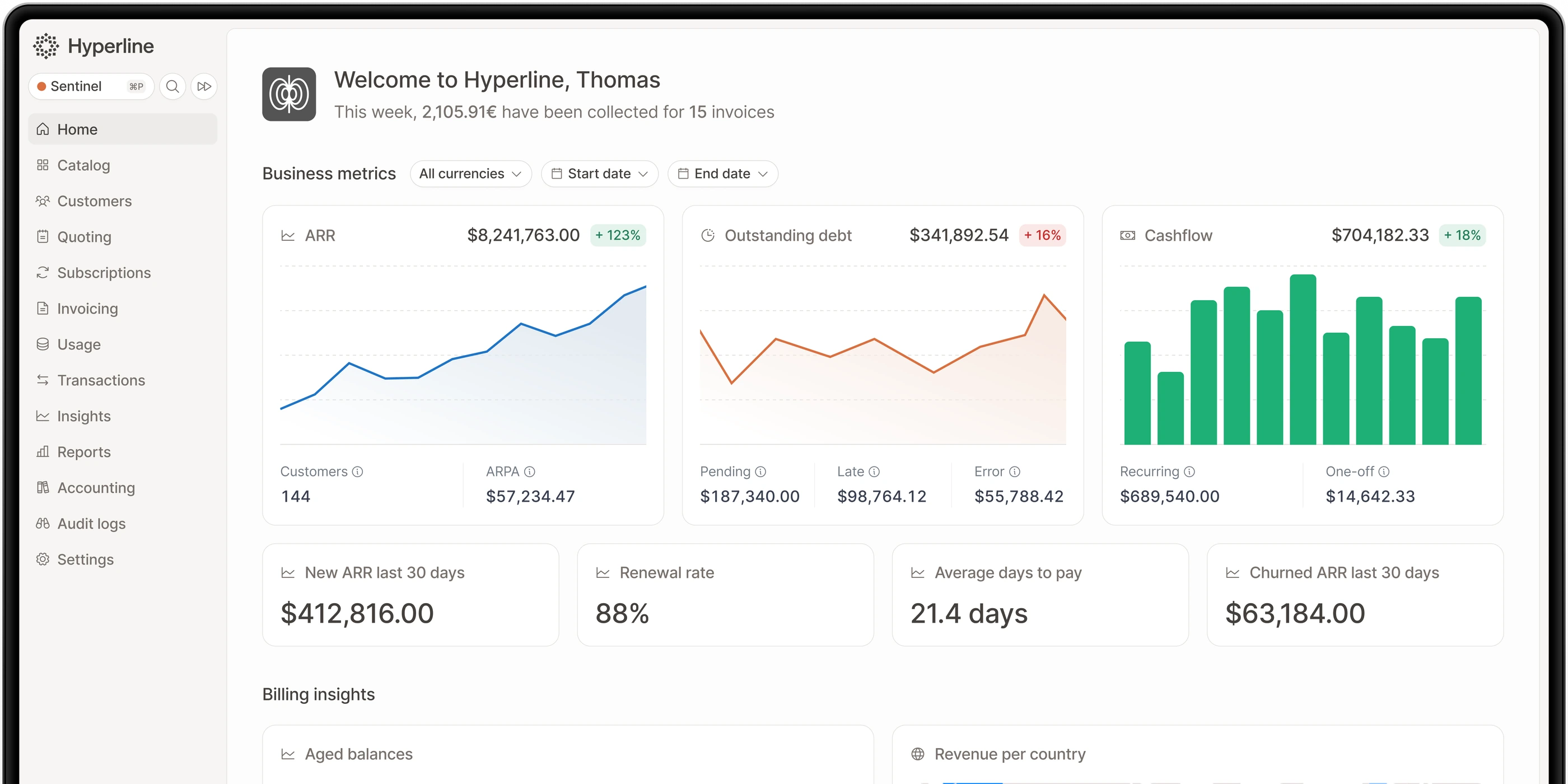
Hyperline: best for B2B AI companies that sell credits and subscriptions through a sales team
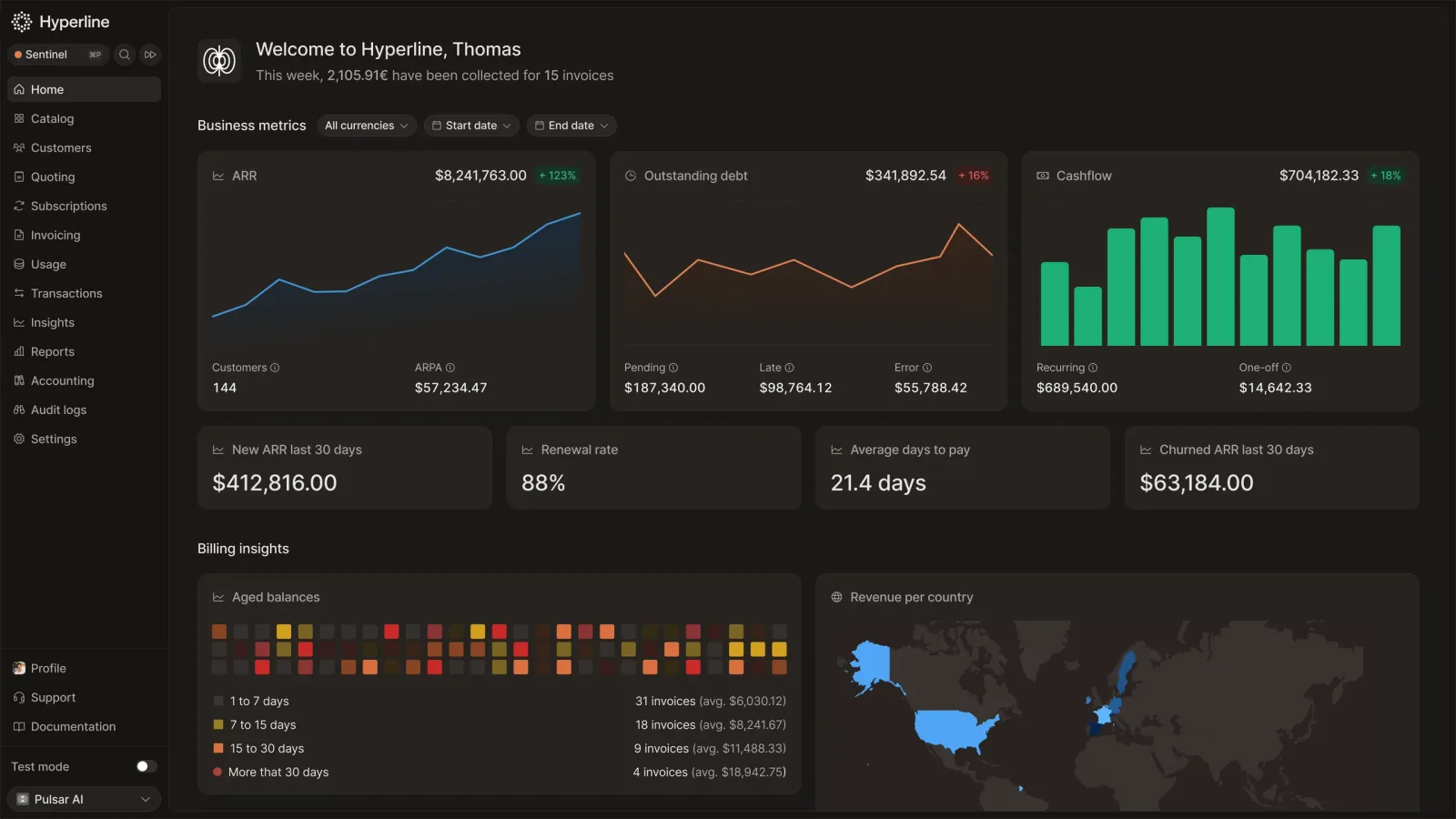
Image: Hyperline
Best for: AI companies that combine a subscription, prepaid credits and usage on the same contract, and sell at least part of their revenue through a sales team.
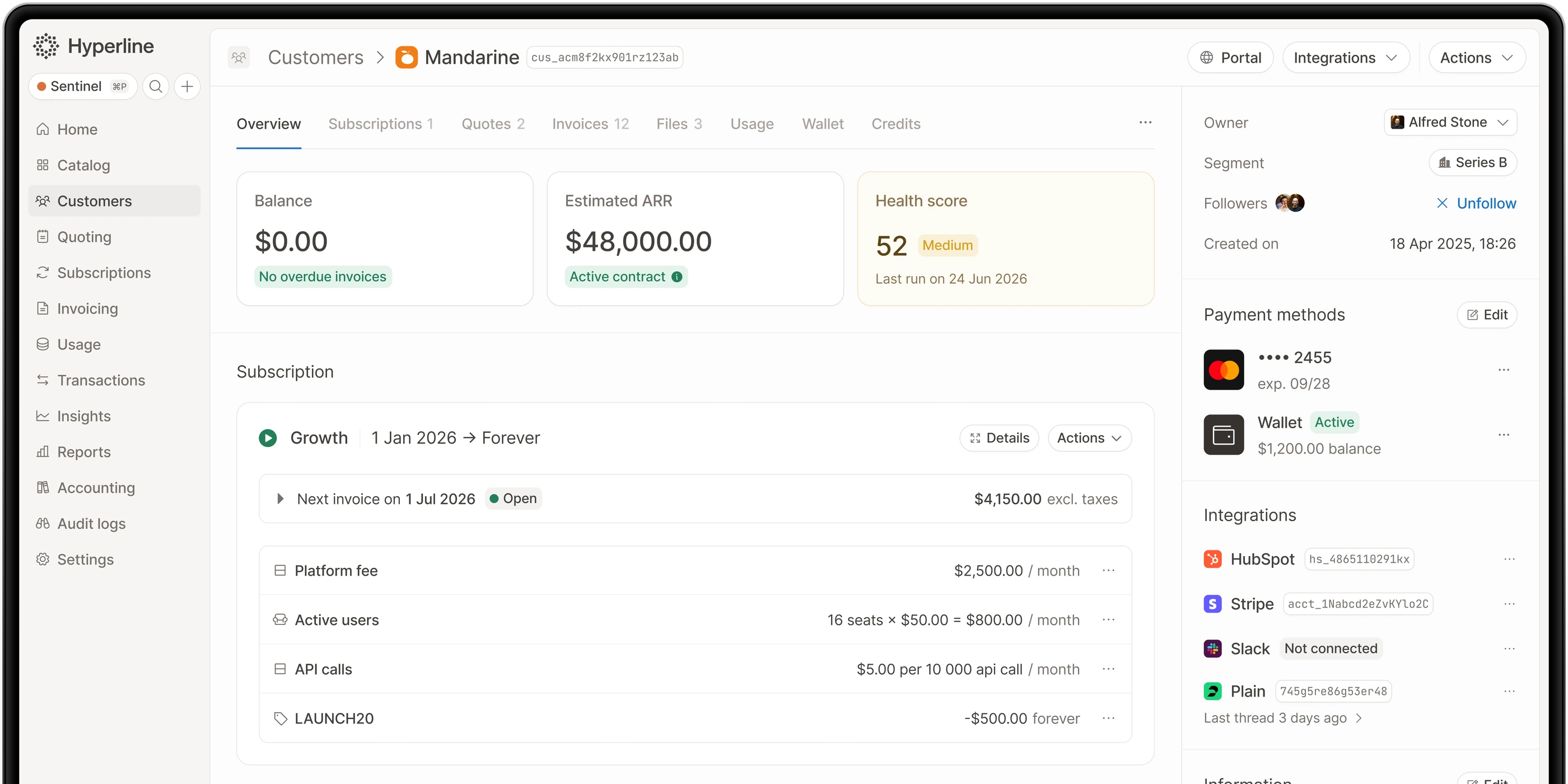
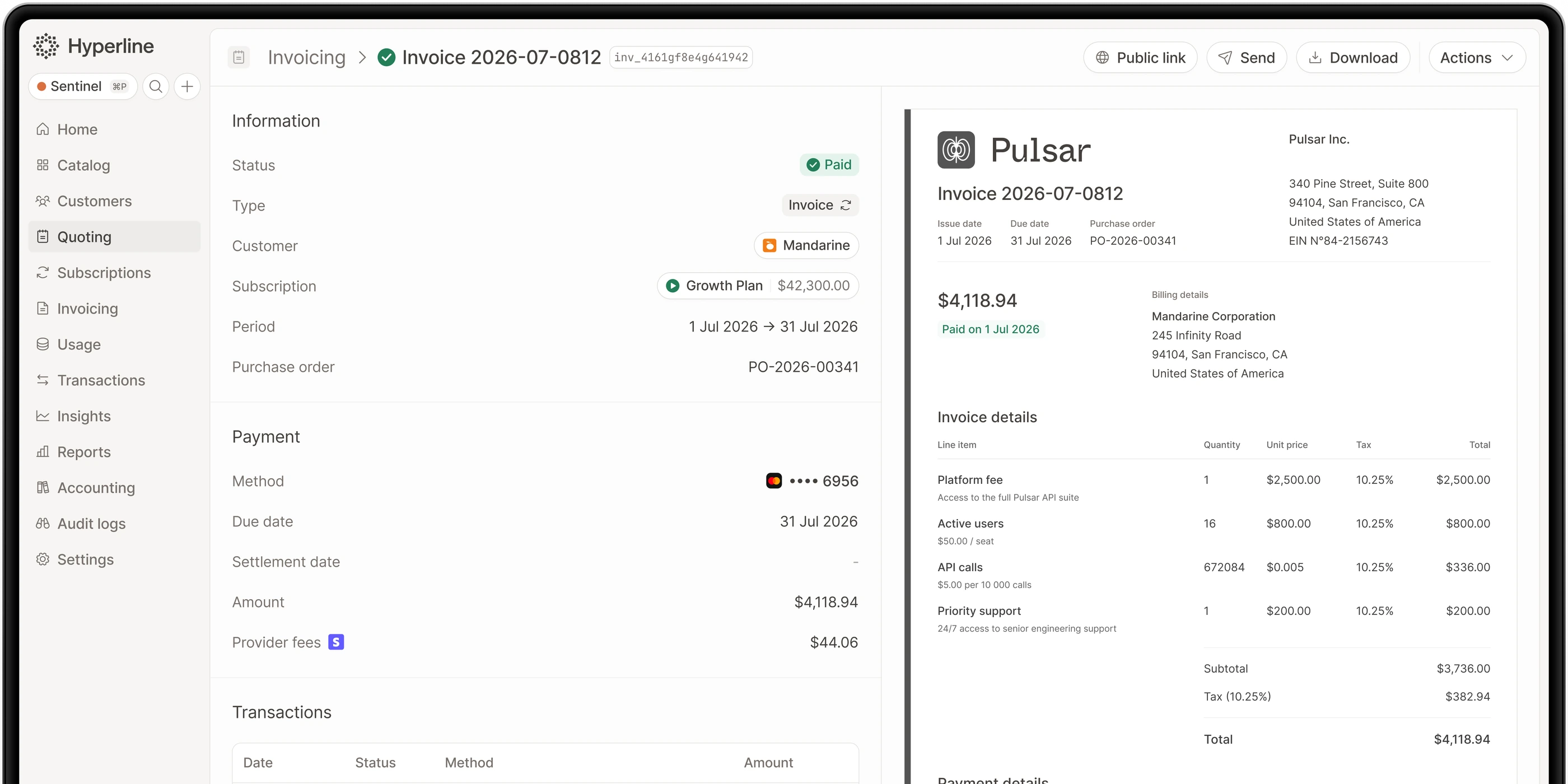
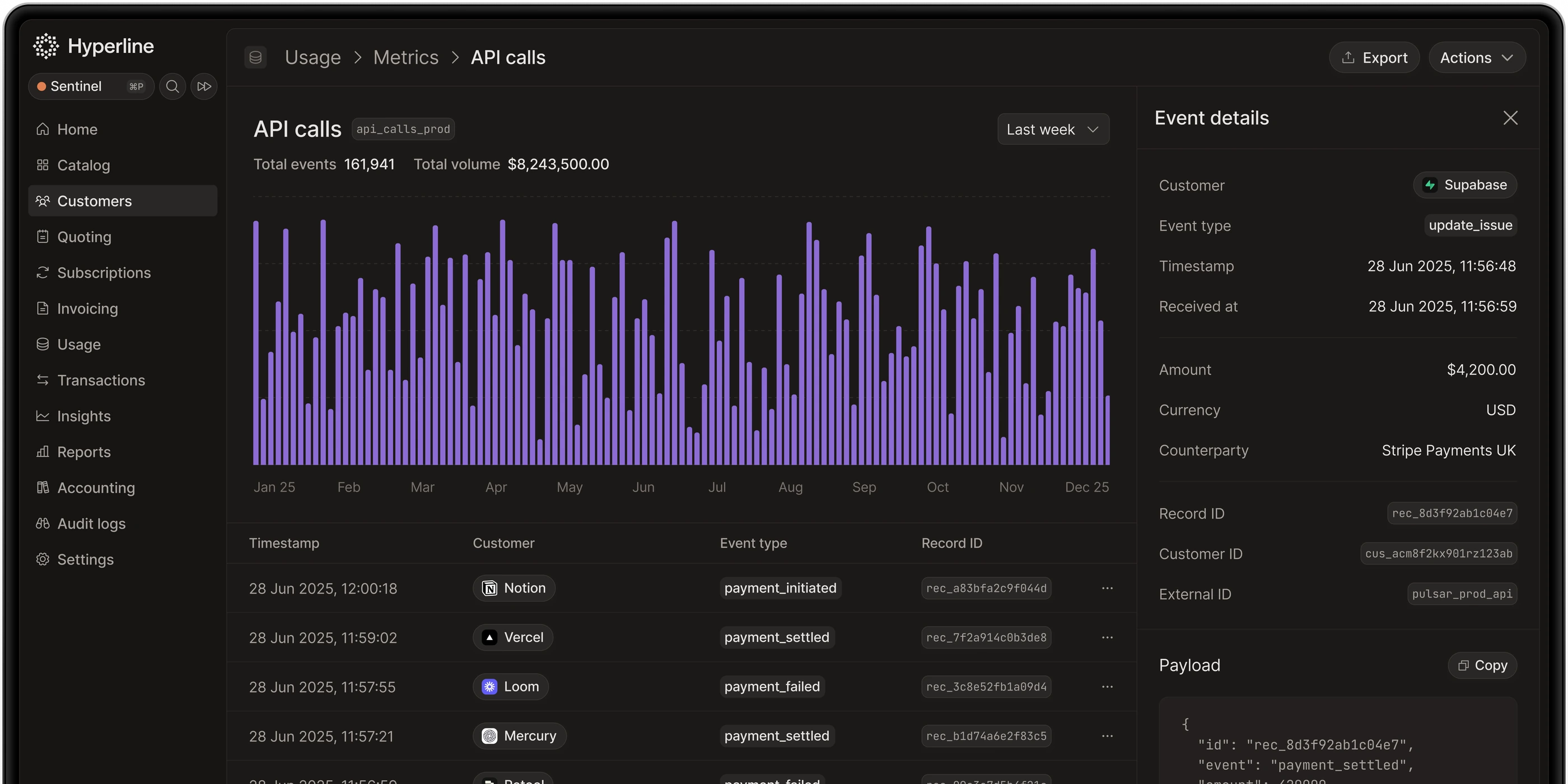
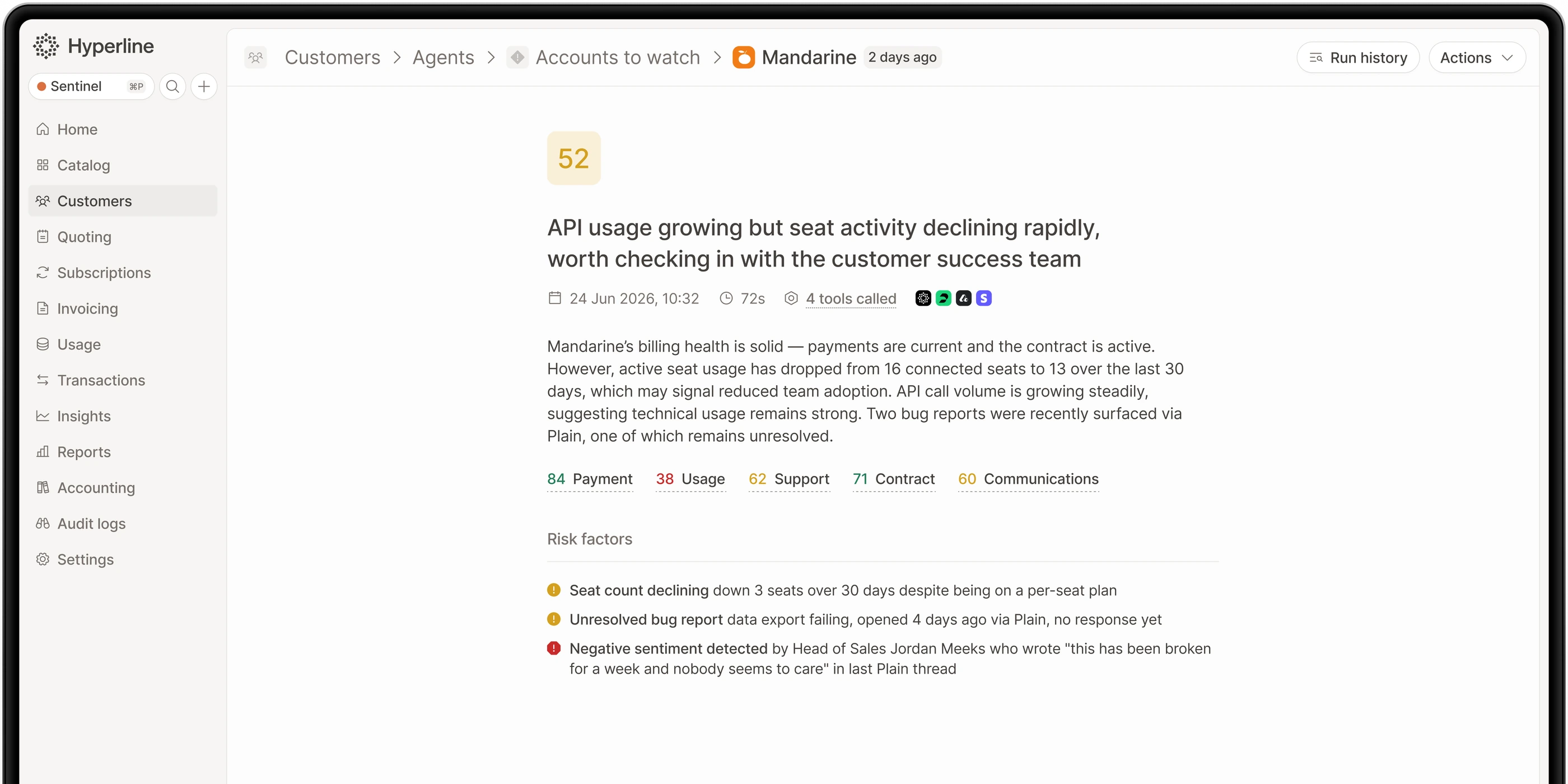
AI considerations. Hyperline meters and prices every event in real time, from the first API call to millions per minute, with usage sent through its API or synced directly from BigQuery, Snowflake, MongoDB or Postgres. Every billable unit traces back to its raw events, so finance and customers can check an invoice line against actual consumption. Its native credit ledger handles balance checks, top-up flows and auto-reload, and sends projected-balance webhooks before a customer runs dry. Customers get a real-time portal where they can follow their consumption, buy credits and explore their invoices. Hyperline also supports outcome-based pricing for products that charge per result rather than per token.
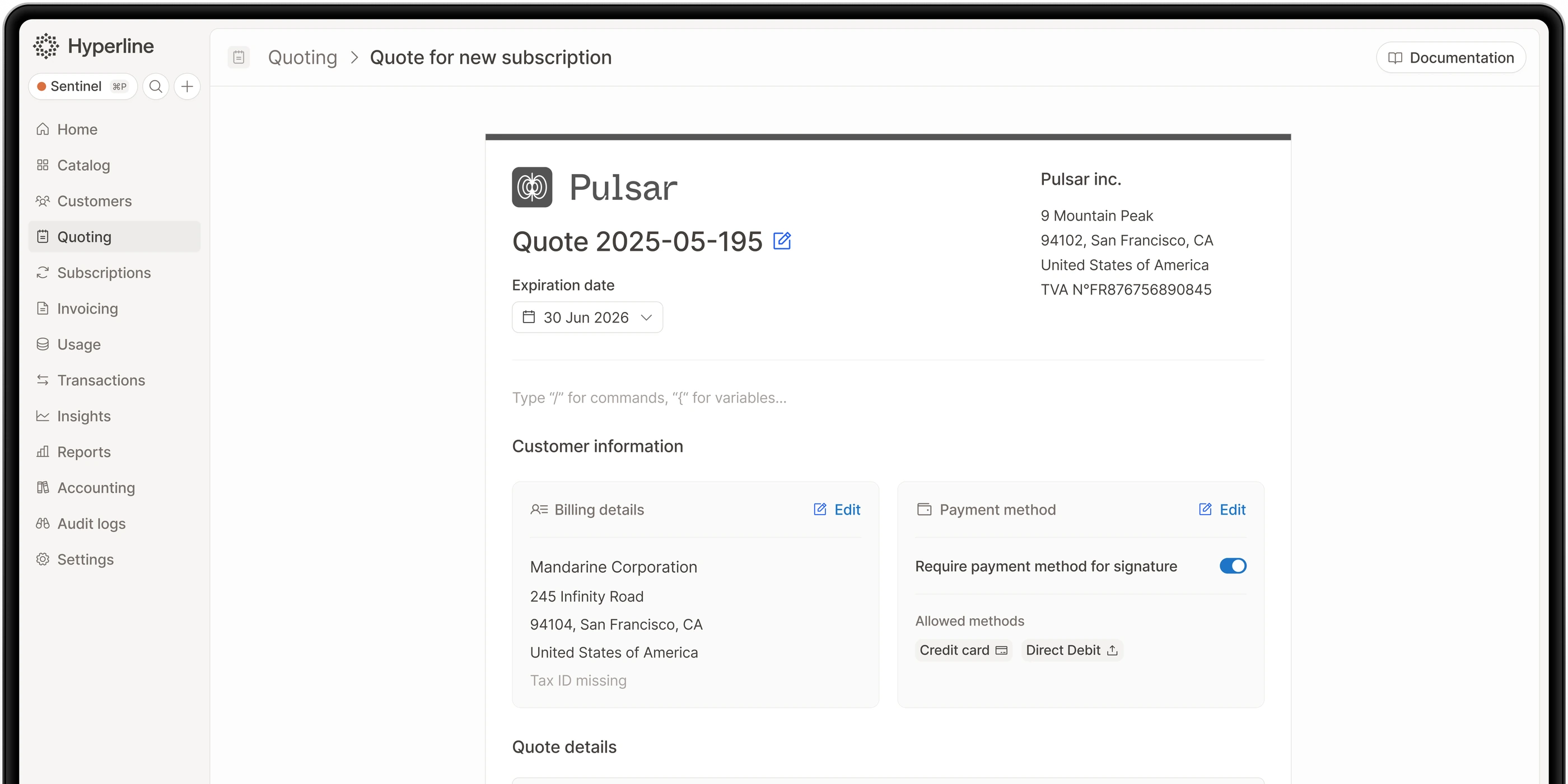
Strengths. Usage products can be added to a quote next to seats and flat fees, and they bill automatically on signature, which removes the re-entry step between sales and finance on committed AI contracts. Hyperline works with Stripe, Adyen, Mollie, Airwallex and GoCardless, so the billing layer stays independent from the payment provider. It reports 99.99% uptime and more than 1 billion usage events processed each month.
Swapcard, an AI-powered event platform, runs its self-serve product on credits and usage-based pricing. When it introduced credits, Stripe Subscriptions could not handle its renewals and prorations, and an implementation on Lago took five months with key gaps. On Hyperline, Swapcard was invoicing customers less than two months after signing up, with minimal developer involvement.
Limits. Hyperline is a hosted platform, so teams that need an open-source or self-hosted engine should look at Lago. Companies processing tens of billions of events per month will find higher published throughput figures at Metronome.
Orb: best for high-volume AI products with complex usage
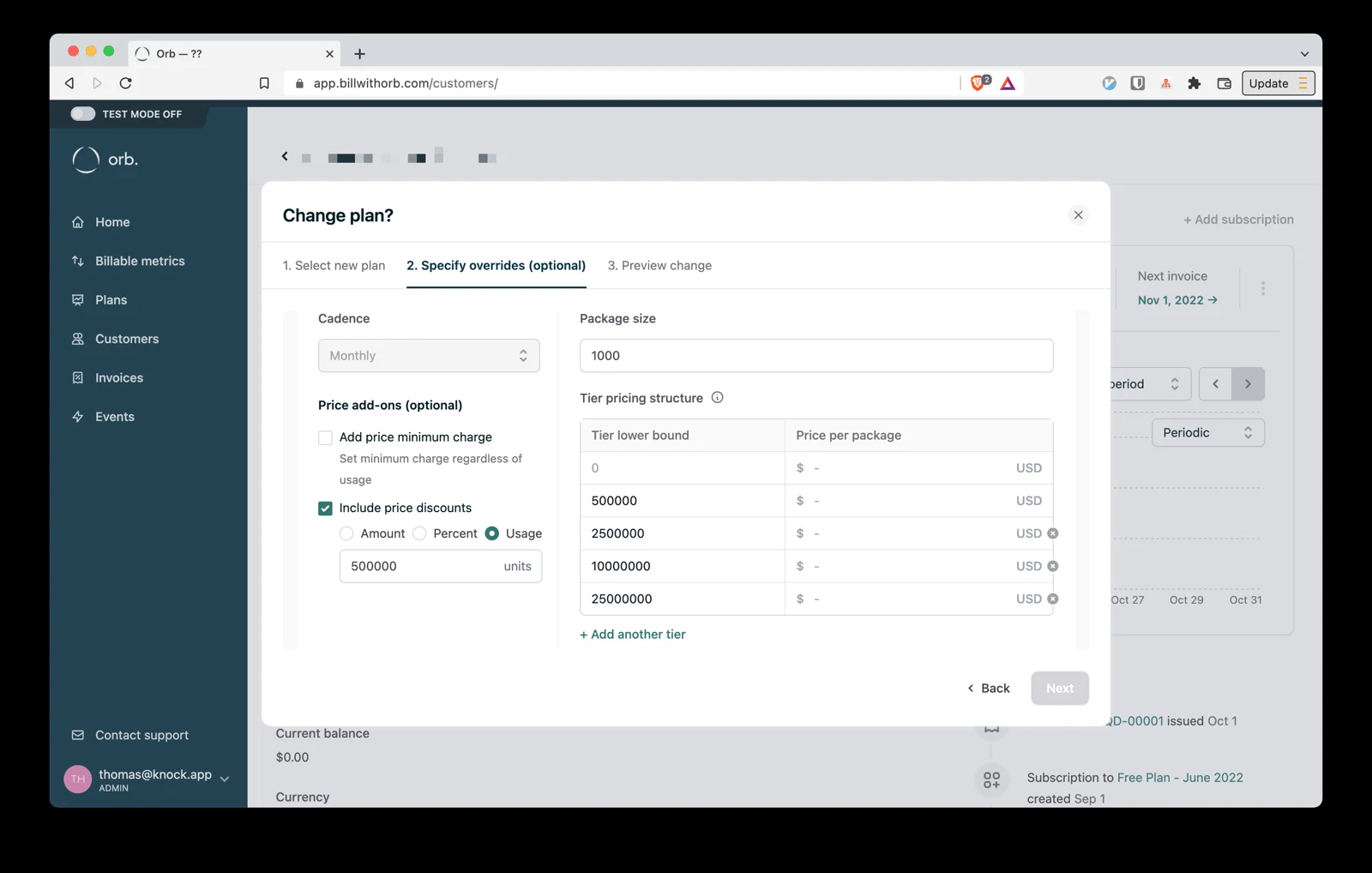
Image: Orb
Best for: engineering-led AI and API companies whose pricing depends on several usage metrics and changes often.
AI considerations. Orb ingests raw usage events once and applies pricing as a layer on top, which makes backfills, corrections and pricing changes easier. It supports token-based pricing and prepaid credits, which Orb presents as "one simple unit instead of token math", and lets teams simulate a price change against historical usage before it goes live. Its AI customers include Vercel, Replit, Glean, Supabase and WRITER.
Strengths. A strong data model for usage, pricing simulation and real-time alerts, built for teams that iterate on pricing.
Limits. Orb is a billing engine, not a full quote-to-cash platform, so quoting and some finance workflows sit in other tools. Adyen completed its acquisition of Orb on July 1, 2026. Adyen says Orb continues to support multi-PSP setups, but the long-term roadmap is now tied to a payment company.
Metronome: best for AI infrastructure at very large scale
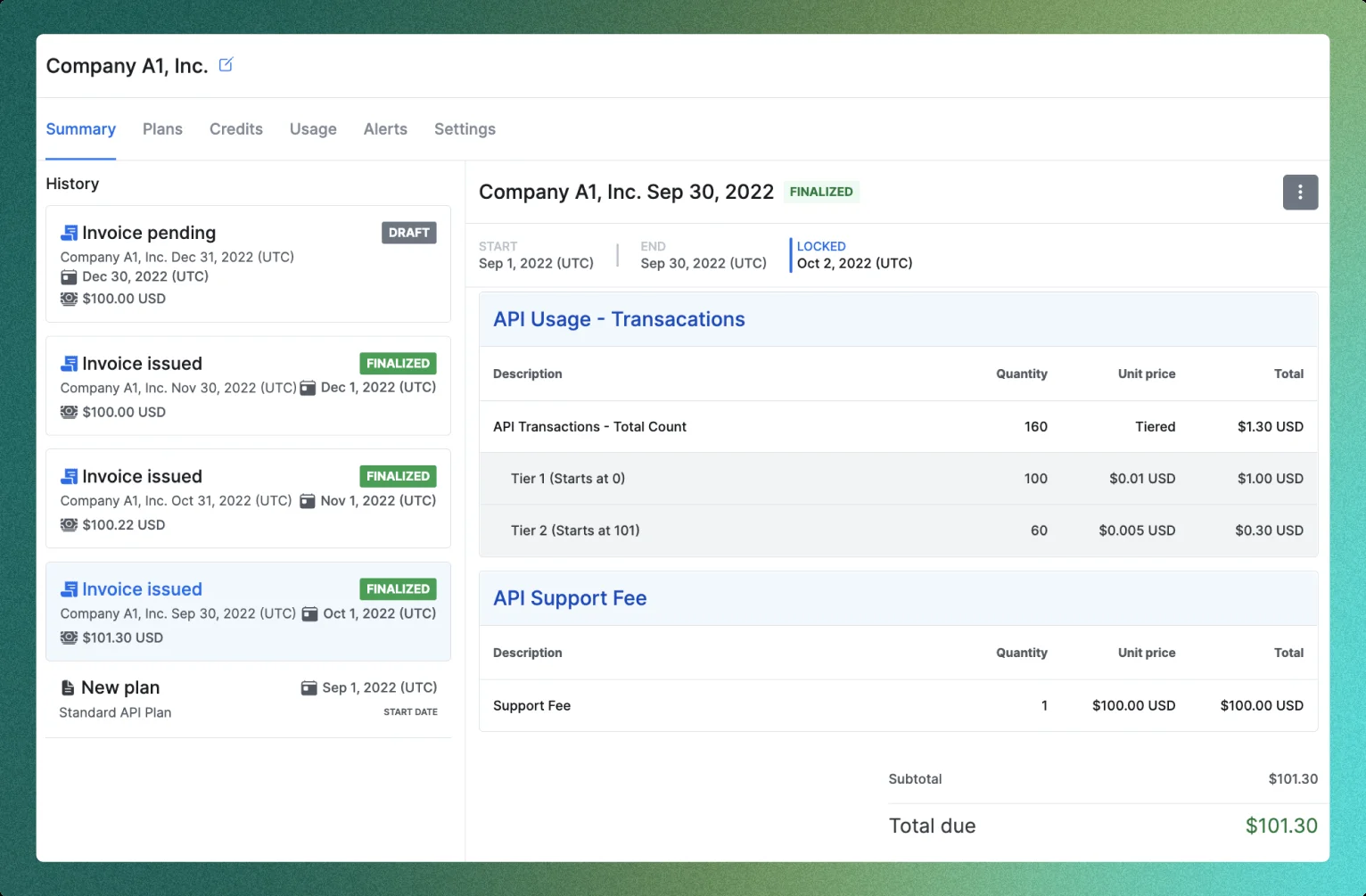
Image: Metronome
Best for: AI infrastructure and model companies with very large event volumes, many usage dimensions and negotiated enterprise contracts.
AI considerations. Metronome was built for consumption pricing: real-time metering, multidimensional pricing, prepaid credits, commitments and spend visibility for customers. It counts OpenAI among its customers and publishes some of the highest throughput figures in the category.
Strengths. Proven at the scale of the largest AI companies, with deep support for enterprise usage contracts.
Limits. Stripe completed its acquisition of Metronome in January 2026, and Stripe now presents it as its advanced usage-based billing product. That makes it a natural path for companies committed to Stripe, and a harder fit for those that want their billing layer to stay independent. It is closer to infrastructure than to a finance tool, and it does not cover sales quoting.
Stripe Billing: best for early-stage AI startups with simple pricing
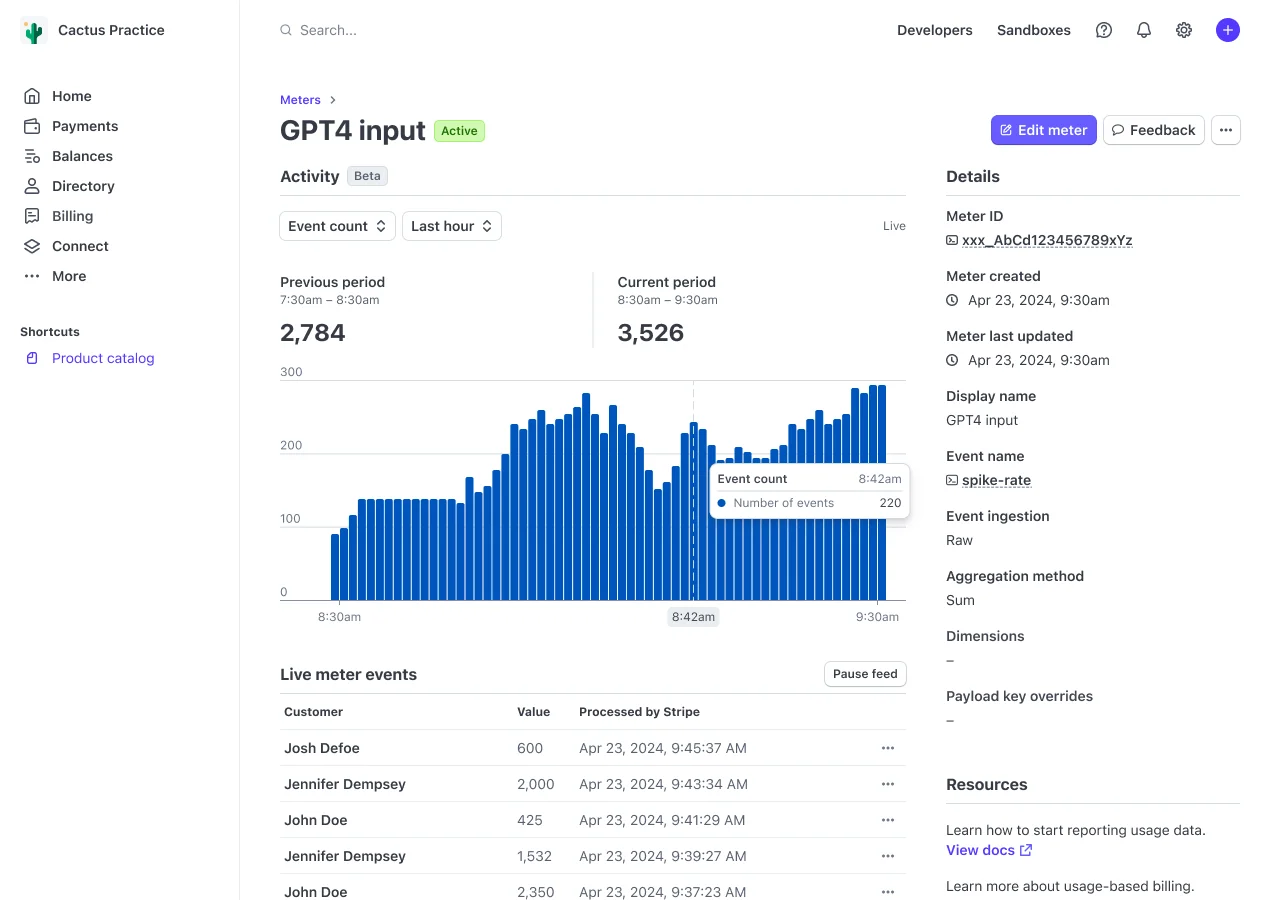
Image: Stripe Billing
Best for: early-stage AI products with pay-as-you-go pricing or a simple subscription with overages.
AI considerations. Stripe Billing reports usage through meters and supports billing credits. Stripe is also building billing for LLM tokens: it tracks the prices of the models you use, meters tokens per customer by model and token type, and applies the markup you set when invoices are generated. As of October 2026 this feature is in private preview, available through a waitlist.
Strengths. If you already process payments with Stripe, billing, invoices, payments and tax stay in one ecosystem, with no extra vendor to integrate.
Limits. Native Stripe Billing is simplest when pricing is simple. Multidimensional rate cards, negotiated contracts and complex credit systems push you toward Metronome, a second product to implement. Everything assumes Stripe as your payment provider.
Lago: best for open source and self-hosting
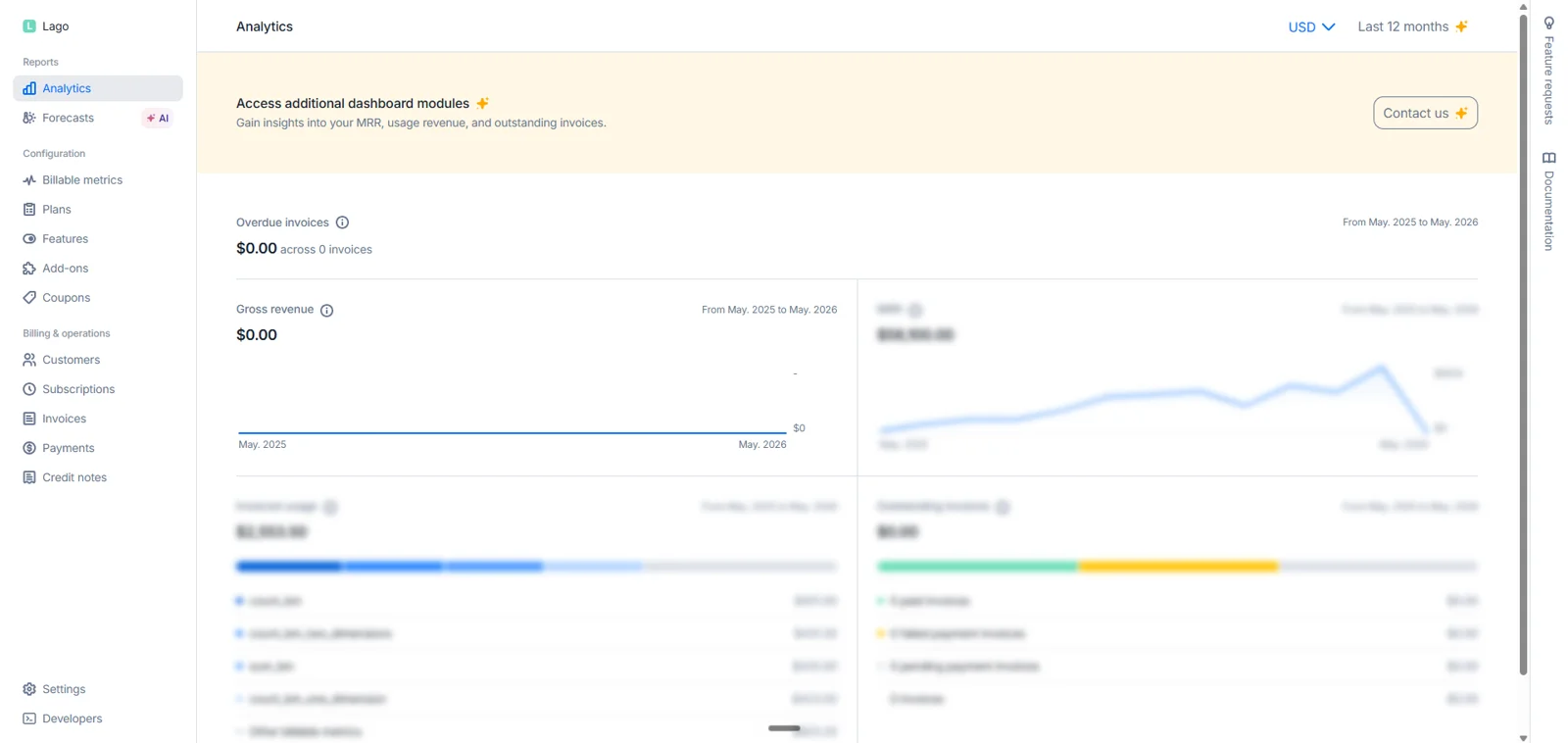
Image: Lago
Best for: engineering teams that want to own their billing infrastructure or keep usage data in their own environment.
AI considerations. Lago meters API calls, tokens, compute and storage, and manages prepaid credits. Its codebase is open source under AGPLv3 and can be deployed on your own infrastructure, in a VPC or in Lago's cloud. Mistral AI is among its customers.
Strengths. Full control over the billing engine and its data, and no dependence on a single vendor.
Limits. Self-hosting means your team operates the system: upgrades, scaling, monitoring and security. Several advanced features sit in the paid edition.
Solvimon: best for AI-native products priced around credit pools
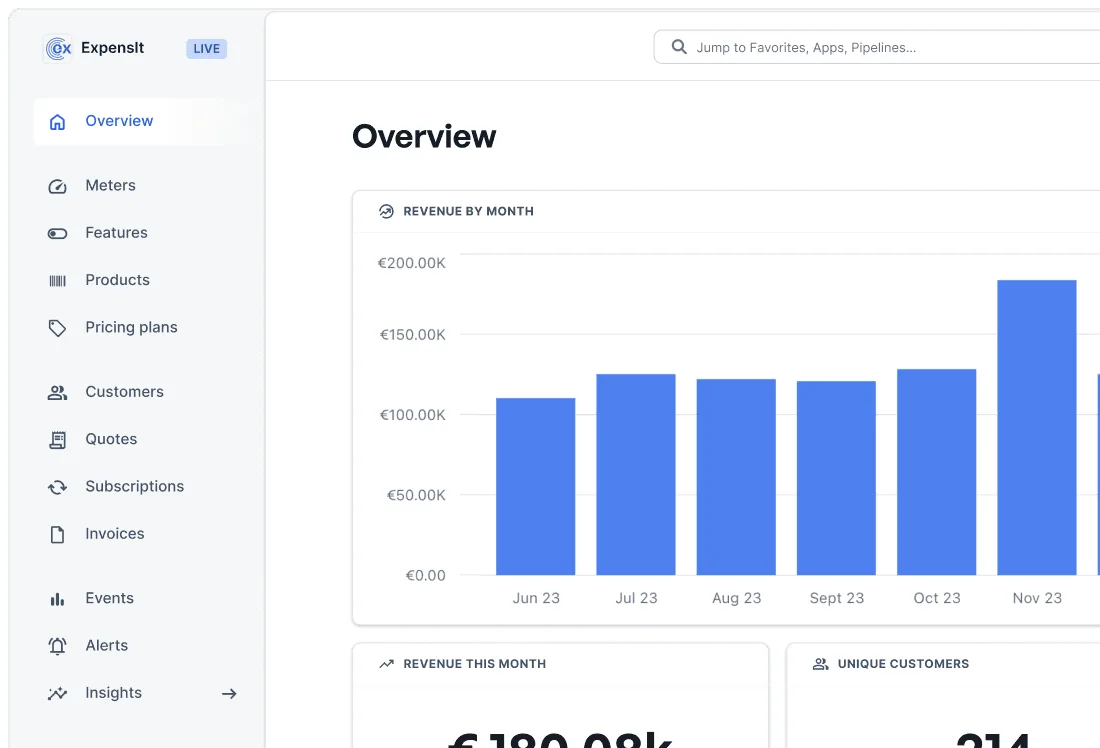
Image: Solvimon
Best for: AI-native companies whose pricing is built entirely around credits and usage.
AI considerations. Solvimon positions itself as billing and revenue management for the AI era, with prepaid credit pools and rollovers among its core pricing models.
Strengths. It is PSP-agnostic, with integrations for Stripe, Adyen and Checkout.com, as well as ERP and CRM connections.
Limits. It is a younger platform with a smaller ecosystem than the established vendors.
Should you build AI billing in-house or buy a platform?
Many AI companies start by counting tokens in their own database and generating invoices with a script or a payment provider's basic billing features. It works at the beginning, and it can be the right call while pricing is a single number per token.
The cost shows up later. Credits need a ledger with an audit trail. Enterprise deals bring commitments, custom rates and mid-term changes. Finance needs revenue recognition that matches invoices. Customers ask for usage dashboards and alerts. Every pricing change becomes an engineering ticket, and the team that should be improving the product spends its time maintaining billing.
A useful rule of thumb: build while you have one pricing model, one currency and only self-serve customers. Buy before you sign your first committed enterprise contract or launch credits, because migrating live credit balances and contracts later is far harder than starting on a dedicated platform.
What changed in 2026: billing platforms now belong to payment companies
2026 reshaped the usage billing market. Stripe completed its acquisition of Metronome in January 2026, after announcing it in December 2025. Adyen completed its acquisition of Orb on July 1, 2026. Salesforce completed its acquisition of m3ter the same day, bringing usage metering into Agentforce Revenue Management.
For AI companies, the practical consequence is that choosing a billing engine is now partly a choice of ecosystem. That is a good fit if you are committed to Stripe, Adyen or Salesforce. If you want to keep the freedom to change payment provider or CRM, or to route payments through several providers by region, independent platforms such as Hyperline, Lago and Solvimon keep that option open.
How to choose: a decision framework
Start with your sales motion, then check the requirements above.
- Self-serve, developer-led, simple pricing: start with Stripe Billing, and plan for a dedicated platform once credits or contracts arrive.
- Developer-led with complex, fast-changing usage pricing: look at Orb, or Lago if you need open source or self-hosting.
- Very large event volumes and enterprise usage contracts, committed to Stripe: Metronome.
- Sales-led or hybrid, with credits, subscriptions and usage on the same contract: Hyperline, which connects the quote, the credit ledger and the invoice.
- Mostly subscription revenue with a usage add-on: a subscription-first platform such as Chargebee can be enough, as long as usage stays a small share of revenue.
Whatever you choose, test it with your real pricing before you sign: send a sample of production events, recreate one enterprise contract and one credit plan, and check that the resulting invoice is one your customers would understand.
Frequently asked questions
What is the best usage-based billing software for AI companies?
There is no single best option. Orb and Metronome suit engineering-led AI products with very high volumes, Lago suits teams that need open source, Stripe Billing suits early-stage startups with simple pricing, Solvimon suits credit-pool pricing, and Hyperline suits B2B AI companies that sell credits and subscriptions through a sales team.
How do AI companies bill for tokens?
Most meter input and output tokens per customer and per model, then either charge per thousand tokens or convert tokens into credits that customers buy in advance. Credits are increasingly common because they give customers one unit to budget for and let the company adjust the underlying token rates as model costs change.
Should an AI product use credits or pay-as-you-go pricing?
Pay-as-you-go is simpler to launch and suits developer audiences. Prepaid credits improve cash flow and give customers predictable spend, which matters more as deals get larger. Many AI companies use both: pay-as-you-go for self-serve users and credit commitments for enterprise contracts.
Can I combine a subscription and credits in the same plan?
Yes. A common AI plan includes a monthly platform fee with a credit allowance, and charges overages or sells top-ups beyond it. Your billing platform needs to handle both on the same invoice, including proration and renewals.
Which AI billing platforms are independent from payment providers?
Since 2026, Metronome belongs to Stripe and Orb belongs to Adyen. Hyperline, Lago and Solvimon are independent and connect to several payment providers. Hyperline, for example, works with Stripe, Adyen, Mollie, Airwallex and GoCardless.
When should an AI startup stop building billing in-house?
Usually when it launches prepaid credits, signs its first committed enterprise contract or starts selling in several currencies. At that point, credit ledgers, contract terms and revenue recognition become expensive to maintain in-house, and migrating live balances later is harder than starting on a dedicated platform.