Best Usage-Based Billing Software in 2026, Compared by Use Case
A use-case-by-use-case comparison of the best usage-based billing software in 2026: Hyperline, Stripe Billing, Metronome, Orb, Lago, Chargebee, Zuora, Maxio, Solvimon and m3ter, with their strengths and limits.

Updated October 2026.
Usage-based billing software charges customers for what they actually consume: API calls, tokens, events, seats, gigabytes or prepaid credits. In 2026 the category has changed more than in any year before it. Stripe now owns Metronome, Adyen now owns Orb, Salesforce now owns m3ter, and almost every AI company has moved at least part of its revenue to consumption or credits.
There is no single best usage-based billing software. The right choice depends on what you bill for, how complex your contracts are, who owns billing in your company and which payment provider you want to keep. This guide compares the main platforms by use case, with their strengths and, just as importantly, their limits.
Quick answer: the best usage-based billing software by use case
| If you are... | Start by evaluating | Why |
|---|---|---|
| A B2B SaaS that sells from a CRM and bills subscriptions, seats and usage together | Hyperline | Usage products live inside the CPQ quote and bill automatically on signature, across several payment providers |
| An early-stage SaaS already processing payments on Stripe | Stripe Billing | Fastest setup, payments and billing in one place |
| An AI or API company with very high event volumes and complex contracts | Metronome or Orb | Built around raw usage events, multidimensional pricing and enterprise commitments |
| A team that wants open source or self-hosting | Lago | Open-source core, deployable on your own infrastructure |
| A subscription business adding usage on top of existing plans | Chargebee | Mature subscription lifecycle with usage-based add-ons |
| A large enterprise with complex finance and ERP requirements | Zuora or m3ter | Enterprise quote-to-cash and revenue workflows |
| A finance-led B2B SaaS focused on revenue reporting | Maxio | Billing combined with SaaS metrics and revenue recognition |
| An AI company built around tokens and credit wallets | Solvimon | Tokens and credits treated as core billing objects |
What is usage-based billing software?
Usage-based billing software turns product activity into invoices. It collects usage events from your product or data warehouse (metering), applies your pricing rules to them (rating), produces invoices and collects payment. Good platforms also handle prepaid credits, minimum commitments, overages, corrections for late or wrong data, and real-time visibility for customers. If you are new to the vocabulary, our glossary entry on metered billing is a good starting point.
The difference with traditional subscription billing is the data. A subscription system needs to know a plan and a date. A usage-based billing system needs to ingest, store and price millions or billions of events, keep them auditable, and recalculate invoices when something changes.
How to choose a usage-based billing platform
Almost every billing tool now claims to support usage-based pricing. The questions below separate the platforms that handle it natively from the ones that bolt a meter onto a subscription engine.
1. How does usage get in?
Check whether the platform ingests raw events through an API, syncs from your data warehouse, or expects you to send it pre-aggregated totals. Raw events and warehouse sync give you more flexibility: you can redefine a billable metric later without rebuilding your pipeline.
2. Which pricing models does it support?
List the models you use today and the ones you expect within 18 months: per-unit, tiered, volume, graduated, package, prepaid credits, minimum commitments with overages, outcome-based pricing, and hybrids that combine a platform fee, seats and usage. Pricing that cannot be configured without engineering work will slow down every pricing change.
3. What happens when data is late or wrong?
Usage data is never perfect. Ask how the platform handles duplicate events, late-arriving events and backfills, and whether it can recalculate an invoice that has not yet been finalized.
4. Does it handle prepaid credits properly?
Credits are now the default for AI products. Look for a real credit ledger with balances, top-ups, auto-reload, expiry rules and alerts before a customer runs out, not just a negative line on an invoice.
5. Can customers see their consumption?
Variable invoices create disputes when customers cannot follow their usage. A customer-facing portal or embeddable usage dashboard, plus spend alerts, prevents most of them.
6. Does it connect to finance?
Usage-based revenue still needs to be recognized, taxed and booked. Check revenue recognition (ASC 606 and IFRS 15), tax coverage, e-invoicing where it is mandatory, and the accounting integrations your finance team relies on.
7. Does it lock you into one payment provider?
Since the 2026 acquisitions, this question matters more. Some billing platforms are now owned by payment companies. Check which payment providers each platform supports and whether you can use several of them at once.
Comparison table
| Platform | Best for | Usage models | Prepaid credits | Payment providers | Deployment |
|---|---|---|---|---|---|
| Hyperline | B2B SaaS selling from a CRM with hybrid pricing | Usage, seats, credits, hybrid, outcome-based | Yes (native ledger) | Stripe, Adyen, Mollie, Airwallex, GoCardless | Cloud |
| Stripe Billing (with Metronome) | Startups on Stripe; advanced usage via Metronome | Meters, tiers, hybrid; multidimensional with Metronome | Yes | Stripe | Cloud |
| Metronome | High-volume AI and API businesses | Multidimensional, commitments, hybrid | Yes | Stripe ecosystem | Cloud |
| Orb | Engineering-led teams with complex usage | Raw-event metrics, hybrid, contracts | Yes | Several | Cloud |
| Lago | Open source and self-hosting | Usage, credits, hybrid | Yes (wallets) | Several | Self-hosted or cloud |
| Chargebee | Subscription businesses adding usage | Usage add-ons, thresholds and overages | Yes | 40+ gateways | Cloud |
| Zuora | Large enterprises | Complex enterprise models | Yes | Several | Cloud |
| Maxio | Finance-led B2B SaaS | Usage and subscriptions | Yes | 20+ gateways | Cloud |
| Solvimon | AI companies built on tokens and credits | Tokens, credits, hybrid | Yes | Stripe and Adyen | Cloud |
| m3ter | Mid-size and large B2B SaaS | Usage and bill calculations at scale | Yes | Via billing and ERP integrations | Cloud |
The best usage-based billing software by use case
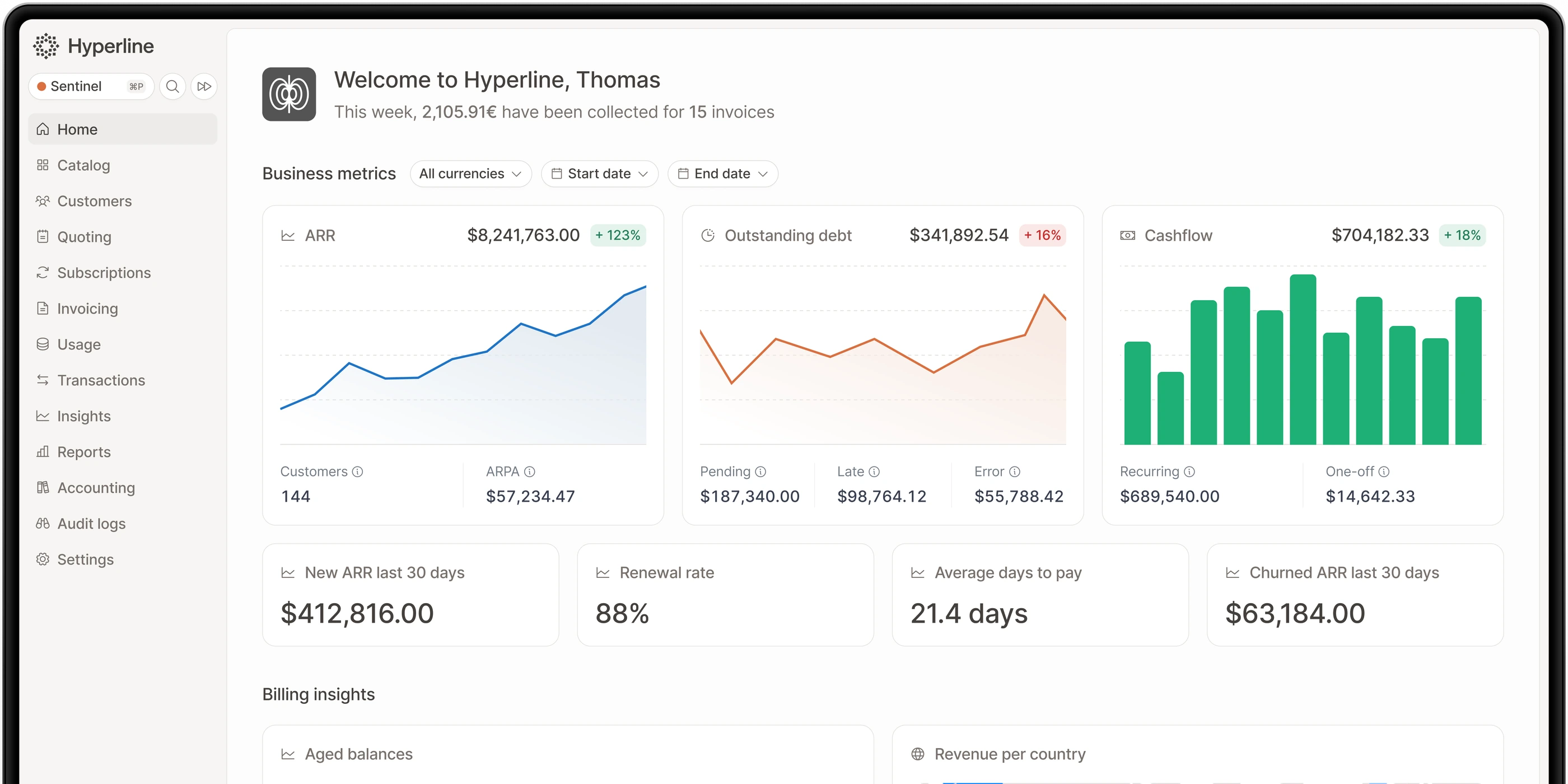
Hyperline: best for B2B SaaS that sells from a CRM with hybrid pricing
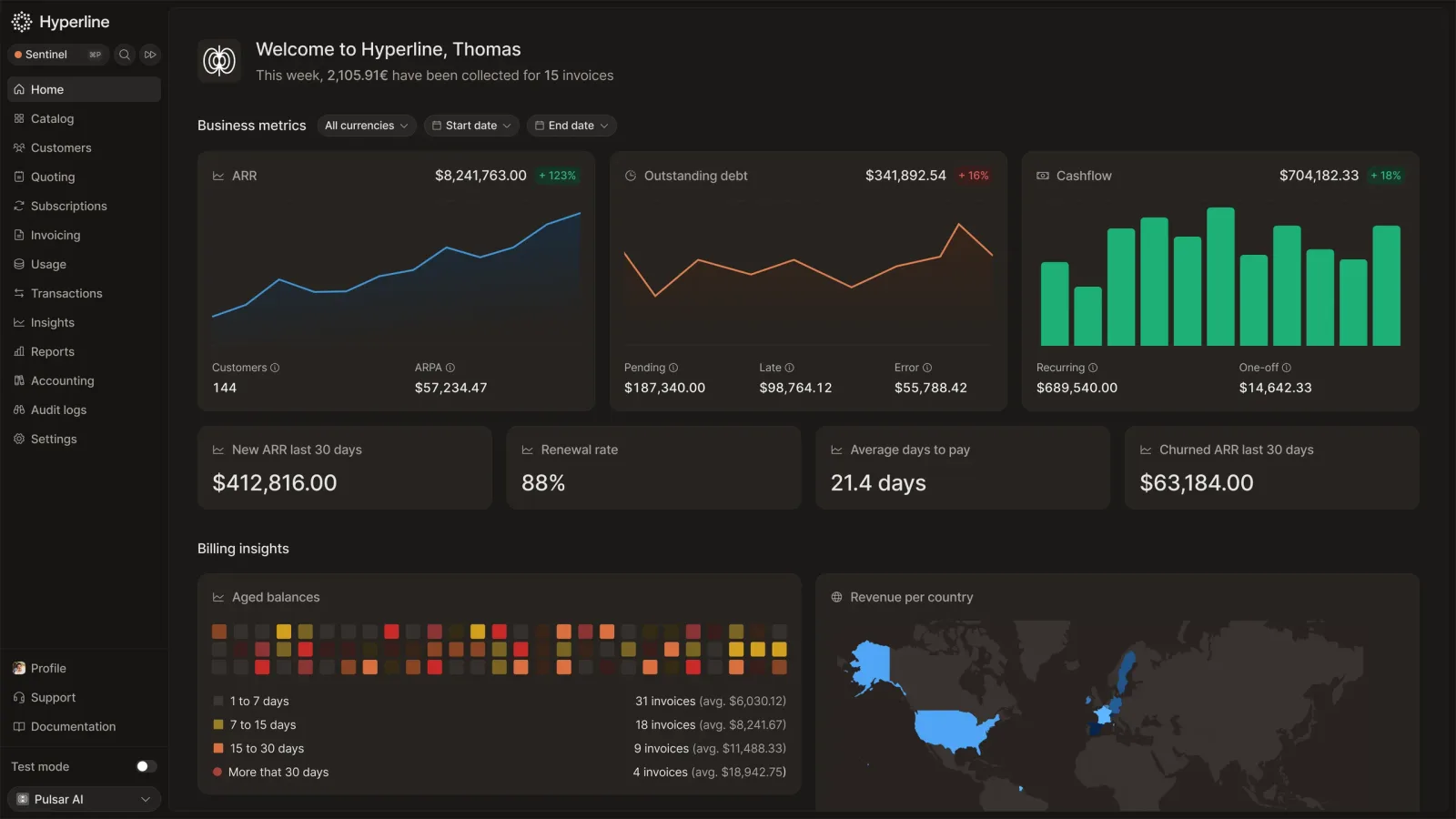
Image: Hyperline
Best for: B2B SaaS and AI companies that sell through a sales team working in HubSpot, Salesforce or Attio, and bill subscriptions, seats and usage on the same contract.
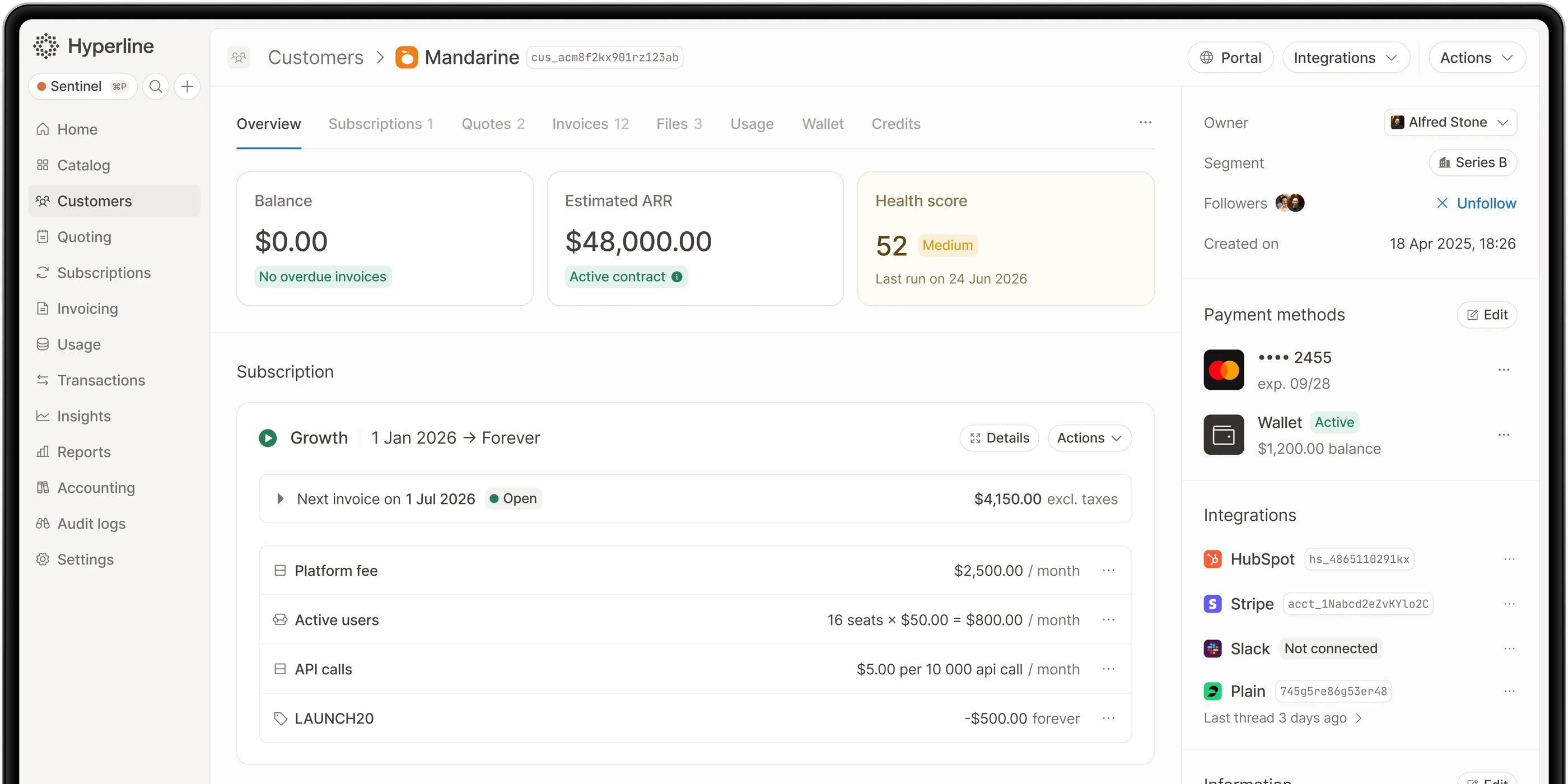
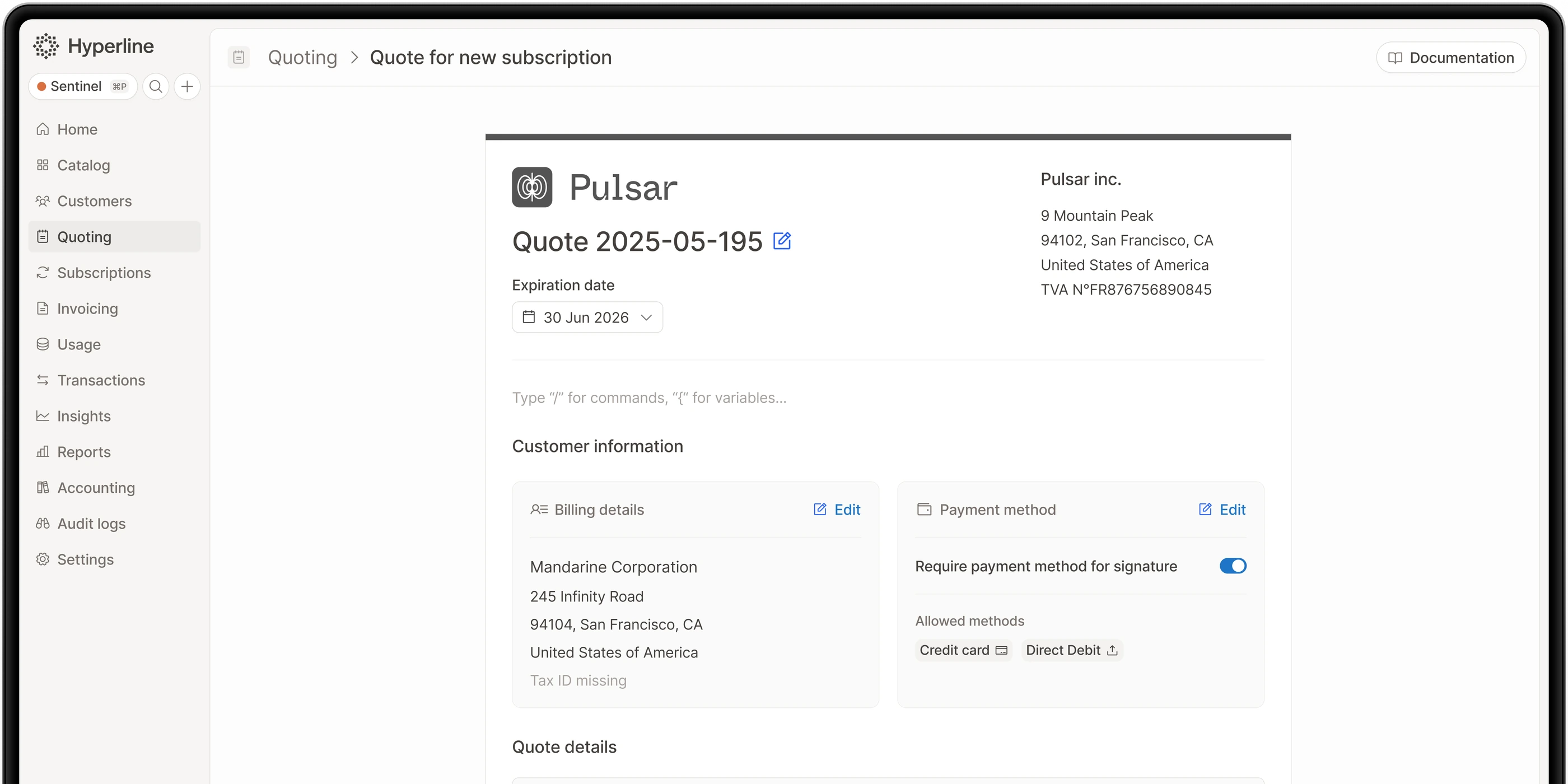
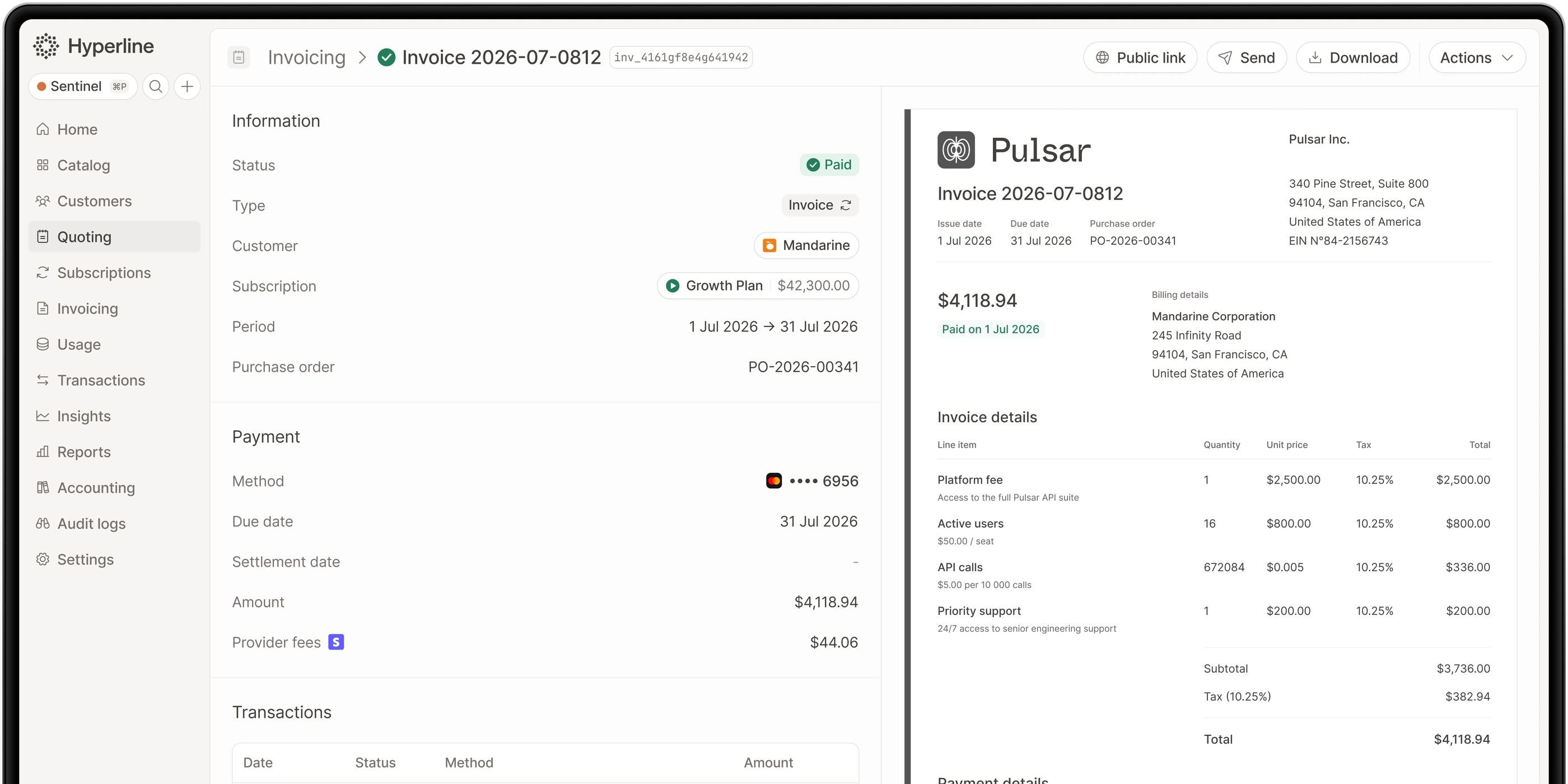
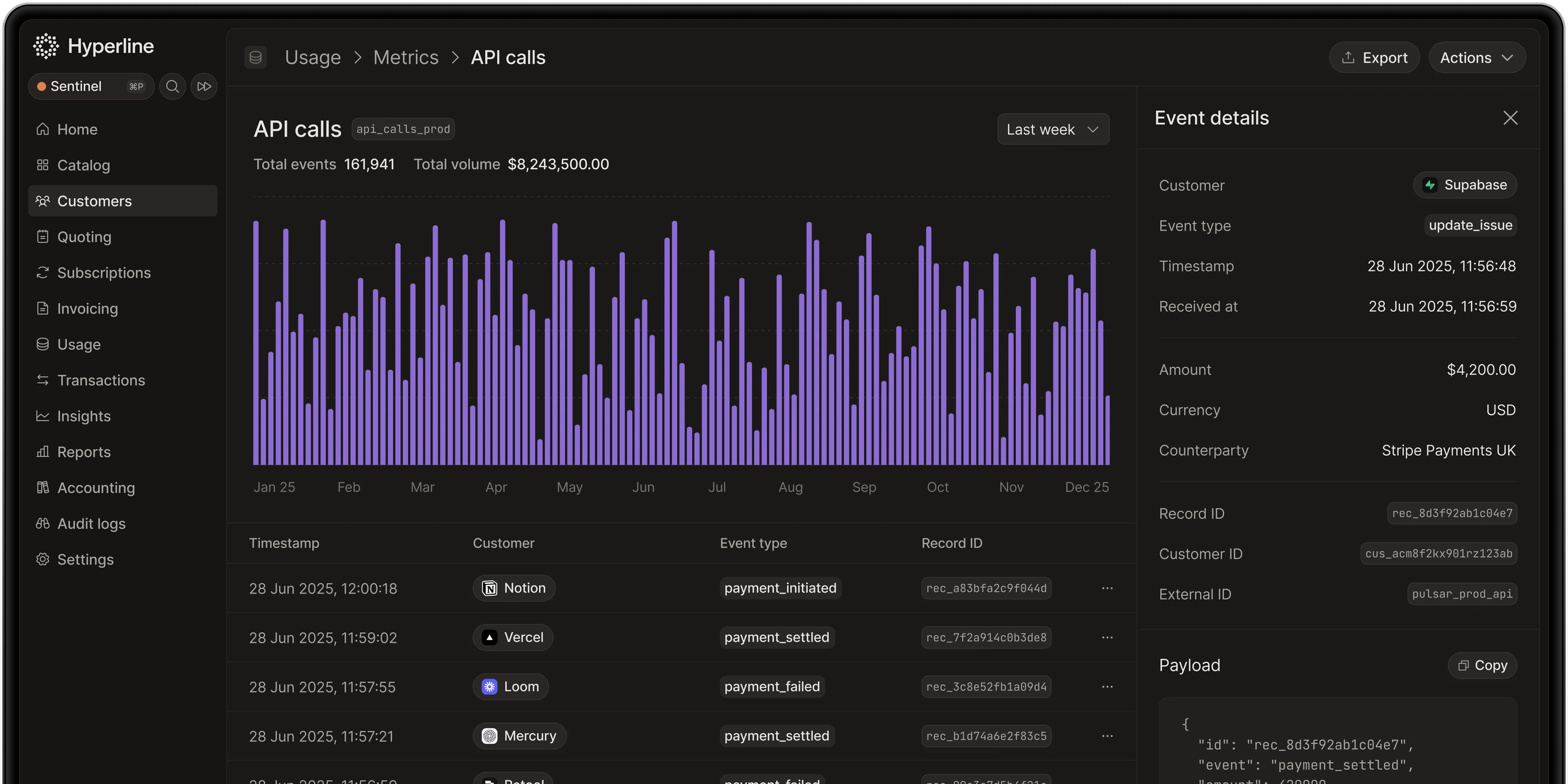
Strengths. Hyperline runs quoting and billing on one data model. Usage-based products can be added to a CPQ quote next to seats and flat fees, signed with native e-signature, and billed automatically on signature, with no re-entry by finance. On the usage side, Hyperline meters events in real time through its API or by syncing directly from BigQuery, Snowflake, MongoDB, Postgres or MySQL, keeps every billable unit traceable to its raw events, and includes a native credit ledger with balance checks, top-ups, auto-reload and projected-balance webhooks before a customer runs out. Customers get a real-time billing portal where they can follow consumption and buy credits.
It is also payment-provider agnostic: Hyperline works with Stripe, Adyen, Mollie, Airwallex and GoCardless. Finance features are native: tax on every invoice across 80+ countries, e-invoicing for Peppol and Chorus Pro, revenue recognition under ASC 606 and IFRS 15, and accounting integrations including NetSuite, QuickBooks, Xero and Pennylane. Hyperline reports 99.99% uptime and more than 1 billion usage events processed each month.
Truvi bills property managers per booking, with no platform fee or subscription. After automating that usage-based model with Hyperline, its month-end close went from 12 weeks with 8 people to 4 days with 4 people.
"Standard plans didn't work for our customers, now we have the flexibility we need and the freedom to test usage as we grow." Peter Starr, Revenue Operations at ScorePlay.
Limits. Hyperline is a hosted platform, so teams that require an open-source or self-hosted billing engine should look at Lago. And if you process tens of billions of events per month, Metronome publishes higher throughput figures.
Stripe Billing: best for startups already on Stripe
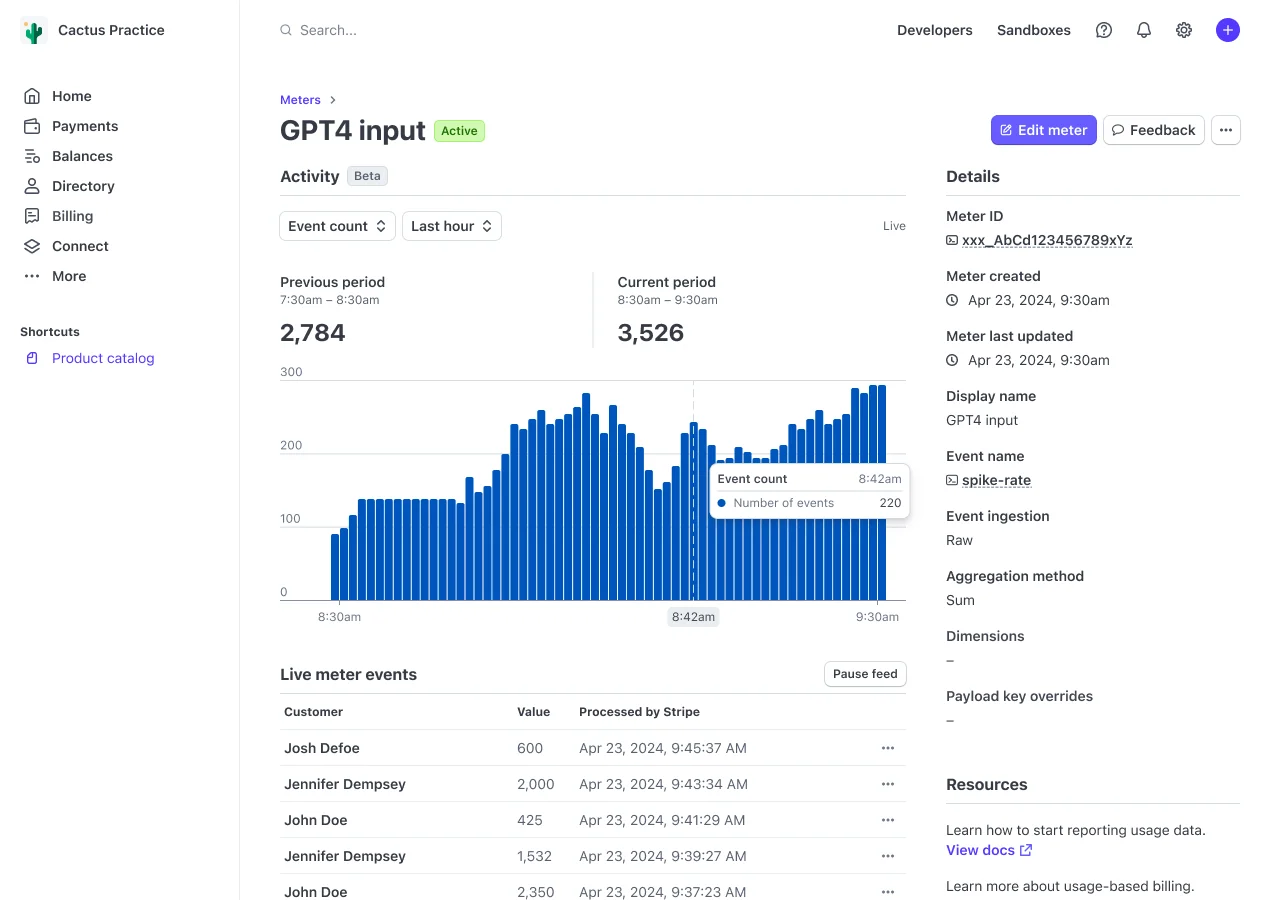
Image: Stripe Billing
Best for: early-stage SaaS and AI products that already process payments on Stripe and have relatively simple usage pricing, such as a price per API call or a subscription with overages.
Strengths. Stripe Billing keeps subscriptions, invoices, payments and tax in one ecosystem, which removes an integration and a vendor. Usage is reported through meters and priced with tiers or hybrid plans. For more complex models, Stripe positions Metronome, which it acquired in January 2026, as its advanced usage-based billing solution. Stripe's own page presents Metronome as "a Stripe product" and cites 35B+ usage events processed each month and 100K+ events per second per business.
Limits. Native Stripe Billing is simplest when your pricing is simple. Multidimensional rate cards, negotiated enterprise contracts and complex credit systems push you toward Metronome, which is a second product to implement even if it belongs to the same company. Everything also assumes Stripe as your payment provider.
Metronome: best for high-volume AI and API businesses
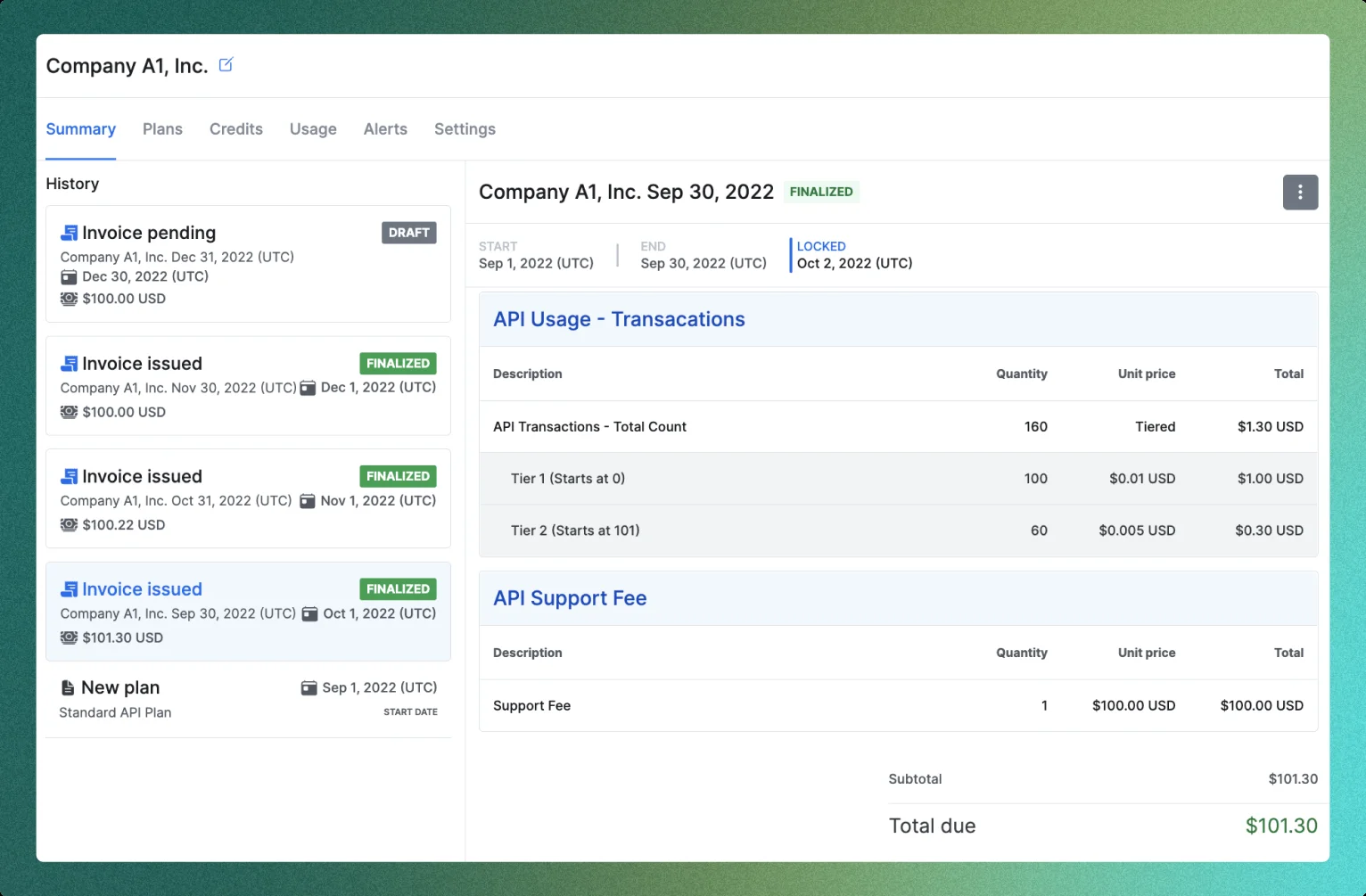
Image: Metronome
Best for: AI, API and infrastructure companies with large event volumes, multiple usage dimensions and negotiated enterprise contracts.
Strengths. Metronome was built for consumption pricing: real-time metering, multidimensional pricing, prepaid credits, commitments and spend visibility for customers. It publishes some of the highest throughput figures in the category and counts OpenAI among its customers. Since January 2026 it is part of Stripe, which makes it the natural upgrade path for Stripe users.
Limits. It is more infrastructure than a simple billing tool, and it is now tied to the Stripe ecosystem, which matters if you want your billing layer to stay independent from your payment provider. It does not cover sales quoting.
Orb: best for engineering-led teams with complex usage
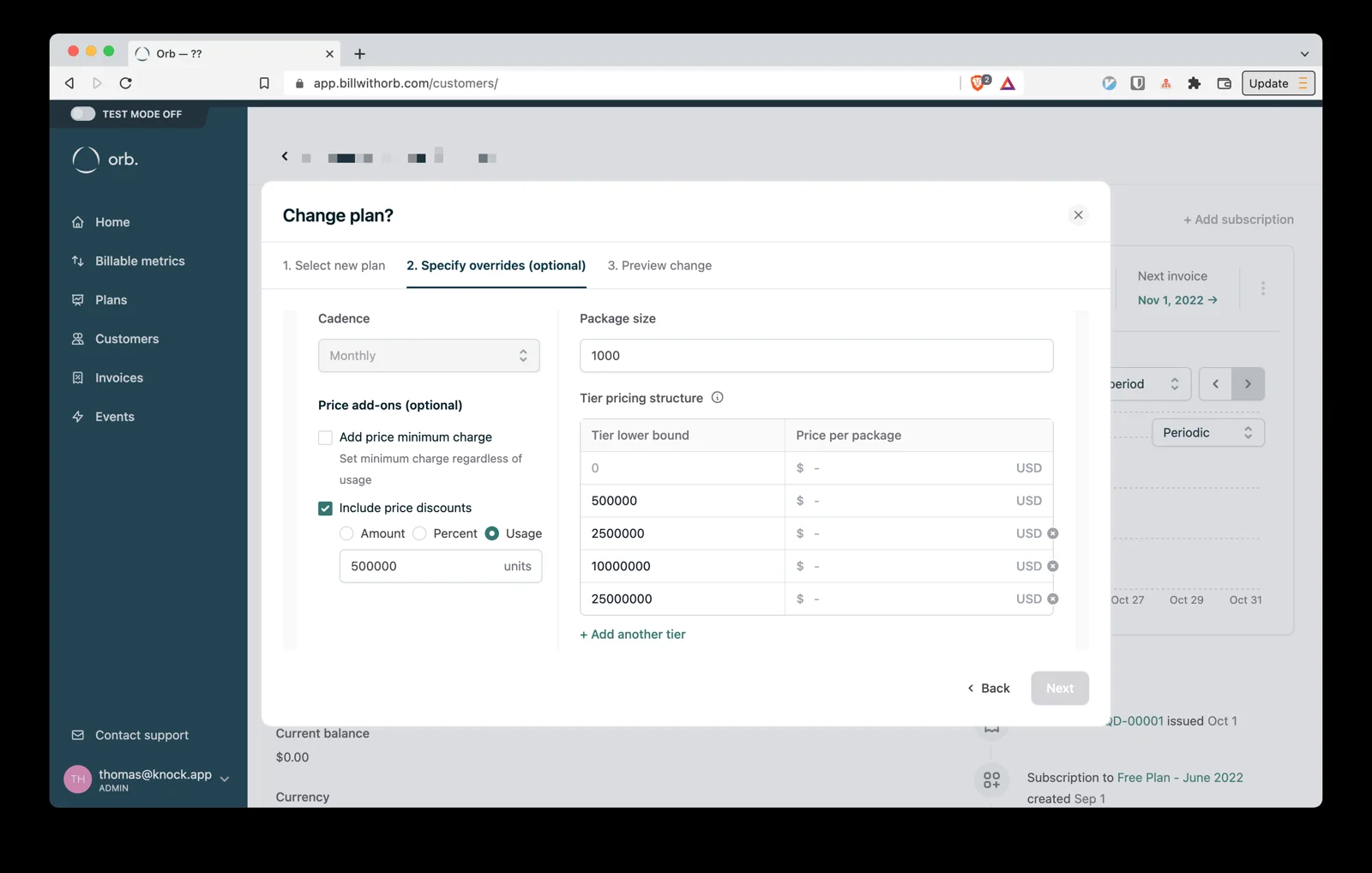
Image: Orb
Best for: API-first and developer-focused companies whose pricing changes often and depends on several usage metrics.
Strengths. Orb stores raw usage events and lets you define billable metrics on top of them, which makes backfills, corrections and pricing experiments easier. It supports hybrid and usage-based pricing, contracts and invoicing, and says its platform is stress-tested at 250,000+ events per second. Adyen completed its acquisition of Orb on July 1, 2026, and says it continues to support multi-PSP setups.
Limits. Orb is a billing engine, not a full quote-to-cash platform, so quoting and some finance workflows sit in other tools.
Lago: best for open source and self-hosting
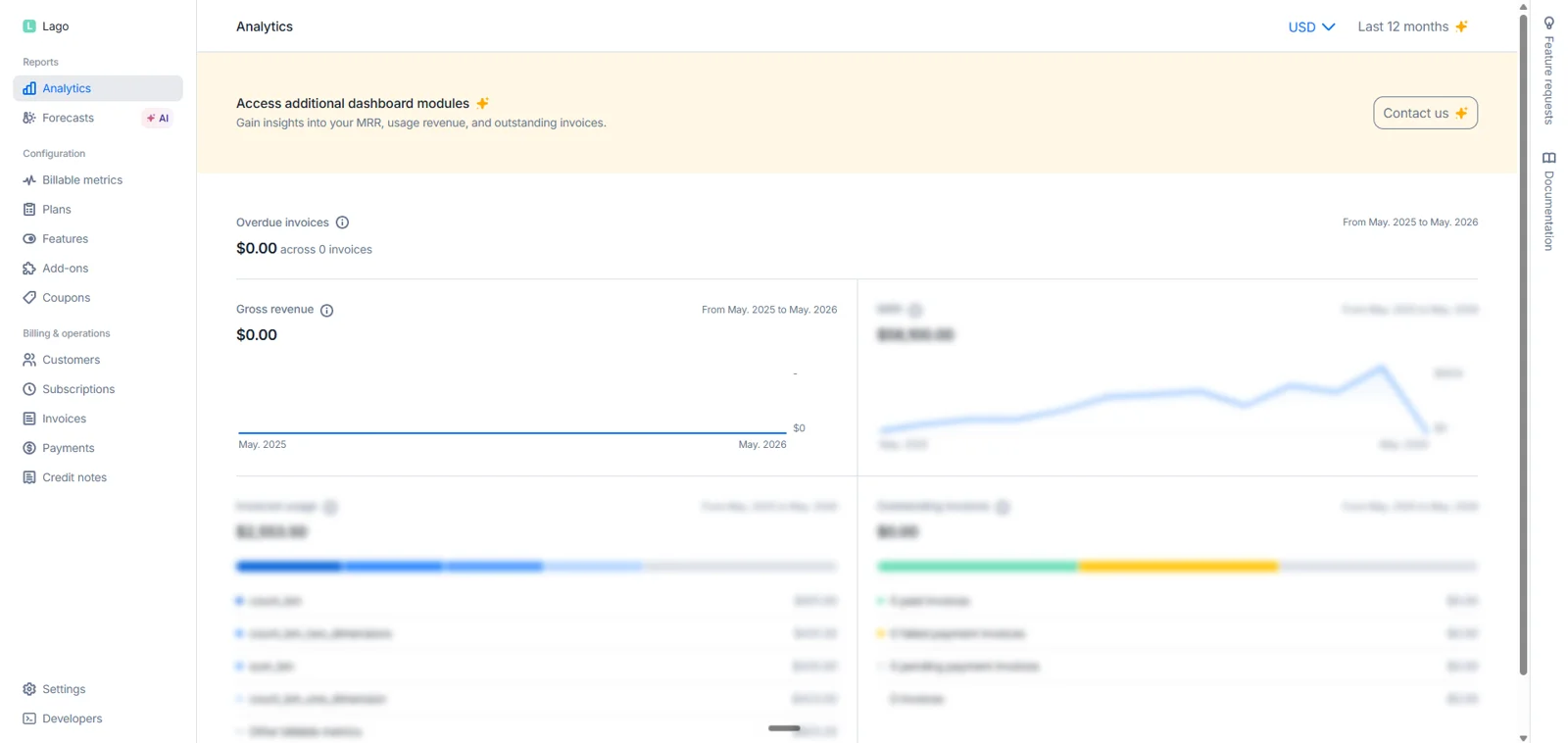
Image: Lago
Best for: engineering teams that want to own their billing infrastructure, keep data in their own environment or avoid dependence on a single vendor.
Strengths. Lago's core is open source and can run on your own infrastructure or in Lago's cloud. It covers usage metering, subscriptions, hybrid plans, prepaid credits through wallets, invoicing and payment orchestration.
Limits. Self-hosting means your team operates the system: upgrades, scaling, monitoring and security. Several advanced features sit in the Premium edition.
Chargebee: best for subscription businesses adding usage
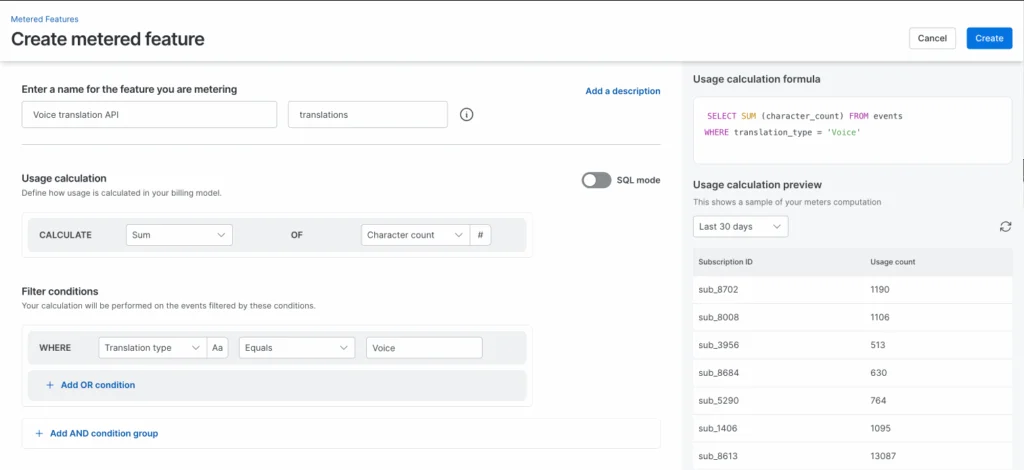
Image: Chargebee
Best for: SaaS companies whose revenue is mostly subscriptions and who want to add usage-based charges, thresholds or overages without changing platform.
Strengths. Chargebee has a mature subscription lifecycle (plans, trials, upgrades, dunning, customer portal) and connects to 40+ payment gateways. It offers usage ingestion with real-time usage limits, alerts and analytics.
Limits. Usage is an extension of a subscription-first platform rather than its core. CPQ for Salesforce and HubSpot and revenue recognition are separate products, which adds implementation work when you need the full quote-to-cash flow.
Zuora: best for large enterprises
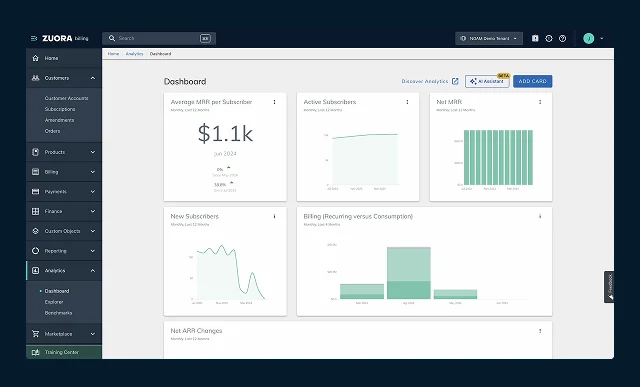
Image: Zuora
Best for: large and public companies with complex contracts, multiple entities, ERP integration and strict audit requirements.
Strengths. Zuora covers subscription management, billing, payments and revenue recognition at enterprise scale and supports complex recurring and usage models.
Limits. Implementations are typically long, and the platform is more than most growth-stage companies need.
Maxio: best for finance-led B2B SaaS
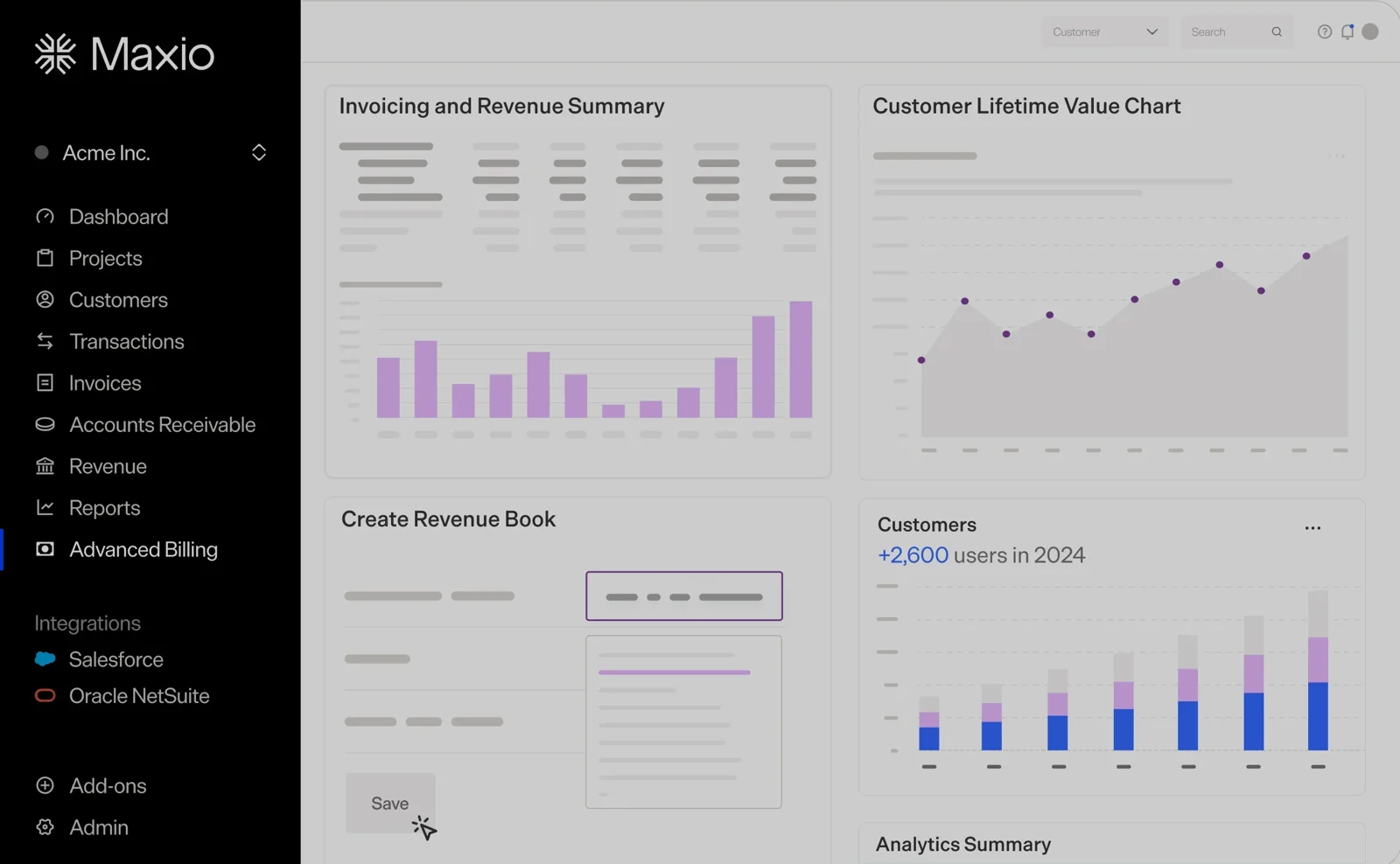
Image: Maxio
Best for: B2B SaaS companies where billing is owned by finance and tightly linked to SaaS metrics and revenue reporting.
Strengths. Maxio combines billing, collections, revenue recognition and SaaS metrics, and connects to 20+ payment gateways.
Limits. It is less focused on high-volume event metering than usage-native platforms, so very granular AI or API pricing can require more work.
Solvimon: best for AI companies built on tokens and credits
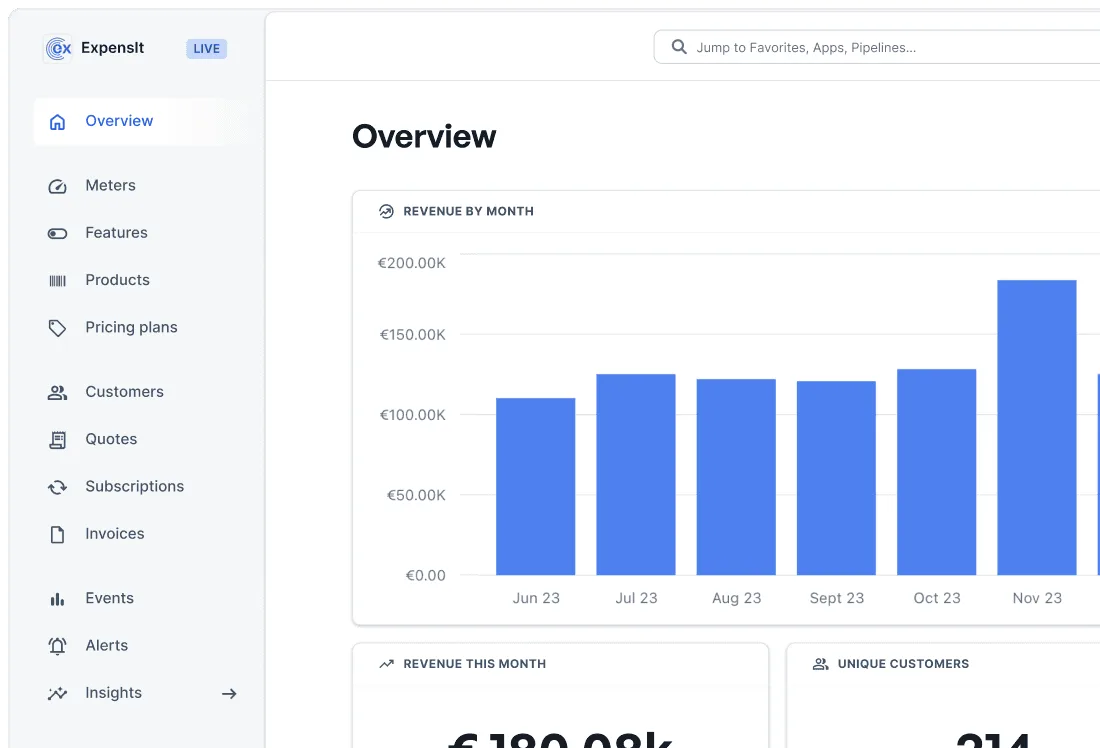
Image: Solvimon
Best for: AI companies whose monetization is built around tokens, credits and hybrid contracts.
Strengths. Solvimon treats tokens and credits as core billing objects, with usage metering for tokens and API calls, and integrates payments through Stripe and Adyen.
Limits. It is a younger platform with a smaller ecosystem than the established vendors.
m3ter: best for usage at enterprise scale inside Salesforce
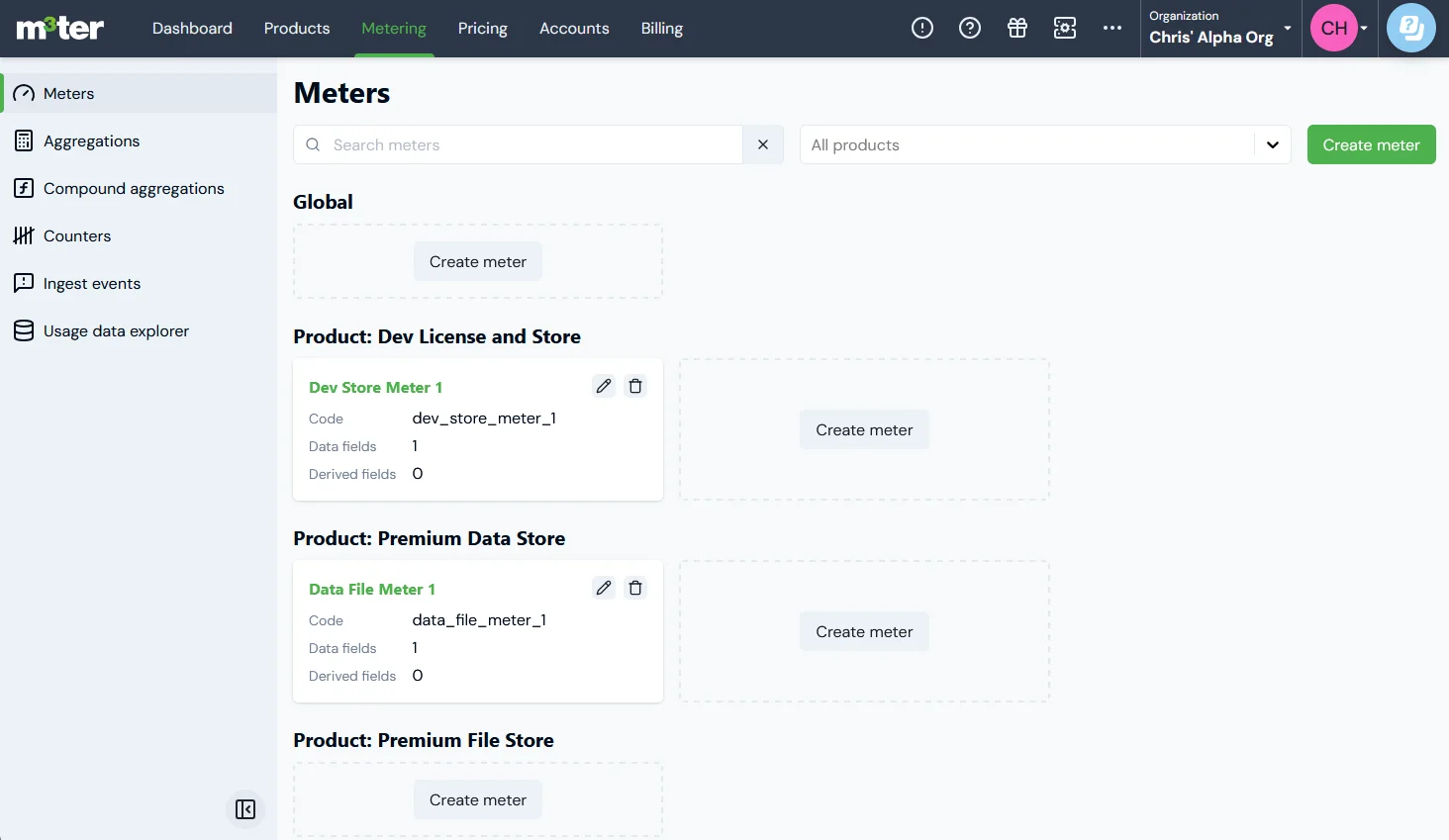
Image: m3ter
Best for: mid-size and large B2B SaaS companies that need a dedicated usage and pricing layer within a broader quote-to-cash stack.
Strengths. m3ter focuses on usage data ingestion and bill calculation at scale, with pre-built CRM and ERP integrations. It is now part of Salesforce, which makes it relevant for companies standardized on Salesforce.
Limits. It is a usage and rating layer that typically sits alongside other billing, payment and ERP systems, and implementations are often part of larger transformation projects.
Which billing systems support hybrid pricing?
Hybrid pricing combines several charges in one contract: a platform fee, seats, usage, credits and sometimes a minimum commitment. It is now the most common model in B2B SaaS and AI, because it gives customers predictability and gives vendors upside when usage grows.
Most platforms in this guide support some form of hybrid pricing, but they do not handle it in the same place:
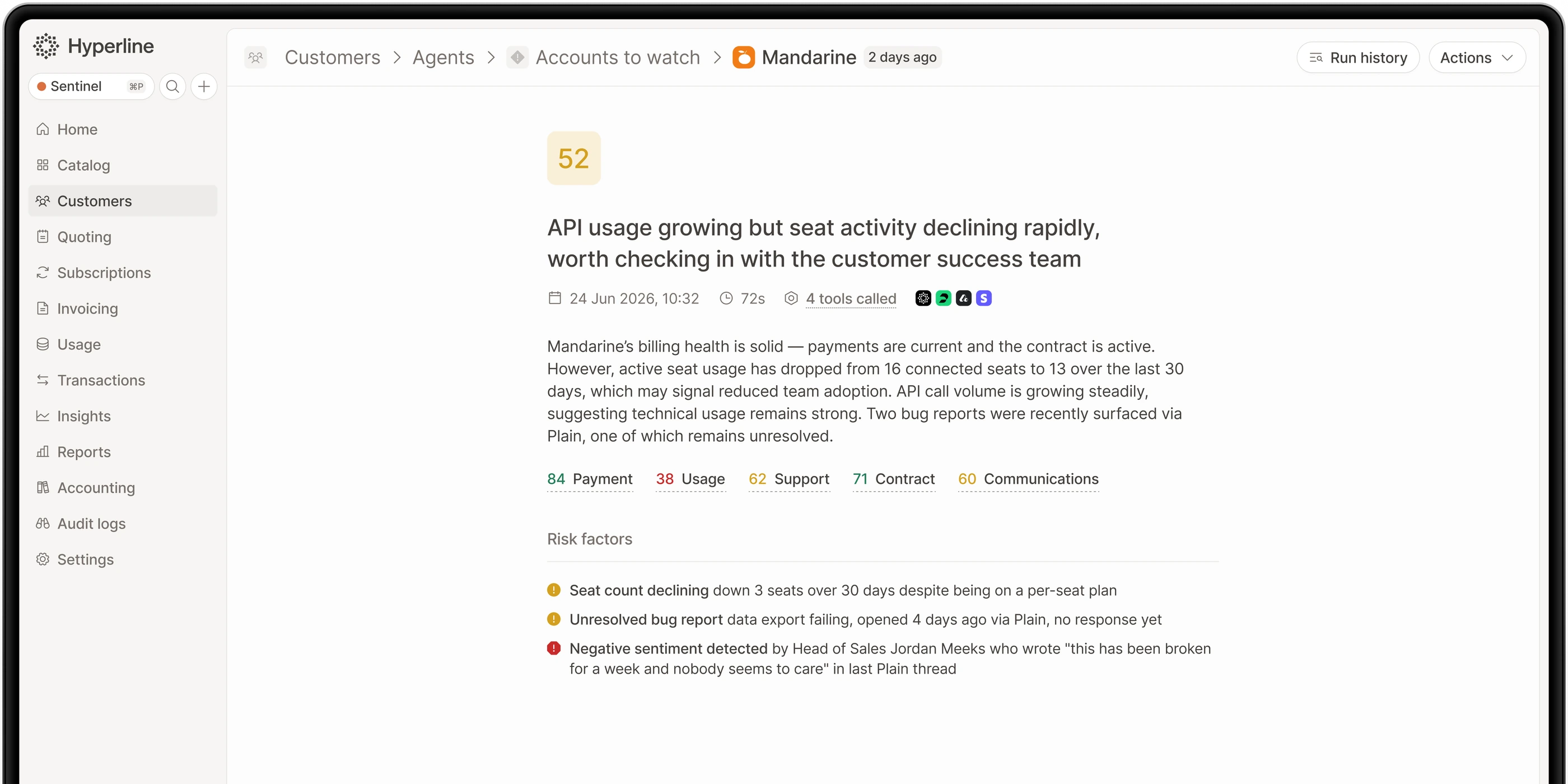
- Hyperline handles hybrid contracts from the quote: sales configures seats, flat fees and usage products in one CPQ quote, and the signed contract becomes the subscription without a handoff.
- Stripe Billing, Chargebee and Maxio start from the subscription and add usage components on top of it.
- Metronome, Orb and m3ter start from usage and model subscriptions and commitments around it.
- Solvimon and Lago combine both, with credits as a central object.
The practical question is who builds the contract. If sales negotiates hybrid deals in a CRM, look for a platform where the quote and the billing share the same data. If pricing is mostly self-serve, a usage-first engine with a checkout may be enough.
Usage-based billing for AI companies
AI products are the main reason usage-based billing changed so fast. Costs depend on tokens, models and compute, and pricing has to follow. When you evaluate a platform for an AI product, check five things:
- Token-level metering. Input and output tokens, priced per model, and sometimes per region or customer tier.
- A real credit ledger. Prepaid credits, credit packs, auto top-ups, expiry, and alerts before a balance runs out.
- Spend controls. Usage limits and thresholds so an agent or a runaway job cannot generate an unexpected bill.
- Customer visibility. A live consumption view for customers, so invoices are never a surprise.
- Cost and revenue visibility. The ability to compare what a customer consumes with what it costs you to serve it.
Hyperline supports prepaid credits with a native ledger, outcome-based pricing and real-time metering, and adds the sales side that AI companies need when they start signing enterprise contracts: usage-based products inside the quote, approvals and e-signature. Metronome, Orb and Solvimon also focus heavily on AI use cases, and Stripe Billing is the simplest starting point for an early AI product.
Stripe Billing vs Metronome vs Orb: what changed in 2026
Three acquisitions reshaped the category this year:
- Stripe completed its acquisition of Metronome in January 2026. Stripe now presents Metronome as its solution for advanced usage-based billing.
- Adyen completed its acquisition of Orb on July 1, 2026. Adyen says Orb keeps operating with continuity and continues to support multi-PSP environments.
- m3ter is now part of Salesforce.
For buyers, the consequence is simple: your choice of billing platform is now more closely linked to your choice of payment provider or CRM vendor than it was a year ago. If you want to keep the freedom to route payments to several providers, or to change provider later, check the payment integrations of each platform and who owns it. Hyperline, Lago, Chargebee and Solvimon are not owned by a payment company or a CRM vendor, and Hyperline connects to Stripe, Adyen, Mollie, Airwallex and GoCardless.
How to switch from subscriptions to usage-based pricing
Moving from flat subscriptions to usage-based or hybrid pricing is as much a pricing project as a billing project. A sequence that works:
- Define the billable unit. Pick a metric that tracks the value customers get (API calls, tokens, documents processed, active seats) and that you can measure reliably.
- Instrument and validate the data. Send usage events or connect your warehouse, then run the meter in shadow mode for a few weeks to check the numbers against reality.
- Design the hybrid offer. Most companies keep a platform fee or a minimum commitment and add usage on top, often with prepaid credits for predictability.
- Model the impact. Replay historical usage against the new price book to see what each customer would have paid.
- Give customers visibility before the first invoice. A usage portal and alerts reduce disputes and churn during the transition.
- Migrate in waves. Start with new customers, then move existing ones at renewal, rather than switching everyone at once.
- Connect finance from day one. Revenue recognition, tax and accounting need to handle variable revenue before the first usage invoice goes out.
Frequently asked questions
What is the best billing system for usage-based pricing?
It depends on your profile. Hyperline suits B2B SaaS that sells hybrid contracts from a CRM, Stripe Billing suits startups already on Stripe, Metronome and Orb suit high-volume AI and API businesses, Lago suits teams that want open source, and Chargebee suits subscription-first companies.
What are the best tools to handle SaaS billing and metered usage?
The tools most often shortlisted are Hyperline, Stripe Billing, Metronome, Orb, Lago, Chargebee, Zuora and Maxio. Compare them on event ingestion, pricing flexibility, credits, corrections, customer visibility and finance integrations rather than on a feature checklist.
What is the best usage-based billing software for AI companies?
AI companies should prioritize token-level metering, a real credit ledger and spend controls. Hyperline combines a native credit ledger with CPQ and e-signature for AI companies selling enterprise contracts, Metronome, Orb and Solvimon focus on AI use cases, and Stripe Billing is the simplest start.
Which billing platforms support prepaid credits?
All the platforms in this guide support prepaid credits in some form. The difference is depth: look for a credit ledger with balances, top-ups, auto-reload, expiry and alerts. Hyperline, Metronome, Orb, Lago and Solvimon handle credits natively.
Which usage-based billing platforms work with any payment provider?
Since Stripe acquired Metronome and Adyen acquired Orb, payment independence varies more. Hyperline, Lago, Chargebee and Solvimon connect to several providers. Hyperline supports Stripe, Adyen, Mollie, Airwallex and GoCardless.
Can I combine subscriptions, seats and usage in one contract?
Yes, most modern platforms support hybrid pricing. Check where the contract is built: in Hyperline, sales adds seats, flat fees and usage products to one CPQ quote, and the signed quote becomes the subscription automatically.
Should I build usage-based billing in-house or buy it?
Building looks simple until you handle late events, corrections, credits, tax, revenue recognition and pricing changes. Most teams buy a platform and keep engineering focused on the product, unless billing itself is a core differentiator.