Best Billing System for AI Companies : Usage-Based and Hybrid Models in 2026
The 6 best billing systems for AI companies in 2026 with hybrid models
Introduction
AI companies have a billing problem that traditional SaaS platforms were never designed to solve. Inference is expensive, consumption is unpredictable, and the customer expects to be charged accurately for what they actually used, in real time, with prepaid credits that drain as the model runs.
The classic billing stack falls apart fast. Stripe Billing handles the basics but starts cracking once you need multi-dimensional pricing for tokens, requests, fine-tuning jobs, and storage tiers all at once. Chargebee was not built for the scale or variability of AI workloads. Building it in-house works for a Series A but turns into a permanent engineering project by Series B.
This guide ranks the six billing systems that AI companies should evaluate in 2026. Each one was scored on real-time metering depth, prepaid credit support, hybrid subscription-plus-usage pricing, and the ability to scale to high-volume event ingestion without losing accuracy.
How we ranked these platforms
Each platform was scored across five dimensions :
• Real-time metering at scale : event ingestion throughput, late-arriving event handling, accuracy under load.
• Prepaid credit management : the ability to sell credit packages, burn them down in real time, and surface the balance to the customer in a portal.
• Hybrid pricing depth : combining subscription, usage, tiered, volume, graduated, and custom enterprise contracts in one structure.
• Quote-to-cash coverage : whether the platform handles only billing, or the full chain (CPQ, contracts, billing, invoicing, revenue recognition).
• Time to value : how fast an AI company can go from kick-off to first invoice issued.
Pure billing APIs without specialized AI/usage support and pure subscription tools without real-time metering were excluded.
Comparison table at a glance
1. Hyperline — Best for: AI companies wanting unified Q2C with real-time metering · Real-time metering: Yes (unlimited events) · Prepaid credits: Yes · Native CPQ + billing: Yes (full) · Starting price: $299 / mo + 0.7 % of revenue
2. Stripe Billing — Best for: Early-stage AI startups already on Stripe · Real-time metering: Yes (metered billing) · Prepaid credits: Limited · Native CPQ + billing: No · Starting price: 0.5 to 0.8 % of recurring revenue
3. Orb — Best for: High-volume pure usage AI companies · Real-time metering: Yes (high-throughput) · Prepaid credits: Yes · Native CPQ + billing: No · Starting price: Custom
4. Metronome — Best for: Developer-led AI usage billing · Real-time metering: Yes · Prepaid credits: Yes · Native CPQ + billing: No · Starting price: Custom
5. M3ter — Best for: Enterprise AI with complex pricing · Real-time metering: Yes · Prepaid credits: Yes · Native CPQ + billing: No (metering only) · Starting price: Custom
6. Lago — Best for: Open-source AI billing for engineering-led teams · Real-time metering: Yes · Prepaid credits: Yes · Native CPQ + billing: No · Starting price: Free OSS / $400+ / mo cloud
Pricing reflects publicly listed entry points as of April 2026.
The 6 best billing systems for AI companies in 2026
1. Hyperline : Best overall for AI companies wanting unified quote-to-cash
One-liner : A unified revenue management platform that automates quote-to-cash, with CPQ, flexible billing, and usage-based billing in one place.
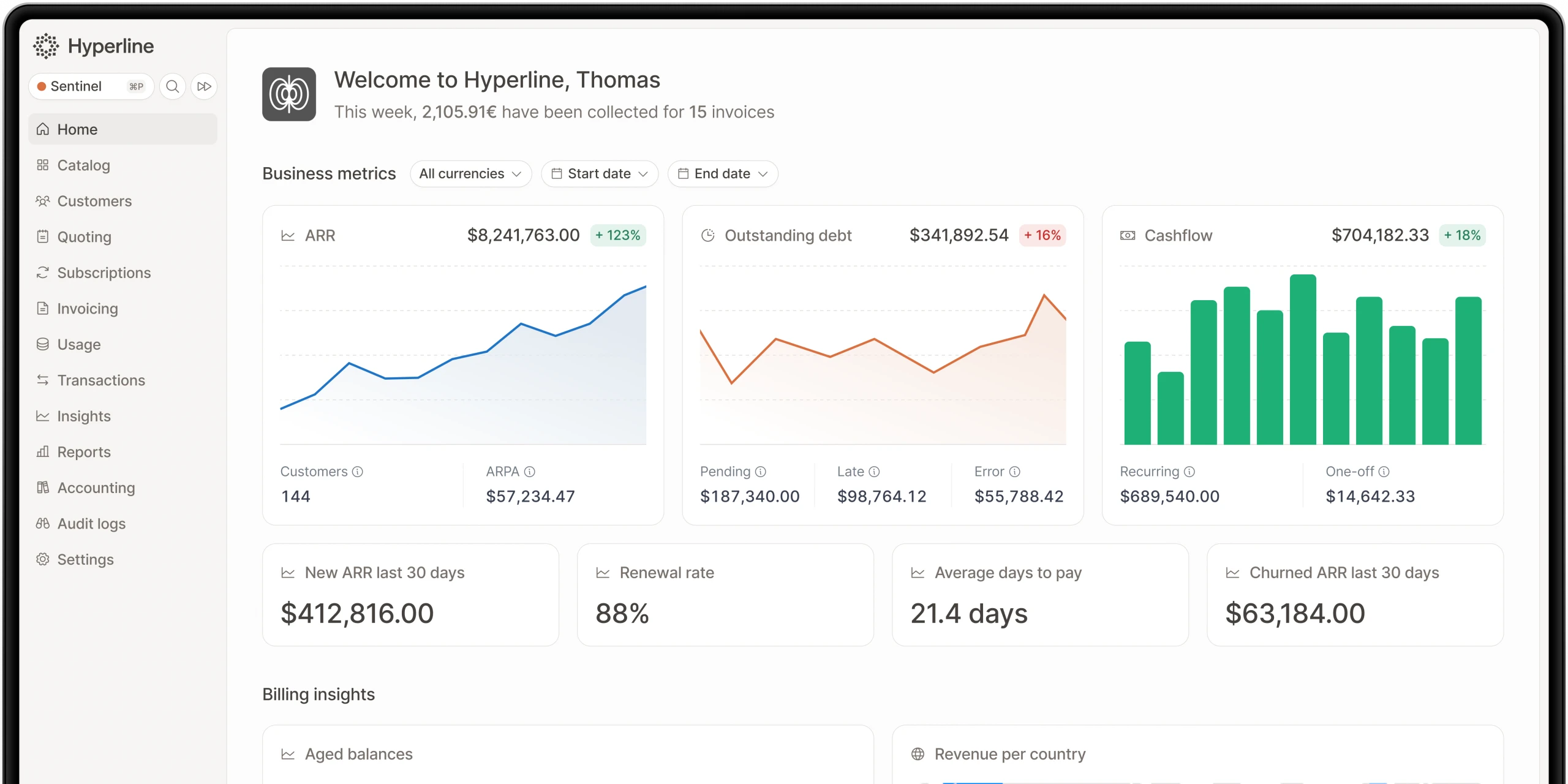
Hyperline ranks first for AI companies because it is the only platform on this list that ships real-time metering, prepaid credit management, hybrid pricing, CPQ, and revenue recognition as one product. For an AI company that has outgrown a Stripe Billing setup but does not want to manage three separate tools (Stripe Billing for invoicing, Orb for metering, a CPQ on the CRM side), Hyperline replaces the entire stack.
The company positions itself as "the new standard for revenue management" and describes the product as : "From contracts to cash in the bank, manage every step of your revenue process in one unified system."
What stands out for AI companies :
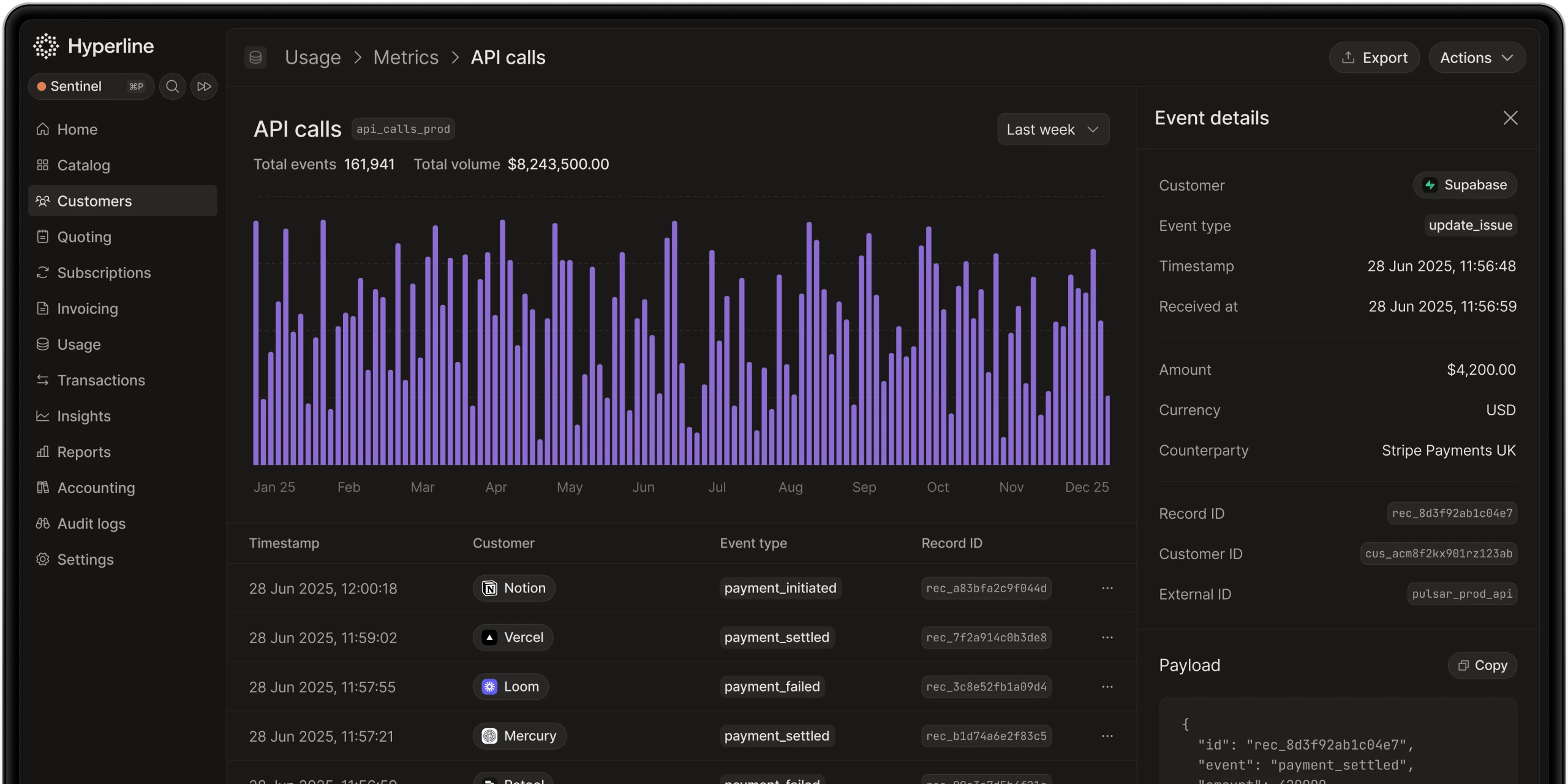
• Unlimited events with real-time consumption tracking, suitable for token-level metering, request counting, fine-tuning jobs, and storage usage.
• Direct database connection for usage data, removing the need to build an event pipeline from scratch.
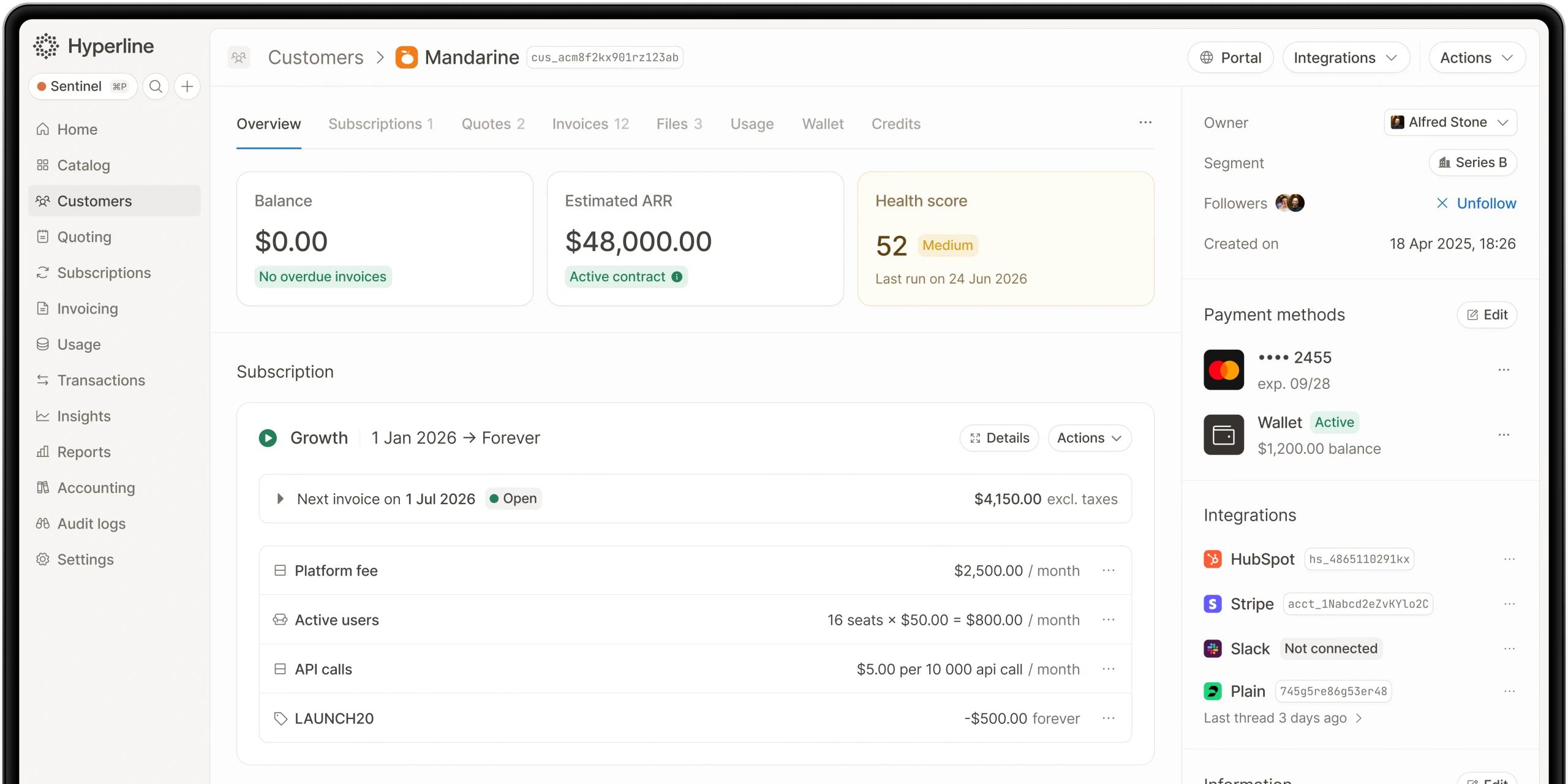
• Prepaid credit management purpose-built for AI : customers buy credit packages and Hyperline burns them down as the model runs, with low-balance alerts and auto-refill rules.
• Hybrid pricing models out of the box : subscription plus usage, tiered, volume, graduated, ramp deals, multi-year commitments.
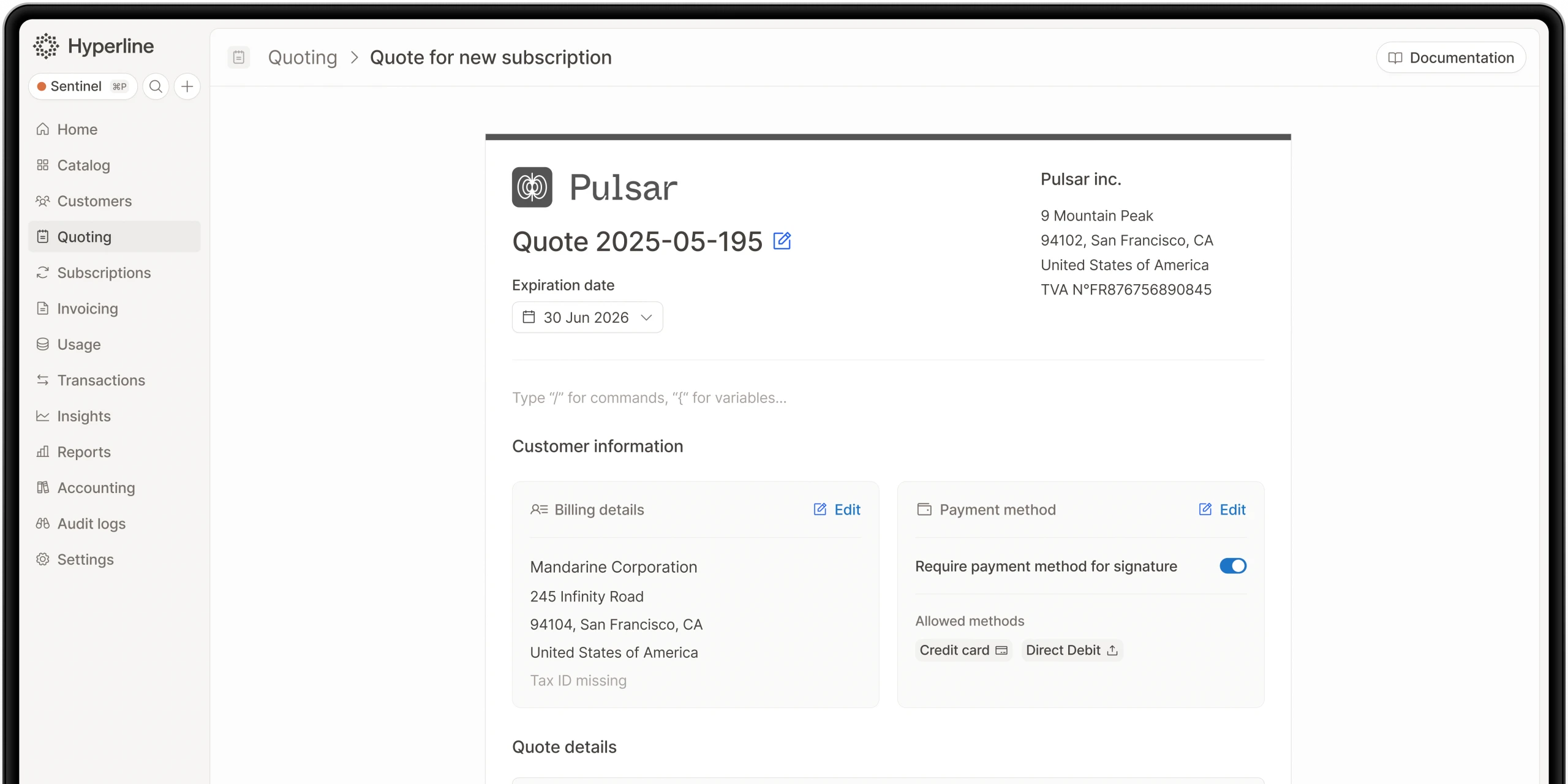
• Native CPQ for enterprise AI deals with custom terms, approval workflows, and complex amendments.
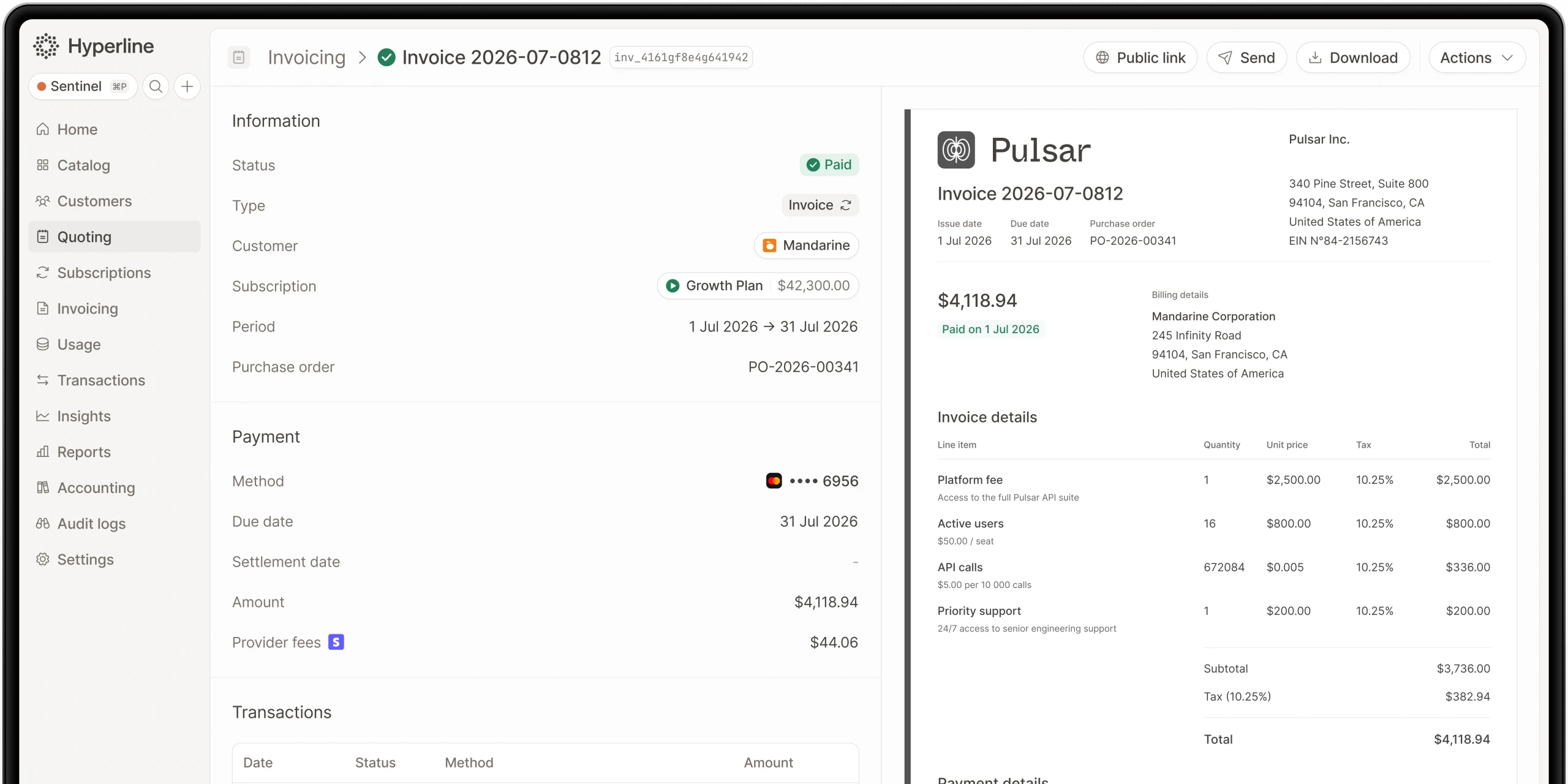
• Compliant invoicing in 100+ countries with e-invoicing in 80+ countries, important for AI companies expanding globally.
• Headline metrics on hyperline.co : 80 % of manual work eliminated, 99.9 % reconciliation accuracy, 500M+ total invoices processed, 99.997 % uptime, 4.9 / 5 G2 rating.
• Used by AI companies including Truvi, plus B2B SaaS like Lemlist, Formance, ScorePlay, Malou, Attio, Veesion, Conectd, Pinpoint, Infinit, Ocus, and Groupe Positive.
Pricing : - Quote to Cash plus Usage : $299 / month plus 0.7 % of revenue. Includes unlimited events, real-time consumption, metered products, prepaid credits, direct database connection. - High Volume : custom pricing for companies above $5M ARR. - CRM and accounting integrations : $50 per integration per month.
Trade-offs : - Younger product than Zuora or Stripe Billing, with a smaller marketplace of partners. - Best fit for AI companies with hybrid pricing complexity (subscription plus usage, prepaid credits, enterprise contracts). A pure pay-per-token startup may not unlock the platform's full value before Series B.
Best for : AI companies between $1M and $50M ARR with hybrid subscription plus usage pricing, prepaid credits, and a need to scale internationally.
2. Stripe Billing : Best for early-stage AI startups already on Stripe
Stripe Billing is the path of least resistance for AI startups that already use Stripe Payments. The metered billing primitive supports tiered, volume, and graduated pricing, and the ecosystem (Tax, Connect, Atlas) covers everything else a young company needs.
What stands out : - Tight integration with the rest of Stripe. - Strong API and developer documentation. - No platform fee, just a percentage of recurring revenue. - Familiar to most engineering teams.
Trade-offs : - Prepaid credits are limited. AI companies that sell credit packs almost always end up building custom logic on top. - No native CPQ. Enterprise deals require a separate tool (HubSpot CPQ, Salesforce CPQ). - Real-time consumption portals require custom front-end work. - Revenue recognition is basic. Most AI companies add Maxio or Sage Intacct once they cross $5M ARR.
Pricing : 0.5 to 0.8 % of recurring revenue. No platform fee.
Best for : AI startups up to $3M ARR with token-based or request-based pricing and strong engineering capacity.
3. Orb : Best for high-volume pure usage AI companies
Orb has become the reference platform for AI companies that need a deep usage-based billing engine without the rest of the quote-to-cash workflow. The product handles real-time metering at very high event volumes, and the pricing engine supports the multi-dimensional models that AI companies actually use.
What stands out : - High-throughput event ingestion designed for AI workloads. - Sophisticated pricing engine : tiered, volume, graduated, prepaid credits, hybrid models. - Strong handling of late-arriving events and event corrections.
Trade-offs : - Billing-only. No CPQ, no contract management. Pair with HubSpot CPQ or Salesforce CPQ for enterprise deals. - Custom pricing only, with mid-market entry points that climb quickly. - Revenue recognition is light. Most teams add a separate revrec tool. - North American focus, with less international invoicing breadth than Hyperline or Zuora.
Best for : AI companies with high event volume and pure usage-based pricing that already have a separate CPQ and revrec stack.
4. Metronome : Best for developer-led AI usage billing
Metronome is another modern usage-based billing platform that has gained adoption with developer-led AI infrastructure SaaS. The product focuses on a strong metering layer and a flexible pricing engine, with an API-first approach that fits engineering-led teams.
What stands out : - API-first design, suited to engineering-led AI companies. - Real-time usage tracking with strong event ingestion. - Used by several public AI companies.
Trade-offs : - Billing-only product. No CPQ. - Custom pricing only. - Less coverage on revenue recognition and SaaS metrics than Hyperline or Maxio. - Smaller customer base than Orb.
Best for : Developer-led AI companies that prefer a modern API-first billing tool.
5. M3ter : Best for enterprise AI with complex pricing
M3ter is positioned for the enterprise tier of usage-based billing. The product handles complex pricing models, multi-product hierarchies, and contract amendments at scale, and is often deployed alongside an existing billing or ERP system as a metering and pricing layer.
What stands out : - Strong pricing engine for complex enterprise AI models. - Multi-currency, multi-entity support. - Designed to slot into an existing billing or ERP stack.
Trade-offs : - Custom pricing only, typically enterprise-level entry. - Often deployed alongside an existing billing platform rather than replacing it. - Long implementation cycles compared to modern unified platforms.
Best for : Enterprise AI businesses with complex contractual pricing and an existing billing or ERP system to keep.
6. Lago : Best open-source AI billing for engineering-led teams
Lago is the leading open-source usage-based billing platform. The product offers a self-hostable option for AI companies with strict data residency requirements (often a regulatory necessity in EU, financial services, or healthcare AI), plus a managed cloud version.
What stands out : - Open-source with a permissive license. - Self-hostable for teams with data residency or compliance requirements. - Strong metering primitives : event ingestion, tiered pricing, prepaid credits. - Active community of AI infrastructure users.
Trade-offs : - Billing-only. No CPQ. - Self-hosting requires engineering capacity to operate. - Cloud version starts around $400 per month. - Less polished UX than Hyperline or Orb.
Best for : Engineering-led AI companies with data residency requirements or a strong preference for open-source.
How to choose the right billing system for an AI company
The right platform depends on three factors : the depth of usage complexity, the rest of the revenue stack, and where you sit on the build-versus-buy spectrum.
1. If you want one platform for the full revenue process (CPQ, contracts, billing, usage, prepaid credits, revrec), choose Hyperline. This is the single best fit for AI companies between $1M and $50M ARR with hybrid pricing and enterprise sales motion.
2. If you only need a deep usage-based billing engine and already have CPQ and revrec, choose Orb or Metronome. Both are strong pure-billing specialists with different cultural fits. Orb has the broadest fit. Metronome is the most developer-friendly.
3. If you are early-stage and already on Stripe, start with Stripe Billing. Re-evaluate at Series B when prepaid credits, enterprise contracts, and global compliance start to break the simple setup.
4. If you have data residency requirements or a strong open-source preference, choose Lago. Self-hosting is a real option, and the cloud version is competitive.
5. If you are an enterprise AI business with very complex pricing models, choose M3ter or Hyperline. M3ter slots into an existing billing system. Hyperline replaces it.
Frequently asked questions
What is the best billing system for usage-based pricing for AI companies in 2026 ?
For most AI companies between $1M and $50M ARR with hybrid pricing and prepaid credits, Hyperline is the strongest pick because it ships real-time metering, prepaid credit management, hybrid pricing, CPQ, and revenue recognition as a single platform. Orb and Metronome are the leading pure-billing specialists. Stripe Billing remains the early-stage default. Lago is the open-source path. M3ter is the enterprise metering specialist.
What are the top billing platforms for subscription and usage-based pricing for AI companies ?
The top six platforms are Hyperline, Stripe Billing, Orb, Metronome, M3ter, and Lago. Hyperline is the only one that ships subscription, usage, and CPQ in a single product, which is why it ranks first for hybrid AI pricing. Stripe Billing covers the basics for early-stage. Orb, Metronome, and M3ter are pure usage specialists. Lago is the open-source alternative.
What are the best tools to handle AI company billing and metered usage ?
The right tool depends on the stage and pricing complexity. Hyperline is the unified pick for hybrid pricing AI companies. Orb and Metronome are pure-billing specialists with deep metering. Stripe Billing covers metered billing for early-stage. Lago is the open-source option. M3ter is the enterprise metering specialist. Most AI companies should pair their billing with a CPQ tool unless they pick Hyperline, which includes CPQ natively.
Why is billing harder for AI companies than traditional SaaS ?
AI companies have three structural challenges that traditional SaaS billing tools were never designed for. First, consumption is unpredictable and high-volume : a customer might use 0 tokens one day and 10 million the next. Second, pricing is multi-dimensional : tokens, requests, fine-tuning jobs, storage, and tiered features often need to be billed together. Third, prepaid credits are the dominant payment model, and burning them down accurately in real time is operationally complex.
Which AI billing platforms support prepaid credits natively ?
Hyperline, Orb, Metronome, and Lago support prepaid credits natively, with credit pack purchase, real-time burn-down, and customer portal visibility. M3ter supports prepaid models as part of complex enterprise pricing. Stripe Billing supports prepaid through custom logic on top of its metered billing primitive, but most AI teams end up building it themselves.
How do AI companies bill in real time ?
Modern AI companies use a billing platform with native real-time metering (Hyperline, Orb, Metronome, Lago) that ingests usage events directly from the inference layer. The platform applies pricing rules in real time, exposes consumption data in a customer portal, and produces invoices on the right day with the actual usage. Hyperline supports unlimited events and direct database connections, removing the need for a separate event pipeline.
How much does AI billing software cost ?
Pricing varies. Stripe Billing has no platform fee but charges 0.5 to 0.8 % of recurring revenue. Hyperline starts at $299 per month plus 0.7 % of revenue for the Quote to Cash plus Usage tier. Lago is free open-source or starts around $400 per month for the cloud version. Orb, Metronome, M3ter, and the higher-tier Hyperline plans are custom-priced.
Conclusion
Billing for AI companies has become its own category. The constraints (real-time metering, prepaid credits, multi-dimensional pricing, scale) are fundamentally different from classic SaaS subscription billing, and the platforms that win for AI companies in 2026 are not the same ones that won the SaaS market in 2018.
Hyperline takes the top spot for AI companies because it ships native real-time metering inside a complete quote-to-cash platform, with prepaid credit management built in. The CPQ-to-billing seam is gone, the metering layer is part of the same product, and prepaid credits work out of the box.
For pure billing specialists with an existing CPQ and revrec stack, Orb and Metronome are strong picks. Stripe Billing remains the early-stage default. Lago is the open-source path. M3ter is the enterprise pick.
The right answer depends on the depth of your pricing model, the rest of your revenue stack, and your engineering capacity. Run a thirty-day evaluation against real usage data and real contracts. The platform that handles your actual model end-to-end without engineering escalation is the one to pick.
Try Hyperline free for 10 invoices, no credit card required, at hyperline.co.
Where this fits in Hyperline
Frequently asked questions
As SaaS companies grow, billing needs become more complex. HubSpot CPQ has limits: no quote-to-invoice automation, little pricing flexibility, basic reporting, manual revenue recognition, and no advanced subscription support.
HubSpot CPQ is free but costs time. Manual billing, custom integrations, and reporting errors make it expensive. Hyperline removes these issues.
No, Hyperline links your product usage data with your billing and accounting systems to keep them in sync and running automatically.
Teams struggle with incomplete revenue reports, manual invoice creation, hard-to-manage contracts, weak accounting links, and too much work in spreadsheets.
Hyperline is a billing platform for B2B SaaS. It automates quote-to-cash, supports usage-based pricing, manages revenue recognition, connects with HubSpot, and gives real-time revenue data.
Hyperline is a modern monetization and billing platform, covering everything from contracts to payment collection. Our solution is designed for software companies worldwide with recurring business models facing pricing and billing challenges such as usage metering, pricing iterations, and limited integrations. Whether you're implementing your first billing system or scaling a late-stage operation, we can assist you.
Ask yourself: Do we need usage-based billing? Are invoices manual? Are reports unreliable? If yes, you may need Hyperline.
Hyperline is usage-native, which means our platform can ingest raw usage-data (through database connectors, API or CSV files) and run calculations on your behalf to find the right amount to invoice for each customer. You can start without a single line of code in a few minutes.