Stripe Billing vs DealHub: which billing platform fits your pricing? [2026]
Stripe Billing and DealHub solve different halves of the billing problem. A criterion-by-criterion comparison of where they diverge, and how to choose.

Choosing between Stripe Billing and DealHub is rarely a feature checklist — they were built for different jobs. Stripe Billing's strength is depth of the Stripe platform, if Stripe is already your processor. DealHub's is the commercial front end — CPQ, contracts and approvals — extended into billing.
This comparison sets them side by side on the 15 capabilities where they genuinely differ, and is based on a criterion-by-criterion review of both vendors' own documentation and pricing pages, last refreshed in 2026.
What is Stripe Billing?
Stripe Billing is the billing layer of the Stripe platform, and it inherits Stripe's strengths: native metering through Billing Meters, a hosted and brandable customer portal, and Stripe Tax covering 100+ countries and 600+ product categories with threshold monitoring, managed registration and filing partners. It is a paid add-on at roughly 0.5%. The tradeoffs are structural rather than functional. Quotes exist, but Stripe Quotes is not a CPQ — no approval routing, no native e-signature. Revenue recognition is a separate paid product. And multi-entity in practice means one Stripe account per entity, with reconciliation handled separately. Being the payment processor is also the constraint: there is no multi-PSP story.
What is DealHub?
DealHub came from CPQ and CLM, and after acquiring Subskribe in November 2025 it became a full quote-to-revenue platform: CPQ, contract lifecycle, subscriptions, billing, metering and revenue recognition on a single data model. Approval workflows are a headline capability rather than an afterthought, with case studies citing approval cycles cut from days to eight hours. Signed quotes activate subscriptions directly. Its Revenue Intelligence module covers ARR, MRR, waterfalls, revenue cohorts, NRR, GRR, churn, expansion and contraction, alongside a real-time deal desk dashboard, and billing is multi-entity, multi-currency and multi-language with prepaid drawdown handled natively. The gaps are downstream: the DealRoom is a pre-sales buyer space rather than a billing portal, dunning is rules-based rather than agentic, and no payment provider appears in its integration centre.
Where Stripe Billing and DealHub differ
Of the 27 capabilities reviewed, these are the 15 where the two diverge. "Limited or add-on" means the capability exists but is constrained, sold separately, or handled through a third party rather than natively.
| Capability | Stripe Billing | DealHub |
|---|---|---|
| Native CPQ | Limited or add-on | Yes |
| E-signature | No | Yes |
| Quote to subscription automation | Limited or add-on | Yes |
| Advanced approval flows | No | Yes |
| Real-time usage metering | Yes | Limited or add-on |
| Multi-frequency billing | Yes | Limited or add-on |
| Multi-entity | Limited or add-on | Yes |
| Customer portal | Yes | Limited or add-on |
| Revenue recognition included | Limited or add-on | Yes |
| EU e-invoicing (Chorus Pro, Peppol) | Limited or add-on | No |
| Advanced reporting dashboards | Limited or add-on | Yes |
| MCP | Yes | No |
| Bi-directional CRM sync | Limited or add-on | Yes |
| In-CRM widget | No | Limited or add-on |
| Modern UI | No | Limited or add-on |
How to choose between them
Work backwards from your pricing model and your finance stack, not from the feature count.
- If your pricing is consumption-led and events arrive continuously, weigh real-time metering above everything else. A platform that aggregates usage on a schedule will show up as invoice disputes.
- If your deals are negotiated, the quoting layer matters more — approval routing, e-signature, and whether the signed quote becomes the subscription without re-keying.
- If your constraint is the close, look at revenue recognition and reporting: whether ASC 606 and IFRS 15 schedules are included or licensed separately, and whether you can drill from a board metric to the invoice behind it.
- If you sell internationally, check tax and e-invoicing carefully. Both are frequently add-ons or third-party integrations rather than native, and that changes the total cost.
A third option: Hyperline
Teams comparing Stripe Billing and DealHub are often really asking a different question — whether the quoting layer, the billing engine and revenue recognition have to live in separate products at all.
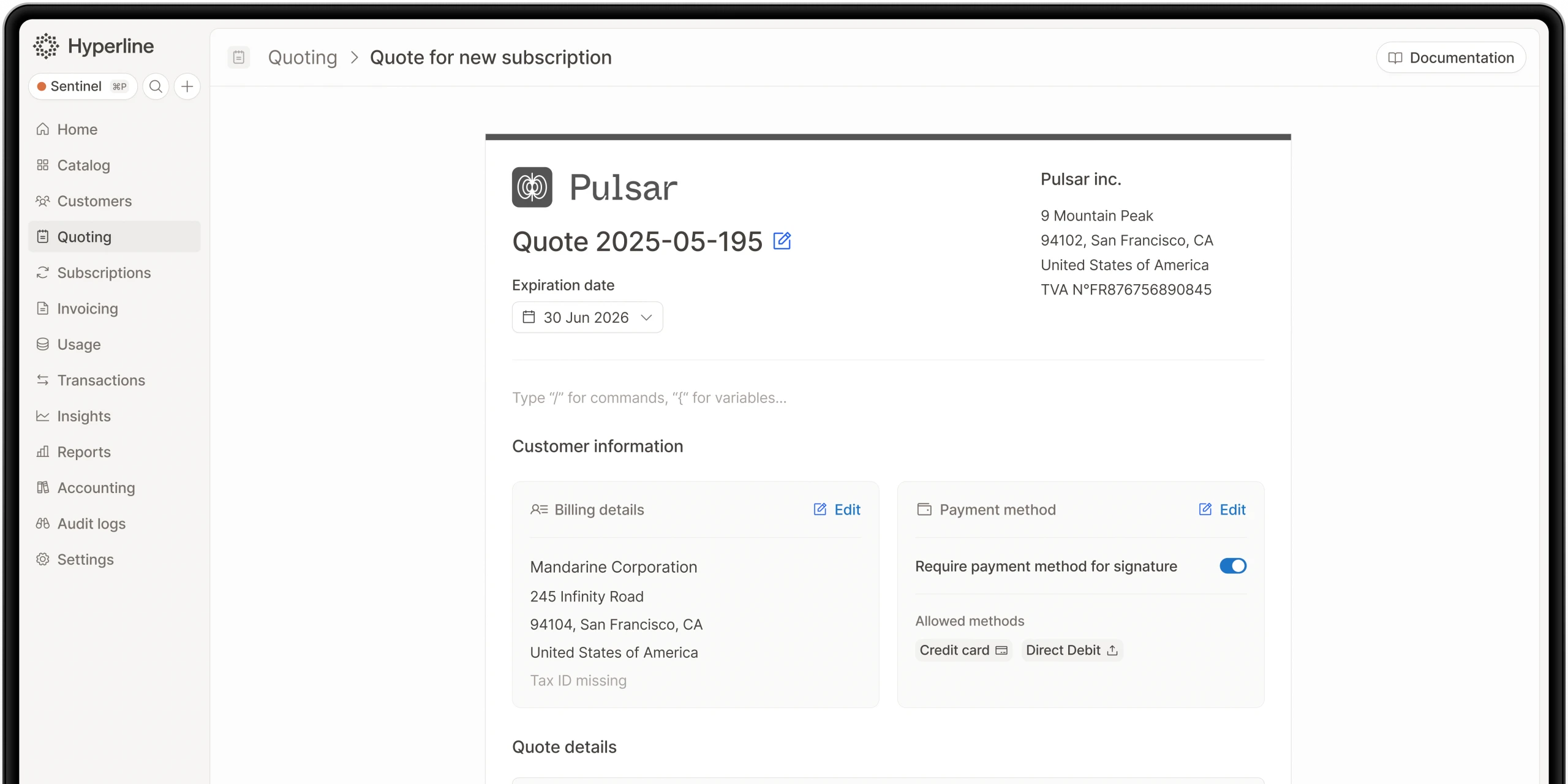
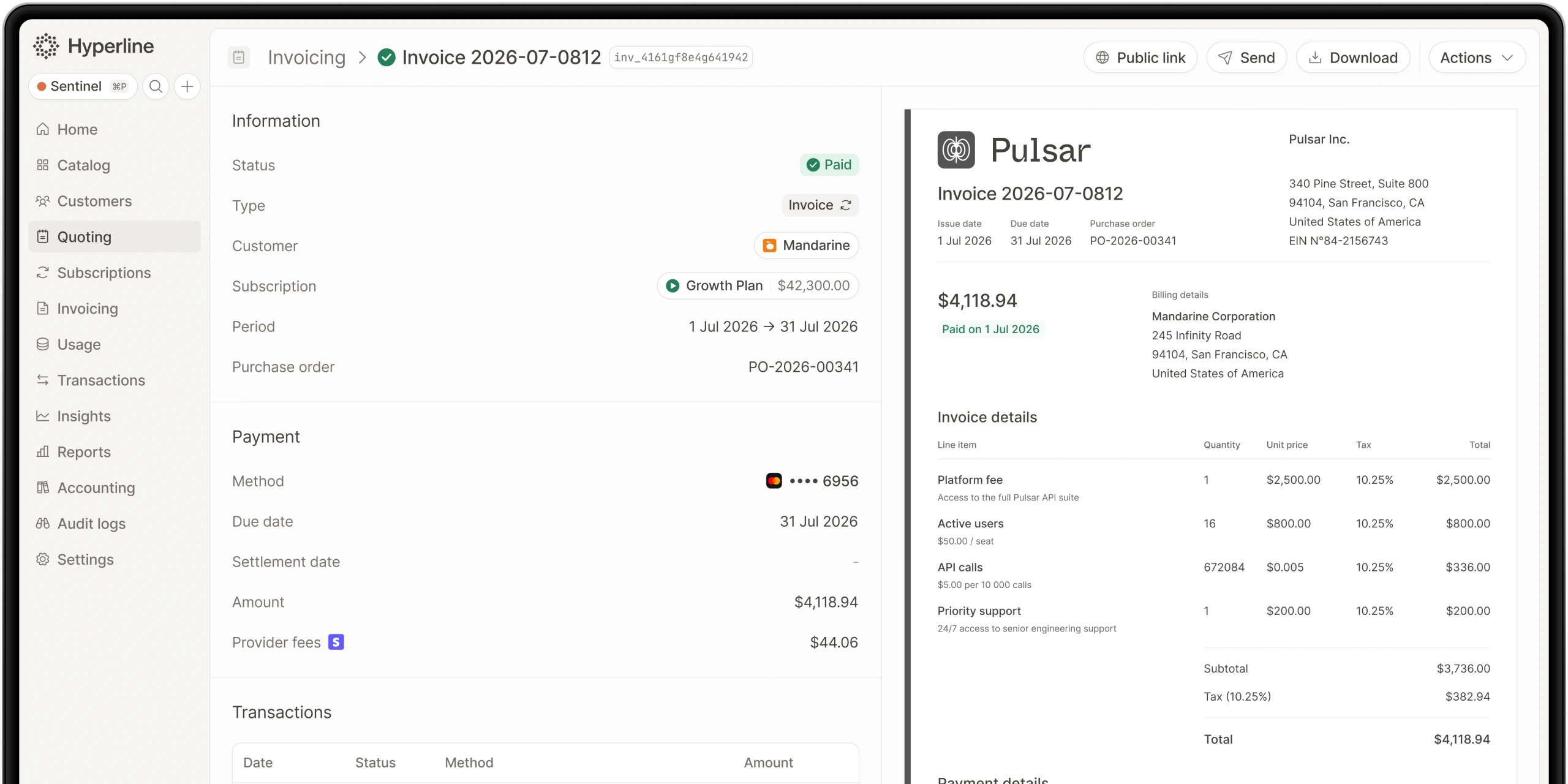
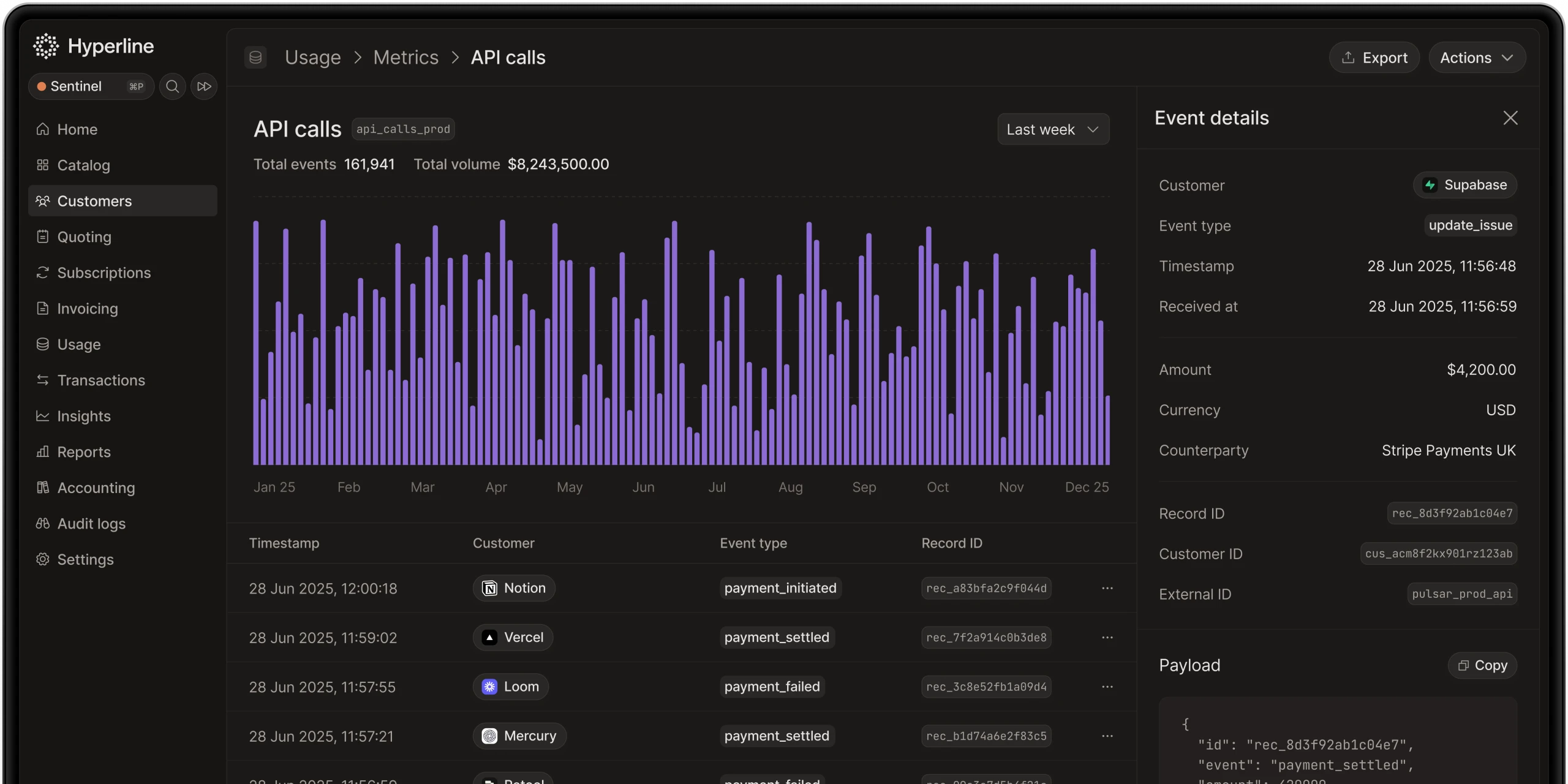
Hyperline covers quote-to-cash on one platform: native CPQ with e-signature and multi-step approvals inside Salesforce, HubSpot or Attio; real-time usage metering from the first API call to millions of events, with prepaid credits and a native credit ledger; revenue recognition producing per-line ASC 606 and IFRS 15 schedules from the same data that issued the invoice; and tax across 80+ countries with Chorus Pro and Peppol e-invoicing built in.
One platform, one contract, configured by finance and RevOps rather than by engineering. You can see how it stacks up against Stripe Billing or DealHub directly, or talk to our team.
Conclusion
Stripe Billing and DealHub are both credible, and the 15 differences above are the ones worth arguing about. Pick Stripe Billing if depth of the Stripe platform, if Stripe is already your processor is your binding constraint; pick DealHub if it is the commercial front end — CPQ, contracts and approvals — extended into billing. If the honest answer is that you need both halves, that is the gap Hyperline was built for.