Usage-based billing
Usage-based billing is the process of measuring what each customer consumes and turning that consumption into accurate invoices.
Usage-based billing is the process of measuring what each customer actually consumes, applying the right price to that consumption and turning it into an accurate invoice. Where a subscription invoice is the same every month, a usage-based invoice changes with the customer's activity: API calls, tokens, seats used, messages sent, compute hours or any other metric that reflects the value delivered. It is the operational side of usage-based pricing: pricing defines what a unit of consumption costs, billing makes sure every unit is counted, rated and collected.
How usage-based billing works
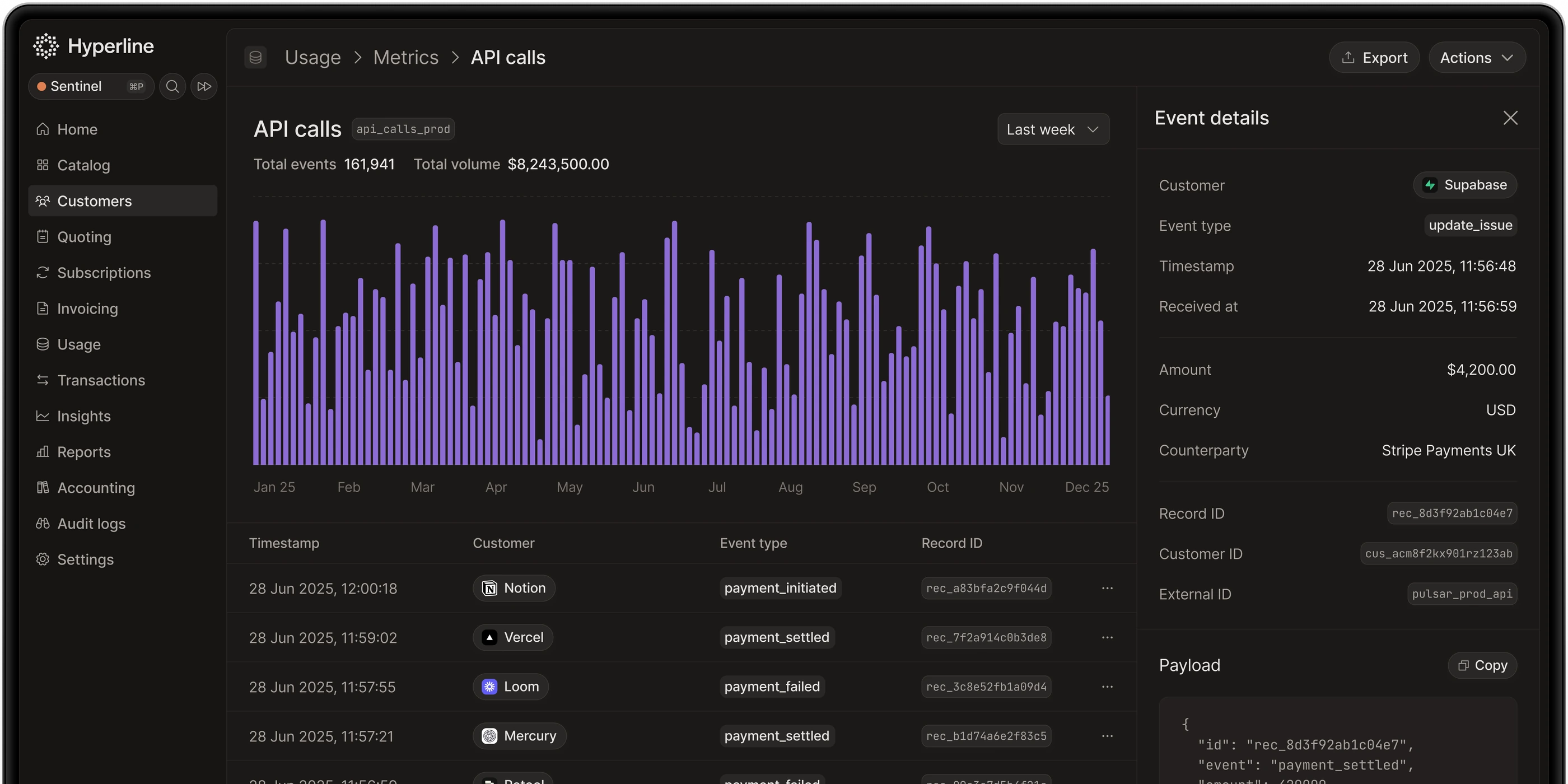
- Usage collection. The product sends usage events to the billing system as they happen: API calls, tokens processed, gigabytes stored, transactions completed.
- Aggregation. Raw events are grouped per customer, per metric and per billing period, and deduplicated so the same event is never counted twice.
- Rating. Pricing rules are applied to the aggregated quantities: unit prices, tiers, volume discounts and any contract-specific terms.
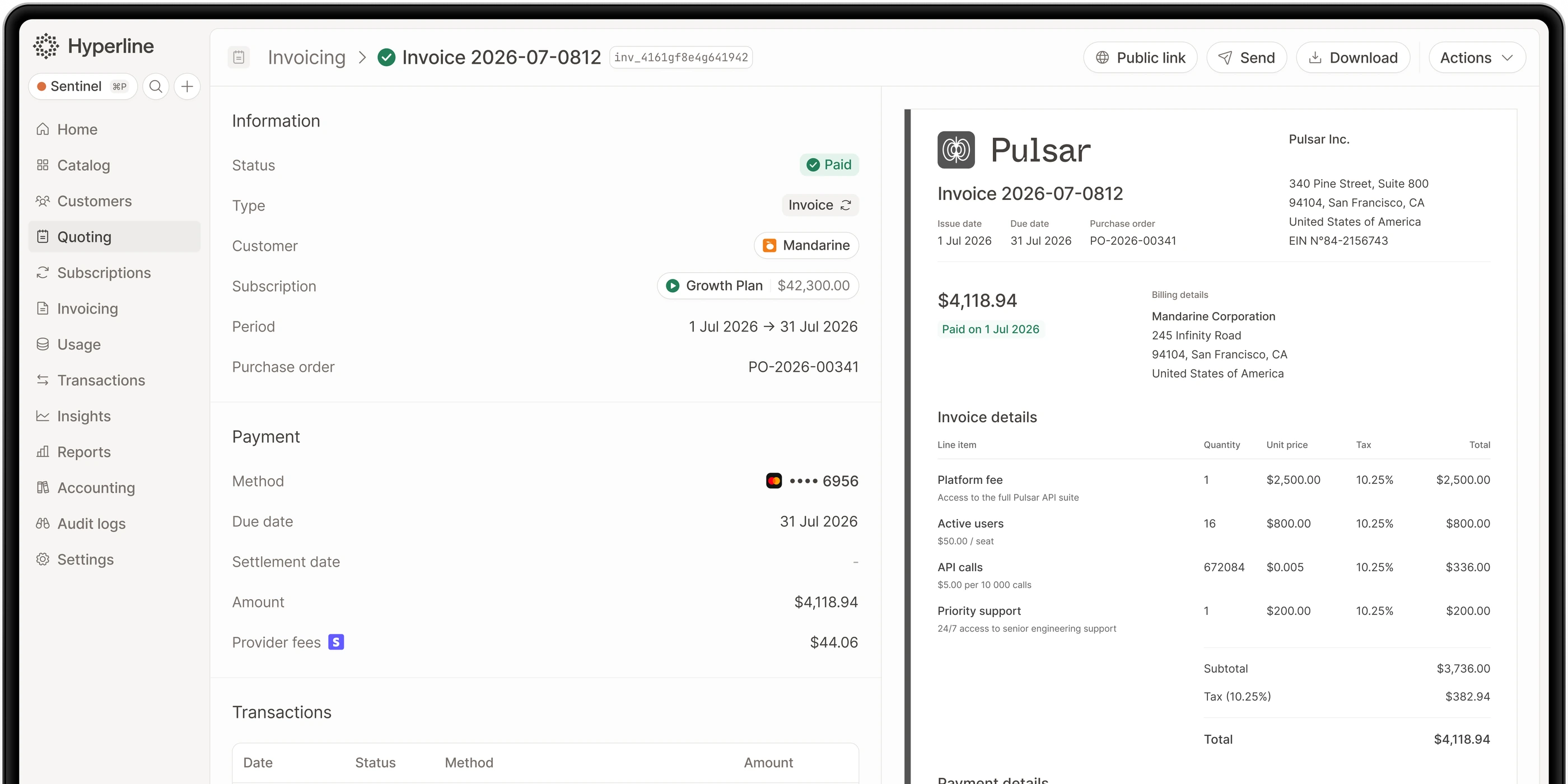
- Invoicing. Rated usage is combined with any fixed fees, credits or minimums into an invoice that shows the customer exactly what they consumed.
- Payment and collection. The invoice is collected by card, direct debit or bank transfer, and prepaid balances or commitments are drawn down accordingly.
Common usage-based billing models
- Pay-as-you-go. The customer is billed in arrears for exactly what they used during the period, with no upfront commitment.
- Prepaid credits. The customer buys a balance of credits upfront and draws it down as they use the product, topping up when the balance runs low.
- Commitment with overages. The customer commits to a minimum spend or volume for the contract term, and anything above it is billed at an agreed overage rate.
- Hybrid. A fixed subscription fee, often with an included allowance, plus usage charges on top. This is the most common model in B2B SaaS today.
Usage-based billing example
An AI platform charges $500 per month for its platform fee, which includes 1 million tokens. Additional tokens cost $0.40 per thousand. In March, a customer processes 3.2 million tokens. The billing system aggregates the month's events, subtracts the 1 million included tokens and rates the remaining 2.2 million: 2,200 × $0.40 = $880. The March invoice totals $1,380, with a usage breakdown the customer can check against their own logs.
Common usage-based billing challenges
- Data quality. Missing, late or duplicated events translate directly into revenue leakage or overbilling.
- Invoice clarity. Customers dispute what they cannot understand, so every usage charge needs to be traceable back to the underlying events.
- Pricing changes. New metrics, tiers or packaging have to be rolled out without breaking existing contracts.
- Revenue recognition. Variable consideration under ASC 606 and IFRS 15 makes recognizing usage revenue more complex than recognizing a flat subscription.
- Spend visibility. Customers expect to see their consumption and projected bill in real time, not discover it at the end of the month.
What to look for in usage-based billing software
Many billing tools support a usage line item. Fewer handle usage-based billing end to end. A few questions help tell them apart:
- How is usage ingested? Real-time ingestion through an API or database connectors gives an up-to-date view of what each customer owes. Batch imports mean that view lags behind actual consumption, and deduplication is often left to the engineering team.
- Does it support the pricing models the business actually runs? Pay-as-you-go is the baseline. Prepaid credits, committed spend with overages and hybrid plans on the same contract are where many tools fall short.
- Can finance change pricing without engineering? If every new metric, tier or discount requires a code change, pricing iteration slows down to the pace of the product roadmap.
- Can customers see their usage? Itemized usage on invoices, spend alerts and a self-serve view of consumption reduce disputes and surprise bills.
- Does usage data flow into quoting and revenue recognition? When contracts, billing and revenue recognition run on the same data, a custom deal is billed as it was signed and finance does not reconcile two versions of the numbers at close.
- Does it fit the payment and compliance setup? Supported payment providers, multi-currency and multi-entity billing, tax and e-invoicing become hard constraints as a company expands into new markets.
The right answer depends on how much of the business is usage-based today and how fast pricing is likely to change.
Where this fits in Hyperline
Related topics
Frequently asked questions
Usage-based pricing is the commercial model: the decision to charge customers according to what they consume. Usage-based billing is the operational process that makes that model work: collecting usage data, rating it against the price list and invoicing it accurately.
The terms are often used interchangeably. Metered billing usually describes the narrower case of measuring consumption and charging for it at the end of the period. Usage-based billing also covers prepaid credits, committed spend with overages and hybrid plans that mix a subscription with usage.
Yes. Many SaaS and AI companies charge a fixed platform fee plus usage above an included allowance. This hybrid model gives the vendor predictable base revenue and lets the customer's bill grow with the value they get.
Spreadsheets and subscription-only billing tools struggle once usage volumes grow or contracts get custom terms. Dedicated usage-based billing software ingests events in real time, applies complex pricing rules consistently and gives customers visibility into what they are spending before the invoice arrives.