Advanced Approvals CPQ: What Makes Approval Architecture Scalable?
When SaaS pricing turns hybrid and usage-based, approvals become the real control plane deciding whether revenue moves quickly and safely.

When Approvals Stop Being Operational
In the early life of a SaaS company, approvals rarely feel like a strategic concern. The commercial team is still compact, pricing is relatively straightforward, and exceptions are manageable through informal coordination.
A discount request is validated over Slack.
A commercial deviation is reviewed in a short call. If a large enterprise opportunity arises, the CFO may step in directly to evaluate the economic implications. At that stage, governance is human, contextual, and largely relationship-driven.
However, SaaS growth does not merely increase volume; it increases structural complexity. As companies expand into mid-market and enterprise segments, pricing evolves from simple subscription tiers into hybrid models that combine recurring subscriptions, usage-based components, multi-year ramp schedules, and negotiated contractual clauses. What once felt linear becomes multidimensional, and the economic exposure embedded in each quote is no longer obvious at a glance.
It is precisely at this moment that the quote approval process ceases to be administrative. It becomes architectural.
Because every quote that leaves the system represents more than a sales document. It is a financial commitment that encodes assumptions about margin, cost to serve, revenue recognition timing, payment structures, and contractual risk. If these assumptions are not validated systematically before a quote is sent for signature, governance becomes reactive rather than preventive. The challenge for modern SaaS organizations is therefore not simply to accelerate quoting.
It is to design an approval architecture that preserves revenue discipline while maintaining commercial velocity across integrated CRM environments such as Salesforce, HubSpot, and Attio.
This is where advanced approvals cpq architecture reveals its true importance.
What CPQ advanced approvals are (and why you should care before you scale)
“Advanced approvals” is often described as “configurable workflows to validate quotes before signature.” That definition is technically correct, but strategically incomplete. In practice, CPQ advanced approvals are the mechanism by which a company encodes economic judgment into its revenue execution systems. If you are still early, you can sometimes compensate with proximity: the CFO sees every strategic discount, RevOps is aware of every exception, and Sales leadership can spot outliers simply because the volume is low.
The moment you scale, that model stops working, not because people become less competent, but because the system has no stable way to translate policy into execution.
This is also why teams searching “streamline deal approvals integrated cpq” are usually not looking for fewer controls. They are looking for controls that are aligned with reality: controls that accelerate low-risk deals while forcing deliberate review on multidimensional risk.
Approval Architecture as Revenue Governance Infrastructure
The term “advanced approvals” is often understood as a synonym for configurable workflows. In many CPQ implementations, it refers to the ability to define routing chains triggered by discount thresholds or deal size. While this interpretation is not inaccurate, it fails to capture the structural dimension of the problem: approval is not fundamentally about routing; it is about embedding financial policy directly into commercial execution.
Consider what a quote actually represents in a scaling SaaS organization.
It encodes:
- Pricing logic,
- Margin assumptions,
- Contract duration,
- Payment terms,
- Usage commitments,
- and sometimes bespoke legal clauses that affect revenue recognition.
When approval logic evaluates only one dimension, typically “discount percentage”, it creates an illusion of control. Governance appears structured, yet the multidimensional economic exposure of the deal remains partially unexamined.
In hybrid pricing environments, risk is rarely one-dimensional.
A moderate discount on a high-margin product may be economically acceptable, while a smaller discount on a low-margin bundle with extended payment terms may materially impact profitability. Static threshold-based approval logic cannot adequately capture these nuances. An effective automated discount approval workflow CPQ system must therefore evaluate context rather than isolated triggers. It must integrate multiple variables and reflect how they interact economically. Without this capability, organizations accumulate governance debt: the gradual misalignment between pricing complexity and approval architecture.
Many SaaS organizations initially attempt to address governance complexity by implementing the advance approval process in Salesforce CPQ. This approach represents a meaningful improvement over manual Slack-based validation: administrators can define approval rules, configure approval chains, and assign conditional triggers based on discount levels or other criteria.
Yet as pricing models evolve and deal structures become more intricate, structural constraints begin to emerge.
1) Sequential routing creates latency at scale
Salesforce-centric approval models often rely on sequential routing. Deals escalate from Sales Manager to Finance to CFO in a predefined order. While conditional triggers can determine when escalation occurs, the underlying architecture frequently assumes linear progression. In global organizations operating across time zones, this linearity introduces latency that compounds over time, especially when quarter-end pressure forces many deals into the approval queue at once.
2) Risk evaluation remains discount-centric
Even when additional conditions are layered into approval rules, discount percentage often remains the primary escalation mechanism. This creates a narrow view of economic exposure that does not fully account for blended margin, cost to serve, usage variability, payment timing, or contract clause deviations that may carry outsized risk.
3) Governance becomes admin-heavy as pricing evolves
Configuration complexity increases as pricing sophistication grows. Approval logic becomes layered and interdependent, making governance adjustments more administratively burdensome. RevOps teams may become reliant on specialized Salesforce administrators to update rules whenever pricing strategy changes.
4) CRM confinement becomes a real constraint in multi-CRM reality
Salesforce-bound governance becomes fragmented in multi-CRM environments. Organizations that operate HubSpot or Attio alongside Salesforce must replicate approval logic or accept governance inconsistency across systems.
These limitations do not invalidate Salesforce CPQ Advanced Approvals. They simply reveal that routing sophistication is not equivalent to lifecycle-embedded governance.
Hyperline’s lifecycle-based quote approval process
Hyperline approaches the quote approval process from a fundamentally different architectural perspective. Rather than layering approval routing on top of CPQ, Hyperline embeds approval directly into the lifecycle of the quote itself. This distinction is subtle but decisive.
How Hyperline quote approval works (step-by-step, as implemented in the product)
This is the operational core that most “advanced approvals” articles skip, and it’s also where reliability matters, because the behavior needs to match the product.
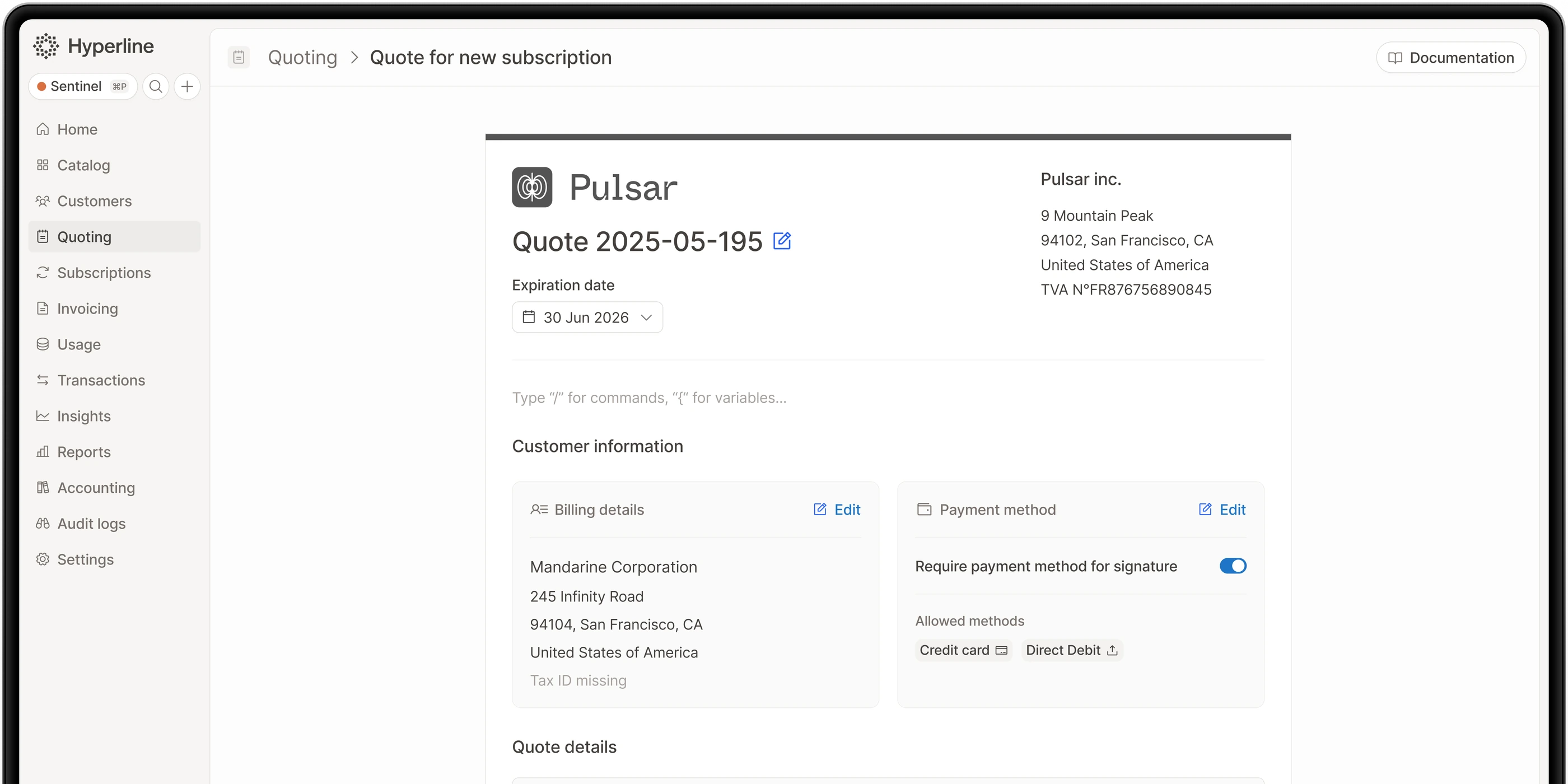
- A quote is created and validated (either in Hyperline UI or via an integrated CRM).
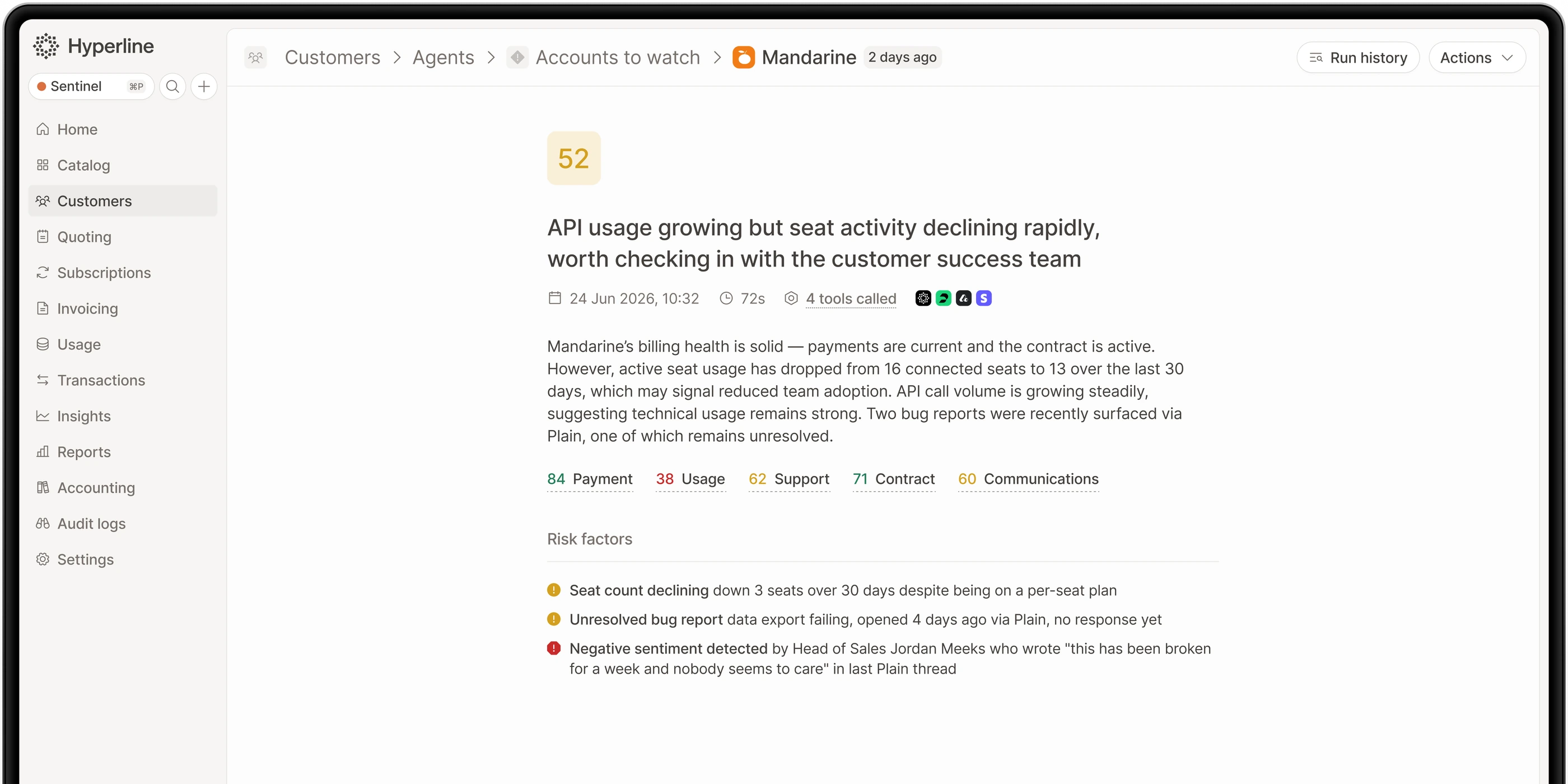
- Hyperline checks a dedicated “quote approval” permission attached to the user’s role/permissions. If the user does not have that permission, the quote moves into a Pending approval state and cannot be sent for signature until approved. If the user does have the permission, the quote is automatically approved and can be sent for signature directly.
- Any user with the quote approval permission can approve quotes, regardless of quote ownership or content meaning governance is policy-driven rather than tied to reporting lines.
- Notification strategy is configurable by your ops stack, not forced by the product. Hyperline does not automatically notify every approver by default; instead, teams typically wire notifications (email, Slack, etc.) through workflow tooling. Hyperline exposes a webhook that is triggered whenever a quote is saved and requires approval.
- Approval happens before the quote can be dispatched for signature. That is the control point: the system structurally prevents “sending now, fixing later,” which is how most governance debt accumulates.
This model matters because it changes the nature of approval: it is not “an extra step after pricing,” it is “a lifecycle gate before commitment.”
To clarify the architectural distinction, it is useful to summarize the structural differences:
| Dimension | Salesforce-centric models | Hyperline |
|---|---|---|
| Approval architecture | Sequential routing | Lifecycle state gating |
| Risk evaluation | Discount threshold-based | Multidimensional conditional logic |
| CRM support | Salesforce-only | Salesforce, HubSpot, Attio |
| Governance model | Hierarchy-driven | Permission-driven |
| Extensibility | Admin-heavy configuration | Webhook-driven programmable events |
The distinction is not merely functional. It is structural. Where Salesforce-centric models primarily optimize routing complexity within a CRM environment, Hyperline embeds approval into the quote lifecycle itself, transforming governance from a configurable workflow into a revenue control layer.
Permission-driven governance instead of hierarchical routing
Hyperline provides a dedicated quote approval permission and role-based controls (see roles & permissions).
This decouples governance from CRM hierarchy. As organizations scale across regions and sales teams expand, approval authority can evolve without rebuilding routing trees. RevOps can adjust approval rights as pricing strategies change, and Finance can distribute approval capacity while keeping consistent policy boundaries.
This is also where Hyperline’s approach aligns with the brief’s core intent: keep control on your sales contract sent. If a quote cannot leave Pending approval without the right permission-based approval, control is systemic, not aspirational.
Modeling approval rules: beyond “discount > X”
Discount is measurable, visible, and easy to parameterize, so it often becomes the default approval trigger. But in modern SaaS monetization, discount is rarely the primary driver of economic risk.
To illustrate, consider two deals in the same company:
- Deal A: a $75k ARR subscription for a high-margin core product, discounted 28% to win a strategic logo.
- Deal B: a $600k hybrid agreement combining subscription access, usage components, and services-heavy onboarding, discounted only 12%, but with lower blended margin, extended payment terms, and a non-standard clause.
If approval logic triggers solely on discount %, Deal A escalates while Deal B may pass without scrutiny. This is precisely why advanced approvals cpq architecture must evolve toward multidimensional evaluation.
A short list of approval conditions most modern SaaS teams actually need to express (and that you can translate into policy in your CPQ layer) includes:
- Discount % relative to plan guardrails (not just absolute discount)
- Blended margin threshold (including services and cost-to-serve assumptions)
- ARR / TCV thresholds (and concentration risk)
- Product mix or SKU category triggers (e.g., regulated add-ons, onboarding bundles)
- Payment terms / billing schedule deviations (monthly vs annual, net-60 vs net-30)
- Contract clause deviations from standard templates (liability, termination, usage definitions)
The point is not to build a maze of rules. The point is to encode the few rules that represent real economic exposure, so that approval time is spent where it creates value.
The Quote Approval Process as a Control Layer in the Revenue Lifecycle
To fully appreciate the structural importance of approval architecture, it is useful to situate the quote approval process within the broader revenue lifecycle.
In a mature SaaS organization, revenue execution flows through a sequence of interdependent systems:
- Opportunity creation and forecasting within CRM.
- Quote configuration within CPQ.
- Approval validation.
- Contract signature.
- Billing activation.
- Revenue recognition.
- Financial reporting.
Lifecycle gating is powerful because it enforces policy upstream. Quotes that do not meet requirements cannot move forward, which reduces downstream remediation and prevents “exception normalization” over time.
A Deeper Look at Contract Control Before Signature
In many SaaS organizations, governance is strongest before negotiation and weakest at the moment of dispatch. Under quarter-end pressure, contracts may be sent before full review. Fields may be modified manually. Exceptions may be rationalized as one-off accommodations.
Hyperline’s quote approval flow explicitly supports the idea of adding “an extra approval step before a quote is sent to a customer for signature,” which is exactly the governance control the brief asked to highlight.
By structurally preventing quotes in Pending approval from being sent for signature, the platform turns “keep control over what is sent” into an enforced mechanism rather than a guideline.
Once a contract is signed, remediation is expensive: billing must adjust, revenue recognition must account for deviations, and legal exposure becomes real. Preventive control at approval time is cheaper, faster, and more reliable.
CRM-Agnostic Governance: Salesforce, HubSpot, and Attio
Many approval systems are constrained by CRM confinement. When governance logic is embedded exclusively within Salesforce, organizations operating additional CRM platforms must replicate approval rules elsewhere.
Hyperline’s CPQ and approval module operate across Salesforce, HubSpot, and Attio, preserving a consistent approval gate regardless of where the quote is initiated. This matters in practice because many scaling SaaS businesses end up with mixed systems : different regions, different go-to-market motions, or post-merger toolchains. A consistent approval layer reduces the “policy drift” that happens when governance is implemented differently in each environment.
Measuring Approval Performance: From Friction to Signal
In mature revenue organizations, approval performance itself becomes a signal.
Key metrics may include:
- Average time spent in Pending approval state.
- Percentage of deals requiring approval.
- Frequency of escalations to executive level.
- Margin deviation before and after approval.
- Incidence of contract clause modifications.
Because Hyperline embeds approval as a defined lifecycle state, these metrics can be measured systematically. Approval ceases to be anecdotal and becomes observable.
This data supports strategic refinement. If approval cycle time increases, RevOps can examine rule configuration. If escalation frequency rises in a specific region, Finance can evaluate pricing alignment. If margin deviation remains high post-approval, governance criteria may require recalibration.
In this sense, advanced approvals CPQ architecture does not merely control risk. It generates governance intelligence.
Best cpq technologies for improving approval cycle time: what to evaluate (and what teams miss)
Most “best cpq technologies for improving approval cycle time” lists focus on surface features; templates, routing, or UI. For complex SaaS pricing, the evaluation needs to be more architectural. The questions that matter are:
- Can the system enforce a true lifecycle gate before signature, not just “route for review”?
- Can approval rules express multidimensional conditions (margin, ARR, product mix, terms), not only discount thresholds?
- Can RevOps evolve governance without waiting on heavy technical work or CRM admin bottlenecks?
- Does the approval layer stay consistent across Salesforce, HubSpot, and Attio, or does governance fragment by CRM?
- Can you integrate your notification and escalation strategy into your ops stack (Slack, email, workflow tools) in a controlled way?
This is where the difference between “workflow configuration” and “governance infrastructure” becomes decisive.
To conclude: Approval is not friction
The CPQ quote approval process is no longer a peripheral workflow. In modern SaaS organizations operating hybrid pricing, multi-CRM environments, and global sales teams, approval architecture defines revenue discipline.
Sequential routing chains and static discount triggers may suffice at moderate scale. But as complexity increases, governance must move upstream into the lifecycle of the quote itself.
Hyperline’s fully integrated CPQ and native approval module ; available across Salesforce, HubSpot, and Attio and embed governance structurally through:
- Lifecycle-based Pending approval states
- Dedicated quote approval permission
- Configurable notification patterns via webhook-triggered automation
- A pre-signature control point that keeps control over what is sent
This is not a matter of workflow convenience. It is architectural alignment between commercial execution and financial policy.
Try Hyperline now.