CPQ for Complex Price Configuration: A Practical Guide
In B2B SaaS, quoting complexity, not volume, is the challenge. Hybrid pricing, usage, discounts, and ramps turn every quote into an operational project.

When every quote becomes an Ops problem
This situation is rarely caused by misaligned teams. In most cases, it is a tooling problem.
That is why CPQ is no longer a nice-to-have. For SaaS companies selling complex products, CPQ becomes a structural component of the revenue lifecycle. A modern CPQ must ensure, from the very first quote, that what Sales sells can be priced, billed, and operated without friction.
That is precisely where Hyperline positions its CPQ.
Why CPQ is critical for complex SaaS products
The end of “simple” SaaS pricing
The era of flat, per-seat SaaS pricing is over. Today’s SaaS companies monetize through a mix of:
- Subscription fees.
- Usage-based components.
- Feature-based bundles.
- Volume tiers and ramped pricing.
- Negotiated enterprise contracts.
These models unlock growth and better monetization, but they also introduce operational risk. Without a CPQ designed for complex products, every deal becomes an exception handled manually.
Over time, complexity spills into Sales Ops, Finance, and Billing.
What breaks without a CPQ
When CPQ is missing or insufficient, quoting relies on spreadsheets, copy-paste workflows, and tribal knowledge held by a few experts. Errors become frequent, approval cycles lengthen, and Sales, Finance, and Ops gradually drift out of alignment.
This is not just an efficiency problem. It directly impacts revenue:
- Pricing errors lead to under-billing.
- Contractual mismatches delay invoicing.
- Finance loses confidence in revenue data.
- RevOps spends time fixing deals instead of scaling processes.
At this stage, CPQ becomes a revenue protection mechanism as much as a sales acceleration tool.
Opt for an Intuitive CPQ product configurator
A CPQ product configurator transforms a static catalog into an intelligent configuration engine. Its role is to absorb complexity at the quoting stage so it does not propagate downstream.
In complex SaaS businesses, deals are rarely identical. Seat counts vary, modules can be optional or mandatory, usage limits differ by customer, and enterprise contracts often include custom SLAs or clauses. Supporting customized products with CPQ is essential to avoid operational chaos.
To achieve this, a CPQ must rely on two foundations: robust rules and a flexible product model.
Good CPQ Rules
Rules encode commercial and operational constraints directly into the quoting process. They ensure Sales can move fast without violating Finance or Ops requirements.
Effective CPQ rules share a few characteristics:
- They are versioned, so pricing logic evolves safely over time.
- They are auditable, making decisions transparently.
- They are automatically enforced, removing human error.
Typical examples include:
- Product dependencies (premium support requires at least one core module)
- Eligibility conditions (certain discounts only apply to multi-year contracts)
- Segment-specific pricing (public sector or non-profits receive predefined rates)
By centralizing these rules, CPQ removes ambiguity from quoting and eliminates downstream rework.
Complex pricing and customized products : where CPQ delivers its real value
Pricing is usually the most sensitive and error-prone part of the quote-to-cash process.
A CPQ for complex products must model real-world pricing logic, not simplified approximations. This includes tiered pricing, usage-based billing, ramp deals, proration across billing periods, and fully customized enterprise pricing.
When CPQ cannot express this logic natively, teams compensate manually. This is where most quote-to-invoice discrepancies originate.
CPQ also plays a central role in discount governance. By embedding approval workflows and pricing boundaries directly into the quote, CPQ protects margins while keeping Sales velocity high.
Consider a SaaS company selling a core platform with usage-based overages, annual uplift, and a discounted onboarding phase during year one.
With Salesforce CPQ, this type of pricing typically requires custom quote lines, formulas, and manual alignment with the billing system. Usage logic often lives outside CPQ, forcing Finance to re-model the deal after signature.
With DealHub, the quote can be presented cleanly, but usage thresholds and ramp logic are usually approximated at quote time and enforced later in billing, increasing the risk of discrepancies.
Hyperline CPQ models this pricing natively. Usage tiers, ramps, uplifts, and discount rules are defined once, directly in the product catalog. The same logic applies at quoting and billing time. What Sales sells is exactly what Finance bills.
This is where CPQ stops being a quoting tool and becomes a pricing engine.
Why a non‑integrated CPQ fails
Many CPQ tools are technically powerful but operationally isolated. They generate quotes that later need to be reinterpreted inside CRM, billing, or finance systems.
This disconnect leads to:
- Duplicate data entry.
- Approximation between quote and invoice.
- Manual reconciliations after deal closure.
This limitation is common across many CPQ solutions.
Salesforce CPQ is deeply embedded in Salesforce, but billing logic typically lives elsewhere, creating a structural gap between quote and invoice. Tacton often requires external billing layers to handle SaaS monetization. DealHub acts as an orchestration layer rather than a revenue system of record.
In all three cases, CPQ generates intent, not execution.
Hyperline eliminates this gap by design. CPQ is not isolated from billing; it is structurally aligned with it.
Over time, teams stop trusting the CPQ output and revert to spreadsheets.
Good Product
Having a good product is equally vital for a successful CPQ system. A product that is intuitive and flexible can greatly enhance the user experience and streamline the sales process.
Example: Hyperline.
Hyperline is a straightforward product that exemplifies these qualities. It offers:
- User-friendly interface: Sales teams can easily navigate the system to create quotes without extensive training.
- Customizable options: Users can select different features based on customer needs, such as adding extra storage or user licenses.
- Integration capabilities: Hyperline works well with existing CRM systems like Hubspot ou Salesforce, making it easy to manage customer data.
CPQ fully integrated into the CRM
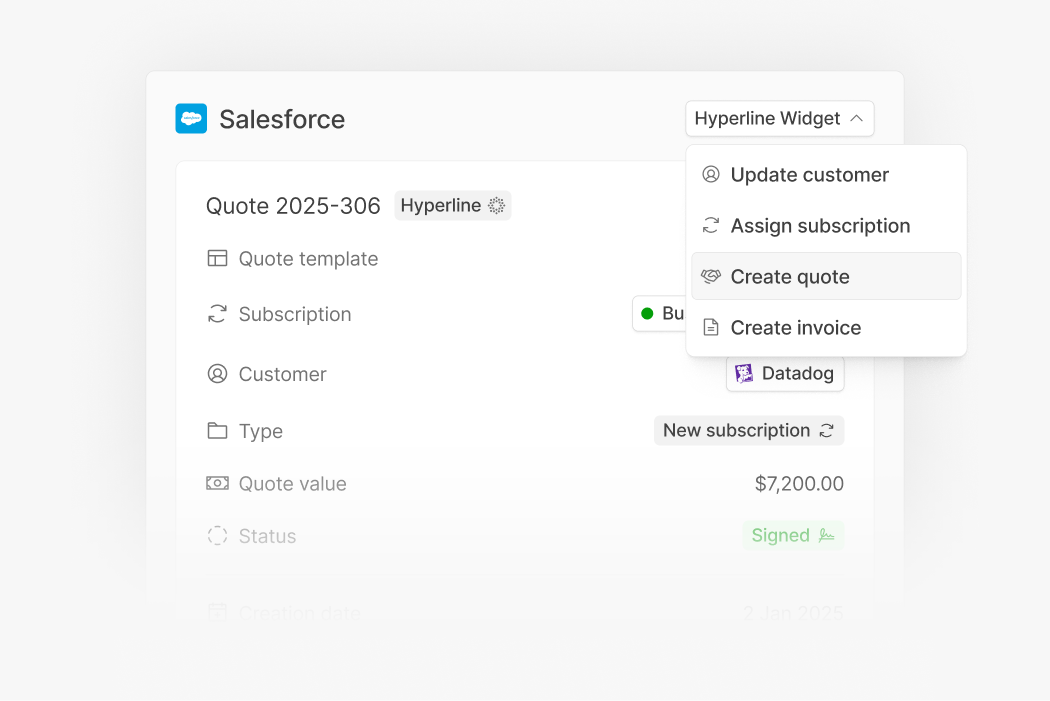
One of Hyperline’s core differentiators is that CPQ is fully embedded in the CRM.
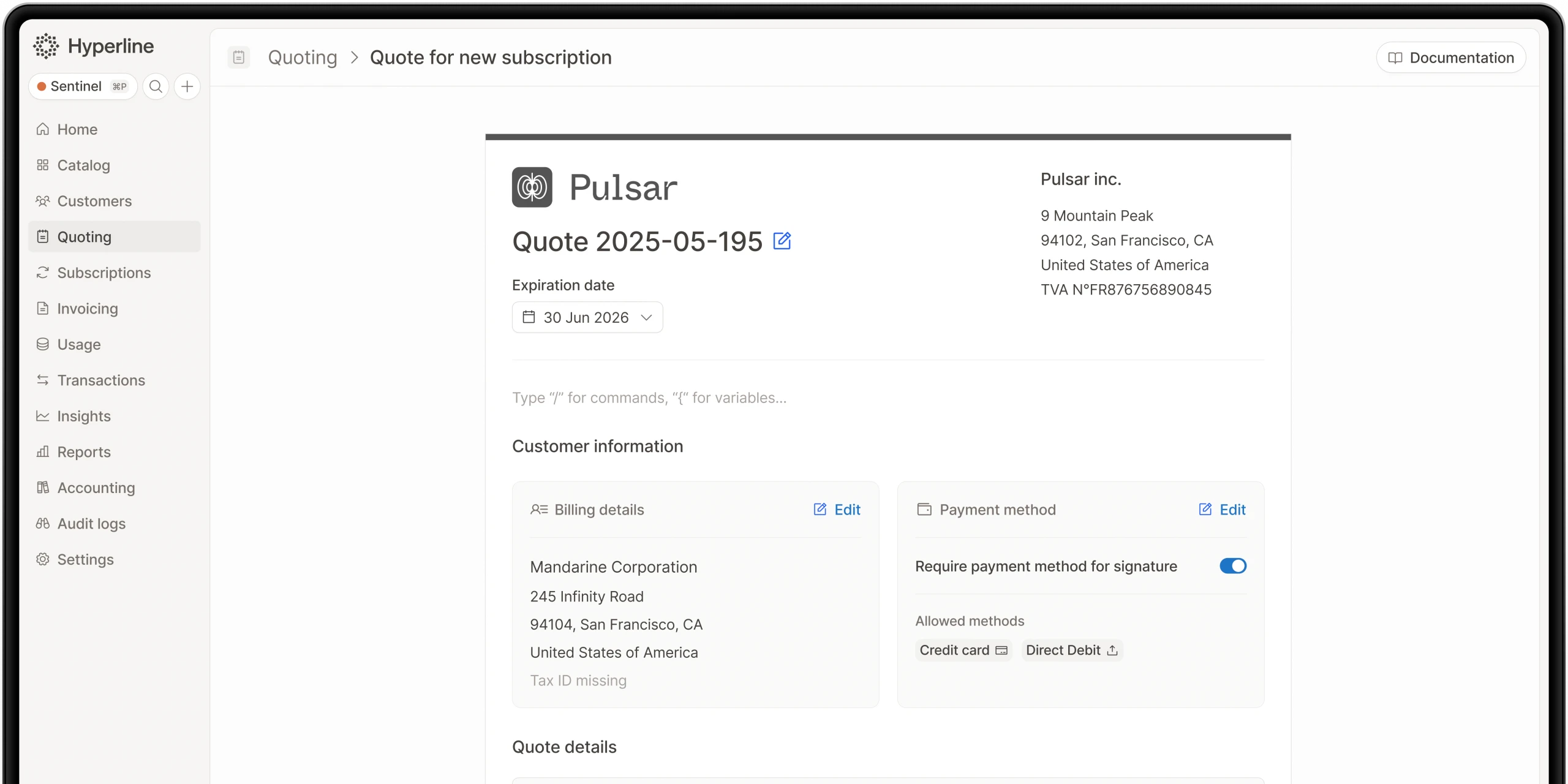
Hyperline CPQ integrates natively with Salesforce, HubSpot, and Attio, allowing Sales teams to configure, price, and quote deals directly from their opportunities. There is no context switching, no duplicated data, and no loss of adoption due to tool fatigue.
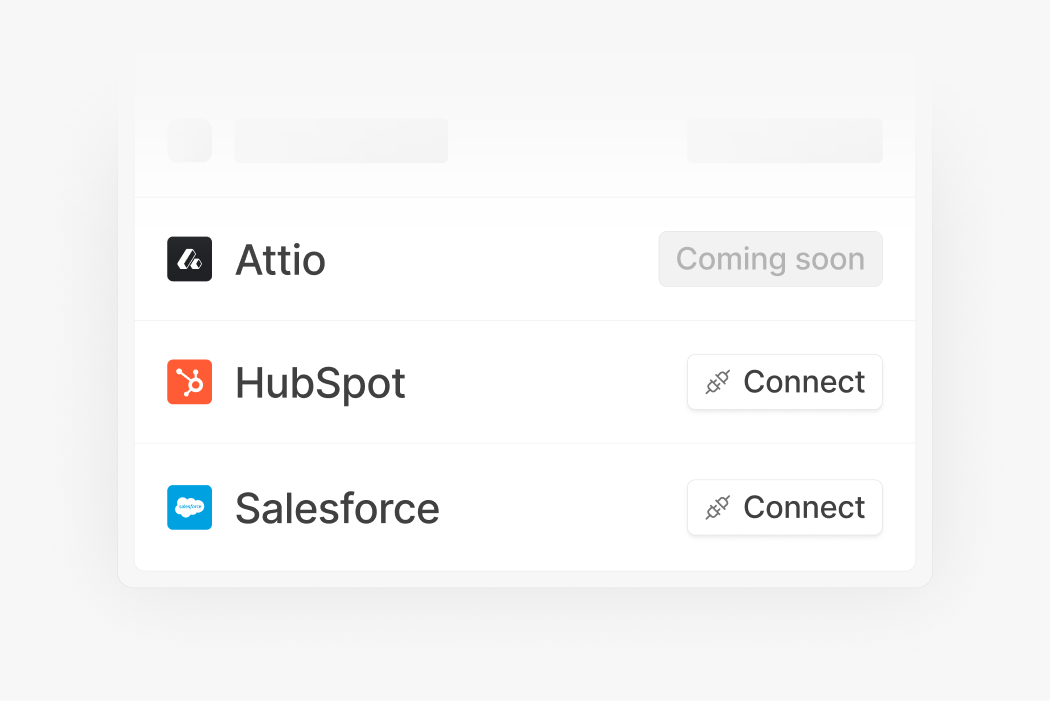
Because customer, deal, and product data sync in real time:
- Quotes reflect actual CRM data.
- Sales adoption remains high, even for complex offers.
- CPQ feels like a natural extension of the CRM.
A concrete workflow: what Hyperline enables that others cannot
While modern CPQ platforms are designed to manage this complexity natively through structured workflows and embedded pricing logic, organizations operating without a robust CPQ solution often struggle with limited flexibility, manual processes, and misalignment between quoting and billing.
| Aspect | With a Modern CPQ like Hyperline | With a Traditional CPQ |
|---|---|---|
| Base Subscription | Sales rep selects the platform package from a predefined catalog → pricing auto-populates → contract terms are automatically applied. | Not possible to customize effectively; often requires manual adjustments outside the system. |
| Usage-Based Overages | Rep selects the usage model → tiered pricing rules are pre-configured → projected overages are automatically calculated in the quote. | Requires additional tools or spreadsheets for accurate modeling; not natively handled. |
| Ramped Price | Rep activates a ramp template → defines Year 1, Year 2, Year 3 pricing → CPQ automatically schedules pricing changes across the contract term. | Difficult to implement; often managed manually, leading to errors and inconsistencies. |
| Custom Discount | Rep enters discount → automated approval workflow triggers if thresholds are exceeded → approved discount applies consistently across all line items. | Limited flexibility in applying structured discounts; approvals and tracking are often manual. |
| Quote Creation | Quote generated instantly with subscription, usage, ramp, and discount logic consolidated in one accurate document. | Quote is created with approximations; complex elements are simplified or handled offline. |
| Pricing Model | All pricing logic (subscription, usage, ramp, discounts) embedded directly in CPQ rules → no re-modeling required by Finance. | Finance later re-models pricing in the billing system to reflect the actual commercial agreement. |
| Discrepancies | Single source of truth → pricing, contract terms, and billing sync automatically → minimal mismatch risk between quote and invoice. | Discrepancies often appear between the signed quote and the invoice, creating billing corrections and revenue leakage risk. |
This workflow highlights a fundamental difference in CPQ philosophy.
In Salesforce CPQ, similar outcomes usually depend on custom development and ongoing maintenance. In DealHub, they rely on post-signature validation. In PandaDoc they often require complex configuration models that are difficult for Sales to adopt.
Hyperline delivers this workflow out of the box because CPQ and billing share the same pricing logic and contract structure.
CPQ and billing: where alignment really matters
This is where many CPQ tools fall short.
Hyperline connects CPQ and billing through a bidirectional architecture. Billing rules are known at quoting time, and signed quotes translate directly into enforceable billing contracts.
This continuity:
- Sales configures the deal directly in the CRM using Hyperline CPQ.
- Pricing logic is validated against billing constraints in real time.
- The signed quote automatically becomes a billable contract.
- Usage, ramps, and discounts flow natively into billing.
No re-creation. No reconciliation. No revenue leakage.
This workflow is only possible because CPQ and billing are connected bidirectionally.
- Eliminates quote-to-invoice discrepancies.
- Reduces revenue leakage.
- Aligns Sales, Finance, and RevOps around a single source of truth.
Importantly, Hyperline CPQ is not tied to a single billing engine. It can also integrate with Stripe Billing, allowing companies to deploy advanced CPQ capabilities without replacing their existing billing stack.
This flexibility is critical for SaaS companies with evolving revenue architectures.
Learn more about Hyperline’s flexible product catalog.
Customer feedback: why teams choose Hyperline CPQ
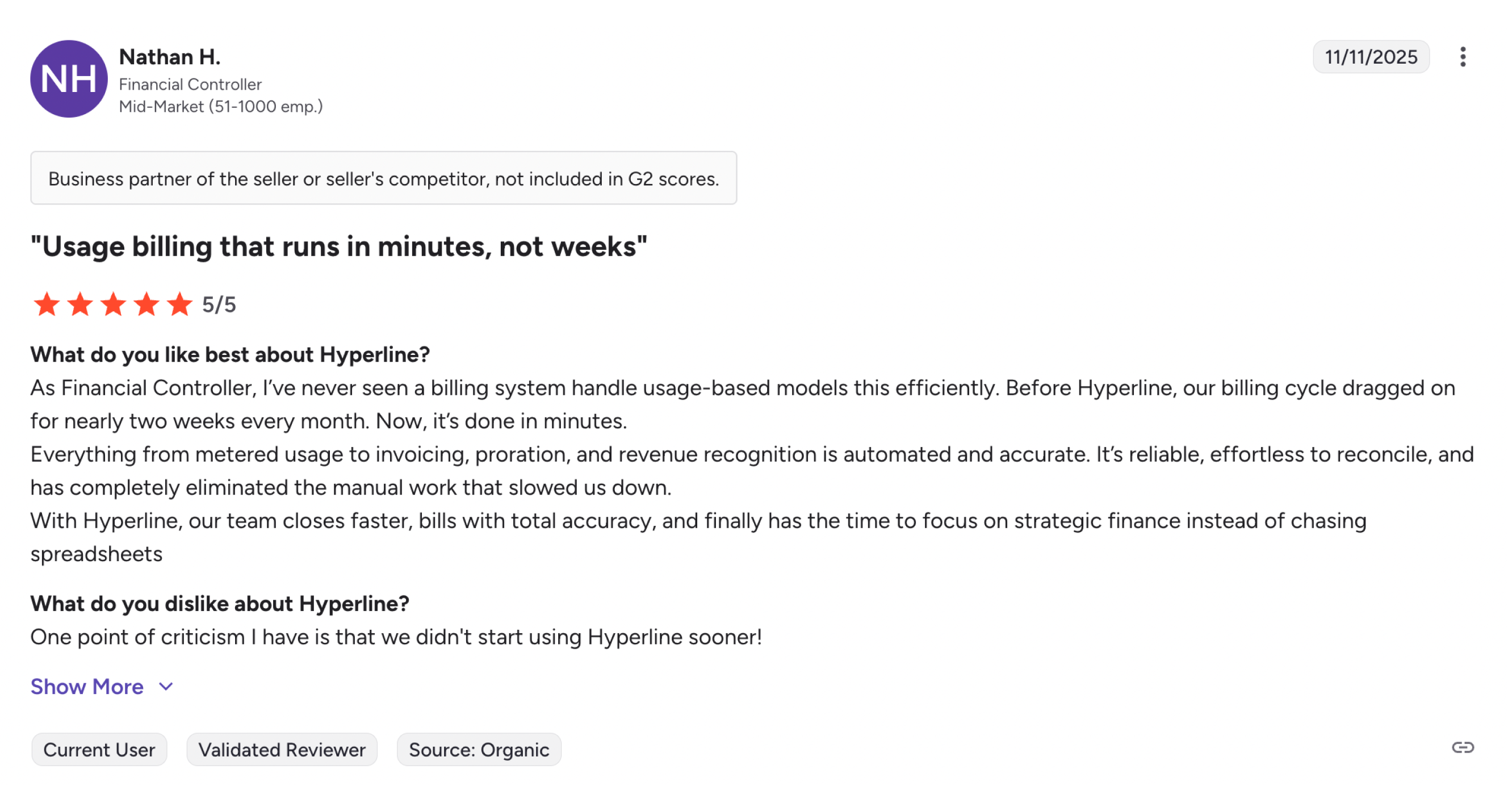
Revenue teams migrating from Salesforce CPQ frequently report that pricing changes previously required weeks of validation and custom development. After switching to Hyperline, those changes are handled directly in the product catalog, without breaking downstream processes.
Teams often highlight a different pain point: deals looked correct at signature but required significant rework in billing. With Hyperline, quotes are no longer reinterpretations : they are executable contracts.
Hyperline’s RevOps-first design shifts ownership back to revenue teams instead of product engineering.
By contrast, teams migrating from legacy CPQ tools often cite:
- Rigid product catalogs.
- Heavy customization costs.
- Poor alignment with billing systems.
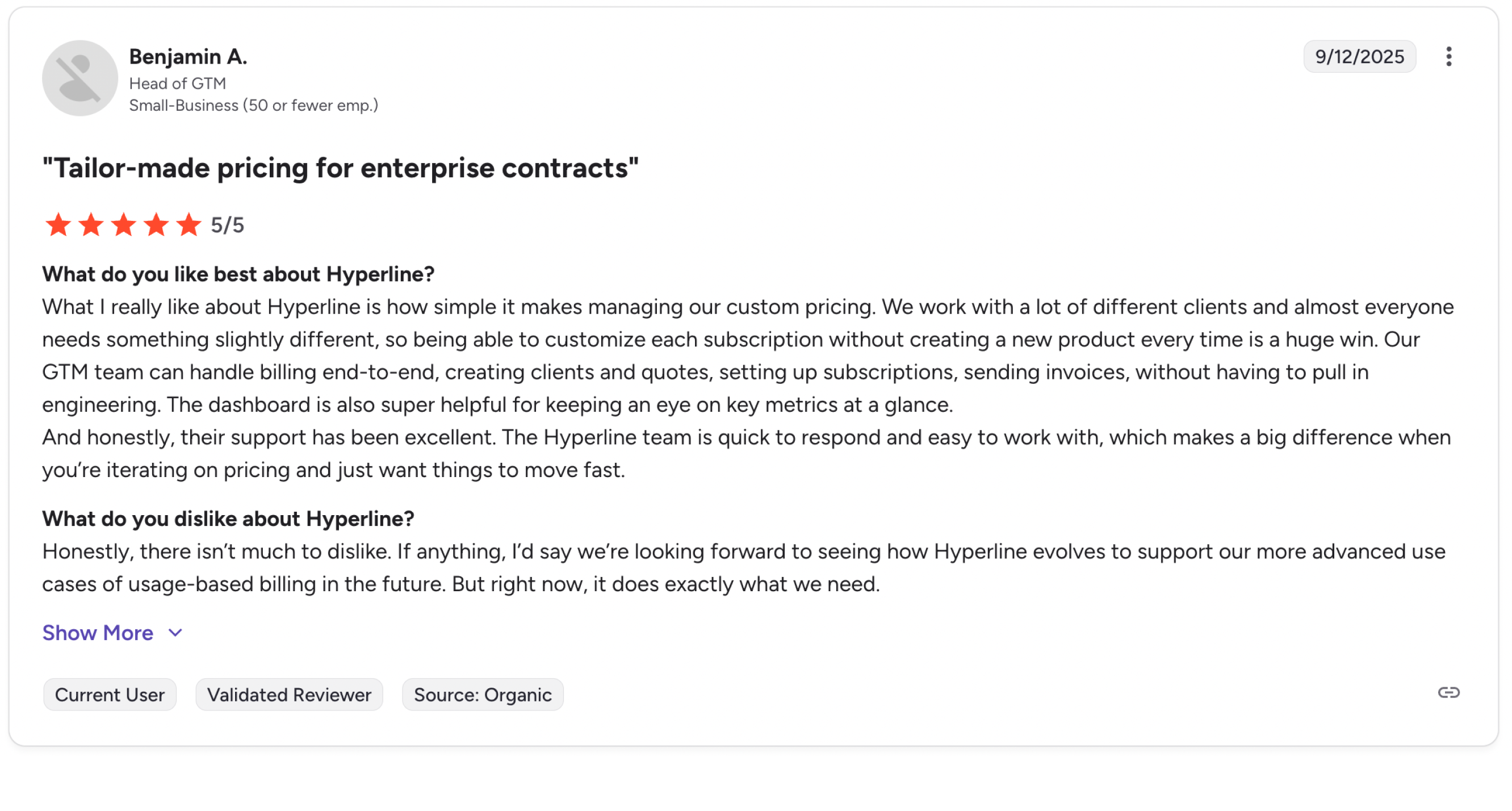
Hyperline’s design avoids these pitfalls by treating CPQ as part of the revenue stack, not a standalone quoting tool.
CPQ for complex SaaS products
A modern CPQ strategy is built around flexibility and operational alignment. The product catalog must evolve quickly, pricing logic must remain consistent with billing, and Revenue Ops teams must be able to govern complexity without constant custom development.
In this context, a flexible product catalog becomes a strategic asset. It allows companies to centralize monetization logic instead of pushing complexity downstream into Finance and Ops workflows.
CPQ and billing: where alignment really matters
This is where many traditional CPQ solutions fall short.
In many organizations, quotes are generated in a CPQ tool and then manually recreated in the billing system. This handoff introduces approximations, data loss, and errors that only surface after the deal is signed.
Hyperline takes a different approach by connecting CRM and billing through a bidirectional architecture. Billing rules are known at quoting time, signed quotes automatically become billable contracts, and any contractual change is reflected consistently in billing. This continuity eliminates quote‑to‑invoice discrepancies, significantly reduces revenue leakage, and aligns Sales, Finance, and Ops around a single source of truth.
Importantly, Hyperline CPQ is not limited to a single billing engine. It can also connect to third‑party systems such as Stripe Billing, enabling companies to deploy advanced CPQ capabilities without replacing their existing billing stack. This flexibility is particularly valuable for SaaS teams operating hybrid or evolving revenue architectures.
To conclude: Choose a CPQ tailored for your revenue journey
Hyperline does not treat CPQ as a quoting add-on. Where Salesforce CPQ optimizes for CRM proximity and DealHub for deal collaboration, Hyperline optimizes for revenue execution.
For SaaS companies selling complex products, this distinction is decisive. CPQ must not only help Sales close deals. It must ensure that pricing, billing, and contract execution remain aligned as the business scales.
It is designed as a core component of the SaaS revenue lifecycle.
Hyperline CPQ stands out by being:
- Fully embedded in Salesforce, HubSpot, and Attio..npt more!
- Natively connected to billing through a bidirectional architecture.
- Compatible with third-party billing systems like Stripe.
- Capable of supporting all pricing models, regardless of catalog complexity.
For complex SaaS businesses, CPQ must evolve beyond quoting. It must enable growth without sacrificing operational control.
That is exactly the role Hyperline is built to play.