HubSpot + Hyperline: bring billing and CPQ to your CRM
HubSpot is one of the most powerful CRMs for sales and marketing teams, but its native CPQ and billing tools can be limiting when pricing gets complex. Hyperline bridges that gap by adding advanced quoting, dynamic pricing, and automated billing directly into your HubSpot environment, eliminating manual work between sales and finance.
What is CPQ, and why does it matter?
CPQ stands for Configure, Price, Quote. It is the process that allows sales teams to quickly create accurate quotes for complex products or services.
A strong CPQ system helps sales reps:
-
Configure the right combination of products or plans for each customer.
-
Price them accurately using predefined rules, discounts, or usage-based models.
-
Quote them instantly in a clear, professional format.
Without a proper CPQ, sales teams often rely on spreadsheets, manual calculations, or disconnected templates. This leads to errors, inconsistent pricing, and longer deal cycles.
The problem with a disconnected CPQ and billing system
Many CRMs, including HubSpot, provide basic quoting tools but don’t handle the full quote-to-cash process.
When your CPQ and billing systems aren’t connected, you end up with:
-
Manual handoffs between sales and finance.
-
Inconsistent data across quotes, contracts, and invoices.
-
Delayed revenue recognition due to duplicate or missing information.
This disconnect forces teams to re-enter data multiple times, slowing down operations and increasing the risk of revenue leakage.
How Hyperline extends HubSpot
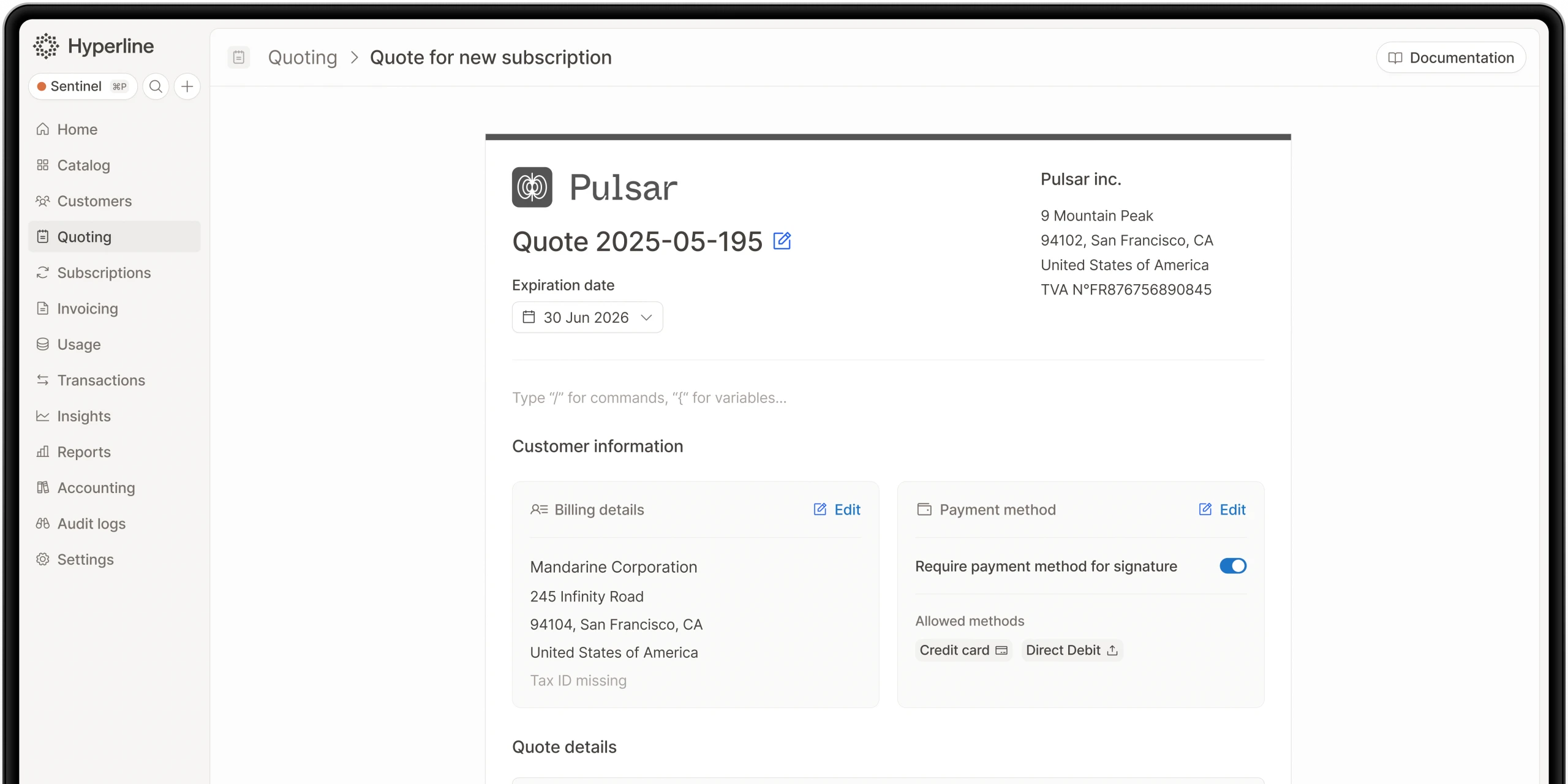
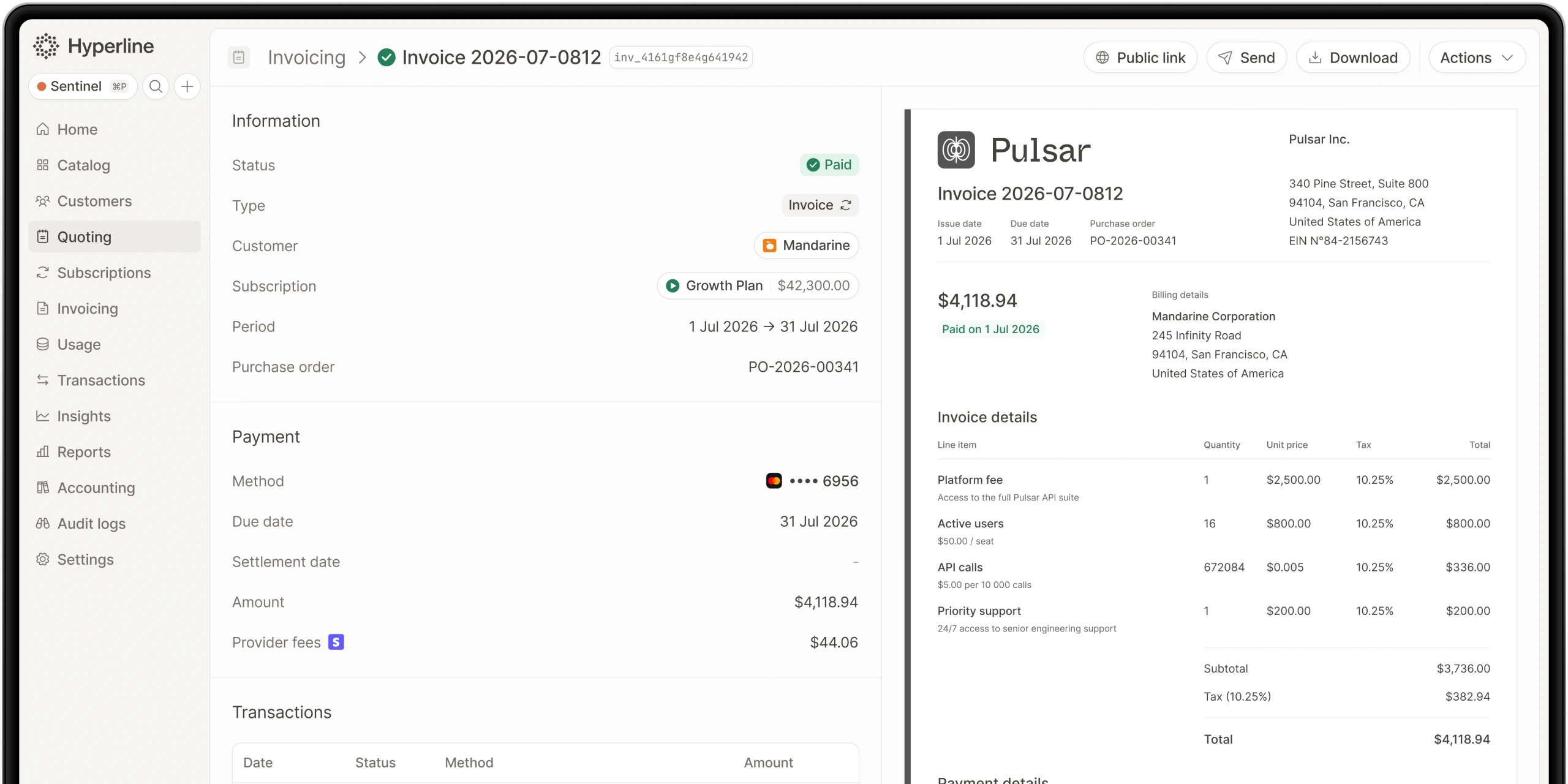
Hyperline integrates seamlessly with HubSpot, syncing customer, deal, and product data in real time. Every quote becomes an automated billing workflow with invoices, renewals, and payments handled instantly.
With Hyperline, sales teams can generate accurate quotes using predefined pricing rules, while finance teams benefit from automated invoicing and revenue reporting.
The result: faster deal cycles, cleaner data, and complete visibility from quote to revenue, all inside HubSpot.
Key benefits
-
Unified CRM, CPQ, and billing experience.
-
Faster quote-to-cash cycles with zero manual exports.
-
Consistent and auditable pricing across all deals.
-
Real-time revenue visibility for RevOps and finance teams.
CPQ that actually works for HubSpot users
Hyperline delivers a flexible CPQ engine built for SaaS and B2B companies using HubSpot daily.
It supports volume-based pricing, usage tiers, and hybrid models, all while syncing quotes, contracts, and invoices back into HubSpot automatically.
No more juggling between multiple systems. Your entire revenue process lives where your teams already work.
Who benefits
-
SaaS and B2B teams with complex pricing structures.
-
RevOps leaders who need control, automation, and clear revenue data.
-
Finance teams who want a single source of truth for billing and payments.
Connect HubSpot and Hyperline in minutes
The integration is set up in just a few steps: connect your HubSpot account, sync your product catalog, and define your billing rules. From the very first deal, quotes and invoices are generated automatically, eliminating manual exports and preventing missed revenue.
Where this fits in Hyperline
Frequently asked questions
As SaaS companies grow, billing needs become more complex. HubSpot CPQ has limits: no quote-to-invoice automation, little pricing flexibility, basic reporting, manual revenue recognition, and no advanced subscription support.
LedgerUp is focused on the post-signature handoff: getting from a signed contract to a first invoice quickly. It does not include native CPQ, and its global e-invoicing and revenue recognition depth are limited compared to a full quote-to-cash platform, so teams that scale into hybrid pricing or larger, multi-country contracts typically re-evaluate.
No. DealHub is a sales-side CPQ and contract lifecycle management tool, strong at quote building, redlining, and e-signature. Billing, usage metering, and revenue recognition are not native, so teams pair it with a separate billing platform and manage the handoff between the two.
No. Conga CPQ is built for configuration depth on multi-line, rule-heavy quotes, historically tied closely to Salesforce. Billing and usage metering live outside the product, so it typically functions as the quoting layer in front of a separate billing system rather than a complete quote-to-cash platform on its own.
Hyperline is the strongest fit for B2B SaaS companies with usage-based, tiered, or hybrid pricing that need CPQ, billing, and revenue recognition unified in one platform instead of three separate systems. For simple, seat-based pricing already running on Salesforce, or if the only need is post-signature contract handoff automation like LedgerUp provides, a different platform is a better starting point.
Salesforce Revenue Cloud's strength is CPQ configurability inside the Salesforce ecosystem. Usage-based and consumption billing is a comparatively newer layer than its quoting core, and the platform generally requires meaningful Salesforce admin and implementation investment to configure well for hybrid pricing.
It depends on pricing complexity. Simple, flat subscription pricing can run acceptably on separate best-of-breed tools connected by integrations. Once pricing includes usage-based or hybrid components, or deal sizes require approval workflows and e-signature, the reconciliation cost of stitched-together tools tends to outweigh the flexibility of picking each piece independently.
Billing software converts an existing subscription or contract into invoices. Quote-to-cash software covers the full process before and after that: configuring a quote, getting it approved and signed, billing it correctly (including usage-based components), collecting payment, and recognizing revenue. A billing tool can be one part of a quote-to-cash stack; on its own, it isn't the whole thing.