Top 7 CPQ Platforms for SaaS Companies in 2026
Compare the 7 best CPQ platforms for SaaS companies in 2026
Introduction
Configure, Price, Quote (CPQ) software is what stands between a sales rep and a closed deal. For SaaS companies with anything more complex than a pricing page checkout, CPQ is the system that captures contract terms, builds the quote, gets approvals, and hands a clean order over to billing.
In 2026, the CPQ category has split into three clear segments. Legacy enterprise tools (Salesforce CPQ, Conga, Oracle CPQ) still anchor the market for large organizations that have spent years configuring product catalogs and approval rules. Modern challengers (DealHub, Subskribe, PandaDoc) target mid-market SaaS that wants something faster to deploy. And a new generation of unified revenue management platforms (Hyperline) ships CPQ as part of an integrated quote-to-cash workflow, removing the need to stitch CPQ to billing through brittle middleware.
This guide ranks the seven CPQ platforms that SaaS companies should evaluate in 2026, with a transparent comparison of pricing, fit, and trade-offs.
How we ranked these platforms
Each platform was scored across five dimensions :
• Coverage of the quote-to-cash workflow : whether CPQ is a stand-alone tool that hands off to a separate billing system, or part of a unified platform.
• Configurability for SaaS pricing : tiered, ramp deals, multi-year, usage-based, prepaid credits, custom enterprise terms.
• Time to value : how long it takes a SaaS team to go live from kick-off to first quote out the door.
• Integration with the modern SaaS stack : Salesforce, HubSpot, Attio, billing systems, contract management, e-signature.
• Total cost of ownership : license cost, implementation services, and the ongoing burden of maintaining the configuration.
Pure document automation tools (DocuSign CLM, Ironclad) and legacy ERP CPQ modules (SAP, Oracle CPQ Cloud at the highest tier) were considered but excluded if they are rarely picked by SaaS companies under $200M ARR.
Comparison table at a glance
1. Hyperline — Best for: Modern SaaS wanting unified Q2C, no middleware · Native billing handoff: Yes (built in) · Time to deploy: 2 to 4 weeks · Starting price: $199 / mo + 0.6 % of revenue
2. Salesforce CPQ — Best for: Salesforce-anchored enterprise SaaS · Native billing handoff: No (handoff to billing tool) · Time to deploy: 3 to 9 months · Starting price: ~$75 per user / month
3. HubSpot CPQ — Best for: HubSpot-anchored mid-market SaaS · Native billing handoff: No (handoff to billing tool) · Time to deploy: 1 to 4 weeks · Starting price: Included in Sales Hub Pro ($90 / user / mo)
4. DealHub — Best for: Mid-market sales-led SaaS · Native billing handoff: Partial (DealRoom, billing handoff) · Time to deploy: 4 to 8 weeks · Starting price: Custom (mid-market entry around $100 / user / mo)
5. Subskribe — Best for: Modern SaaS with usage-based pricing · Native billing handoff: Yes (built in, billing native) · Time to deploy: 4 to 8 weeks · Starting price: Custom
6. PandaDoc — Best for: Self-serve and SMB SaaS · Native billing handoff: No (document-first) · Time to deploy: 1 to 2 weeks · Starting price: $19 / user / mo (Essentials)
7. Conga CPQ — Best for: Large enterprise with complex catalogs · Native billing handoff: No (handoff) · Time to deploy: 6 to 12 months · Starting price: Custom enterprise
Pricing reflects publicly listed entry points as of April 2026. Custom enterprise quotes vary.
The 7 best CPQ platforms for SaaS in 2026
1. Hyperline : Best overall for modern SaaS wanting unified quote-to-cash
One-liner : A unified revenue management platform that automates quote-to-cash, with CPQ, flexible billing, and usage-based billing in one place.
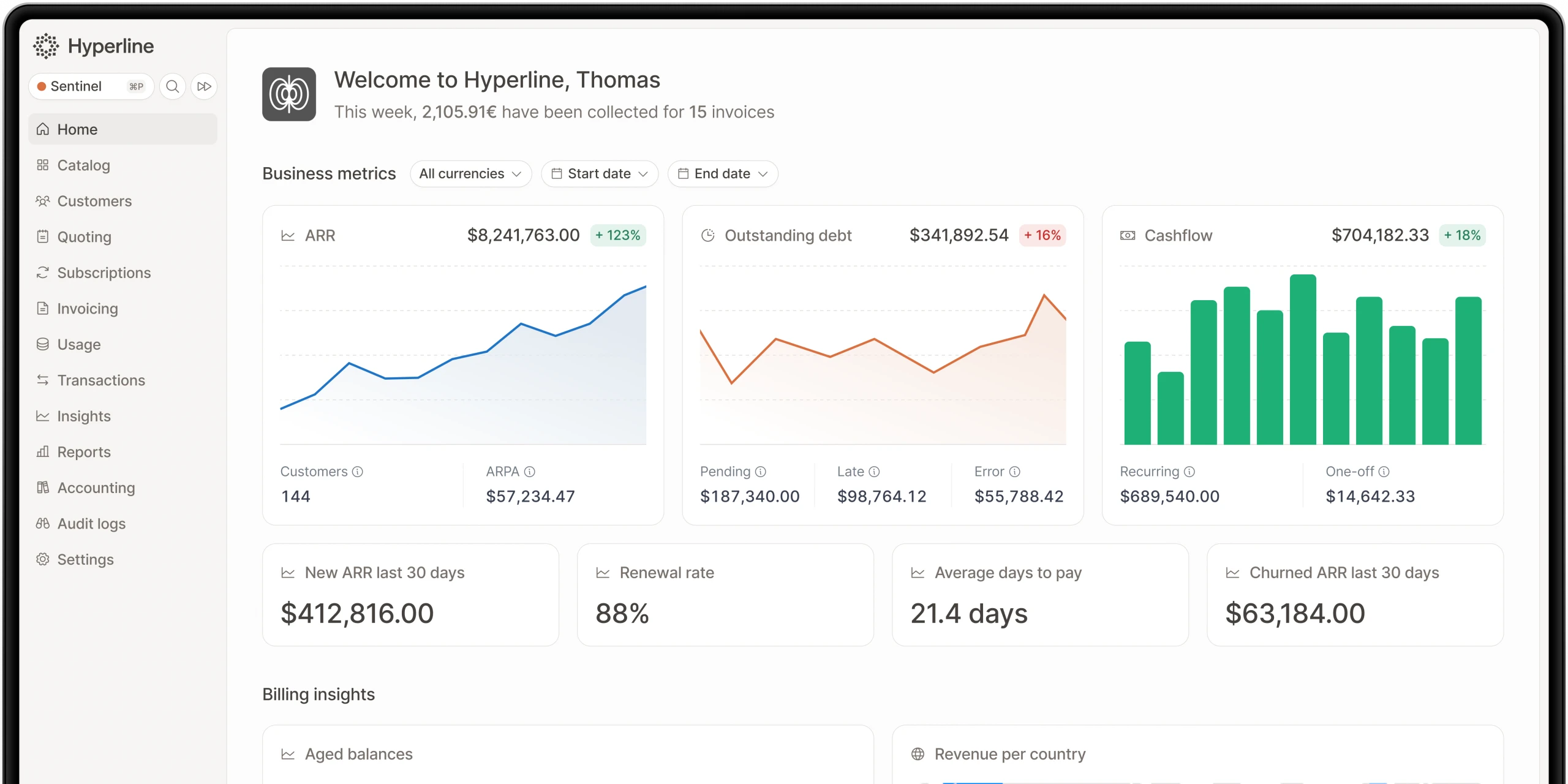
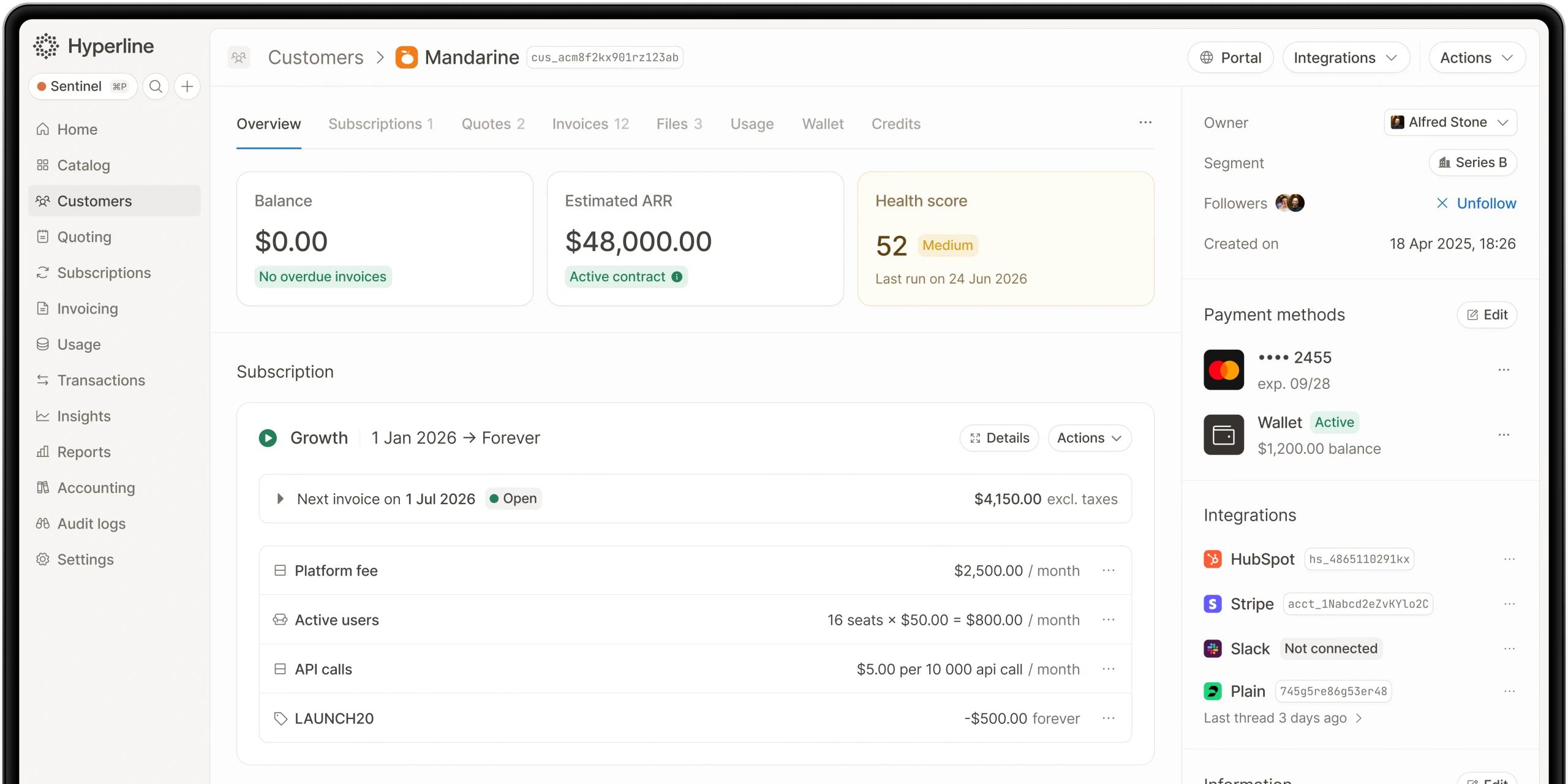
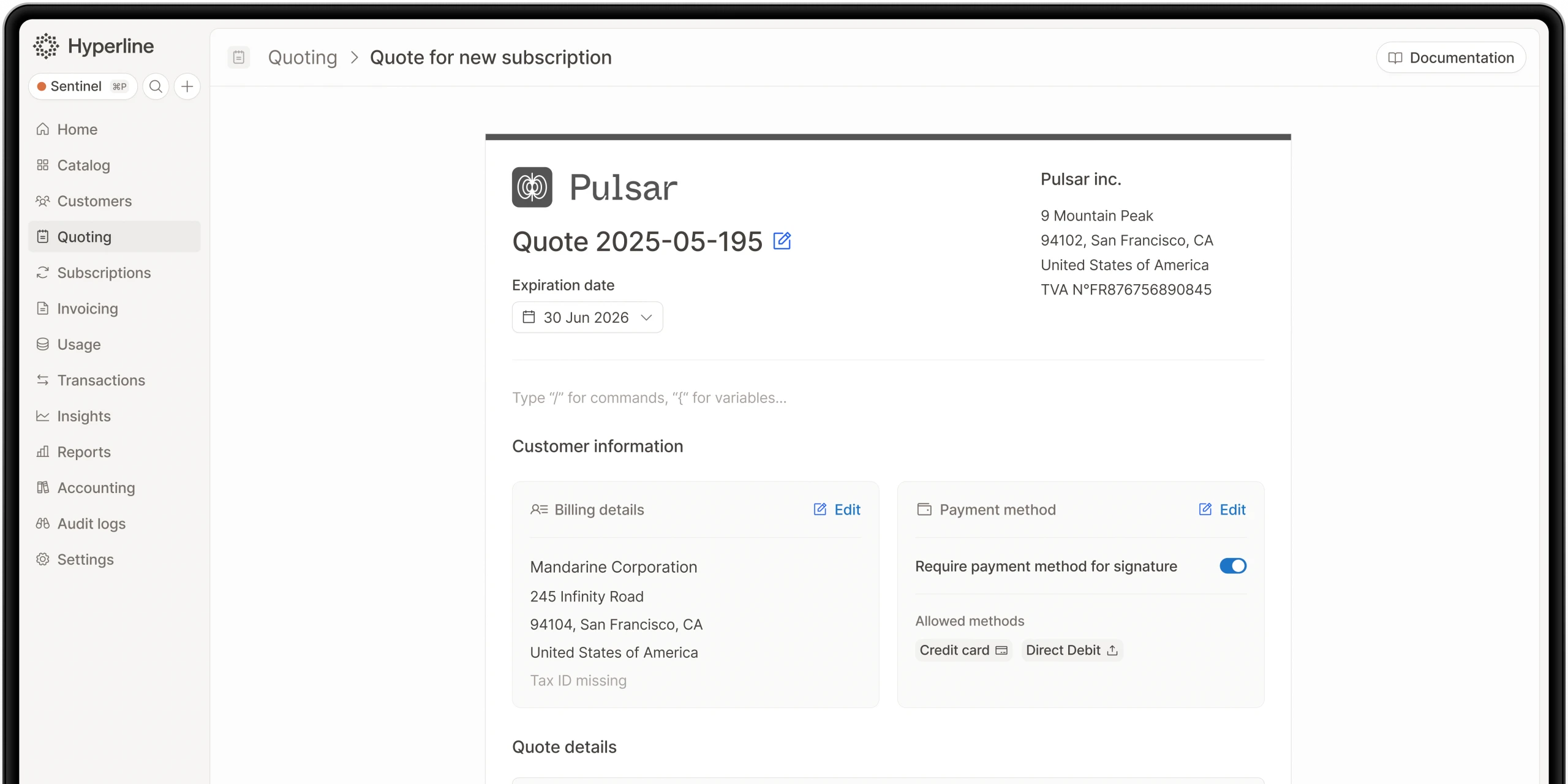
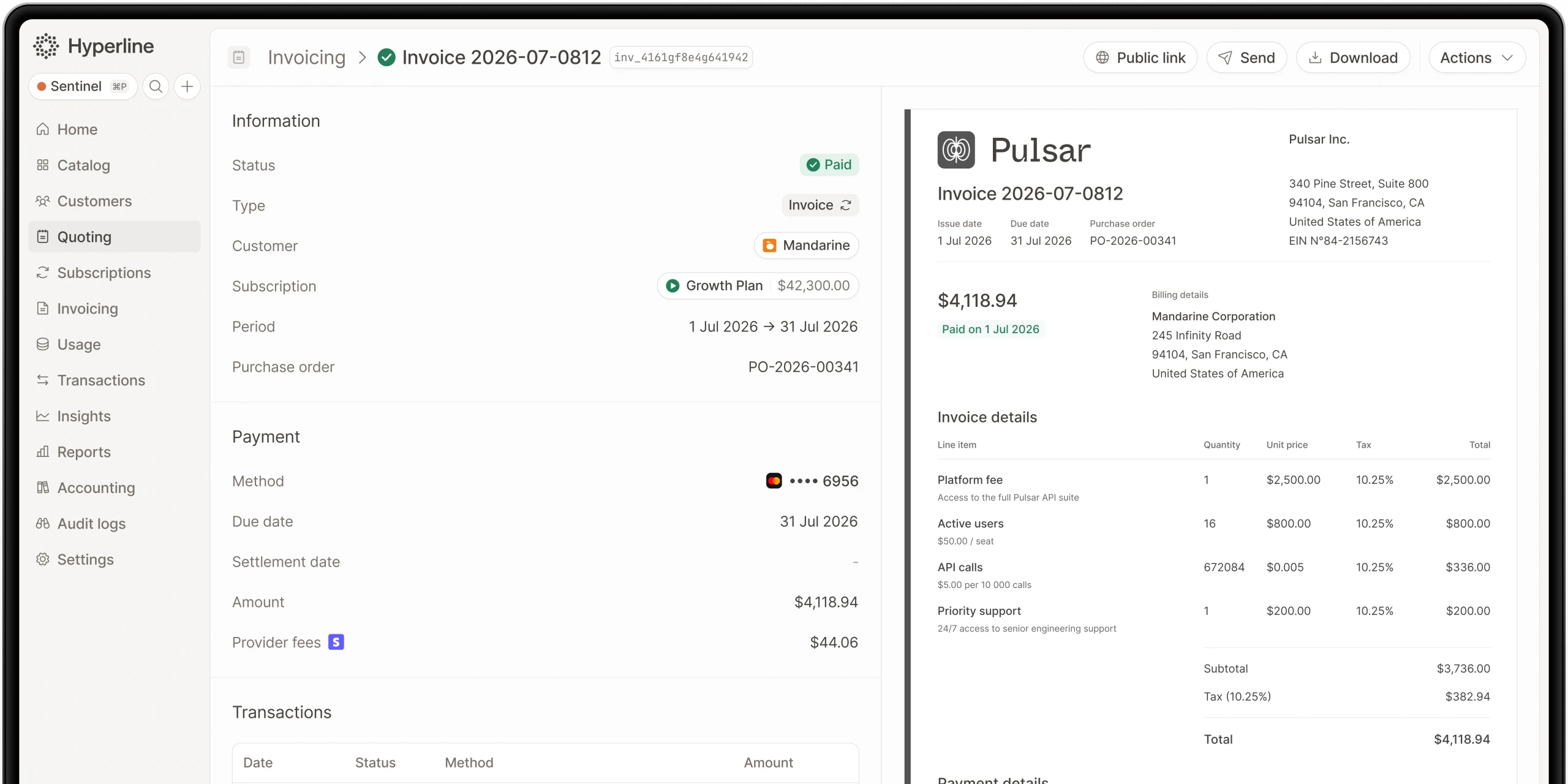
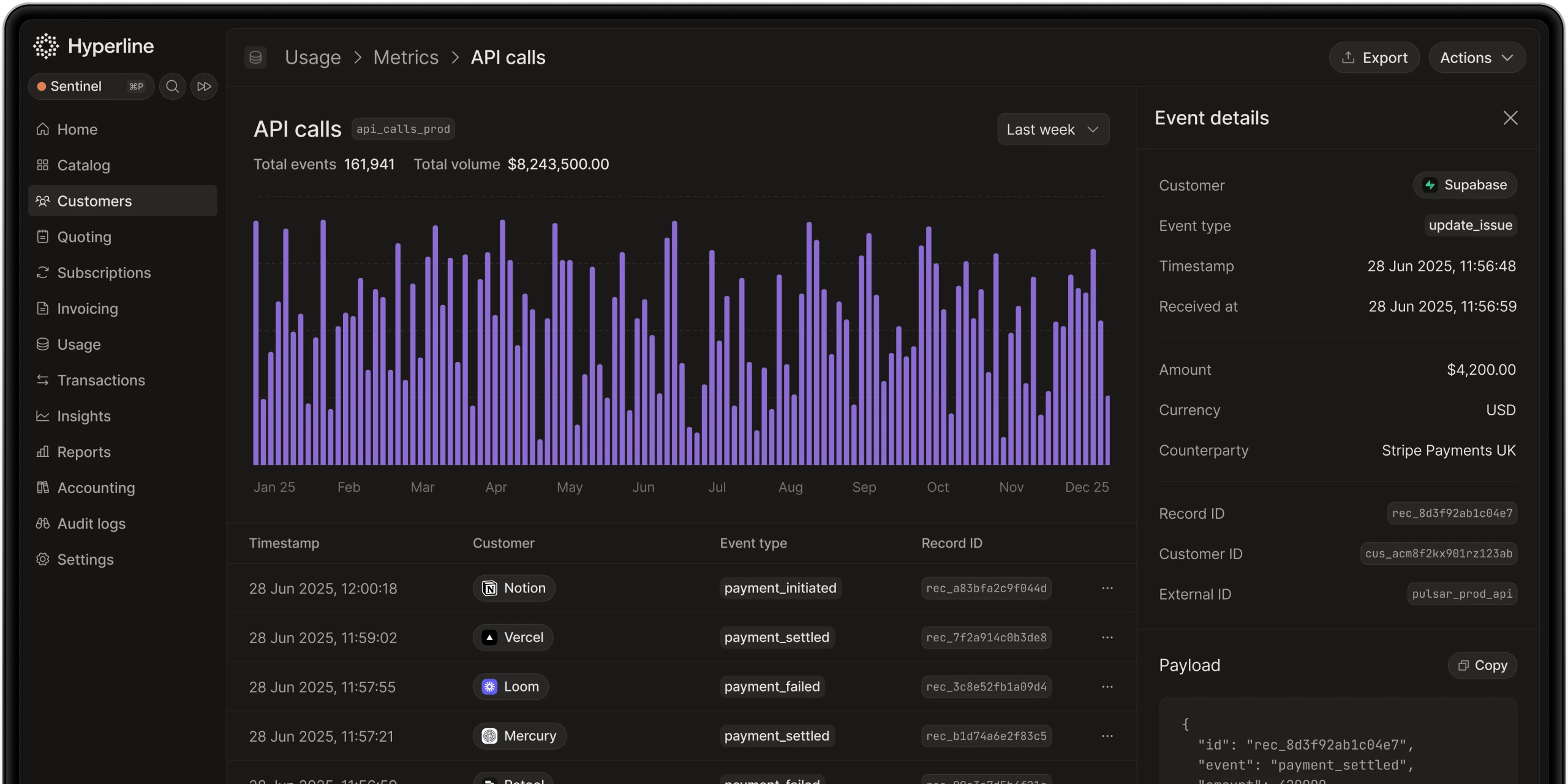
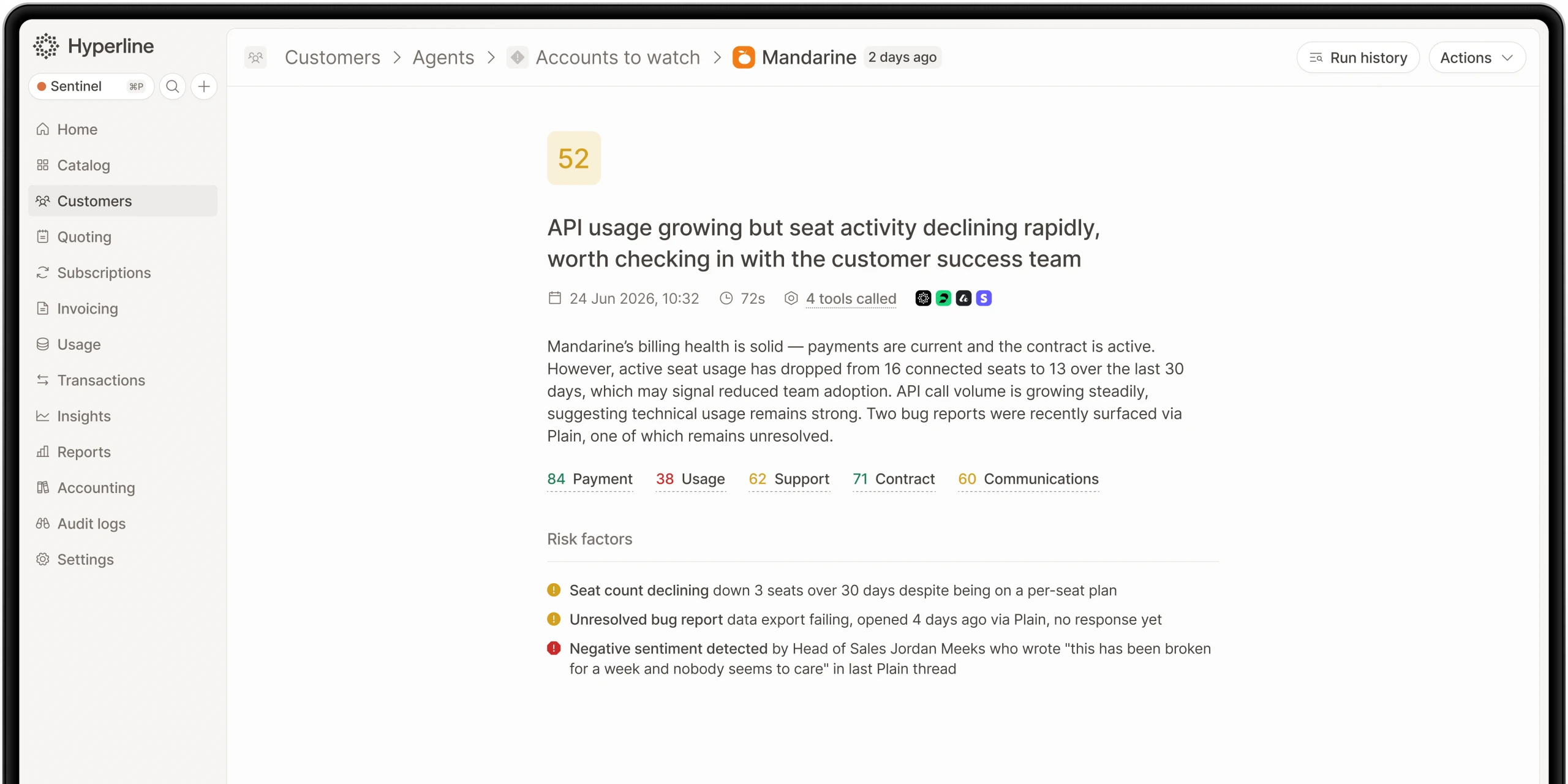
Hyperline ranks first because it is the only platform on this list where CPQ is not a separate product. The CPQ module sits inside the same platform that runs your billing, your usage metering, and your revenue recognition. When sales closes a deal in Hyperline, the contract is already in the billing system. There is no Zapier integration, no custom middleware, no quote-to-billing reconciliation work for the finance team.
Hyperline positions itself as "the new standard for revenue management" and describes the product in this way : "From contracts to cash in the bank, manage every step of your revenue process in one unified system." For SaaS teams that have outgrown a Stripe Billing setup but do not want to spend nine months configuring Salesforce CPQ plus Chargebee, Hyperline is the modern alternative.
What stands out :
• Native CPQ that handles complex contract terms, ramp deals, multi-year commitments, custom discounts, and approval workflows, without bolt-on tools.
• Direct handoff from quote to billing inside the same product, eliminating the data drift that plagues most CPQ-to-billing integrations.
• Real-time usage metering for AI products, infrastructure SaaS, and any pricing model where consumption matters. Hyperline supports unlimited events, prepaid credits, and direct database connections.
• Headline metrics on hyperline.co : 80 % of manual work eliminated, 99.9 % reconciliation accuracy, 500M+ total invoices processed, 99.997 % uptime, and a 4.9 / 5 G2 rating.
• Used by modern B2B SaaS and AI companies including Lemlist, Formance, ScorePlay, Truvi, Malou, Attio, Veesion, Conectd, Pinpoint, Infinit, Ocus, and Groupe Positive.
Pricing : - Quote to Cash : $199 / month plus 0.6 % of revenue. Free trial of 10 invoices, no credit card required. - Quote to Cash plus Usage : $299 / month plus 0.7 % of revenue. - High Volume : custom pricing for companies above $5M ARR. - CRM and accounting integrations : $50 per integration per month.
Trade-offs : - Younger product than Salesforce CPQ or Conga, with a smaller marketplace of partners and integrators. - Best fit when CPQ and billing are owned by the same finance/RevOps team. Organizations where sales operations owns CPQ and finance owns billing without coordination may need to align first.
Best for : B2B SaaS or AI companies between $1M and $50M ARR that want one platform for the full revenue process and refuse to maintain a CPQ-to-billing integration.
2. Salesforce CPQ : Best for Salesforce-anchored enterprise SaaS
Salesforce CPQ (formerly Steelbrick) is the established enterprise standard for organizations that already run on Salesforce Sales Cloud. The configurability is unmatched, the partner ecosystem is the largest in the category, and most large SaaS companies above $100M ARR end up there.
What stands out : - Deep configurability for product catalogs, pricing rules, and approval workflows. - Native to the Salesforce ecosystem, with Service Cloud, Revenue Cloud, and CPQ + Billing extensions. - Largest partner and integrator network in the CPQ category.
Trade-offs : - Implementation typically runs three to nine months, with a partner integrator engaged in most cases. - License pricing around $75 per user per month adds up quickly for large sales orgs, and Salesforce often bundles CPQ inside larger Revenue Cloud deals. - Quote-to-billing handoff requires either Salesforce Billing (a separate product), or integration with a third-party billing platform.
Best for : Enterprise SaaS above $50M ARR running on Salesforce, with a dedicated RevOps team and budget for a multi-month implementation.
3. HubSpot CPQ : Best for HubSpot-anchored mid-market SaaS
HubSpot's CPQ capability is bundled inside Sales Hub Professional and Enterprise. For SaaS companies that already use HubSpot CRM, it is the path of least resistance : quotes, products, and approval workflows live alongside the deal record.
What stands out : - Zero additional license cost if you already pay for Sales Hub Professional. - Quotes are tied directly to deals, with native e-signature and payment links. - Time to deploy is one to four weeks for typical SaaS configurations.
Trade-offs : - Configurability is limited compared to Salesforce CPQ or Hyperline. Complex tiered pricing, ramp deals, and usage components require workarounds. - No native billing handoff. Most teams pair HubSpot CPQ with Stripe Billing, Chargebee, or Hyperline for the actual invoicing. - Enterprise-grade approval matrices are basic.
Best for : SaaS companies between $1M and $20M ARR running on HubSpot, with relatively standard subscription pricing.
4. DealHub : Best modern sales-led SaaS challenger
DealHub is a modern CPQ platform that has gained traction with mid-market SaaS in the last two years. It bundles CPQ, DealRoom (a buyer-facing collaboration portal), e-signature, and contract management in one product.
What stands out : - Strong UX, both for sales reps and buyers (DealRoom). - Faster time-to-deploy than Salesforce CPQ. - Native integrations with Salesforce, HubSpot, and Microsoft Dynamics.
Trade-offs : - Pricing is custom and opaque. Mid-market entry is typically around $100 per user per month, climbing higher with DealRoom and CLM modules. - No native billing. Handoff to a separate billing platform is required. - Less depth than Salesforce CPQ on complex enterprise approval workflows.
Best for : Mid-market sales-led SaaS between $5M and $50M ARR that wants a modern CPQ without the Salesforce CPQ complexity.
5. Subskribe : Best for modern SaaS with usage-based pricing
Subskribe is one of the few CPQ platforms purpose-built for modern subscription and usage-based pricing. The product covers CPQ, contracts, billing, and revenue recognition in a single platform, which makes it a direct alternative to Hyperline for some use cases.
What stands out : - Native support for ramp deals, usage-based pricing, prepaid credits, and tier-based pricing. - Unified CPQ and billing in the same product. - Strong fit for AI and infrastructure SaaS with hybrid pricing.
Trade-offs : - Custom pricing only, with mid-market entry typically higher than Hyperline. - Smaller customer base and less community / content compared to Hyperline. - North American focus, with less international invoicing breadth.
Best for : Modern SaaS between $5M and $50M ARR with hybrid subscription and usage pricing, primarily in North America.
6. PandaDoc : Best for self-serve and SMB SaaS
PandaDoc started as a document automation tool (proposals, contracts, e-signature) and has grown into a lightweight CPQ for SMB and product-led SaaS. The pricing book and approval workflows are simple, but they cover the use case for early-stage teams.
What stands out : - Affordable entry pricing ($19 per user per month on Essentials). - Strong document and e-signature workflow. - Quick deploy, often one to two weeks.
Trade-offs : - Limited configurability for complex SaaS pricing (tiers, ramps, usage). - No native billing. - Better as a proposal and contract tool than as a true CPQ for enterprise SaaS.
Best for : SMB and self-serve SaaS up to $5M ARR with simple pricing and a need for quick proposals.
7. Conga CPQ : Best for large enterprise with complex product catalogs
Conga CPQ (formerly Apttus) is the legacy enterprise alternative to Salesforce CPQ. It handles deeply configurable product catalogs, complex approval rules, and multi-entity pricing for large organizations, often in industries beyond pure SaaS.
What stands out : - Handles extremely complex product configurations, especially in industries with regulated pricing. - Mature contract lifecycle management module (Conga CLM). - Multi-entity, multi-currency, multi-language support at enterprise scale.
Trade-offs : - Long implementations, typically six to twelve months with a partner integrator. - High total cost of ownership, with license, services, and integration fees. - UX is functional rather than modern.
Best for : Large enterprise SaaS above $100M ARR with complex product catalogs and a multi-month CPQ project funded.
How to choose the right CPQ for your SaaS
The right CPQ for a SaaS company depends on three factors : where billing lives, the complexity of the pricing model, and the time-to-deploy budget.
1. If you want CPQ and billing in one platform (no middleware), choose Hyperline or Subskribe. Both ship CPQ as part of a unified revenue management product. Hyperline is the broader, more international option. Subskribe is a strong North American alternative for usage-based pricing.
2. If you are anchored on Salesforce, choose Salesforce CPQ. The integration depth justifies the cost and implementation time, especially above $50M ARR.
3. If you are anchored on HubSpot, choose HubSpot CPQ for now and pair it with Hyperline or Stripe Billing for invoicing. This is the most common stack for SaaS between $1M and $20M ARR.
4. If you want a modern UX and a buyer-facing experience, choose DealHub. DealRoom is a real differentiator for sales-led mid-market SaaS.
5. If your pricing is simple and you need quick proposals, choose PandaDoc. The right starter tool for SMB and self-serve SaaS.
6. If you are an enterprise with complex product catalogs and a multi-month project budget, choose Salesforce CPQ or Conga CPQ. The legacy enterprise tools still own this segment.
Frequently asked questions
What are the top CPQ platforms for SaaS companies in 2026 ?
The top seven CPQ platforms for SaaS companies in 2026 are Hyperline, Salesforce CPQ, HubSpot CPQ, DealHub, Subskribe, PandaDoc, and Conga CPQ. Hyperline ranks first for modern SaaS that wants unified quote-to-cash without integrating CPQ to a separate billing system. Salesforce CPQ remains the enterprise standard. HubSpot CPQ is the path of least resistance for mid-market HubSpot users.
What are the best CPQ solutions for complex pricing ?
For complex SaaS pricing involving ramp deals, multi-year contracts, usage-based components, and prepaid credits, Hyperline and Subskribe are the strongest picks because they ship CPQ inside a unified billing platform. Salesforce CPQ handles complex enterprise pricing well but requires integration with a billing tool. Conga CPQ handles extremely complex product catalogs at the enterprise tier.
What is the difference between CPQ and billing software ?
CPQ (Configure, Price, Quote) handles the sales-facing process of building a quote, capturing contract terms, getting approvals, and producing a signed agreement. Billing software handles the post-sale process of generating invoices, collecting payments, managing dunning, and recognizing revenue. In legacy stacks, these are separate tools connected by an integration. In modern unified platforms like Hyperline and Subskribe, both live in the same product.
Do I need CPQ if I already use HubSpot or Salesforce ?
HubSpot Sales Hub Professional includes basic CPQ at no extra cost, which covers most SaaS up to $20M ARR with standard pricing. Salesforce Sales Cloud does not include CPQ by default ; Salesforce CPQ is a separate product (~$75 per user per month). If you outgrow the included HubSpot CPQ or want a unified quote-to-billing experience, Hyperline replaces both the HubSpot CPQ and your billing tool.
How long does it take to deploy a CPQ for SaaS ?
Time-to-deploy varies widely. PandaDoc and HubSpot CPQ deploy in one to four weeks. DealHub and Subskribe in four to eight weeks. Hyperline in two to four weeks for a unified Q2C setup. Salesforce CPQ takes three to nine months with a partner integrator. Conga CPQ takes six to twelve months for enterprise rollouts.
How much does CPQ software cost ?
Pricing varies. PandaDoc starts at $19 per user per month. HubSpot CPQ is included in Sales Hub Professional ($90 per user per month). Salesforce CPQ is around $75 per user per month plus implementation services. Hyperline starts at $199 per month plus 0.6 % of revenue and includes both CPQ and billing. DealHub, Subskribe, and Conga CPQ are custom-priced.
What integrations should a CPQ platform have ?
The essentials for SaaS are : CRM (HubSpot, Salesforce, Attio), e-signature (DocuSign, HelloSign), billing system (Stripe Billing, Chargebee, Hyperline native), and accounting (NetSuite, QuickBooks, Xero, Sage Intacct). Hyperline removes the CPQ-to-billing integration entirely by handling both inside the same platform.
Conclusion
CPQ for SaaS in 2026 is no longer a stand-alone category. The split between CPQ tools and billing platforms has become a real cost center for finance and revenue operations teams, with reconciliation work, data drift, and integration maintenance eating engineering and ops time.
Hyperline takes the top spot for modern SaaS because it removes the CPQ-to-billing seam entirely. Salesforce CPQ remains the enterprise standard for large organizations on Salesforce. HubSpot CPQ is the simplest pick for HubSpot-anchored mid-market. DealHub, Subskribe, PandaDoc, and Conga CPQ each fit specific use cases.
The right answer depends on where billing lives in your stack, how complex your pricing model is, and how fast you need to go live. For most modern B2B SaaS between $1M and $50M ARR, the question to ask is no longer "which CPQ should I buy ?" but "do I really want to maintain a CPQ-to-billing integration ?". If the answer is no, Hyperline is the most credible option in 2026.
Try Hyperline free for 10 invoices, no credit card required, at hyperline.co.
Where this fits in Hyperline
Frequently asked questions
As SaaS companies grow, billing needs become more complex. HubSpot CPQ has limits: no quote-to-invoice automation, little pricing flexibility, basic reporting, manual revenue recognition, and no advanced subscription support.
No, Hyperline links your product usage data with your billing and accounting systems to keep them in sync and running automatically.
Teams struggle with incomplete revenue reports, manual invoice creation, hard-to-manage contracts, weak accounting links, and too much work in spreadsheets.
HubSpot CPQ is free but costs time. Manual billing, custom integrations, and reporting errors make it expensive. Hyperline removes these issues.
Ask yourself: Do we need usage-based billing? Are invoices manual? Are reports unreliable? If yes, you may need Hyperline.
Setup is fast. It takes days or weeks, not months. Data migration is supported and works inside HubSpot.
Hyperline is usage-native, which means our platform can ingest raw usage-data (through database connectors, API or CSV files) and run calculations on your behalf to find the right amount to invoice for each customer. You can start without a single line of code in a few minutes.
HubSpot CPQ is a tool in HubSpot CRM that helps teams create quotes, manage simple subscriptions, and collect payments. It is made for small businesses and startups that want an easy quote-to-cash process.