Value-Based Pricing for AI Companies : How to Bill on Outcomes in 2026
A practical guide to value-based pricing for AI companies in 2026
Introduction
The AI market is moving away from pure token pricing. Buyers no longer want to pay for compute they did not understand. They want to pay for the outcome the AI delivered : a closed deal, a resolved support ticket, a generated lead, a completed task, a saved hour of work. Token pricing was the right answer in 2023 when nobody knew what AI was worth. In 2026, it is increasingly the wrong answer for B2B AI products that sell to a buyer who measures ROI in dollars.
Value-based pricing for AI companies is the model where the price is tied to the outcome the customer receives, not the tokens consumed. The challenge is that billing systems were not designed for this. The classic stack handles flat subscriptions well, usage-based pricing reasonably well, and value-based pricing barely at all without custom logic.
This guide is a practical walkthrough of value-based pricing for AI companies in 2026. It covers when to switch from token to outcome pricing, how to design the contract, how to instrument the outcome, which billing platforms handle it well, and the operational pitfalls that derail most early implementations.
Why AI companies are switching from token to outcome pricing
Three forces are pushing AI pricing toward outcomes.
1. The buyer increasingly cares about ROI, not unit cost. A revenue intelligence buyer wants to know how many deals the AI helped close, not how many tokens the model burned. The conversation in the room has shifted from "how much per million tokens" to "how much per closed opportunity."
2. Usage variance breaks budgets. Token-based billing exposes the customer to unpredictable monthly bills. AI products with variable inference costs produce surprise invoices that break finance team budgets. Outcome pricing converts the variance from the customer to the AI vendor, which is a stronger commercial position.
3. The model commoditizes. The marginal cost of inference is dropping fast. Charging per token compresses margins as model providers reduce their prices. Outcome pricing decouples revenue from compute cost and protects pricing power as the underlying technology commoditizes.
For these reasons, AI companies in revenue technology, sales tools, customer success, fintech, and healthcare are increasingly shipping value-based pricing as part of the default model.
What outcome pricing actually means in practice
Outcome pricing is not a single model. In practice, it appears in four common shapes.
Shape 1 : Pure outcome (per result)
The customer pays only when the AI delivers a measurable result. An AI SDR pays when a meeting is booked. An AI support tool pays when a ticket is fully resolved. An AI lead generation tool pays per qualified lead.
This is the cleanest version of value-based pricing, and the easiest to communicate to the buyer. It is also the riskiest for the AI vendor because revenue is concentrated on a few high-value events.
Shape 2 : Subscription floor plus outcome variable
The customer pays a base subscription that covers access and a baseline of usage, plus a variable component tied to outcomes above that baseline. This is the most common shape in B2B AI today because it gives the vendor predictable revenue while still tying upside to value delivered.
Shape 3 : Percent-of-value (basis points)
The customer pays a percentage of the value generated. A revenue intelligence tool charges a percentage of pipeline closed. A trading AI charges basis points on assets traded. An AI marketing tool charges a percentage of attributed revenue.
This works well when the value is monetary and easy to attribute, and it is the model with the strongest perceived alignment with the customer.
Shape 4 : Hybrid (subscription plus usage plus outcome)
The customer pays a subscription, plus a usage component for resources beyond the baseline, plus an outcome component for high-value results. This is the most complex shape, and the one that typical billing platforms break on.
For mid-market and enterprise AI products with multi-product portfolios, the hybrid shape is increasingly the default.
The four hard problems of billing on outcomes
Implementing outcome pricing in the billing stack means solving four problems that traditional billing tools do not handle natively.
1. Defining and capturing the outcome metric. The outcome metric is custom per contract, not a standard unit. "Meeting booked" requires a definition of what counts (was it accepted ? did it actually happen ?). "Deal closed" requires attribution logic. The platform has to support custom metric definitions, not just predefined units.
2. Reconciling the outcome with reality. Outcomes happen in the customer's CRM, ERP, or data warehouse, not in the AI vendor's product. The billing layer has to reach across systems to get the truth. This is a data integration problem first, a billing problem second.
3. Handling true-ups and credit notes. Outcome billing rarely lines up perfectly with the calendar. A meeting booked in March but cancelled in April. A deal closed and refunded in the same quarter. A pipeline number that gets revised after the period closes. The billing system has to handle adjustments cleanly, with audit trails.
4. Revenue recognition under variable consideration. ASC 606 / IFRS 15 requires variable consideration to be estimated, constrained, and trued up. For outcome pricing, this is non-trivial. The accounting team needs the billing platform to produce the inputs, not work around it.
How to design the outcome metric and contract
The outcome metric is the foundation of the entire pricing structure. Get it wrong and everything else cracks.
Step 1 : Pick a metric the customer already measures. The outcome metric should already exist in the customer's CRM, support system, or data warehouse. If you have to ask the customer to start measuring something new for your billing, you have lost.
Step 2 : Make the metric measurable, not subjective. "Customer satisfaction" is a bad outcome metric for billing because it is fuzzy. "Tickets fully resolved without human escalation in under 24 hours" is a good one because it is objective and verifiable.
Step 3 : Define the attribution clearly. If the AI is one of multiple inputs to the outcome (e.g. one channel in a multi-touch attribution model), define how attribution works in the contract. The default is "AI-only outcomes" or "AI-influenced outcomes with a fixed weight," not subjective judgment.
Step 4 : Set a floor and a cap. Pure outcome pricing exposes both parties to revenue volatility. A floor (subscription minimum) protects the AI vendor. A cap (maximum per period) protects the customer. The combination is what makes the deal close.
Step 5 : Handle the long tail. Some outcomes happen long after the AI's involvement (e.g. a deal that closes 9 months after the AI generated the lead). The contract has to specify the attribution window, typically 60 to 180 days.
The platform shortlist for outcome billing
Five billing platforms handle outcome pricing well in 2026. The right pick depends on the complexity of the model and the rest of the revenue stack.
Hyperline (unified quote-to-cash with native outcome support)
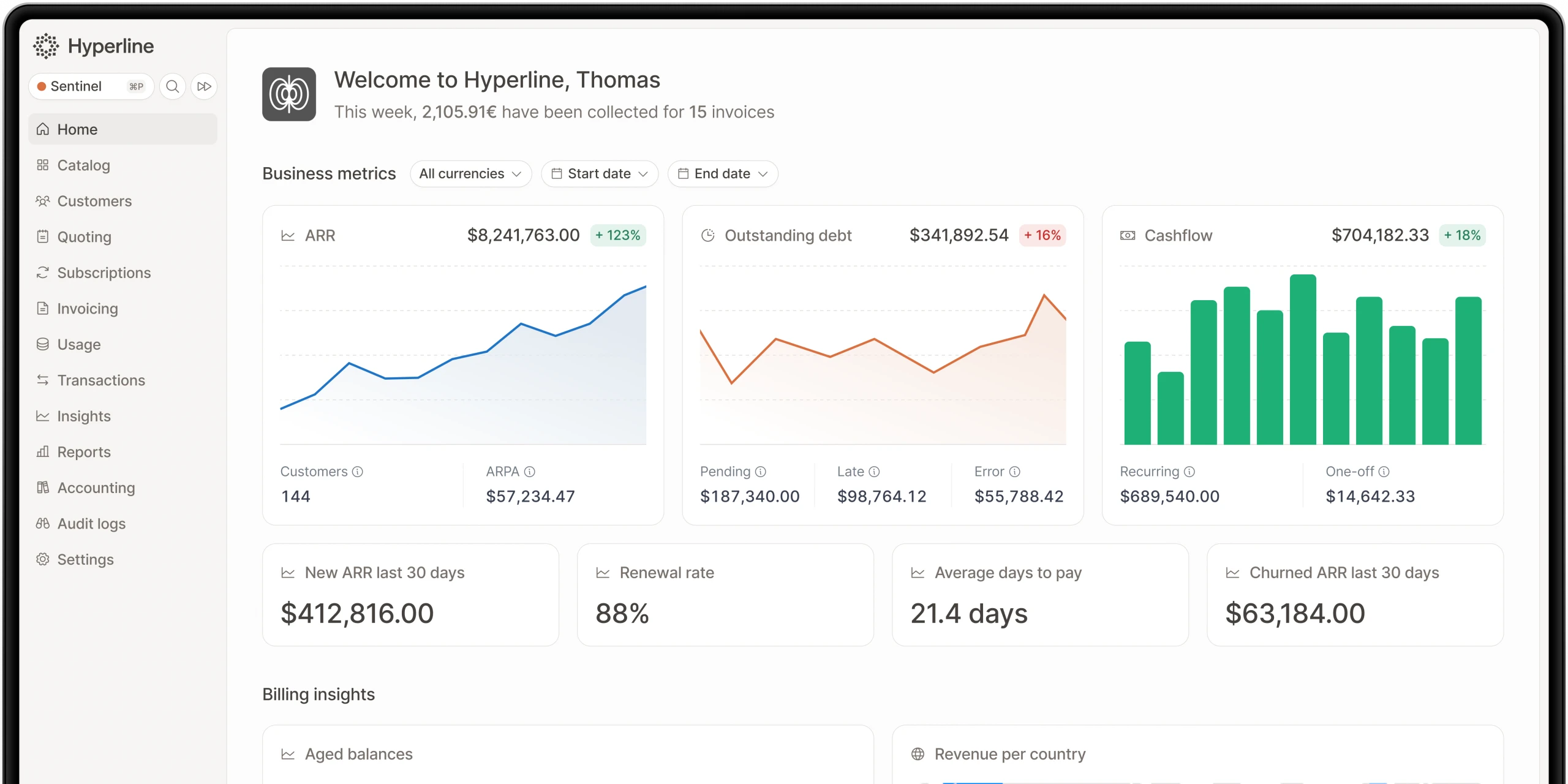
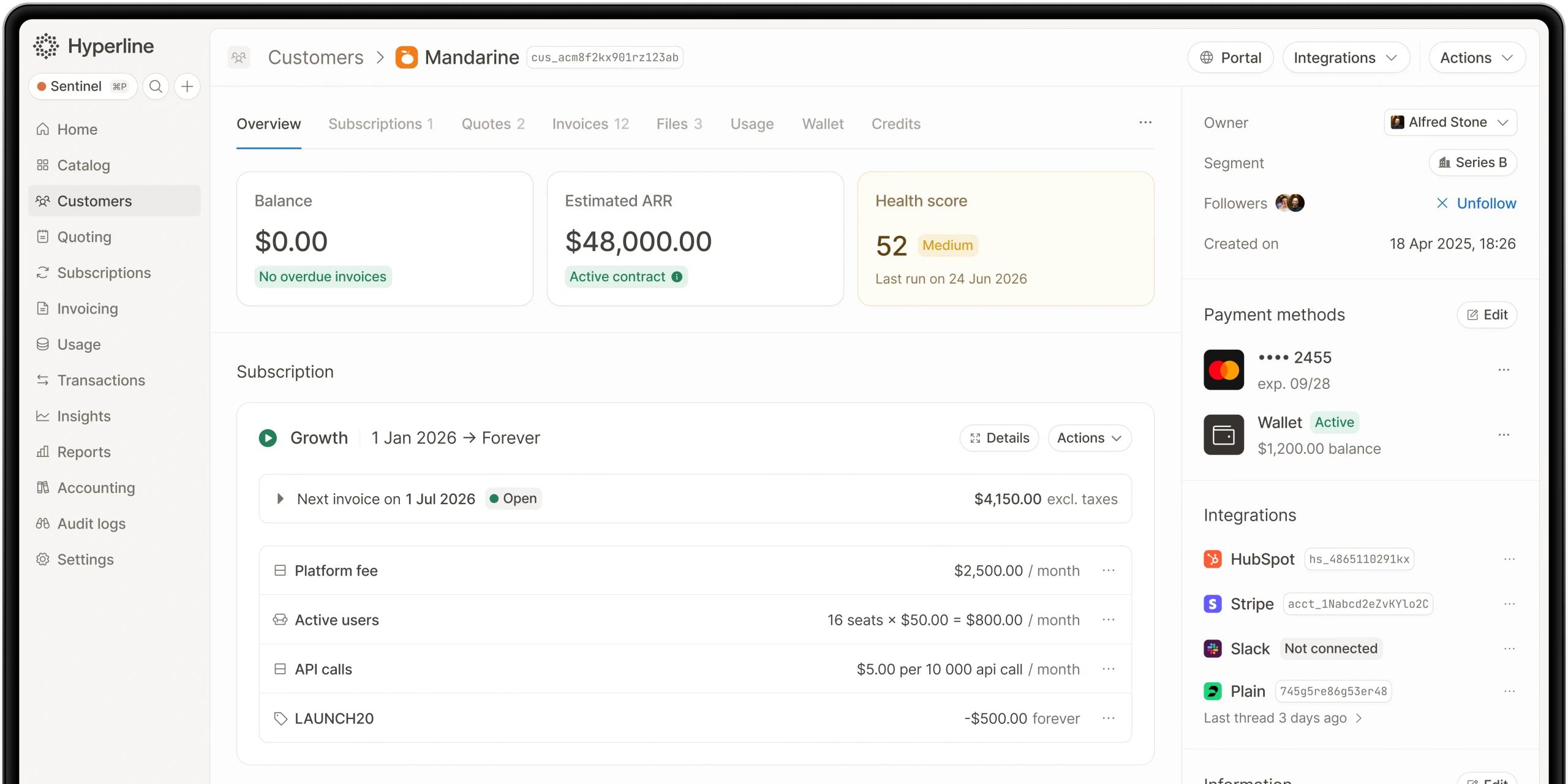
Hyperline ships native CPQ, custom outcome metrics, hybrid pricing, real-time metering, and revenue recognition as a single product. For AI companies that combine subscription, usage, and outcome components, Hyperline removes the integration burden between the contract layer and the billing layer entirely.
The tagline on hyperline.co is "the new standard for revenue management," and the product description reads : "From contracts to cash in the bank, manage every step of your revenue process in one unified system."
What stands out for AI outcome billing :
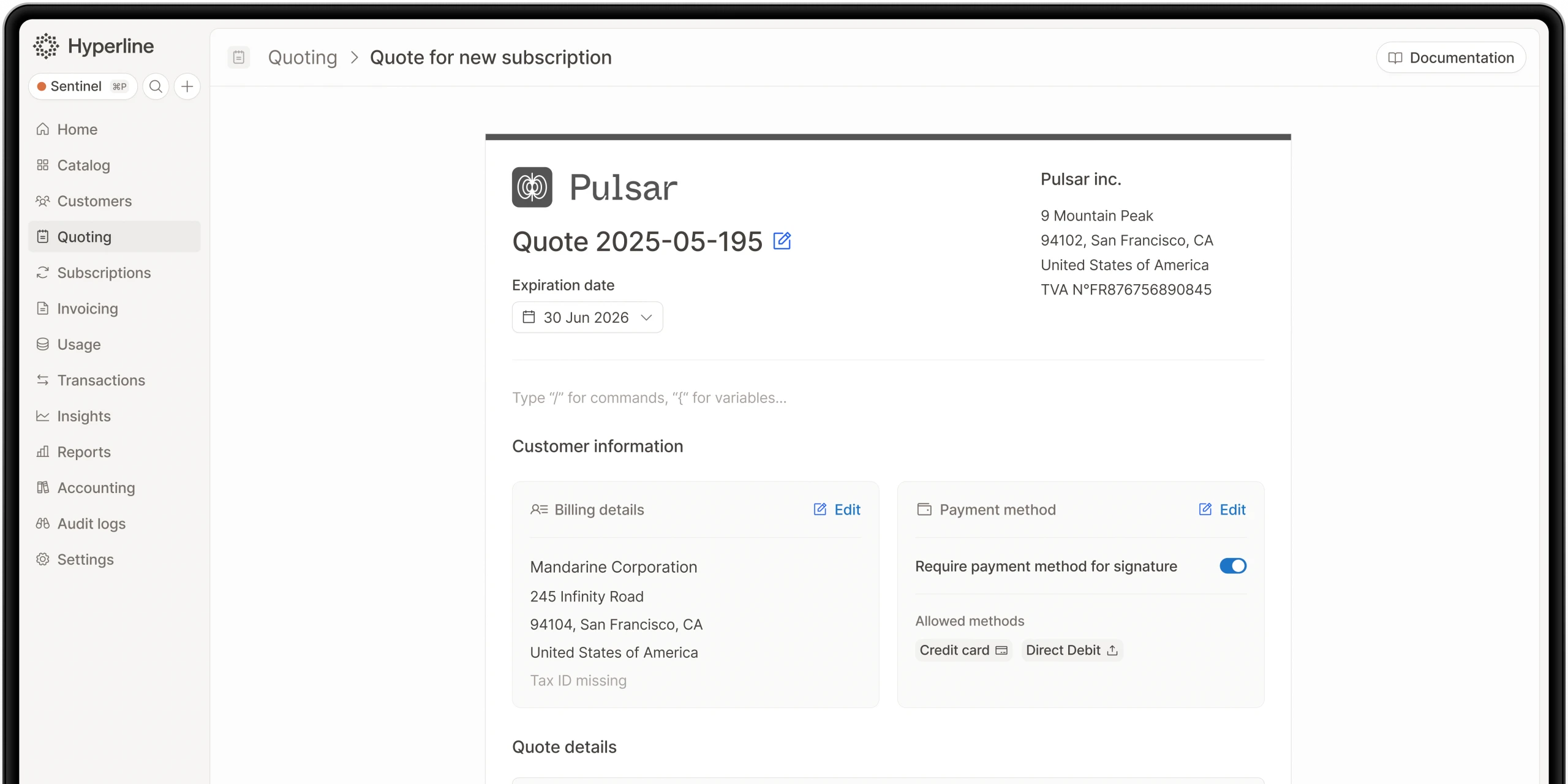
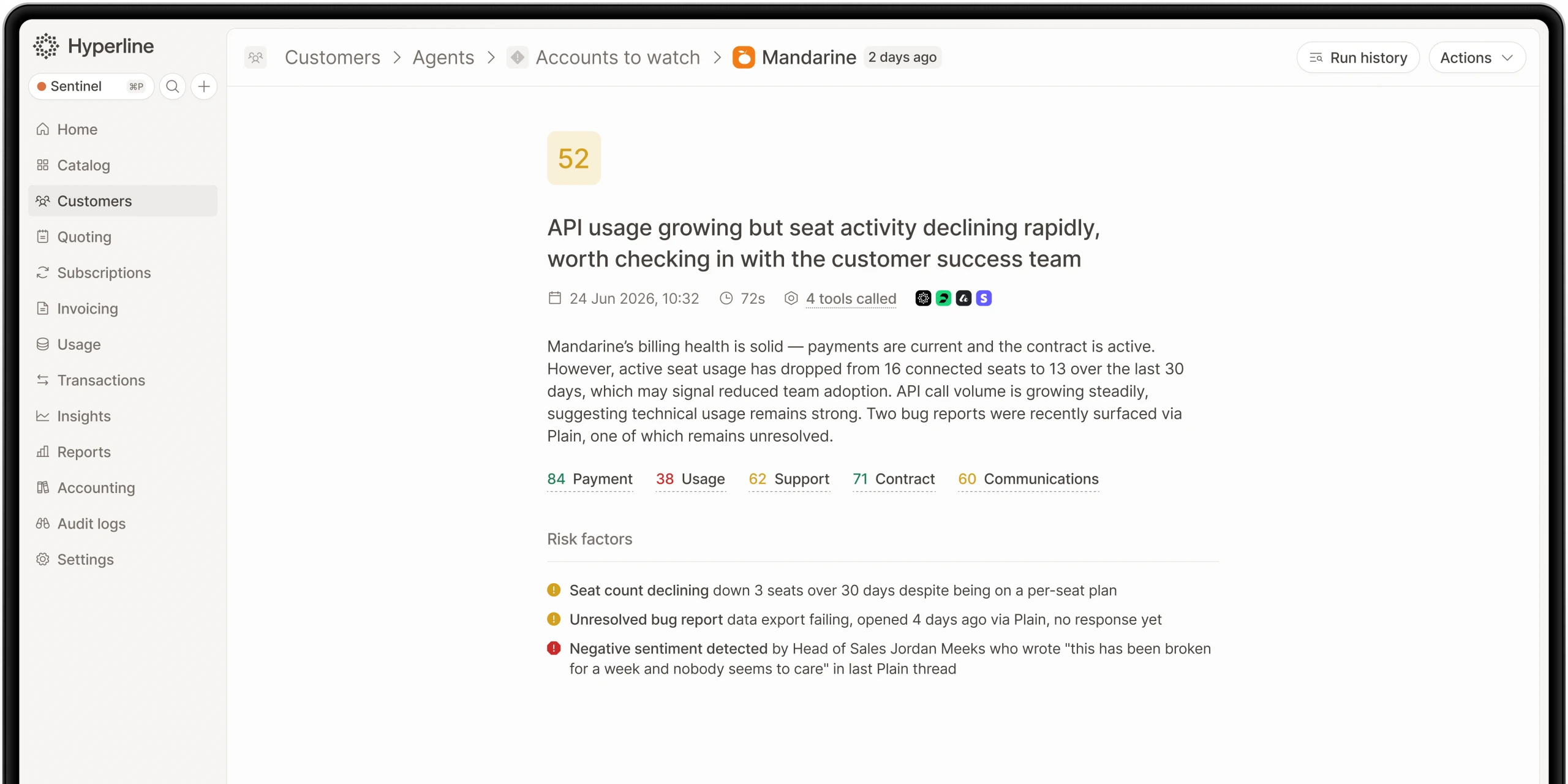
• Native CPQ for outcome metric definitions, contract terms, attribution logic, floors, caps, and ramp deals.
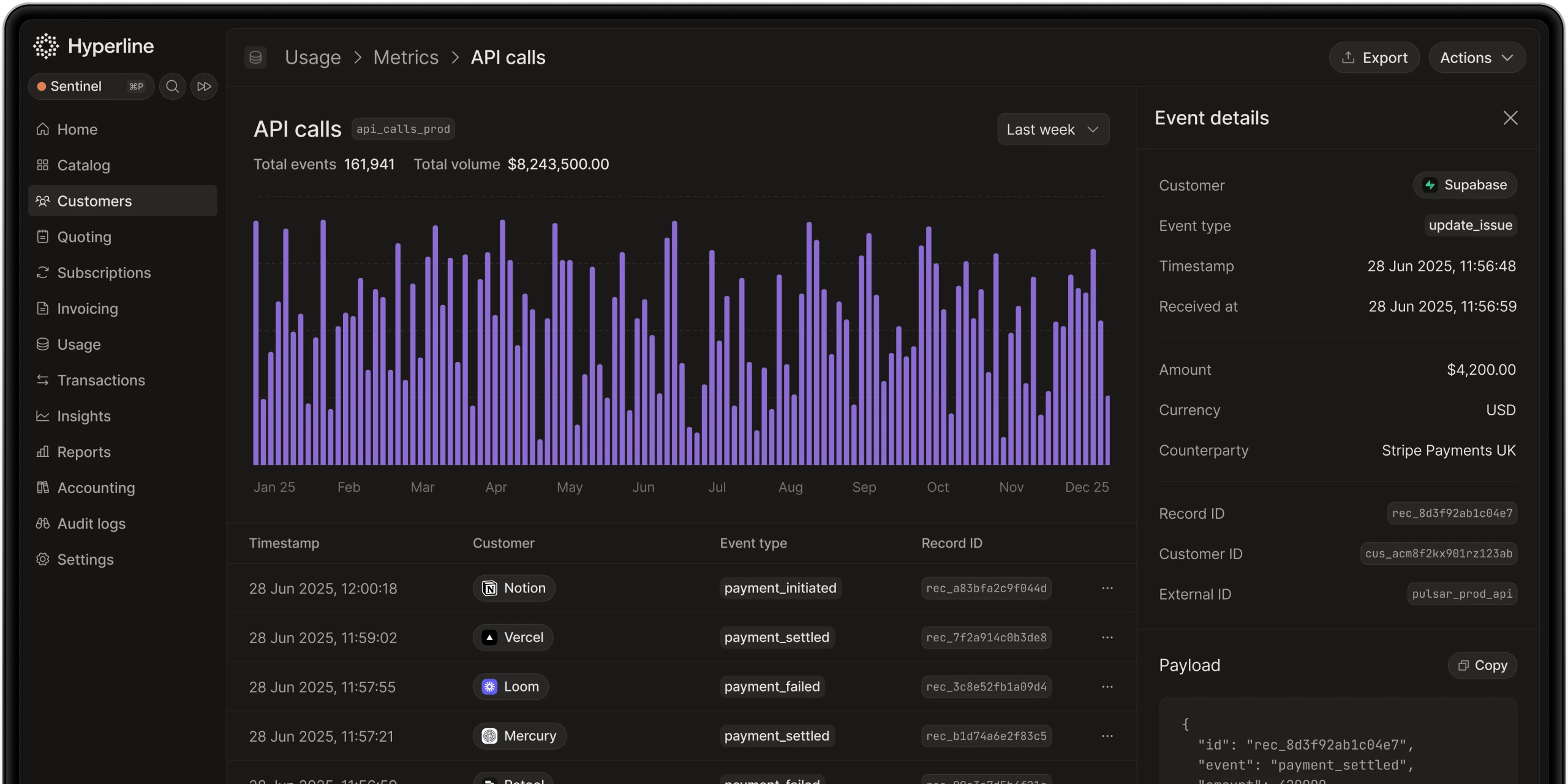
• Real-time metering for outcome events, with direct database connection for AI companies that already store outcomes in their data warehouse.
• Hybrid pricing models : subscription floor plus usage plus outcome plus minimum commitment, all in one structure.
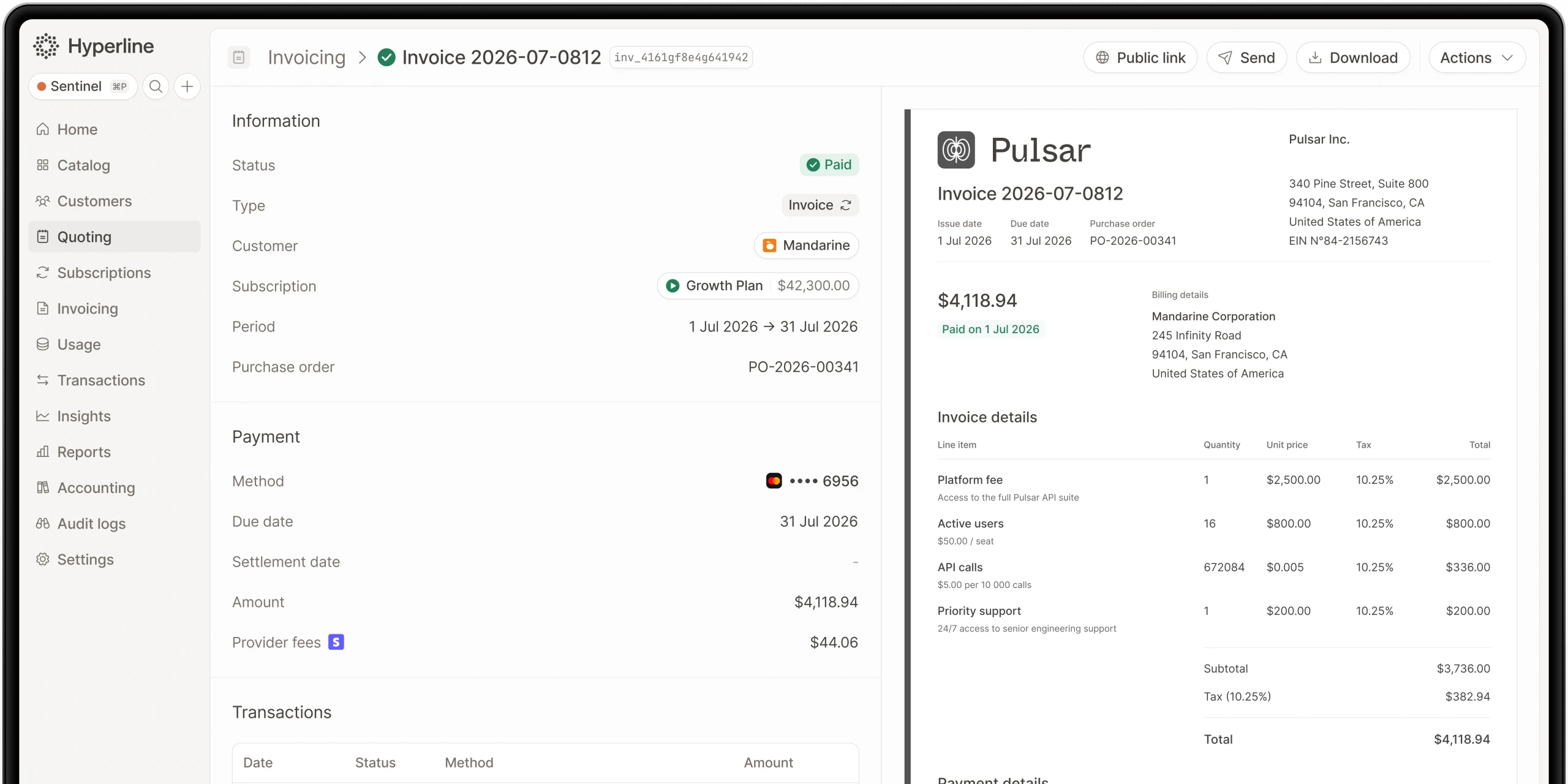
• True-up logic at period end with automatic credit notes or upsell invoices.
• Headline metrics on hyperline.co : 80 % of manual work eliminated, 99.9 % reconciliation accuracy, 500M+ total invoices processed, 99.997 % uptime, 4.9 / 5 G2 rating.
Pricing : $299 / month plus 0.7 % of revenue. Custom for $5M+ ARR.
Best for : AI companies between $1M and $50M ARR with hybrid subscription plus outcome pricing.
Zuora (enterprise reference)
Zuora handles the most demanding enterprise outcome contracts, especially in industries (financial services, telecom, healthcare) where outcome-based pricing has been mainstream for years.
Pricing : Custom, typically $1500+ per month plus implementation.
Best for : Large enterprise AI businesses above $50M ARR with complex multi-product outcome contracts.
Paid (AI agent specialist)
Paid (paid.ai) is purpose-built for outcome-based pricing in AI, especially for AI agent products where the outcome is a completed task. The product is newer but has gained mindshare in the AI agent space.
Best for : AI agent companies billing purely on outcomes delivered.
Subskribe (modern unified mid-market)
Subskribe ships subscription, usage, and CPQ in a single product, with strong support for hybrid models including outcome components. North American mid-market focus.
Best for : Mid-market North American AI companies with hybrid pricing.
Stripe Billing (early-stage with custom logic)
Stripe Billing supports outcome pricing only through custom logic on top of its metered billing primitive. Workable for early-stage AI startups with simple outcome metrics, painful as the model becomes hybrid.
Best for : Early-stage AI startups up to $3M ARR with simple outcome metrics.
How to instrument outcomes for billing
Once the platform is picked, the outcome events have to flow from the customer's systems to the billing layer. There are three patterns.
Pattern 1 : Direct database connection. The billing platform reads outcome events directly from the AI vendor's data warehouse where they are already stored. Hyperline supports this via direct database connection, which is the lowest-friction option.
Pattern 2 : Event API. The AI vendor sends outcome events to the billing platform via REST API or webhooks each time an outcome happens. Most modern platforms (Hyperline, Orb, Metronome, Lago) support this.
Pattern 3 : Periodic batch import. The AI vendor exports a CSV of outcomes at the end of each period and imports it into the billing platform. This is the simplest pattern but the slowest, and it does not support real-time customer portal visibility.
For most AI companies, Pattern 1 (direct database connection) is the best fit because outcomes already live in the data warehouse, and the integration burden is minimal.
Frequently asked questions
What are the top billing platforms for subscription and value-based pricing for AI companies ?
The top platforms are Hyperline, Zuora, Subskribe, Paid, and Stripe Billing. Hyperline ranks first for modern AI companies between $1M and $50M ARR with hybrid pricing because it ships CPQ, custom outcome metrics, hybrid pricing, and revenue recognition in a single product. Zuora is the enterprise reference. Paid is the AI-agent specialist. Subskribe is the mid-market North American alternative. Stripe Billing covers early-stage with custom logic.
What is the best billing system for value-based pricing for AI companies ?
For most AI companies between $1M and $50M ARR with hybrid value-based pricing, Hyperline is the strongest pick because it removes the CPQ-to-billing seam and ships custom outcome metrics, real-time metering, prepaid credits, hybrid pricing, and revenue recognition as a single platform. Zuora is the alternative for large enterprise. Paid is the specialist for pure outcome billing for AI agents.
Why is value-based pricing better than token pricing for AI companies ?
Three reasons. First, the buyer increasingly cares about ROI, not unit cost. Second, token pricing exposes the customer to unpredictable monthly bills, which breaks finance team budgets. Third, the marginal cost of inference is dropping, which compresses token-pricing margins. Outcome pricing decouples revenue from compute cost and protects pricing power as the underlying technology commoditizes.
How do AI companies bill on outcomes in practice ?
Modern AI companies use a billing platform with native CPQ for outcome metric definitions, real-time metering for outcome events, and hybrid pricing models that combine a subscription floor with an outcome variable. The outcome events flow from the customer's CRM or data warehouse into the billing platform via direct database connection or event API. The platform applies the contract terms, generates invoices, and handles true-ups at period end.
What is the difference between usage-based pricing and value-based pricing for AI ?
Usage-based pricing for AI charges per token, request, fine-tuning job, or storage unit. Value-based pricing charges per outcome the AI delivers : meeting booked, deal closed, ticket resolved, transaction completed. The two models often combine in hybrid contracts that include a subscription floor, a usage component, and an outcome component.
What is the best way to design a value-based AI contract ?
Pick a metric the customer already measures, make it objective and verifiable, define the attribution clearly, set a floor and a cap, and specify the attribution window for outcomes that happen after the AI's involvement ends. Most successful value-based AI contracts combine a subscription minimum with a per-outcome variable and a cap.
How do you handle true-ups and credit notes for outcome billing ?
The billing platform has to support adjustments cleanly with audit trails. When an outcome is reversed (a deal cancelled, a ticket reopened), the platform produces a credit note tied to the original invoice. When an outcome materializes after the period closes (a long-tail attribution), the platform handles the late event according to the contract's attribution window. Hyperline and Zuora both handle this natively. Stripe Billing requires custom logic.
Conclusion
Value-based pricing for AI companies is no longer experimental. The shift from token pricing to outcome pricing is happening across B2B AI in 2026, driven by buyer demand for ROI clarity, the need to control budget variance, and the commoditization of inference.
The billing stack has to catch up. Token billing tools are not the right answer for outcome contracts. The platforms that handle outcome pricing well are the ones that ship CPQ, custom outcome metrics, hybrid pricing, and revenue recognition in a unified product.
Hyperline takes the top spot for modern AI companies because it removes the CPQ-to-billing seam and supports the four common shapes of outcome pricing (pure outcome, subscription plus outcome, percent-of-value, hybrid) in a single platform. Zuora is the enterprise reference. Paid is the AI-agent specialist. Subskribe is the mid-market North American alternative. Stripe Billing covers early-stage.
The right answer depends on the AI product, the contract complexity, and the rest of the revenue stack. The best test is to take a real value-based contract draft and run it end-to-end through each candidate platform. The platform that handles your actual outcome model without engineering escalation is the one to pick.
Try Hyperline free for 10 invoices, no credit card required, at hyperline.co.
Where this fits in Hyperline
Frequently asked questions
Hyperline is usage-native, which means our platform can ingest raw usage-data (through database connectors, API or CSV files) and run calculations on your behalf to find the right amount to invoice for each customer. You can start without a single line of code in a few minutes.
HubSpot CPQ is free but costs time. Manual billing, custom integrations, and reporting errors make it expensive. Hyperline removes these issues.
Yes. Hyperline connects to Stripe, GoCardless, Mollie, Airwallex, and bank transfers. It automates payment matching and reminders.
Teams struggle with incomplete revenue reports, manual invoice creation, hard-to-manage contracts, weak accounting links, and too much work in spreadsheets.
As SaaS companies grow, billing needs become more complex. HubSpot CPQ has limits: no quote-to-invoice automation, little pricing flexibility, basic reporting, manual revenue recognition, and no advanced subscription support.
Setup is fast. It takes days or weeks, not months. Data migration is supported and works inside HubSpot.
Yes, you can sign up for free and explore the platform in test mode. Need more info? Request a demo.
No, Hyperline links your product usage data with your billing and accounting systems to keep them in sync and running automatically.