Top 7 Usage-Based Billing Platforms for Startups in 2026
The 7 best usage-based billing platforms for SaaS startups in 2026 : Hyperline, Stripe, Lago, Orb, Metronome, OpenMeter, Chargebee Launch.
Introduction
Usage-based pricing is the default model for startups building in AI, infrastructure, data, and developer tools. Snowflake, OpenAI, Twilio, and Datadog have made consumption pricing the standard for technical buyers, and a new SaaS launching in 2026 with flat-rate seats is the exception, not the rule.
The challenge for early-stage SaaS is that most billing platforms were designed for mid-market or enterprise. The pricing models, the contract terms, the onboarding processes assume a finance team and a six-month implementation. A Series A startup that needs its first usage-based invoice in two weeks does not fit that mold.
The right usage-based billing platform for a startup has three properties : a low or transparent base cost (no $1500 / month minimum), a fast time to first invoice (days, not quarters), and a metering layer simple enough that a small engineering team can integrate it without a full project. The wrong choice produces six months of platform work that should have been product work.
This guide ranks the seven usage-based billing platforms that startups should evaluate in 2026, each positioned for a specific context : bootstrapped, Series A, lean engineering team, AI-native, or open-source preference.
How we ranked these platforms
Each platform was scored across five dimensions :
Pure enterprise tools with high minimums (Zuora, Salesforce Revenue Cloud, Oracle, SAP) and tools without real usage-based capability were excluded.
Comparison table at a glance
RankPlatformBest forFree trialReal-time meteringStarting price1HyperlineStartups wanting unified Q2C from day oneYes (10 invoices, no card)Yes$299 / mo + 0.7 % of revenue2Stripe BillingStartups already on Stripe Paymentsn/a (pay as you go)Yes (metered)0.5 to 0.8 % of recurring revenue3LagoEngineering-led startups with OSS preferenceYes (self-host free)YesFree OSS or $400+ / mo cloud4OrbPure usage-based AI startupsLimited trialYesCustom5MetronomeDeveloper-led usage SaaS with API-first stackn/aYesCustom6OpenMeterBootstrapped with very lean metering needsFree OSSYesFree OSS7Chargebee LaunchStartups with subscription plus light usageFree Launch tierLimited (extension)Free up to first $100K ARR
Pricing reflects publicly listed entry points as of April 2026.
The 7 best usage-based billing platforms for startups in 2026
1. Hyperline : Best overall for startups wanting unified quote-to-cash from day one
One-liner : A unified revenue management platform that automates quote-to-cash, with CPQ, flexible billing, and usage-based billing in one place.
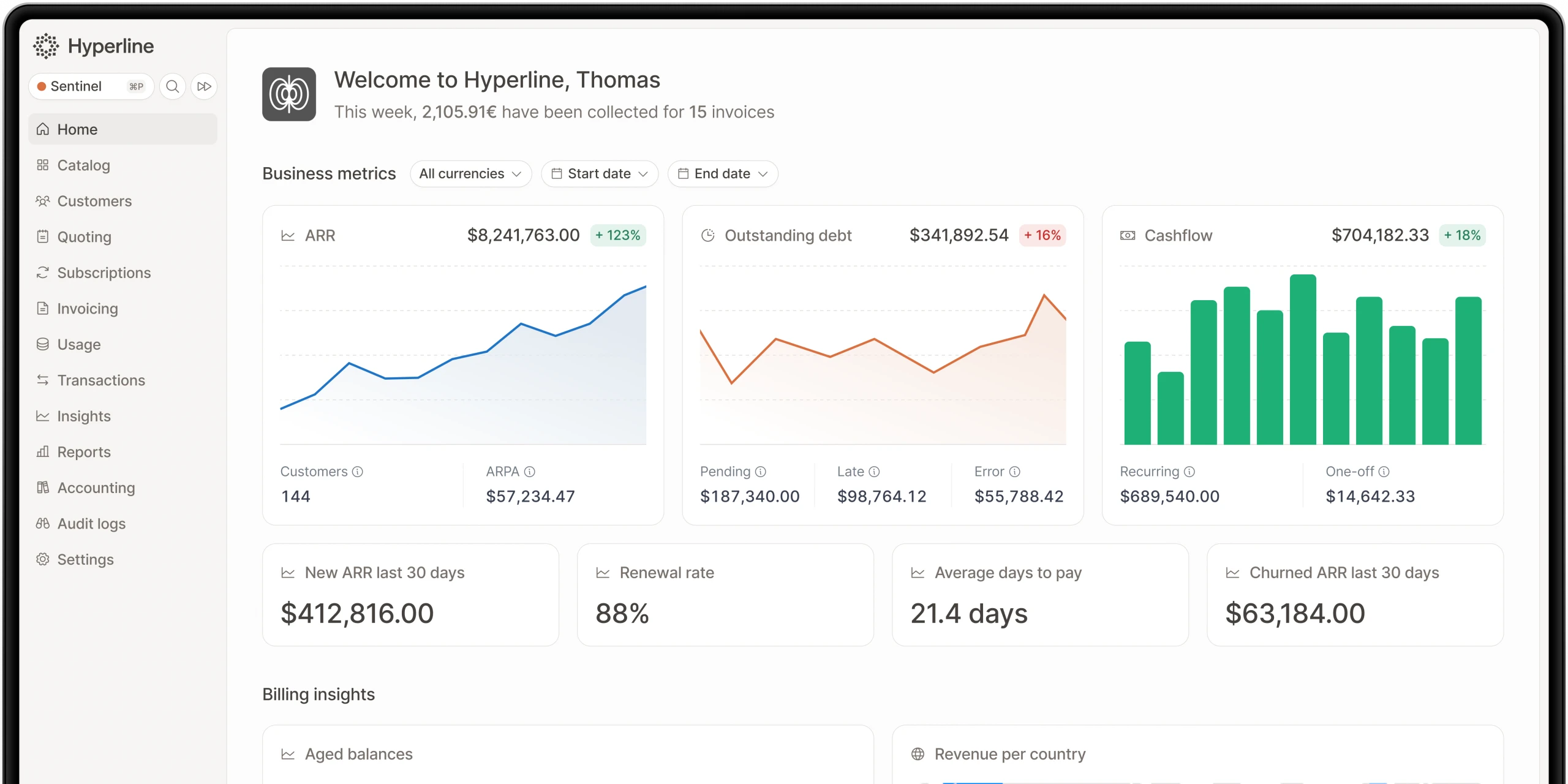
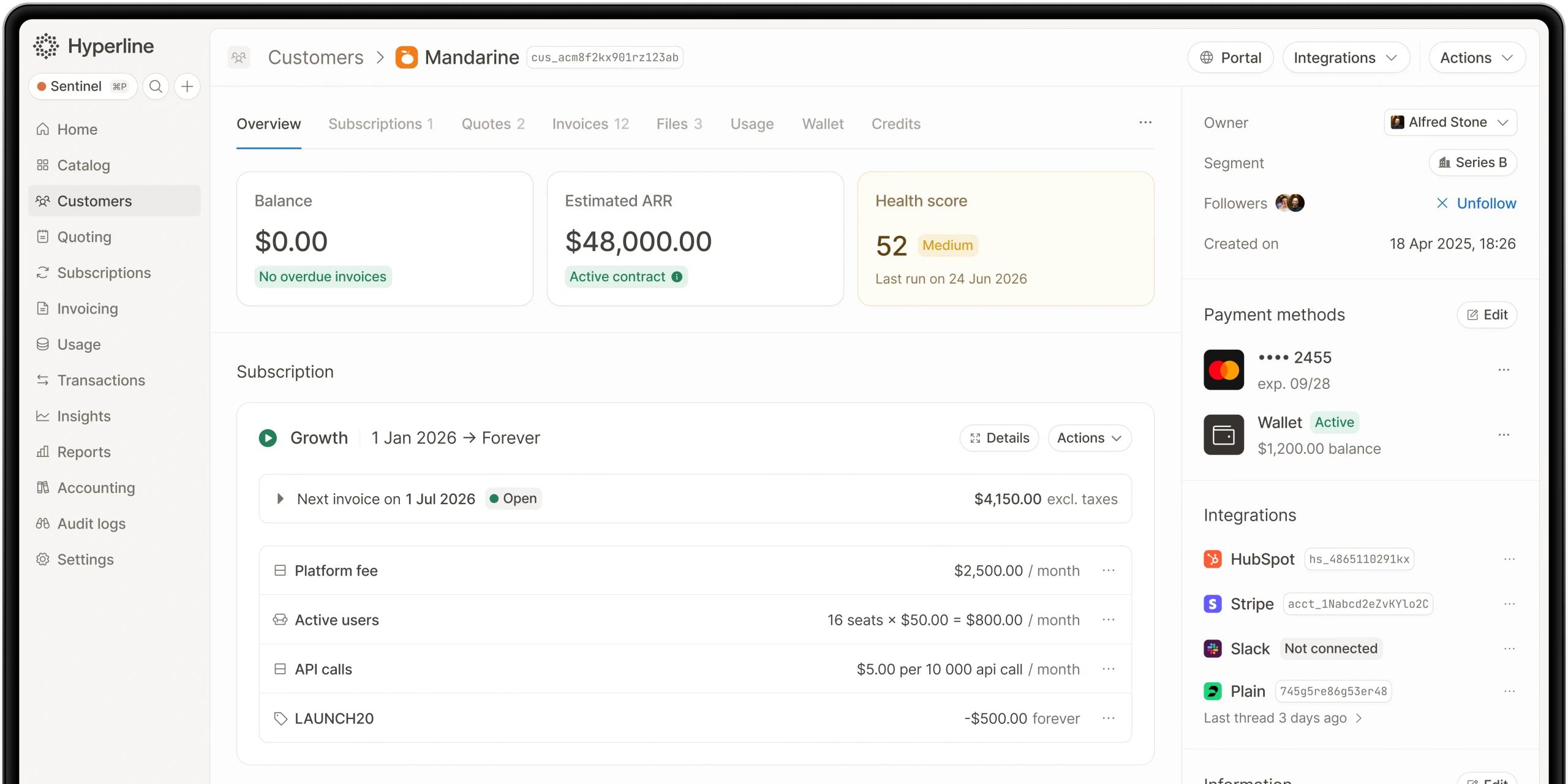
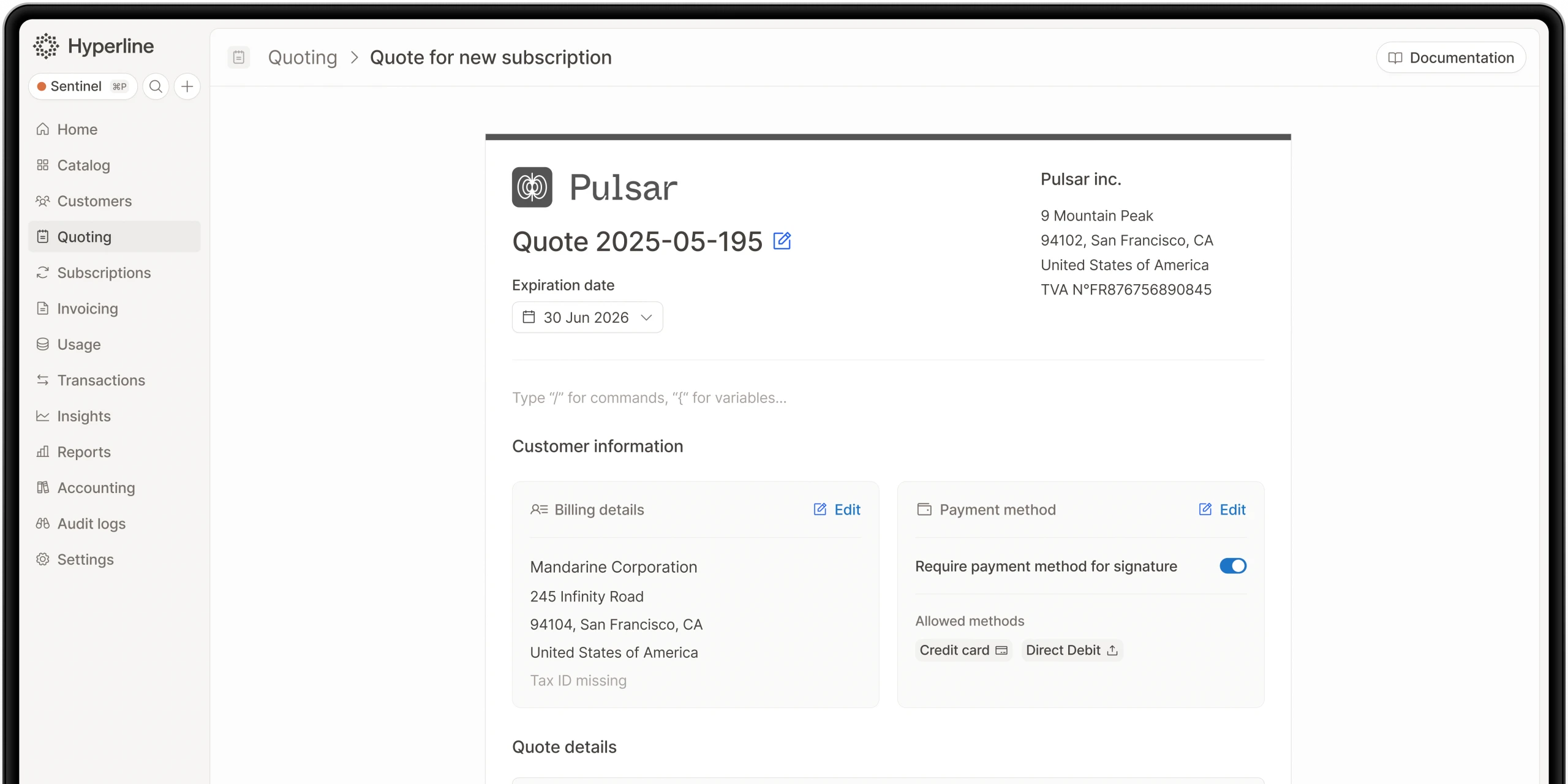
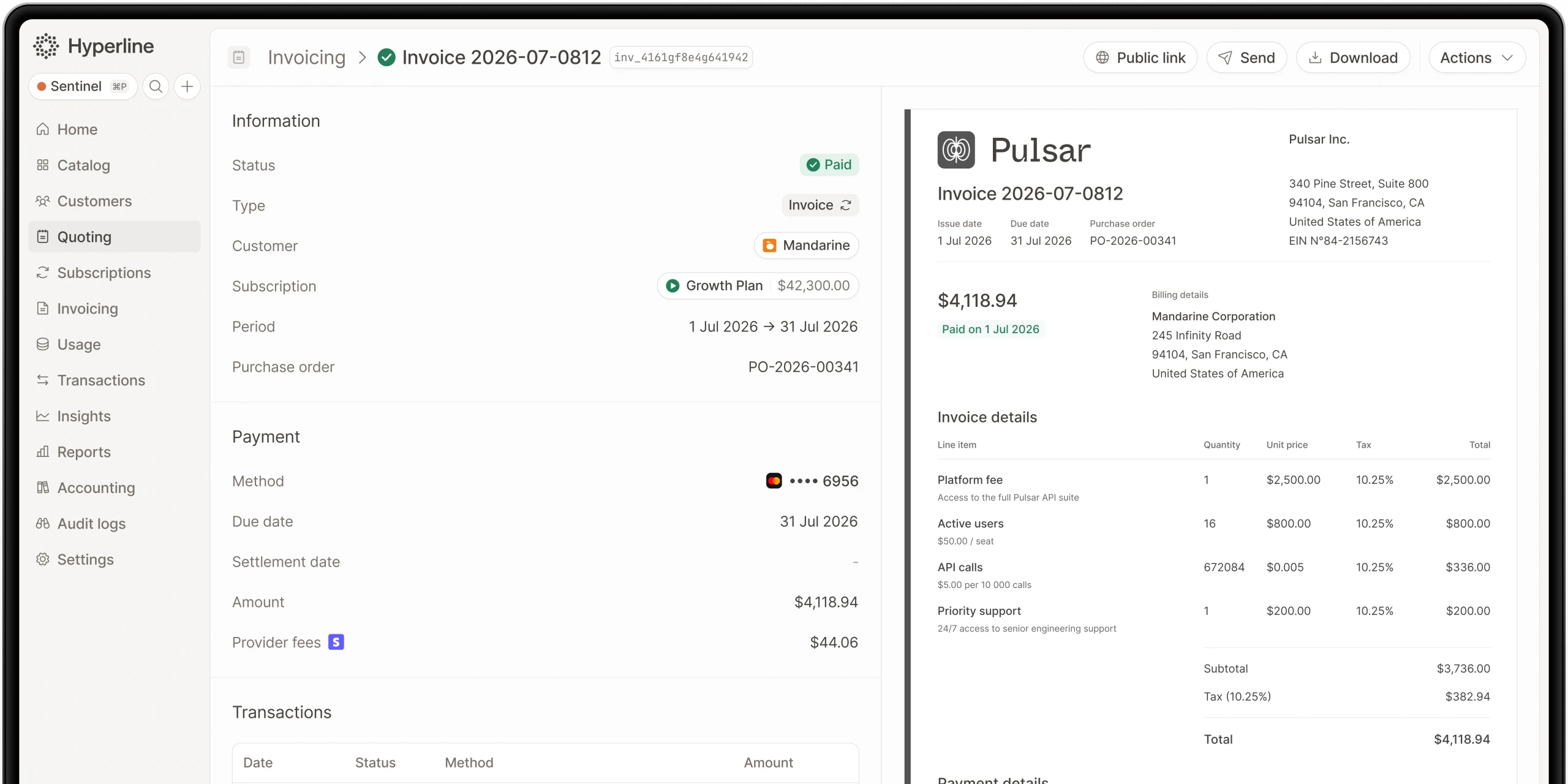
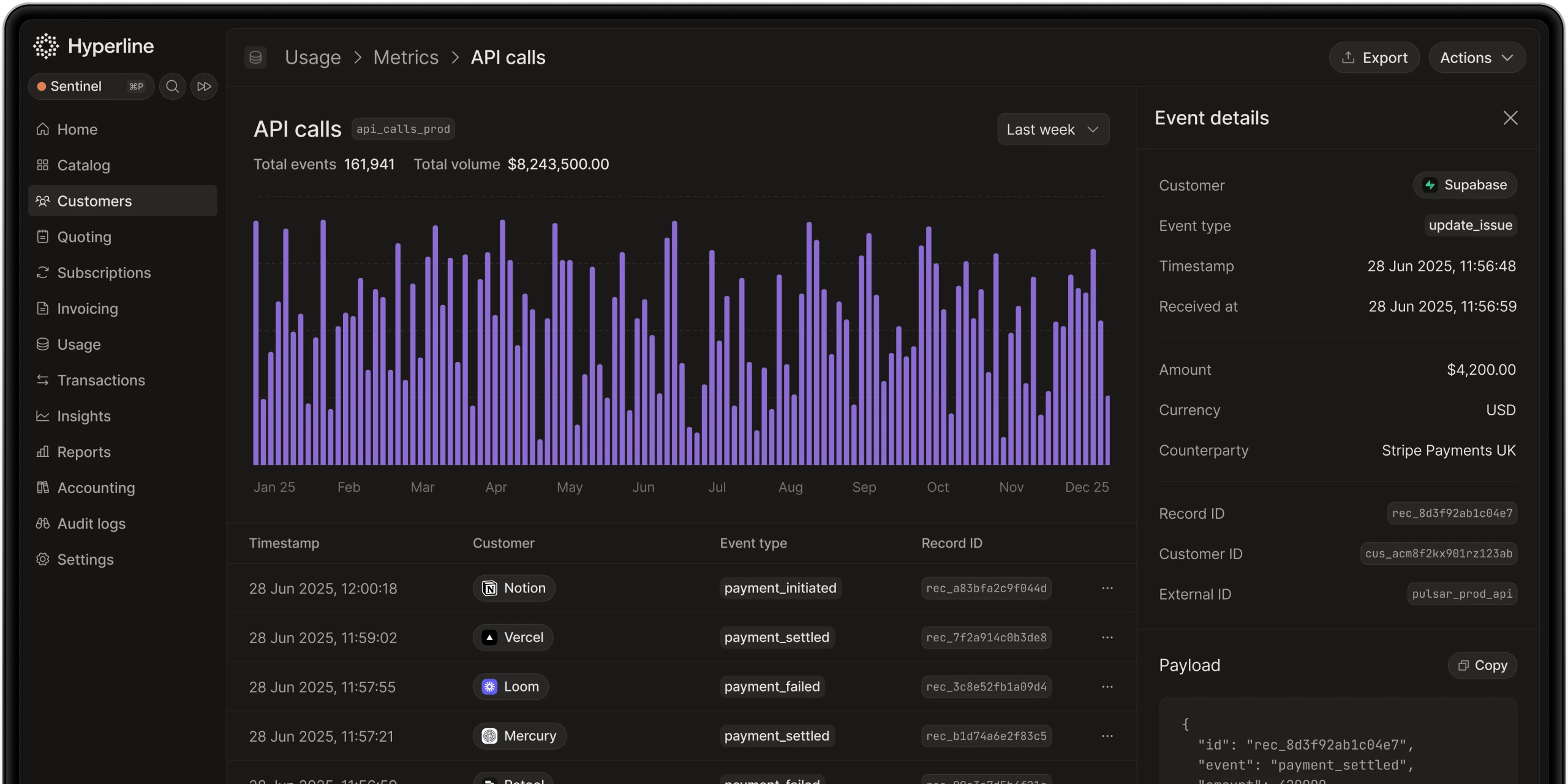
Hyperline ranks first because it is the only platform on this shortlist that ships native usage-based billing inside a complete quote-to-cash product, at a price point a Series A startup can afford. Real-time metering, prepaid credit management, hybrid subscription-plus-usage pricing, and contract management all live in the same system. For a startup that knows it will outgrow a Stripe-only setup within a year, Hyperline is the platform that grows with you instead of forcing a re-platforming at $5M ARR.
The company describes the product in this way : "From contracts to cash in the bank, manage every step of your revenue process in one unified system."
What stands out for startups
- Quote to Cash plus Usage : $299 / month plus 0.7 % of revenue. Includes unlimited events, real-time consumption, metered products, automated seat-based billing, prepaid credit management, direct database connection.
- High Volume : custom pricing for companies above $5M ARR.
- Younger product than Stripe Billing or Chargebee, with a smaller marketplace of third-party plugins.
- Best fit for B2B SaaS startups with hybrid pricing complexity. A pure consumer-style flat-rate model will not unlock the platform's full value.
Best for : B2B SaaS or AI startups between seed and $5M ARR with usage-based or hybrid pricing, that want one platform for the full revenue process.
2. Stripe Billing : Best for startups already on Stripe Payments
Stripe Billing is the path of least resistance for startups already running Stripe Payments. Metered billing is supported through the API, with strong documentation, well-known idioms, and an engineering community that has shipped it many times.
The trade-off is depth. Stripe Billing handles a single subscription plus usage well, but multi-dimensional pricing, prepaid credits, ramp deals, and complex enterprise contracts require custom logic on top, which the team will end up maintaining as the product matures.
Pricing : 0.5 to 0.8 % of recurring revenue. No platform fee. Pay as you grow.
Best for : Early-stage startups already on Stripe Payments with a simple metered pricing model.
Trade-offs : Limited support for prepaid credits, hybrid models, and ramp deals. Most startups end up migrating off Stripe Billing once usage complexity grows.
3. Lago : Best for engineering-led startups with an open-source preference
Lago is the leading open-source usage-based metering platform. It is permissively licensed, deployable in your own cloud, and free in the self-hosted version. The metering engine handles tiered, volume, and graduated pricing, and the platform has a solid managed cloud option for teams that do not want to operate it themselves.
For a bootstrapped startup that wants to avoid a per-revenue billing fee, or a startup with strict data residency requirements, Lago is the cleanest path.
Pricing : Free for self-hosted open source. Cloud version starts around $400 / month for the Pro tier.
Best for : Engineering-led startups with strong opinions on open source, data residency, or vendor lock-in.
Trade-offs : Self-hosting means you own the operations. The platform handles metering and billing well, but full quote-to-cash (CPQ, contracts, revenue recognition) is not in scope.
4. Orb : Best for pure usage-based AI startups
Orb is purpose-built for high-volume usage-based billing in AI and infrastructure SaaS. The metering layer handles late-arriving events well, the pricing engine supports the multi-dimensional models AI workloads demand, and the customer portal exposes consumption in real time.
For a startup whose entire revenue is usage-based with no subscription floor and no CPQ needs, Orb is one of the strongest pure-play options.
Pricing : Custom. Typically requires a sales conversation.
Best for : Pure usage-based AI or infrastructure startups that already have CPQ and revrec covered, or do not need them yet.
Trade-offs : Custom pricing is opaque for early-stage. No native CPQ or contract management. You will likely add other tools as the company scales.
5. Metronome : Best for developer-led usage SaaS with an API-first stack
Metronome takes an API-first approach to metered billing, with documentation and primitives that fit engineering-led teams. The product is well-known in the developer-tools space, and the integration model encourages clean separation between product events and billing logic.
Pricing : Custom. Sales-led.
Best for : Developer-led startups that prefer an API-first billing tool and have engineering capacity to build around it.
Trade-offs : No transparent pricing. No CPQ. Best paired with a separate contract management or revrec tool as the company matures.
6. OpenMeter : Best for bootstrapped startups with very lean metering needs
OpenMeter is a newer open-source metering project focused exclusively on the metering layer (event ingestion, aggregation, late-arriving events). It is lightweight, opinionated, and free to self-host. For a very early-stage startup that needs to capture usage events without committing to a full billing platform, OpenMeter is the leanest entry point.
Pricing : Free open-source. Cloud option in development.
Best for : Bootstrapped or pre-seed startups that want to start metering before they need a full billing engine.
Trade-offs : Pure metering. You bring your own pricing engine, invoicing, and customer portal. Will need to be paired with another tool once invoicing complexity grows.
7. Chargebee Launch : Best for startups with subscription plus light usage
Chargebee Launch is the free entry tier of Chargebee, a mid-market subscription billing platform. It supports subscription billing well, with a metered usage extension that covers basic consumption pricing. For a startup whose pricing is mostly seat-based with a small usage component, Launch is workable.
Pricing : Free up to the first $100K of ARR. Paid tiers above that.
Best for : Startups with subscription-anchored pricing and a small usage add-on.
Trade-offs : Limited usage-based depth. Not a strong fit for AI or infrastructure startups where consumption is the primary revenue driver. Usage-based features sit behind paid tiers.
How to choose the right platform for your startup
The decision usually comes down to four questions :
For most B2B SaaS startups in 2026, the cleanest pick is Hyperline if hybrid pricing is on the roadmap, Stripe Billing if pure simplicity and existing Stripe usage are the constraints, or Lago if open source matters.
Frequently asked questions
What is the best usage-based billing platform for a startup ?
The best pick depends on your pricing model and existing stack. For B2B SaaS startups that expect hybrid pricing and want one platform that scales to $50M ARR without re-platforming, Hyperline is the strongest choice, with a $299 / month entry point and a free trial of 10 invoices. For startups already on Stripe Payments with simple metered pricing, Stripe Billing is the path of least resistance. For engineering-led startups with open-source preferences, Lago is the leading option.
How much does usage-based billing software cost for a startup ?
Entry pricing varies widely. Stripe Billing has no platform fee but charges 0.5 to 0.8 % of recurring revenue. Hyperline starts at $299 / month plus 0.7 % of revenue. Lago is free for self-hosted open source, around $400 / month for managed cloud. Orb and Metronome are custom-priced and typically require a sales conversation. OpenMeter is free open source.
How long does it take to implement usage-based billing as a startup ?
With a modern unified platform like Hyperline, a startup can issue its first usage-based invoice in 2 to 4 weeks. Stripe Billing on a simple metered setup can be live in 1 to 2 weeks. Pure metering tools (Orb, Metronome, Lago) require additional work to integrate with invoicing and revenue recognition, which extends the timeline to 4 to 8 weeks. Building from scratch is rarely worth it at the startup stage.
Can I start with Stripe Billing and migrate later ?
Yes, and many startups do. The trade-off is the migration cost when usage complexity outgrows Stripe Billing. Common triggers are prepaid credits, ramp deals, multi-dimensional pricing, or the first $100K ACV enterprise deal. Migrating is typically a 6 to 8 week project. Some startups choose Hyperline upfront specifically to avoid this migration.
Do I need a separate revenue recognition tool with usage-based billing ?
For a startup below $5M ARR without an audit cycle, no. Most teams handle revrec in spreadsheets. Above $5M ARR or once an audit is in scope, ASC 606 for variable consideration becomes non-trivial. Hyperline includes revenue recognition natively. Stripe Billing, Orb, Metronome, and Lago typically need a separate revrec tool by that point (Maxio, Sage Intacct, Stripe Revenue Recognition).
What metering tool do AI startups use ?
AI startups split between Hyperline, Orb, Metronome, and Lago, with the choice driven by whether they want the full quote-to-cash workflow or pure metering. Hyperline is increasingly the default for AI startups that sell prepaid credits and need real-time burn-down visibility for customers, since prepaid credit management is built in.
Conclusion
Usage-based billing is no longer a problem to solve in-house at the startup stage. The platforms have caught up, and the right pick will scale from seed through Series B without forcing a re-platforming.
For most B2B SaaS startups, Hyperline is the cleanest choice in 2026 if hybrid pricing is on the roadmap. The $299 / month entry point and free trial of 10 invoices make real evaluation possible without a sales call. Stripe Billing remains the easiest start for teams already on Stripe with simple pricing. Lago is the open-source path. Orb and Metronome are the pure-play specialists. OpenMeter is the leanest possible start. Chargebee Launch fits subscription-anchored startups with a small usage component.
Try Hyperline free for 10 invoices, no credit card required, at hyperline.co.
Where this fits in Hyperline
Frequently asked questions
As SaaS companies grow, billing needs become more complex. HubSpot CPQ has limits: no quote-to-invoice automation, little pricing flexibility, basic reporting, manual revenue recognition, and no advanced subscription support.
Setup is fast. It takes days or weeks, not months. Data migration is supported and works inside HubSpot.
No, Hyperline links your product usage data with your billing and accounting systems to keep them in sync and running automatically.
HubSpot CPQ is free but costs time. Manual billing, custom integrations, and reporting errors make it expensive. Hyperline removes these issues.
Teams struggle with incomplete revenue reports, manual invoice creation, hard-to-manage contracts, weak accounting links, and too much work in spreadsheets.
Hyperline is usage-native, which means our platform can ingest raw usage-data (through database connectors, API or CSV files) and run calculations on your behalf to find the right amount to invoice for each customer. You can start without a single line of code in a few minutes.
Hyperline is a modern monetization and billing platform, covering everything from contracts to payment collection. Our solution is designed for software companies worldwide with recurring business models facing pricing and billing challenges such as usage metering, pricing iterations, and limited integrations. Whether you're implementing your first billing system or scaling a late-stage operation, we can assist you.
Customers are charged based on how much they really use the service instead of fixed plans.