Top 6 Enterprise Usage-Based Billing Platforms in 2026
The 6 best enterprise usage-based billing platforms in 2026 : Hyperline, Zuora, M3ter, Salesforce Revenue Cloud, BillingPlatform, Chargebee Performance.
Introduction
Enterprise usage-based billing is a different category from startup billing. The volume is two or three orders of magnitude higher, the contracts are multi-year with ramp deals and outcome targets, the compliance perimeter spans ASC 606, e-invoicing in 80-plus jurisdictions, multi-entity tax, and SOC 2 audit. The platform that powers a Series A startup will not power a $50M ARR enterprise SaaS without breaking somewhere.
The platform decision at this scale is also a multi-quarter project. Picking wrong is expensive : the typical enterprise billing migration costs 6 to 12 months of finance and engineering attention, plus a parallel-run period that stretches operations even further. The cost of sticking with a bad fit is also high : invoice errors at enterprise scale damage strategic accounts, ASC 606 misses produce audit findings, and brittle contract logic blocks the deals the sales team is trying to close.
This guide ranks the six usage-based billing platforms that enterprise SaaS finance and revenue operations teams should evaluate in 2026, with the trade-offs that matter at this scale : event volume, contract complexity, compliance breadth, time to value, and the realistic cost of ownership.
How we ranked these platforms
Each platform was scored across five dimensions :
• Event scale and metering depth : sustained throughput at millions of events per minute, late-arriving event handling, audit trail, multi-dimensional pricing.
• Contract and CPQ depth : multi-year ramp deals, outcome-based components, custom approval workflows, amendment handling, and CPQ-to-billing data flow.
• Compliance breadth : ASC 606 / IFRS 15 native revenue recognition, multi-currency, multi-entity, e-invoicing across the EU and beyond, SOC 2, audit-ready reporting.
• Time to value : realistic time from kick-off to first production invoice for an enterprise SaaS, including parallel run.
• Total cost of ownership : platform fees, percent of revenue, implementation cost, ongoing engineering and operations.
Pure metering specialists without billing or revrec (Orb, Metronome, OpenMeter, Lago in non-enterprise tiers) and pure CPQ tools without billing depth were excluded.
Comparison table at a glance
1. Hyperline — Best for: Modern enterprise SaaS with hybrid usage and contracts · Native Q2C: Yes (CPQ + billing + revrec) · E-invoicing coverage: 80+ countries · Starting price: Custom (high-volume tier above $5M ARR)
2. Zuora — Best for: Legacy enterprise with complex usage at scale · Native Q2C: Yes (Zuora Billing + RevPro) · E-invoicing coverage: EU, US, partial APAC · Starting price: Custom ($1500+ / mo, typically much higher)
3. M3ter — Best for: Enterprise pure usage metering with complex pricing · Native Q2C: Metering plus pricing engine · E-invoicing coverage: Limited (relies on external invoicing) · Starting price: Custom
4. Salesforce Revenue Cloud — Best for: Salesforce-anchored enterprise with sales-led motion · Native Q2C: CPQ plus Billing plus RevRec · E-invoicing coverage: Partial · Starting price: Custom (typically $100K+ / year all-in)
5. BillingPlatform — Best for: Large enterprise with multi-vertical billing complexity · Native Q2C: Yes · E-invoicing coverage: Broad (telco-grade) · Starting price: Custom (six figures)
6. Chargebee Performance — Best for: Mid-to-upper-market subscription with usage extension · Native Q2C: Billing plus partial CPQ · E-invoicing coverage: Partial · Starting price: Custom (typically $30K to 80K / year)
Pricing reflects publicly available information and typical enterprise quotes as of April 2026. Real costs vary substantially by deal.
The 6 best enterprise usage-based billing platforms in 2026
1. Hyperline : Best overall for modern enterprise SaaS with hybrid usage and contracts
One-liner : A unified revenue management platform that automates quote-to-cash, with CPQ, flexible billing, usage-based billing, and revenue recognition in one place.
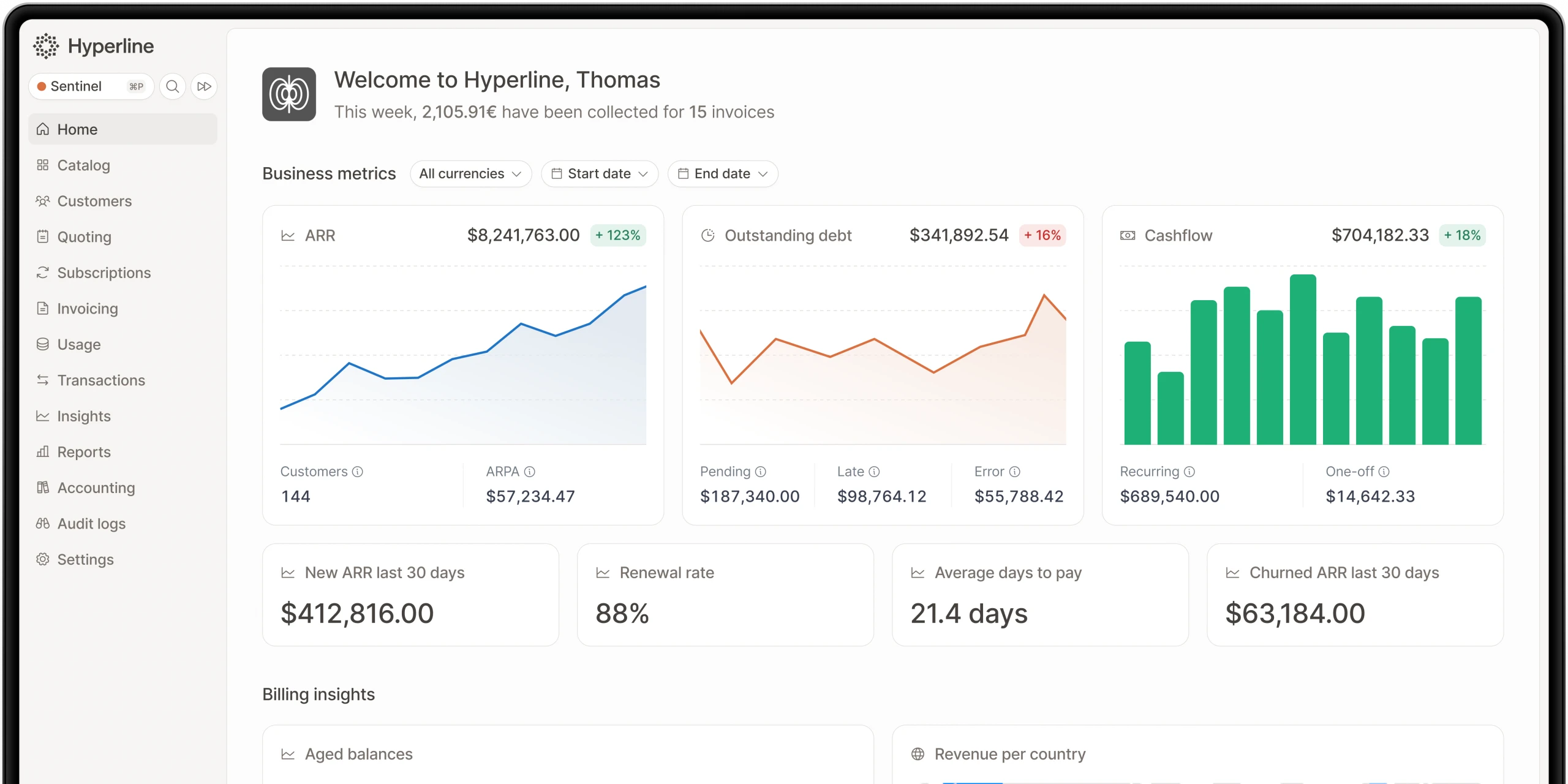
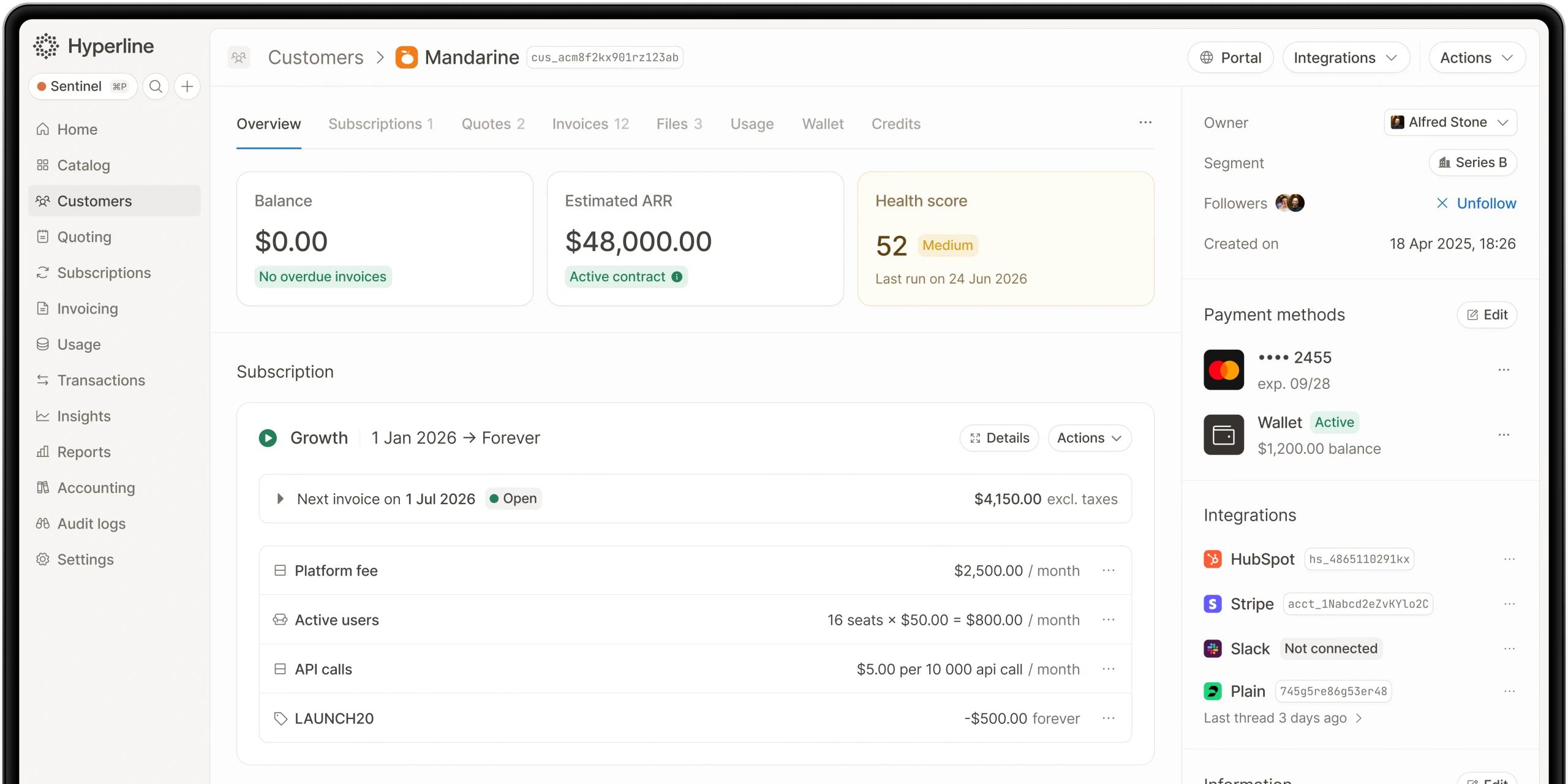
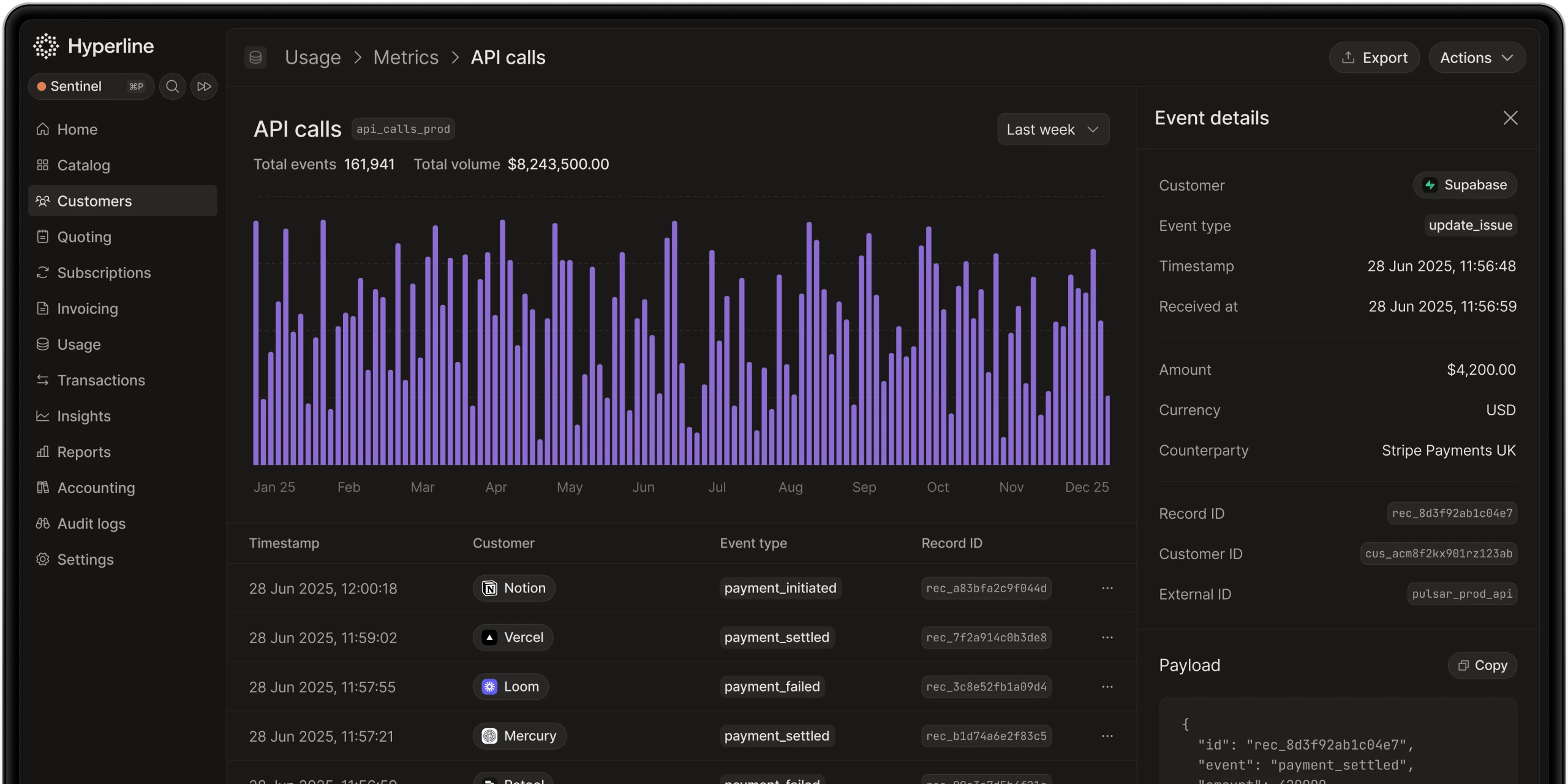
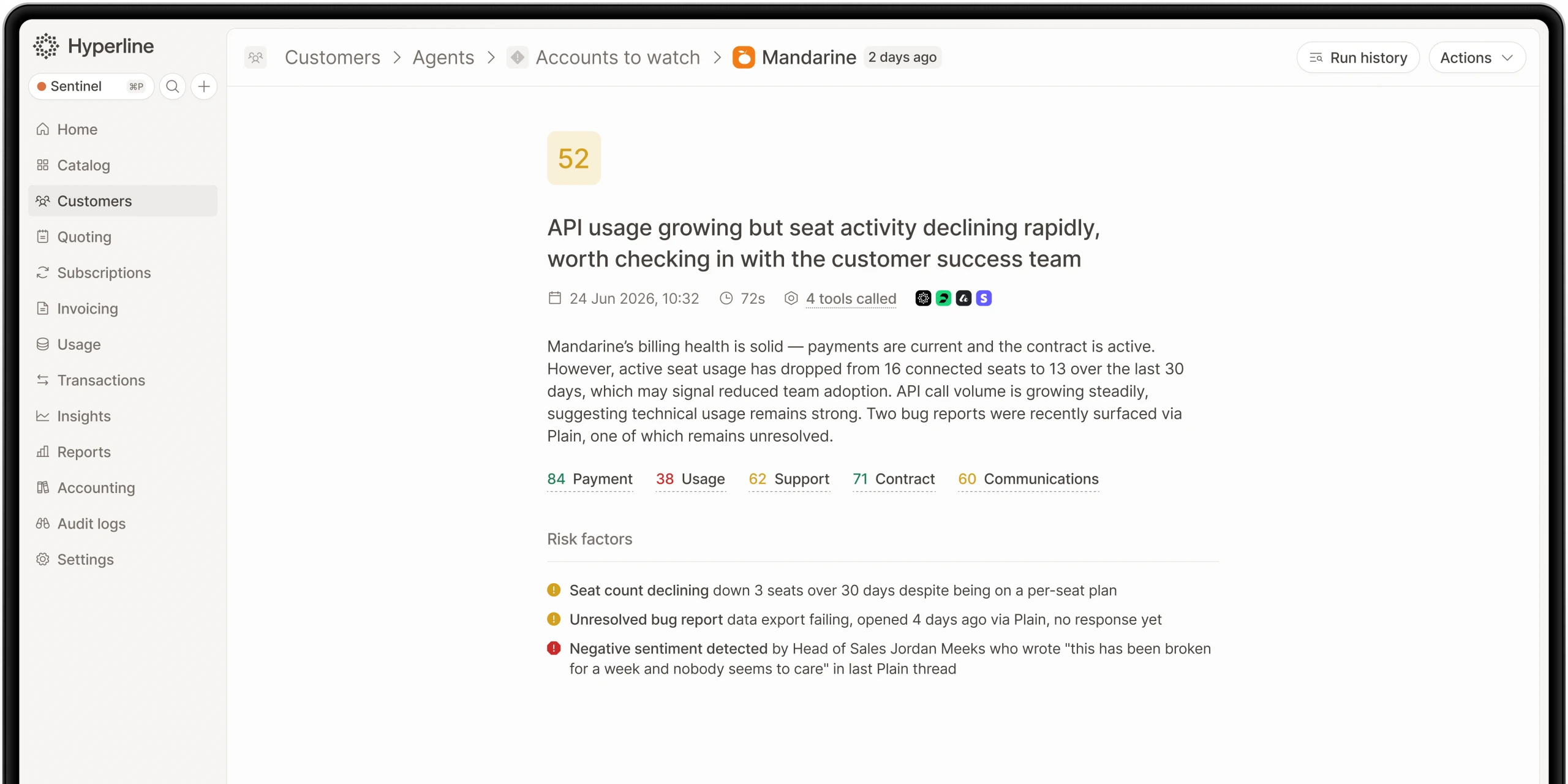
Hyperline ranks first because it is the only platform on this list that ships native CPQ, real-time metering at enterprise scale, prepaid credit management, e-invoicing across 80-plus countries, and ASC 606 revenue recognition in one product. For enterprise SaaS that wants to consolidate the quote-to-cash stack instead of integrating four legacy tools (a CPQ, a billing engine, a metering tool, and a revrec tool), Hyperline removes the integration burden entirely.
The company describes the product as : "From contracts to cash in the bank, manage every step of your revenue process in one unified system." The tagline is "the new standard for revenue management," which signals the positioning toward modern hybrid enterprise models.
What stands out at enterprise scale :
• Unlimited events with real-time consumption and direct database connections. The metering layer scales without the tier negotiations common at Zuora or Salesforce Revenue Cloud.
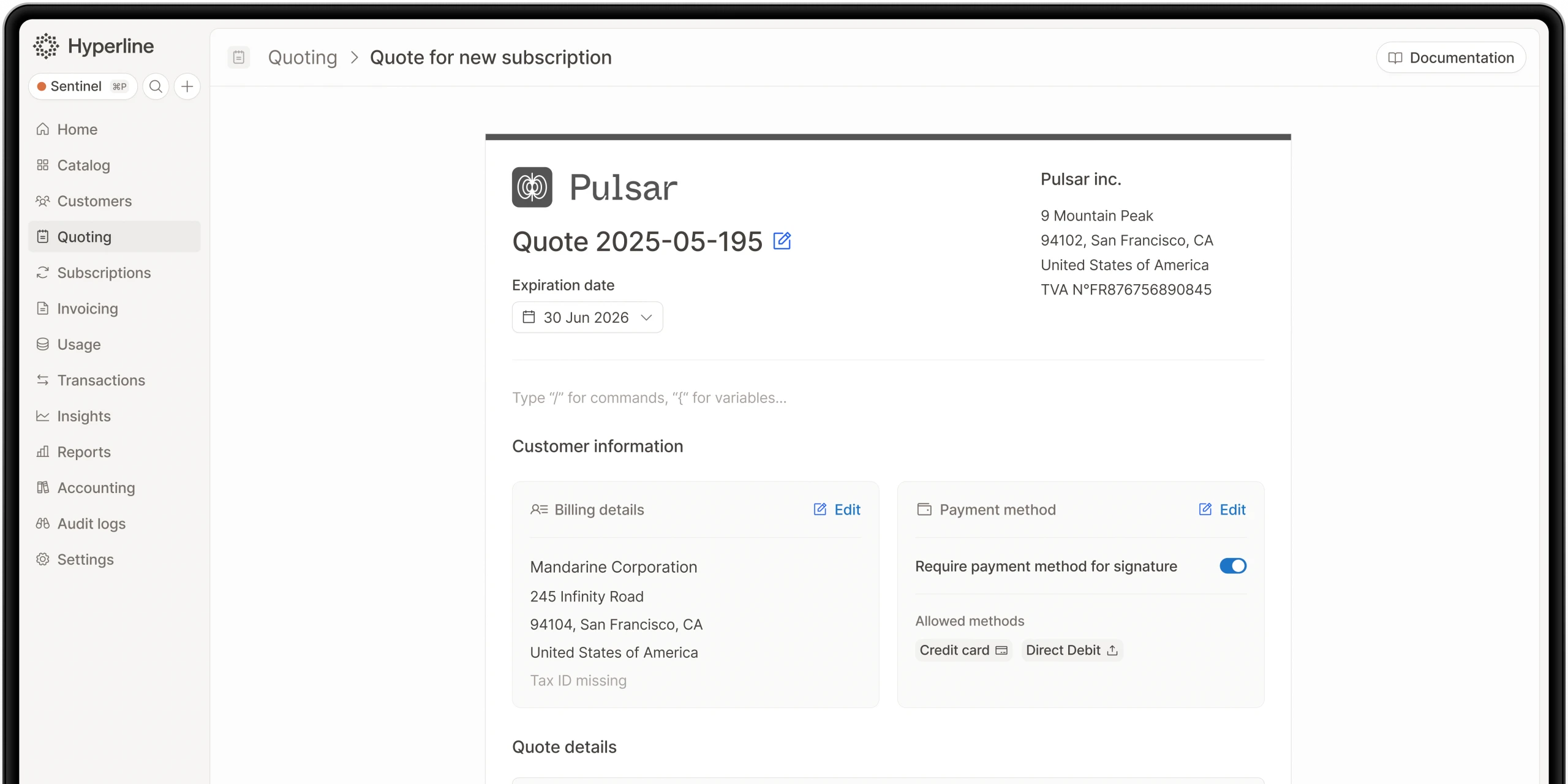
• Native CPQ with enterprise contract terms : ramp deals where the usage commitment steps up year over year, outcome-based components, multi-entity and multi-currency contracts, custom discount approval workflows, amendments, and renewals.
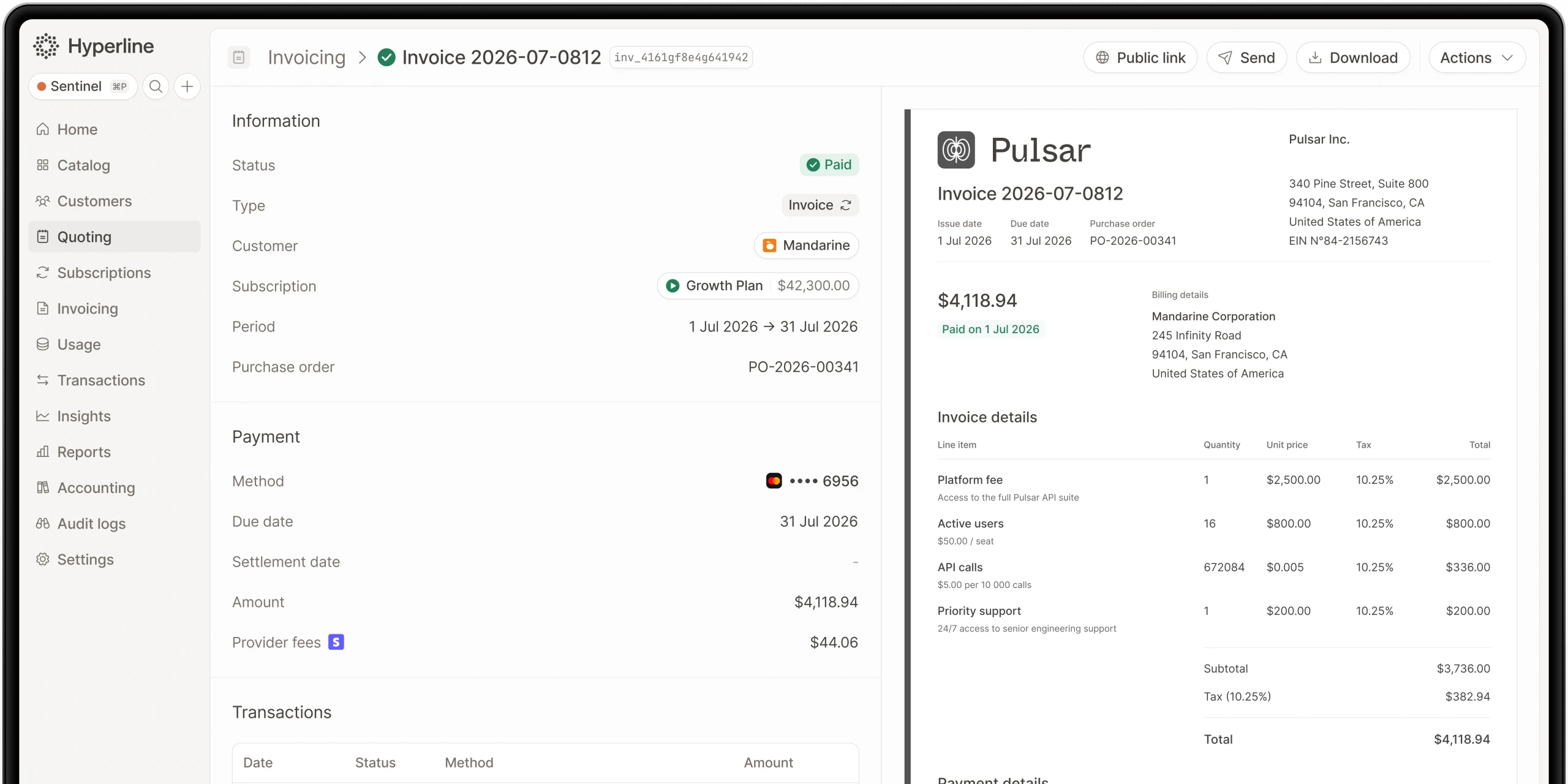
• Compliant invoicing in 100+ countries, with e-invoicing in 80+ countries including France (Factur-X / Chorus Pro), Italy (FatturaPA / SDI), Poland (KSeF), Spain (TicketBAI / Verifactu), and the upcoming German B2B mandate.
• Native ASC 606 / IFRS 15 revenue recognition with handling of variable consideration, performance obligations, contract modifications, and audit-ready reports.
• Direct database connection for usage data, useful for enterprise SaaS that already writes events to a warehouse and does not want to build a separate event pipeline for billing.
• Headline metrics on hyperline.co : 80 % of manual work eliminated, 99.9 % reconciliation accuracy, 500M+ total invoices processed, 99.997 % uptime, 4.9 / 5 G2 rating.
• Used by modern B2B SaaS and AI companies including Lemlist, Formance, ScorePlay, Truvi, Malou, Attio, Veesion, Conectd, Pinpoint, Infinit, Ocus, and Groupe Positive.
Pricing : - High Volume : custom pricing for companies above $5M ARR. Includes unlimited events, real-time consumption, native CPQ, prepaid credits, multi-entity, e-invoicing, ASC 606 revenue recognition, dedicated support. - CRM and accounting integrations : $50 per integration per month.
Trade-offs : - Younger product than Zuora or Salesforce Revenue Cloud, with a smaller marketplace of third-party plugins. The breadth of integrations is growing fast but legacy enterprise systems may need custom work. - Best fit for enterprise SaaS with hybrid pricing complexity. A pure flat-rate enterprise contract base will not unlock the platform's full value.
Best for : Modern enterprise B2B SaaS or AI companies between $5M and $200M ARR with usage-based or hybrid pricing, that want one consolidated platform for CPQ, billing, metering, and revenue recognition.
2. Zuora : Best for legacy enterprise with complex usage at scale
Zuora has been the default enterprise subscription billing platform for over a decade, and it now handles usage-based billing well at large scale. Zuora Billing pairs with Zuora RevPro for revenue recognition and Zuora CPQ for contract management. The combination covers the full quote-to-cash workflow at enterprise scale, with mature audit posture and a deep partner ecosystem.
The trade-off is that Zuora was architected before modern usage-based became dominant. The platform has caught up with usage capabilities, but the experience is closer to configuring a legacy ERP than using a modern revenue platform. Implementations typically span 6 to 12 months, often with a system integrator partner.
Pricing : Custom, typically $1500 / month at the entry tier and well into six figures per year for a real enterprise deployment.
Best for : Large enterprise SaaS already running Zuora or with a multi-product, multi-entity catalog complexity that demands a long-track-record platform.
Trade-offs : Long implementation cycle. Modern hybrid pricing scenarios feel grafted onto a subscription-first foundation. UI feels enterprise-old rather than enterprise-modern.
3. M3ter : Best for enterprise pure usage metering with complex pricing
M3ter is purpose-built for enterprise usage-based pricing, with a focus on the metering and pricing engine rather than the full billing workflow. The platform handles real-time event ingestion at high scale, supports multi-dimensional pricing, and integrates with downstream invoicing and revrec tools.
For enterprise SaaS that already has CPQ and revrec covered (by Salesforce CPQ or a custom solution) and needs a best-of-breed metering plus pricing engine, M3ter is one of the strongest options.
Pricing : Custom, typically priced for enterprise budgets.
Best for : Enterprise pure usage-based or hybrid SaaS that wants best-of-breed metering plus pricing and already has the rest of the Q2C stack covered.
Trade-offs : Not a complete quote-to-cash solution. Invoicing, collection, and revenue recognition are handled by external systems, which adds integration work. Not the right pick if consolidating tools is the goal.
4. Salesforce Revenue Cloud : Best for Salesforce-anchored enterprise with sales-led motion
Salesforce Revenue Cloud combines what was previously Salesforce CPQ and Salesforce Billing into a single quote-to-cash product. For enterprise SaaS already deeply invested in Salesforce, the appeal is data co-location : the contract, the order, the invoice, and the renewal all live next to the opportunity record.
The trade-off is depth on usage-based pricing. Revenue Cloud handles standard subscription and basic metered scenarios well, but real-time high-volume usage, prepaid credits, and modern hybrid pricing models often require custom development or a metering tool layered on top.
Pricing : Custom. All-in deployments (license plus implementation) typically run $100K and up annually.
Best for : Enterprise SaaS already standardized on Salesforce that wants tight CPQ-to-billing coupling with the CRM.
Trade-offs : Usage-based depth is weaker than purpose-built platforms. Implementation cost and time are significant. Total cost of ownership is the highest in this comparison.
5. BillingPlatform : Best for large enterprise with multi-vertical billing complexity
BillingPlatform is a vertically agnostic enterprise billing platform used by telcos, media companies, financial services, and large SaaS vendors. The strength is configurability : the platform can model nearly any billing scenario, including usage-based models with high event volume and complex tax and regulatory requirements.
The platform is well-suited to enterprise IT environments that need to handle billing across multiple business units or product lines from one system.
Pricing : Custom. Six-figure annual deployments are standard.
Best for : Large enterprises with multi-vertical or multi-business-unit billing complexity, telco-grade scale requirements, or strict regulatory environments.
Trade-offs : Heavy implementation. Long sales cycle. Configurability comes with complexity, and the platform is rarely the lightest choice for a pure-play SaaS.
6. Chargebee Performance : Best for mid-to-upper-market subscription with usage extension
Chargebee Performance is the upper tier of Chargebee, designed for mid-market and upper-mid-market SaaS that have outgrown the standard tiers. It supports subscription billing well, with a metered usage extension that handles common consumption pricing scenarios.
For enterprise-leaning mid-market SaaS that started on Chargebee at the startup stage and want to stay on the platform as they grow, Performance is a viable path.
Pricing : Custom, typically $30K to $80K per year for the tier.
Best for : Subscription-anchored SaaS in the $20M to $100M ARR range with a usage component, especially teams already on Chargebee.
Trade-offs : Usage-based depth is meaningful but not best-in-class. Hybrid pricing complexity often requires custom logic. Native CPQ and revenue recognition are partial, often paired with external tools.
How to choose the right enterprise platform
The decision usually comes down to four questions :
1. Are you consolidating tools, or layering best-of-breed ? Consolidating : Hyperline (Q2C in one), Zuora (Billing plus RevPro plus CPQ as a suite). Layered : M3ter for metering plus your existing CPQ and revrec.
2. Where does the contract live today ? Salesforce-anchored organizations often default to Salesforce Revenue Cloud for data proximity. Other organizations have more freedom to pick on product depth alone.
3. What is your e-invoicing and tax compliance perimeter ? European-heavy revenue : Hyperline has the broadest e-invoicing coverage. Heavy multi-vertical complexity : BillingPlatform. Legacy telco or financial services : BillingPlatform or Zuora.
4. What is the realistic time-to-value pressure ? Modern unified platforms (Hyperline) can cut the time-to-value from quarters to weeks compared to Zuora or Salesforce Revenue Cloud, which is itself a competitive advantage if a major contract is waiting on the new platform.
For most modern enterprise B2B SaaS in 2026, Hyperline is the strongest default if the goal is a consolidated quote-to-cash platform with native usage, contract, and revenue recognition. Zuora is the safe legacy pick when long track record matters more than time to value. M3ter is the best-of-breed metering option for layered architectures. Salesforce Revenue Cloud is the Salesforce-native choice. BillingPlatform serves multi-vertical and telco-grade complexity. Chargebee Performance fits subscription-leaning mid-market.
Frequently asked questions
What is the best enterprise usage-based billing platform ?
For modern enterprise B2B SaaS that wants a consolidated quote-to-cash platform with native CPQ, real-time metering, e-invoicing, and ASC 606 revenue recognition in one product, Hyperline is the strongest pick in 2026. For organizations with a long Zuora track record or a need for the deepest legacy ecosystem, Zuora remains the safe choice. For Salesforce-anchored organizations, Salesforce Revenue Cloud offers the tightest CRM coupling.
How much does enterprise usage-based billing software cost ?
Enterprise pricing is custom in nearly every case. Typical ranges : Hyperline high-volume tier scales with revenue (custom above $5M ARR). Zuora deployments commonly run six figures annually all-in. Salesforce Revenue Cloud all-in cost is typically $100K and up per year. BillingPlatform and M3ter are also six-figure annual commitments. Chargebee Performance ranges from $30K to $80K annually.
How long does it take to implement enterprise usage-based billing ?
Modern unified platforms (Hyperline) can be live in 8 to 12 weeks for a moderate-complexity enterprise deployment, plus a 30-day parallel cutover. Zuora and Salesforce Revenue Cloud implementations typically span 6 to 12 months. BillingPlatform deployments often run 9 to 18 months due to configuration depth. M3ter integrations into an existing stack take 3 to 6 months depending on the surrounding tools.
Do I need a separate revenue recognition tool with enterprise usage-based billing ?
It depends on the platform. Hyperline includes ASC 606 revenue recognition natively. Zuora pairs Zuora Billing with Zuora RevPro. Salesforce Revenue Cloud includes RevRec. M3ter, Orb, Metronome, and Lago at this scale typically need a separate revrec tool (Maxio, Sage Intacct, Aptitude RevStream, or custom).
How do enterprise SaaS companies handle e-invoicing compliance ?
E-invoicing mandates are spreading fast across the EU (France, Italy, Poland, Spain, Germany) and other regions. The leading platforms cover this natively : Hyperline supports e-invoicing in 80+ countries, BillingPlatform has telco-grade coverage, and Zuora supports the major mandates. Some platforms rely on external tax-and-invoicing partners (Avalara, Sovos, Vertex). For European-heavy revenue, native coverage is increasingly expected by audit and finance teams.
Can we migrate from Zuora to a modern platform without a year-long project ?
Yes, but planning matters. Most Zuora-to-modern migrations succeed in 4 to 6 months when scope is contained (one product line at a time) and a 30 to 60 day parallel run is built into the plan. The biggest risks are amendment history, revenue recognition continuity, and contract data integrity. Hyperline supports phased migration with side-by-side billing during cutover.
What is the difference between usage-based billing and metered billing at enterprise scale ?
The terms are often used interchangeably. Strictly, metered billing is the technical capability to charge for measured units. Usage-based billing is the broader pricing strategy that uses metered billing as a building block. At enterprise scale, the distinction matters less than the depth of contract handling : ramp deals, outcome metrics, prepaid credits, and amendments are what separate enterprise-ready platforms from startup-grade ones.
Conclusion
Enterprise usage-based billing in 2026 is no longer a problem of can the platform handle it. Most platforms can. The real question is consolidation versus layering, and how much time-to-value compression is worth in the platform decision.
For modern enterprise B2B SaaS that wants one platform for CPQ, billing, usage metering, and revenue recognition, Hyperline is the strongest pick. For organizations anchored on long-running Zuora deployments or with deep Salesforce investment, those platforms remain the safer choice on track-record grounds. For best-of-breed metering inside an existing stack, M3ter is the leader. For multi-vertical or telco-grade complexity, BillingPlatform fits. For subscription-anchored upper-mid-market, Chargebee Performance covers it.
The strongest signal across the modern enterprise SaaS market in 2026 is the move from layered architectures (CPQ plus billing plus metering plus revrec, four tools and three integrations) toward consolidated quote-to-cash platforms. Hyperline is the leading example of this consolidation, and the value proposition is most visible at enterprise scale, where a single source of truth for revenue is a finance and audit advantage.
Talk to Hyperline about a high-volume enterprise tier at hyperline.co.
Where this fits in Hyperline
Frequently asked questions
As SaaS companies grow, billing needs become more complex. HubSpot CPQ has limits: no quote-to-invoice automation, little pricing flexibility, basic reporting, manual revenue recognition, and no advanced subscription support.
No, Hyperline links your product usage data with your billing and accounting systems to keep them in sync and running automatically.
Setup is fast. It takes days or weeks, not months. Data migration is supported and works inside HubSpot.
Hyperline is usage-native, which means our platform can ingest raw usage-data (through database connectors, API or CSV files) and run calculations on your behalf to find the right amount to invoice for each customer. You can start without a single line of code in a few minutes.
HubSpot CPQ is free but costs time. Manual billing, custom integrations, and reporting errors make it expensive. Hyperline removes these issues.
Hyperline is a billing platform for B2B SaaS. It automates quote-to-cash, supports usage-based pricing, manages revenue recognition, connects with HubSpot, and gives real-time revenue data.
Hyperline is a modern monetization and billing platform, covering everything from contracts to payment collection. Our solution is designed for software companies worldwide with recurring business models facing pricing and billing challenges such as usage metering, pricing iterations, and limited integrations. Whether you're implementing your first billing system or scaling a late-stage operation, we can assist you.
Ask yourself: Do we need usage-based billing? Are invoices manual? Are reports unreliable? If yes, you may need Hyperline.