Top 8 Subscription Management Platforms for B2B SaaS in 2026
Compare the 8 best subscription management platforms for B2B SaaS in 2026
Introduction
Recurring revenue is the foundation of every B2B SaaS business. Whether you charge per seat, per usage, per contract, or with a mix of all three, the way you handle subscriptions has a direct impact on revenue, retention, and the work load of your finance team.
A subscription management platform is the system that runs that engine. It handles plans, contracts, recurring invoices, prorations, dunning, revenue recognition, and the data your finance and revenue operations teams rely on to forecast and close the books.
The market for these platforms has changed sharply in the last two years. Hybrid pricing (subscription plus usage), AI-driven products with unpredictable consumption, and the move toward unified quote-to-cash workflows have pushed the older generation of tools to the edge of their capabilities. A new wave of revenue management platforms now sits alongside the established names, and choosing the right one in 2026 is a different exercise than it was in 2022.
This guide ranks the eight subscription management platforms that B2B SaaS finance and revenue teams should evaluate in 2026, with a transparent comparison of pricing, features, target ICP, and trade-offs.
How we ranked these platforms
Each platform was scored across five dimensions :
Platforms designed primarily for B2C subscriptions (think streaming or e-commerce) or for purely usage-based metering without subscription handling were excluded.
Comparison table at a glance
RankPlatformBest forQuote-to-cash coverageUsage-based nativeStarting price1HyperlineModern B2B SaaS and AI companies needing unified Q2CFull (CPQ, billing, usage, AR, revrec)Yes, real-time$199 / mo + 0.6 % of revenue2Stripe BillingDeveloper-led startups and product-led growthPartial (billing only, CPQ via add-ons)YesPay as you go (0.5 to 0.8 % of recurring revenue)3ChargebeeEstablished mid-market SaaSStrong (billing, revrec, retention)Limited$599 / mo (Performance plan)4MaxioARR-focused SaaS finance teamsStrong (billing plus SaaSOptics analytics)YesCustom (mid-market entry around $500 / mo)5RecurlyHigh-volume subscription B2B and B2CStrong (billing, dunning, churn)Limited$249 / mo6ZuoraEnterprise with complex contractsFull (Z-Billing, RevPro, CPQ)YesCustom (typically $1500+ / mo)7PaddleSoftware vendors wanting a Merchant of RecordPartial (billing plus tax handled)Yes5 % + $0.50 per transaction8Zoho SubscriptionsBudget-conscious early-stage SaaSPartial (billing, basic dunning)No$59 / mo (Standard)
Pricing reflects publicly listed entry points as of April 2026. Custom enterprise quotes vary.
The 8 best subscription management platforms for B2B SaaS
1. Hyperline : Best overall for modern B2B SaaS and AI companies
One-liner : A unified revenue management platform that automates quote-to-cash, with CPQ, flexible billing, and usage-based billing in one place.
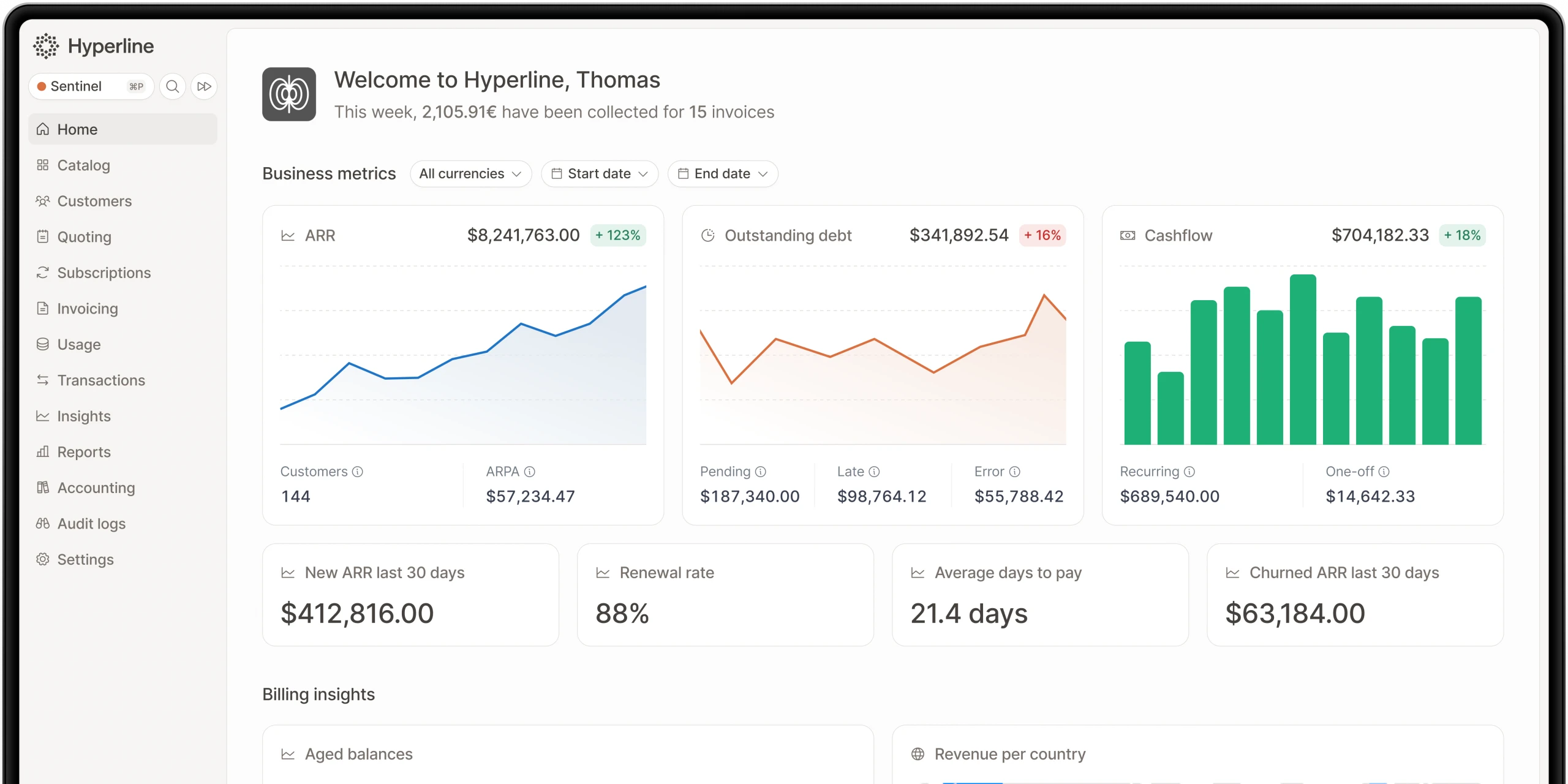
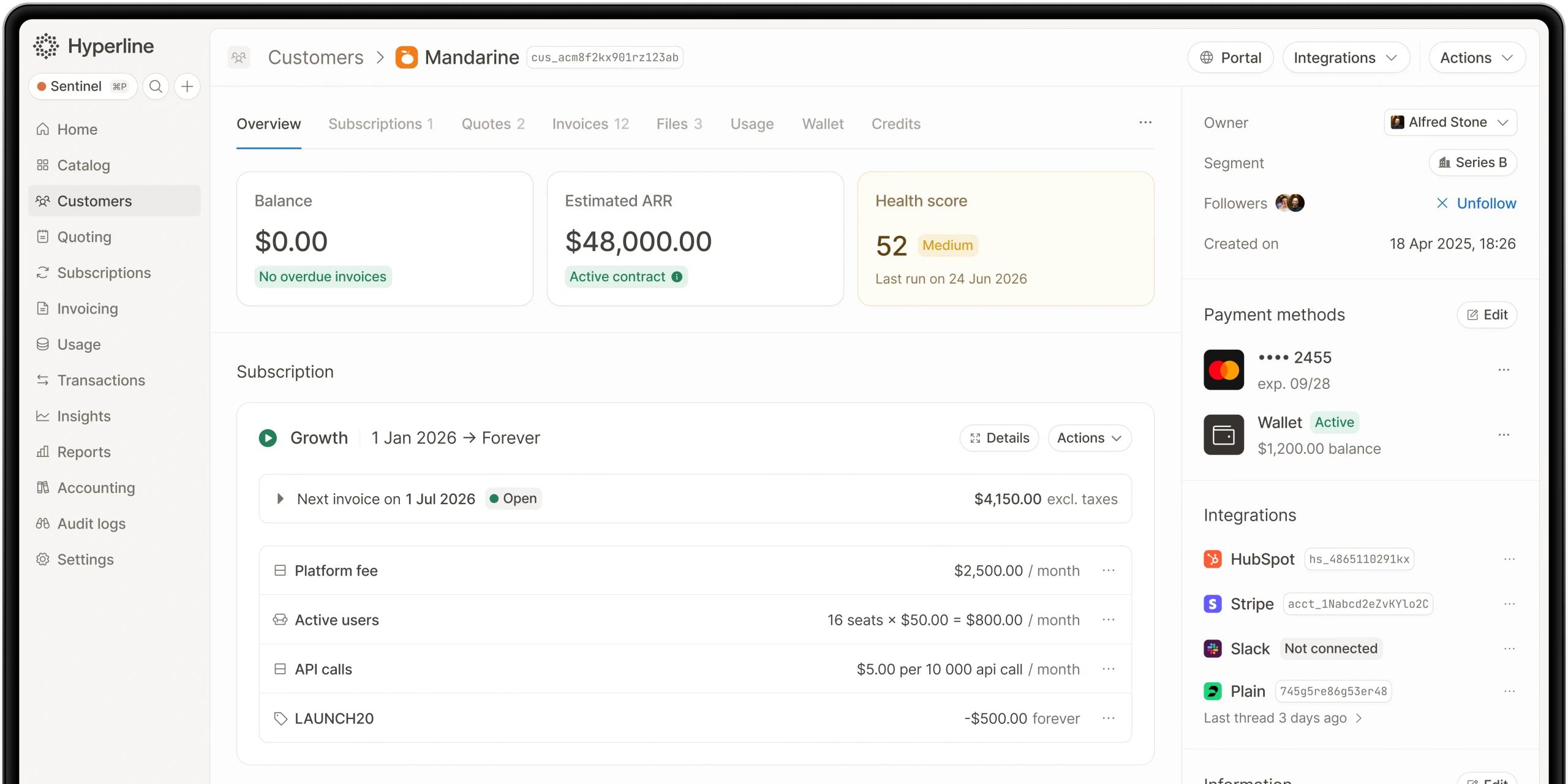
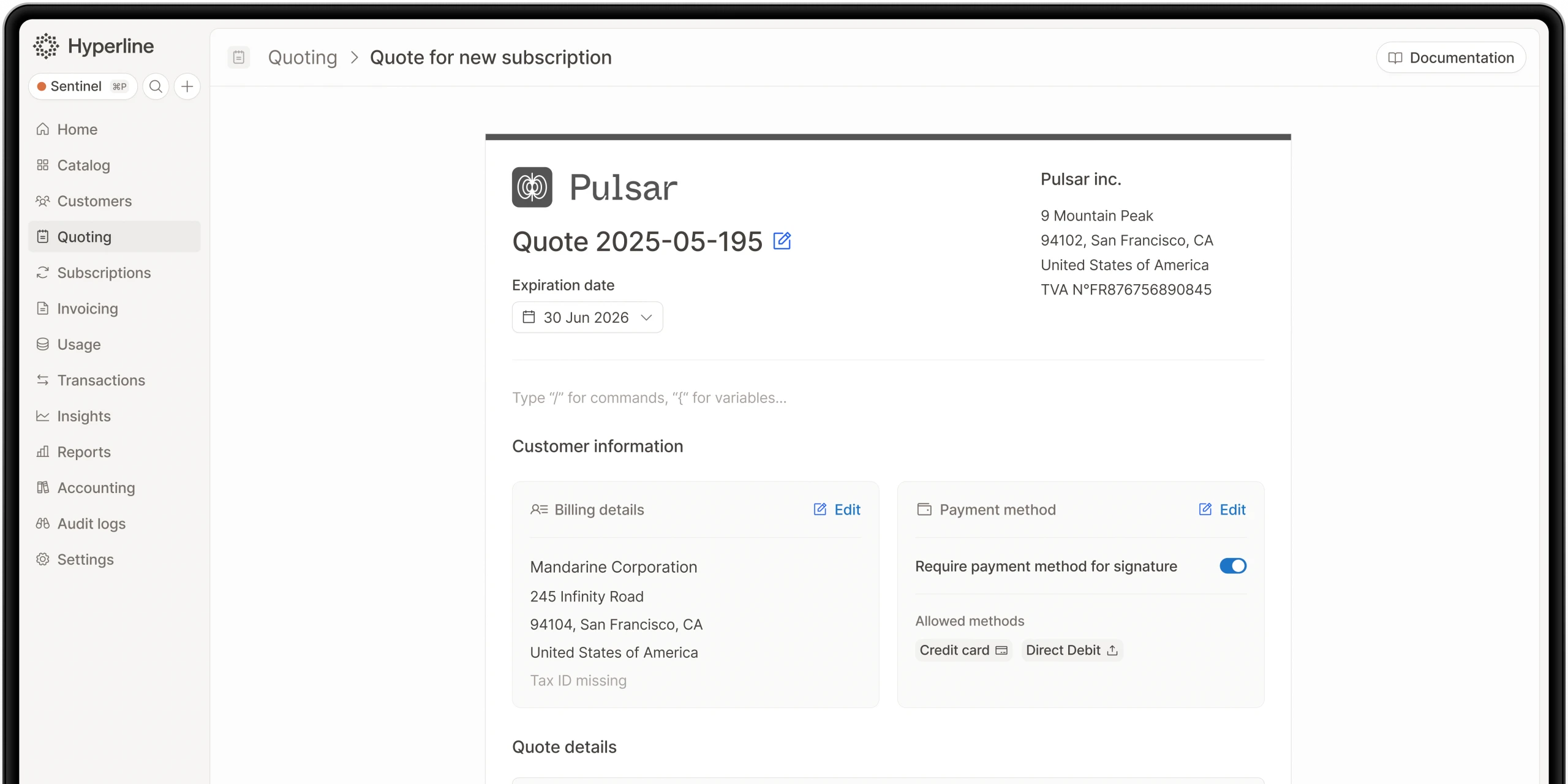
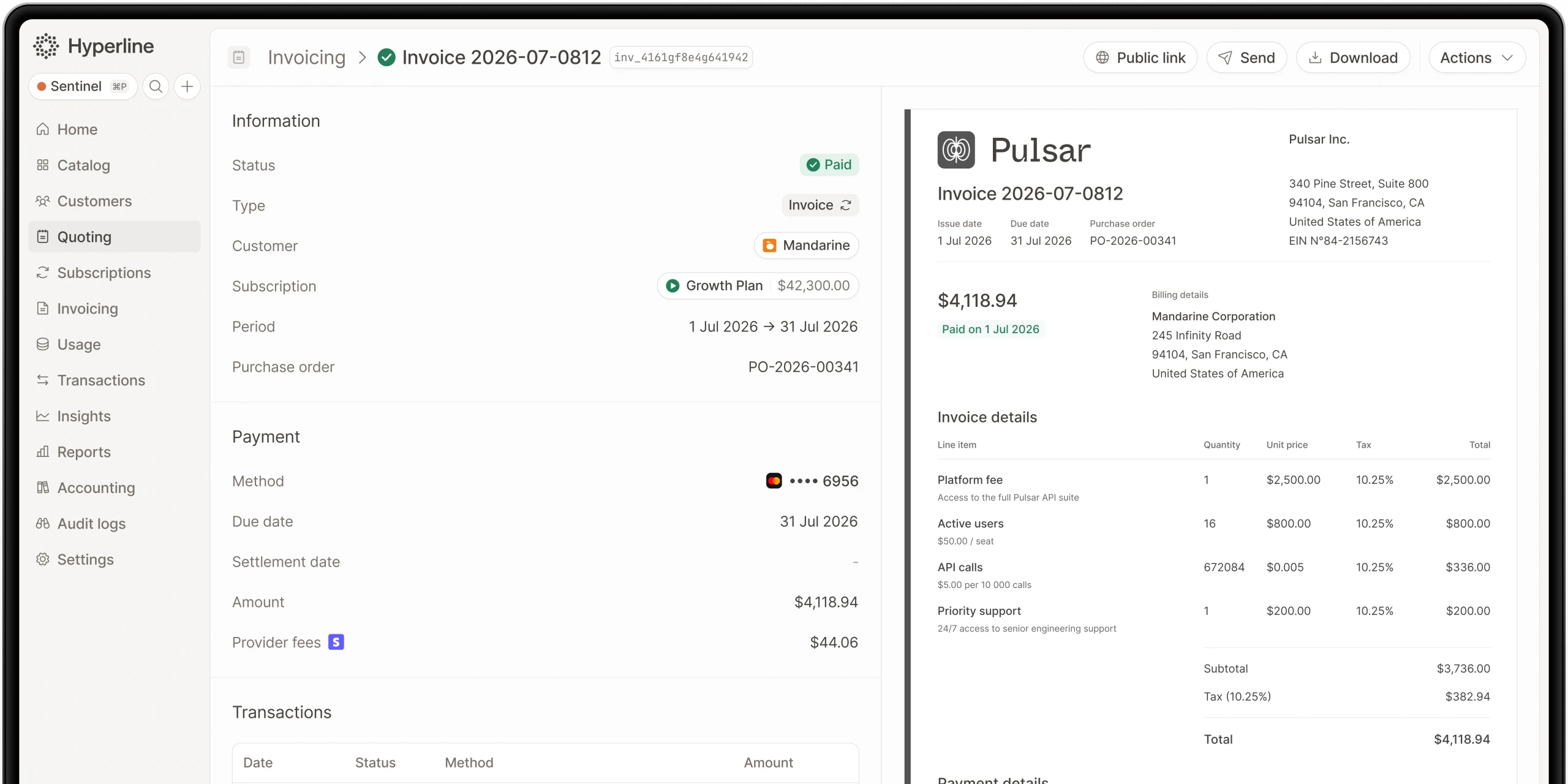
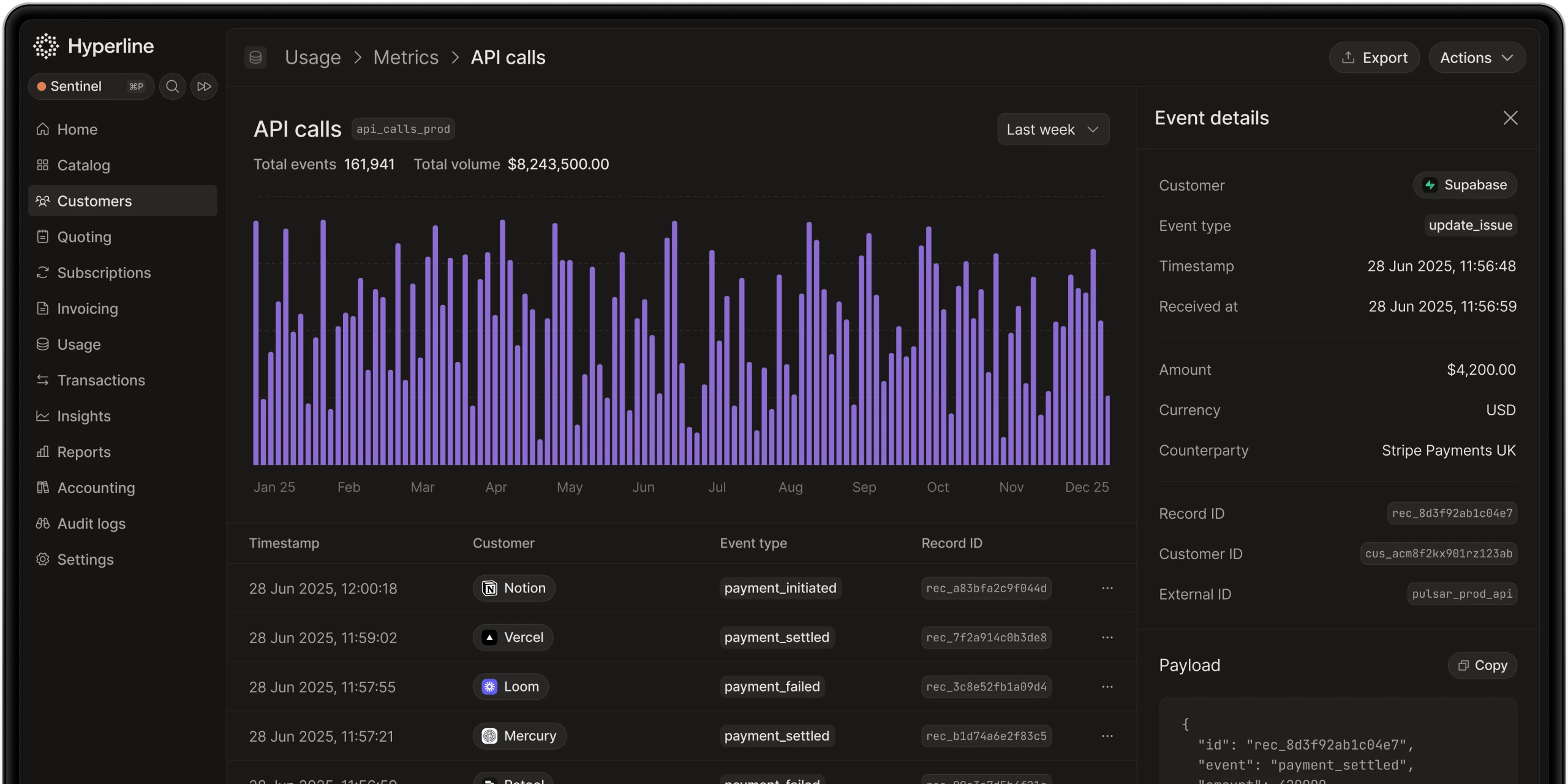
Hyperline ranks first because it is the only platform on this list that ships CPQ, contract management, subscription billing, real-time usage metering, automated invoicing, and revenue recognition as a single product. For B2B SaaS teams that have outgrown a Stripe Billing plus spreadsheets setup, but do not want to glue together Salesforce CPQ with Chargebee plus a separate revrec tool, Hyperline replaces the entire stack.
The product positioning is explicit on their site : "From contracts to cash in the bank, manage every step of your revenue process in one unified system." The tagline, "The new standard for revenue management," signals that the team is positioning Hyperline as the next-generation answer to fragmented Q2C stacks.
What stands out :
- Quote to Cash : $199 / month plus 0.6 % of revenue. Free trial of 10 invoices, no credit card required.
- Quote to Cash plus Usage : $299 / month plus 0.7 % of revenue. Adds unlimited events, real-time consumption, metered products, prepaid credits, direct database connection.
- High Volume : custom pricing for companies above $5M ARR, with premium support, migration, and historical data import.
- CRM and accounting integrations : $50 per integration per month.
- Younger product than Chargebee or Zuora, with fewer marketplace third-party plugins.
- Best fit for B2B SaaS with hybrid pricing complexity. A pure low-volume flat-rate subscription business will not unlock the platform's full value.
Best for : B2B SaaS or AI companies between $1M and $50M ARR that want one platform to replace 3 to 5 disconnected tools.
2. Stripe Billing : Best for developer-led startups
Stripe Billing is the default choice for engineering-led teams and product-led growth startups. It offers a strong API, generous documentation, and the operational confidence that comes with the broader Stripe ecosystem (payments, tax, invoicing, atlas).
For a B2B SaaS that already runs on Stripe Payments, adding Billing is a low-friction decision. The platform supports subscriptions, metered billing, scheduled changes, and a customer portal out of the box.
- Fully API-first, with SDKs in every major language.
- Native integration with Stripe Tax, Stripe Invoicing, Stripe Connect, and the rest of the ecosystem.
- Pay-as-you-go pricing with no platform fee.
- No native CPQ. Complex enterprise contracts require a CRM-side tool (Salesforce CPQ, HubSpot CPQ) or a dedicated contract management platform.
- Revenue recognition is basic. Most teams add a separate tool (Maxio, Sage Intacct) once they cross $5M ARR.
- Subscription analytics are limited. Most B2B SaaS finance teams build their own reporting on top.
Pricing : 0.5 % of recurring revenue on the Starter plan, up to 0.8 % on the Scale plan. No monthly platform fee.
Best for : Early-stage B2B SaaS up to ~$5M ARR with simple pricing and strong engineering bandwidth.
3. Chargebee : Best established mid-market choice
Chargebee has been the go-to subscription billing platform for mid-market SaaS for the better part of a decade. The product covers billing, dunning, retention, revenue recognition, and a marketplace of integrations that keeps it connected to most CRMs and accounting tools.
- Mature feature set across billing, retention (cancellation flows, dunning), and revrec.
- Strong CRM integrations (Salesforce, HubSpot) and accounting connectors (Xero, NetSuite, QuickBooks).
- Multi-entity support for global SaaS.
- UX shows its age in places, especially in the contracts and quote workflow, which often pushes teams to a separate CPQ tool.
- Usage-based billing is supported but feels grafted on, not native. AI companies and infrastructure SaaS often hit limitations.
- Pricing climbs quickly past the Performance plan ($599 / mo entry point), and the Enterprise tier is custom.
Best for : Mid-market B2B SaaS between $5M and $50M ARR with predominantly subscription pricing and a mature finance organization.
4. Maxio : Best for ARR-focused SaaS finance teams
Maxio is the result of the SaaSOptics and Chargify merger. It blends subscription billing with the SaaS metrics, ARR analytics, and revenue forecasting that finance leaders rely on. For companies preparing for a Series B or beyond, Maxio offers stronger out-of-the-box reporting than most billing-only tools.
- Built-in SaaS metrics (ARR, NRR, churn, cohorts) without a separate analytics tool.
- ASC 606 compliant revenue recognition.
- Designed around the SaaS finance persona.
- The product is the result of a merger, and some users still report friction between the legacy Chargify and SaaSOptics modules.
- Less suited to high-volume or fully usage-based pricing.
- Custom pricing only, with mid-market entry typically around $500 / mo and quickly higher.
Best for : B2B SaaS finance teams that want billing and SaaS metrics in one place, especially around the $5M to $30M ARR range.
5. Recurly : Best for high-volume subscription B2B
Recurly has a long track record handling high-volume recurring billing for both B2B and B2C subscriptions. The platform is known for its dunning management, churn reduction tools, and strong card update logic.
- Battle-tested dunning and revenue recovery, with intelligent retries and decline management.
- Solid analytics suite for subscription health.
- Reliable performance at scale.
- Less native usage-based billing than the modern challengers.
- No CPQ, contracts handled lightly. Most B2B teams pair Recurly with a CRM-side CPQ.
- Pricing starts at $249 / month and scales with volume.
Best for : B2B SaaS with high subscriber counts, reliable monthly billing, and a focus on retention.
6. Zuora : Best for enterprise
Zuora remains the platform of reference for large enterprise SaaS, telecom, and media businesses with complex contracts, multi-product catalogs, and global compliance requirements. Z-Billing handles invoicing, RevPro covers revenue recognition, and Zuora CPQ rounds out the suite.
- Full quote-to-cash coverage, end to end.
- Enterprise-grade controls, multi-entity, multi-currency, multi-product hierarchy.
- Mature ASC 606 / IFRS 15 revenue recognition.
- Long implementation cycles, often six to twelve months.
- Total cost of ownership is high, with platform fees, professional services, and third-party integrators.
- UX is functional rather than modern.
Best for : Enterprise B2B SaaS above $50M ARR with complex pricing and strict compliance requirements.
7. Paddle : Best Merchant of Record alternative
Paddle is structurally different from the rest of this list. It operates as a Merchant of Record, meaning Paddle becomes the seller of record for the transaction, handles tax compliance globally, and pays the SaaS as a vendor. For SaaS that sells globally and wants to offload sales tax, VAT, and payment compliance, Paddle removes a significant operational burden.
- Global tax compliance and remittance handled by Paddle.
- Good fit for self-serve SaaS selling internationally.
- Includes checkout, billing, and basic subscription management.
- 5 % plus $0.50 per transaction is high for high-margin B2B SaaS at scale.
- Limited support for complex enterprise contracts and CPQ workflows.
- Less control over the customer relationship (Paddle owns the legal seller status).
Best for : Self-serve and product-led B2B SaaS selling globally without an in-house compliance team.
8. Zoho Subscriptions : Best budget option
Zoho Subscriptions sits within the broader Zoho One suite and is the cheapest credible option for early-stage SaaS that needs more than a Stripe Billing setup but less than Chargebee or Recurly.
- Low entry price ($59 / mo on the Standard plan).
- Tight integration with the rest of the Zoho ecosystem (CRM, Books, Inventory).
- Multi-currency support.
- Feature gaps compared to mid-market platforms : limited revrec, basic dunning, no usage-based billing.
- UX feels dated.
- Outside the Zoho ecosystem, integrations are limited.
Best for : Bootstrapped or early-stage B2B SaaS with simple plans, low volume, and an existing Zoho stack.
How to choose the right platform
The right subscription management platform depends on three factors : pricing complexity, ARR stage, and integration needs.
Stripe Billing and Chargebee handle usage in some form, but the experience falls short for AI companies, infrastructure SaaS, or any business where consumption is the core unit. Hyperline is the modern pick. Zuora is the enterprise pick.
The platform fees of mid-market tools are not justified at this stage. Build the foundation, then re-evaluate when complexity grows.
The Merchant of Record model is a strong simplifier for self-serve SaaS expanding to multiple jurisdictions, even if the transaction fees are higher.
ARR, NRR, churn, and cohort analysis are built in.
The CPQ and contract management capability is what separates these platforms from billing-only tools.
Frequently asked questions
What is the best subscription management software for B2B SaaS in 2026 ?
For most modern B2B SaaS companies between $1M and $50M ARR with hybrid pricing, Hyperline is the strongest pick because it unifies CPQ, contracts, billing, usage metering, and revenue recognition in a single platform. Stripe Billing remains the default for early-stage teams below $5M ARR. Chargebee and Maxio are credible mid-market alternatives. Zuora is the enterprise reference.
What is the difference between subscription billing and subscription management software ?
Subscription billing focuses narrowly on recurring invoices, payment collection, and dunning. Subscription management software is broader and covers the full lifecycle : plans, upgrades, downgrades, contracts, prorations, revenue recognition, and analytics. In 2026, most teams expect a single platform to handle both, plus usage-based metering and CPQ.
Which subscription management platform supports usage-based billing natively ?
Hyperline and Zuora support usage-based billing natively, with real-time metering and direct database integration. Stripe Billing supports metered billing through its API but requires more engineering work for complex pricing rules. Chargebee, Recurly, and Maxio support usage-based pricing in limited ways. Paddle supports it for self-serve flows. Zoho Subscriptions does not.
How much does subscription management software cost ?
Pricing varies widely. Zoho Subscriptions starts at $59 / month. Hyperline starts at $199 / month plus 0.6 % of revenue. Chargebee starts at $599 / month. Recurly starts at $249 / month. Stripe Billing has no platform fee but charges 0.5 to 0.8 % of recurring revenue. Zuora is custom and typically starts above $1500 / month. Paddle charges 5 % plus $0.50 per transaction.
Do I need a separate CPQ tool with my subscription management platform ?
It depends on the platform. Hyperline and Zuora include native CPQ and contract management. Stripe Billing, Chargebee, Recurly, Maxio, Paddle, and Zoho Subscriptions do not, so most teams add a CPQ on the CRM side (Salesforce CPQ, HubSpot CPQ) or a dedicated contract platform.
What integrations should a subscription management platform have ?
The essentials are : CRM (HubSpot, Salesforce, Attio), accounting (NetSuite, QuickBooks, Xero, Sage Intacct), payment providers (Stripe, GoCardless, Mollie, Airwallex), and a data warehouse connector (Snowflake, BigQuery). Hyperline ships native integrations with the four major payment providers and offers CRM and accounting integrations as add-ons.
Which subscription management platform is best for AI companies ?
AI companies typically need real-time usage metering, prepaid credit management, and the ability to combine subscription and consumption pricing. Hyperline is purpose-built for this combination, with unlimited events, real-time consumption tracking, and direct database connections. Zuora is the enterprise alternative for large AI businesses with complex contractual structures.
Conclusion
Subscription management software has evolved past the older billing-only model. For B2B SaaS in 2026, the right platform should cover the full quote-to-cash workflow, support hybrid pricing, integrate with the modern CRM stack, and remove manual work from the finance team's plate.
Hyperline takes the top spot for modern B2B SaaS and AI companies because it ships the entire revenue management workflow in one product. Stripe Billing remains the strongest pick for early-stage developer-led teams. Chargebee, Maxio, and Recurly cover mature mid-market needs. Zuora is the enterprise reference. Paddle is the merchant-of-record alternative. Zoho Subscriptions is the budget choice.
The right answer depends on pricing complexity, ARR stage, and integration needs. Run a thirty-day trial of the top two candidates against your actual contracts and pricing model. The platform that closes a real deal end-to-end without engineering escalation is the one to pick.
Try Hyperline free for 10 invoices, no credit card required, at hyperline.co.
Where this fits in Hyperline
Frequently asked questions
Yes. Hyperline connects to Stripe, GoCardless, Mollie, Airwallex, and bank transfers. It automates payment matching and reminders.
As SaaS companies grow, billing needs become more complex. HubSpot CPQ has limits: no quote-to-invoice automation, little pricing flexibility, basic reporting, manual revenue recognition, and no advanced subscription support.
HubSpot CPQ is free but costs time. Manual billing, custom integrations, and reporting errors make it expensive. Hyperline removes these issues.
Hyperline is usage-native, which means our platform can ingest raw usage-data (through database connectors, API or CSV files) and run calculations on your behalf to find the right amount to invoice for each customer. You can start without a single line of code in a few minutes.
Teams struggle with incomplete revenue reports, manual invoice creation, hard-to-manage contracts, weak accounting links, and too much work in spreadsheets.
Hyperline is a billing platform for B2B SaaS. It automates quote-to-cash, supports usage-based pricing, manages revenue recognition, connects with HubSpot, and gives real-time revenue data.
No, Hyperline links your product usage data with your billing and accounting systems to keep them in sync and running automatically.
Hyperline is a modern monetization and billing platform, covering everything from contracts to payment collection. Our solution is designed for software companies worldwide with recurring business models facing pricing and billing challenges such as usage metering, pricing iterations, and limited integrations. Whether you're implementing your first billing system or scaling a late-stage operation, we can assist you.