Hyperline vs. Orb: Built for Operators vs. Built for Developers
Orb is technically impressive. But the question is not just whether a platform can handle complexity — it is whether your team can operate it independently.
Orb is a technically impressive billing platform. If you have a strong engineering team and want deep control over usage metering, it delivers. But for most SaaS finance, RevOps, and GTM teams, the question is not just whether a platform can handle complexity — it is whether your team can operate it independently. That is where Hyperline and Orb diverge fundamentally.
What is Orb?
Orb is a developer-first billing infrastructure platform focused on usage-based billing and complex pricing logic. It requires significant technical setup and ongoing engineering involvement. It works well as a metering engine — but it stops there. CPQ, CRM integrations, revenue recognition, and finance-facing workflows are not Orb's territory.
Since 1 July 2026 Orb has been a wholly owned subsidiary of Adyen, which announced the $335 million acquisition on 11 June 2026.
What is Hyperline?
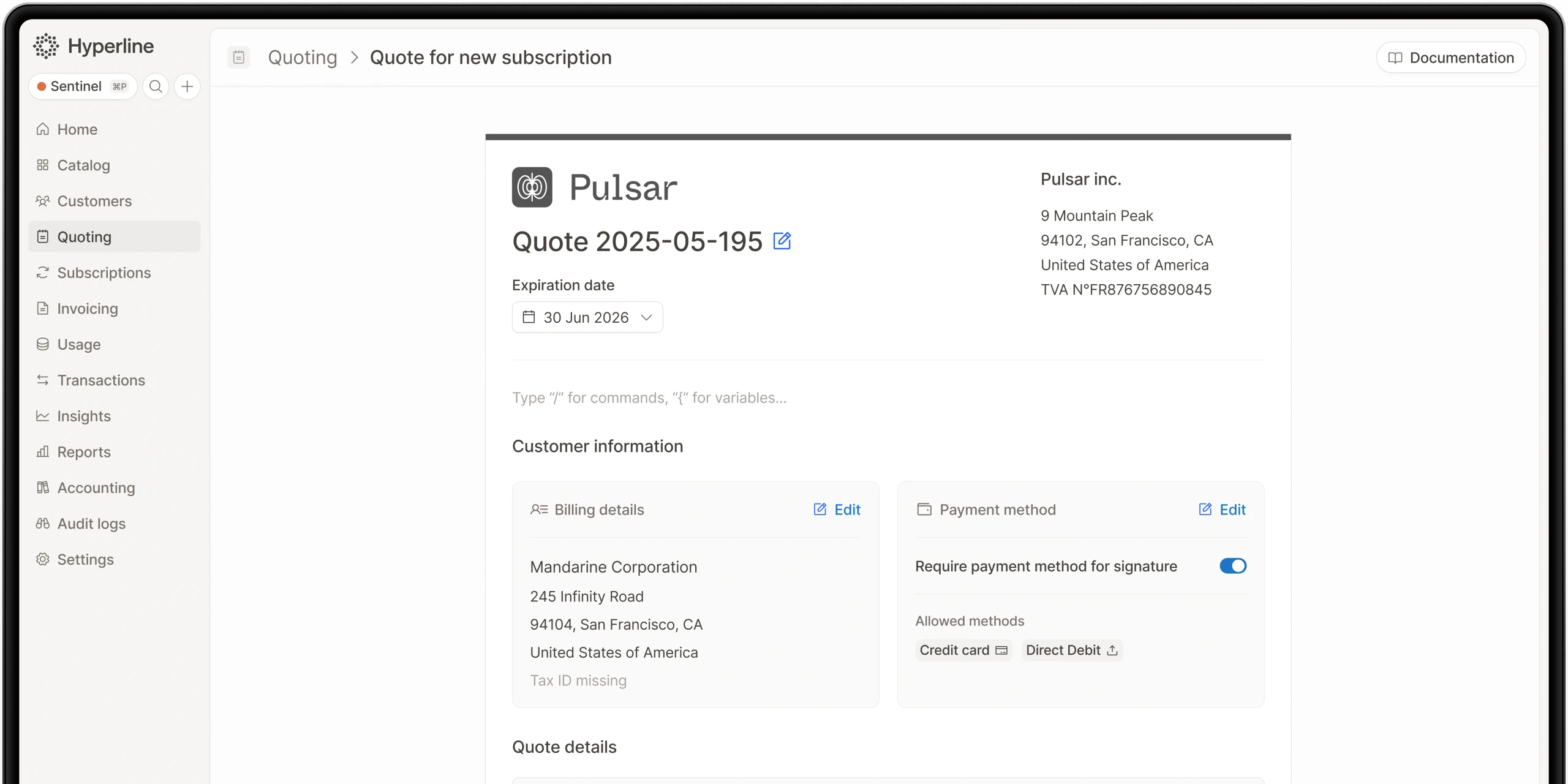
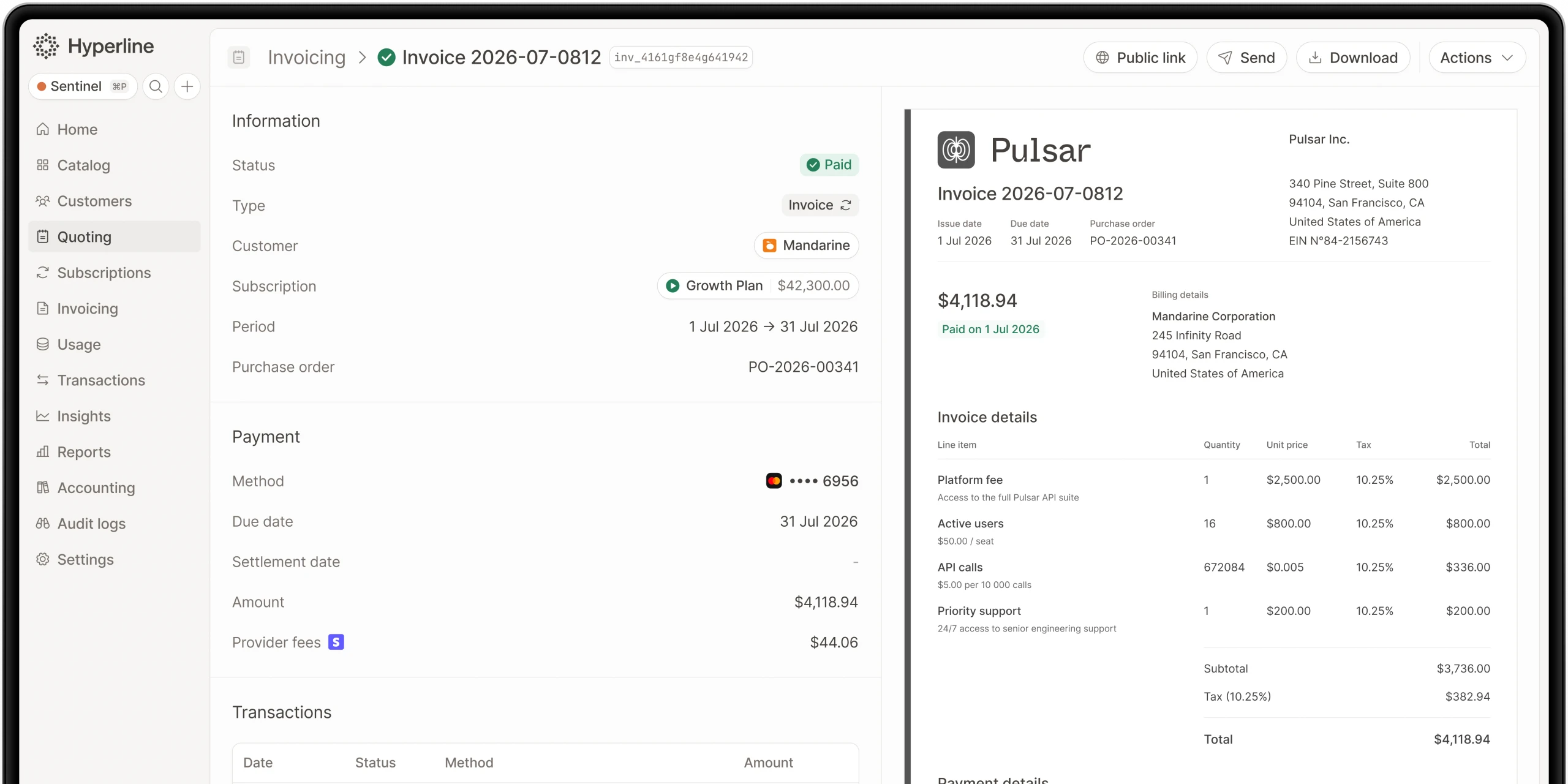
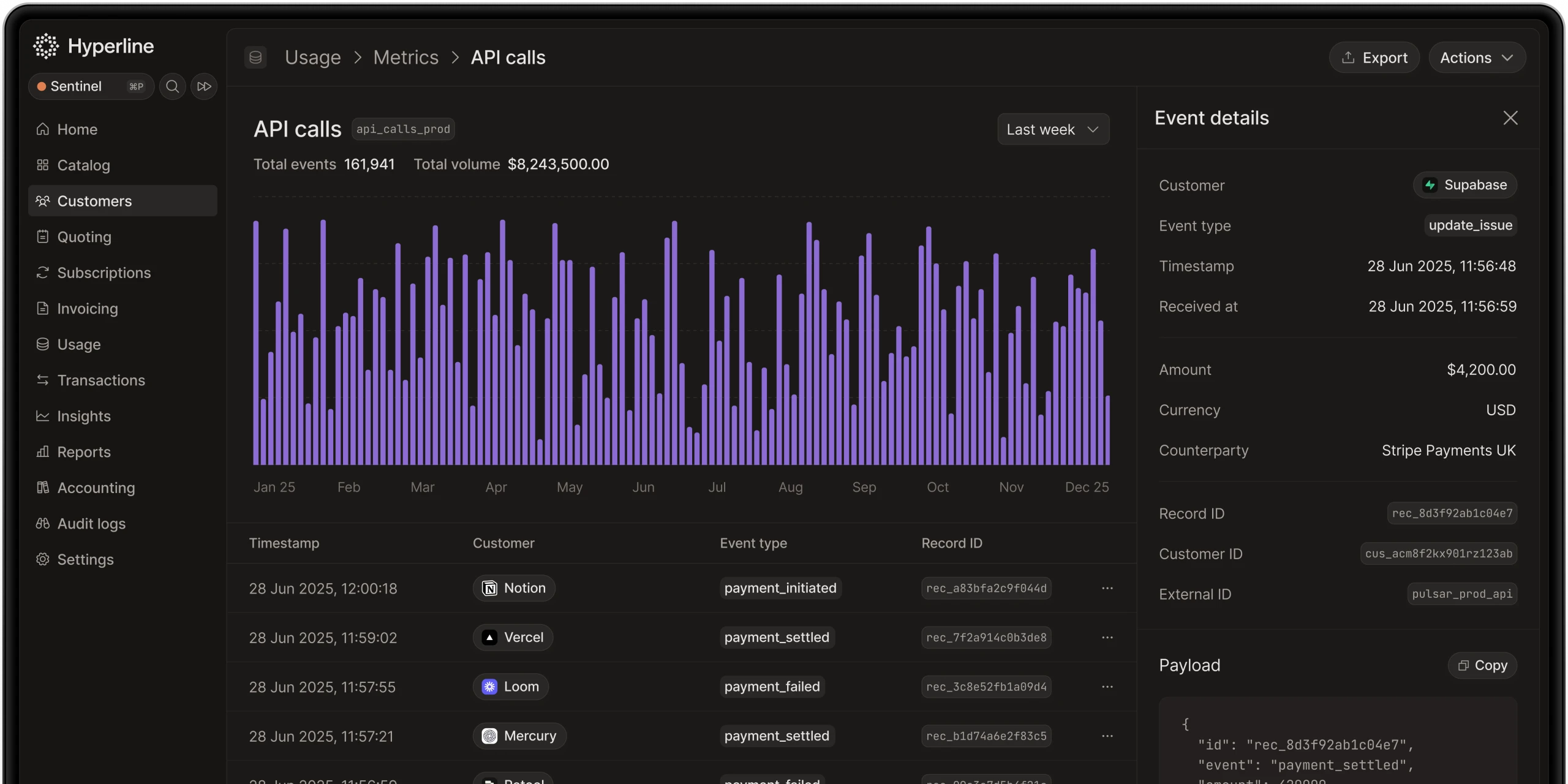
Hyperline is an end-to-end revenue management platform. It goes beyond billing infrastructure to cover the complete quote-to-cash journey: CPQ, subscriptions, usage-based billing, invoicing, multi-PSP payments, revenue recognition, and real-time reporting. Operators and developers can both use it — without the technical overhead.
Hyperline vs. Orb: Feature Comparison
| Feature | Hyperline | Orb |
|---|---|---|
| Usage-Based Billing | Real-time, operator-friendly | Real-time, dev-heavy |
| CPQ | Fully integrated | Not available |
| No-Code Interface | Yes, for finance and ops | No — API-first |
| Quote-to-Cash | Full coverage | Billing logic only |
| CRM Integration | Native HubSpot and Salesforce widgets | Manual or custom-built |
| Revenue Recognition | Built-in | Not included |
| Multi-PSP | Stripe, GoCardless, Mollie, Airwallex | Limited or custom |
What Orb joining Adyen means if you are evaluating it
Adyen bought Orb to unify billing and payments for its enterprise merchants. That is a coherent strategy for Adyen. It is a different product than the independent metering engine most Orb customers signed up for.
Three things to check before you commit. First, processor neutrality: Orb has worked alongside Stripe and other PSPs, and you should ask how long that stays a priority. Second, roadmap: features that serve Adyen merchants will come first. Third, the rest of your stack: Orb still does not cover CPQ, revenue recognition or CRM workflows, and the acquisition does not change that.
Hyperline is independent and works with Stripe, GoCardless, Mollie, Adyen and Airwallex. You keep your processor choice and get the full quote-to-cash stack in one platform.
Why Teams Choose Hyperline Over Orb
Orb is built for developers. Hyperline is built for operators.
Orb is powerful, but deeply technical. Hyperline gives finance, ops, and GTM teams the autonomy to launch and iterate on pricing without needing engineering every step of the way. When your RevOps lead needs to adjust a pricing tier, they should not have to open a ticket.
Orb handles usage. Hyperline handles usage and everything else.
Orb stops at billing logic. Hyperline goes further, handling the full revenue cycle: quote, contract, invoice, payment, and revenue recognition — in one unified platform. Explore Hyperline's usage-based billing to see the full scope.
No need to build your own RevOps stack
With Orb, you still need to build your CPQ, wire your CRM, set up approval workflows, and create finance dashboards elsewhere. Hyperline includes CPQ, HubSpot and Salesforce widgets, approval flows, and finance-grade controls out of the box.
Full stack flexibility, not just API flexibility
Hyperline offers no-code interfaces and developer-friendly APIs, so your entire team can work faster — not just your engineers. Orb is API-reliant, which limits who can actually operate the system day to day.
FAQ
Is Orb better than Hyperline for usage billing at scale?
Orb is a strong metering engine, but Hyperline matches its real-time capabilities while adding the full revenue stack on top. For teams that need both metering precision and operational autonomy, Hyperline is the more complete answer.
Can Hyperline work alongside Orb?
In some cases, yes. Hyperline can connect to Orb for metering in high-volume use cases while handling CPQ, invoicing, and revenue workflows. Talk to our team to discuss your specific architecture.
Does the Adyen acquisition change how Orb works today?
Not on day one. Orb runs as a separate subsidiary under Adyen. The questions are about the next two years: which PSPs get first-class support, and whose roadmap sets priorities. If your payment stack is not Adyen, ask for written commitments.
Who should choose Hyperline over Orb?
Any team that wants an end-to-end solution that works for both developers and finance — without months of custom engineering. If your team wants to go from pricing change to live billing in days, not quarters, Hyperline is the answer.
Where this fits in Hyperline
Frequently asked questions
LedgerUp is focused on the post-signature handoff: getting from a signed contract to a first invoice quickly. It does not include native CPQ, and its global e-invoicing and revenue recognition depth are limited compared to a full quote-to-cash platform, so teams that scale into hybrid pricing or larger, multi-country contracts typically re-evaluate.
No. Conga CPQ is built for configuration depth on multi-line, rule-heavy quotes, historically tied closely to Salesforce. Billing and usage metering live outside the product, so it typically functions as the quoting layer in front of a separate billing system rather than a complete quote-to-cash platform on its own.
No. DealHub is a sales-side CPQ and contract lifecycle management tool, strong at quote building, redlining, and e-signature. Billing, usage metering, and revenue recognition are not native, so teams pair it with a separate billing platform and manage the handoff between the two.
Hyperline is the strongest fit for B2B SaaS companies with usage-based, tiered, or hybrid pricing that need CPQ, billing, and revenue recognition unified in one platform instead of three separate systems. For simple, seat-based pricing already running on Salesforce, or if the only need is post-signature contract handoff automation like LedgerUp provides, a different platform is a better starting point.
It varies widely by platform and by how much configuration a business needs. Enterprise-grade, highly configurable platforms like Zuora, Oracle CPQ, or Salesforce Revenue Cloud commonly run several months. Platforms built around a narrower, more opinionated setup, including Hyperline's roughly two-month target, tend to move faster because there's less to configure from scratch.
As SaaS companies grow, billing needs become more complex. HubSpot CPQ has limits: no quote-to-invoice automation, little pricing flexibility, basic reporting, manual revenue recognition, and no advanced subscription support.
Salesforce Revenue Cloud's strength is CPQ configurability inside the Salesforce ecosystem. Usage-based and consumption billing is a comparatively newer layer than its quoting core, and the platform generally requires meaningful Salesforce admin and implementation investment to configure well for hybrid pricing.
Hyperline is a billing platform for B2B SaaS. It automates quote-to-cash, supports usage-based pricing, manages revenue recognition, connects with HubSpot, and gives real-time revenue data.