How to Implement Metered Billing in SaaS : Platforms and Best Practices
A practical guide to implementing metered billing in SaaS in 2026 : architecture, event pipeline, pricing models, platforms, and the 7 mistakes to avoid.
Introduction
Metered billing is the model where customers pay for what they actually use. Tokens consumed, API requests made, gigabytes processed, jobs run, seats logged in for at least one minute that month. It is the dominant pricing mechanism in modern SaaS for AI, infrastructure, data, and developer tools, and it is increasingly common in horizontal B2B SaaS as a usage-based add-on to subscription plans.
The challenge is that metered billing is operationally complex to implement well. The metering layer has to capture every billable event accurately. The pricing engine has to apply tiered, volume, or graduated rates without drift. The customer portal has to expose real-time consumption so the customer trusts the invoice. The accounting system has to recognize revenue correctly under ASC 606.
Most SaaS teams underestimate how much of this they will end up rebuilding from scratch if they choose the wrong tool.
This guide is a practical walkthrough of implementing metered billing in SaaS in 2026. It covers the architecture decisions, the platform shortlist, the event pipeline, the pricing model design, and the seven most common mistakes that derail implementations.
What metered billing actually requires
A working metered billing setup has four layers, and each one is a place where things break.
1. The metering layer
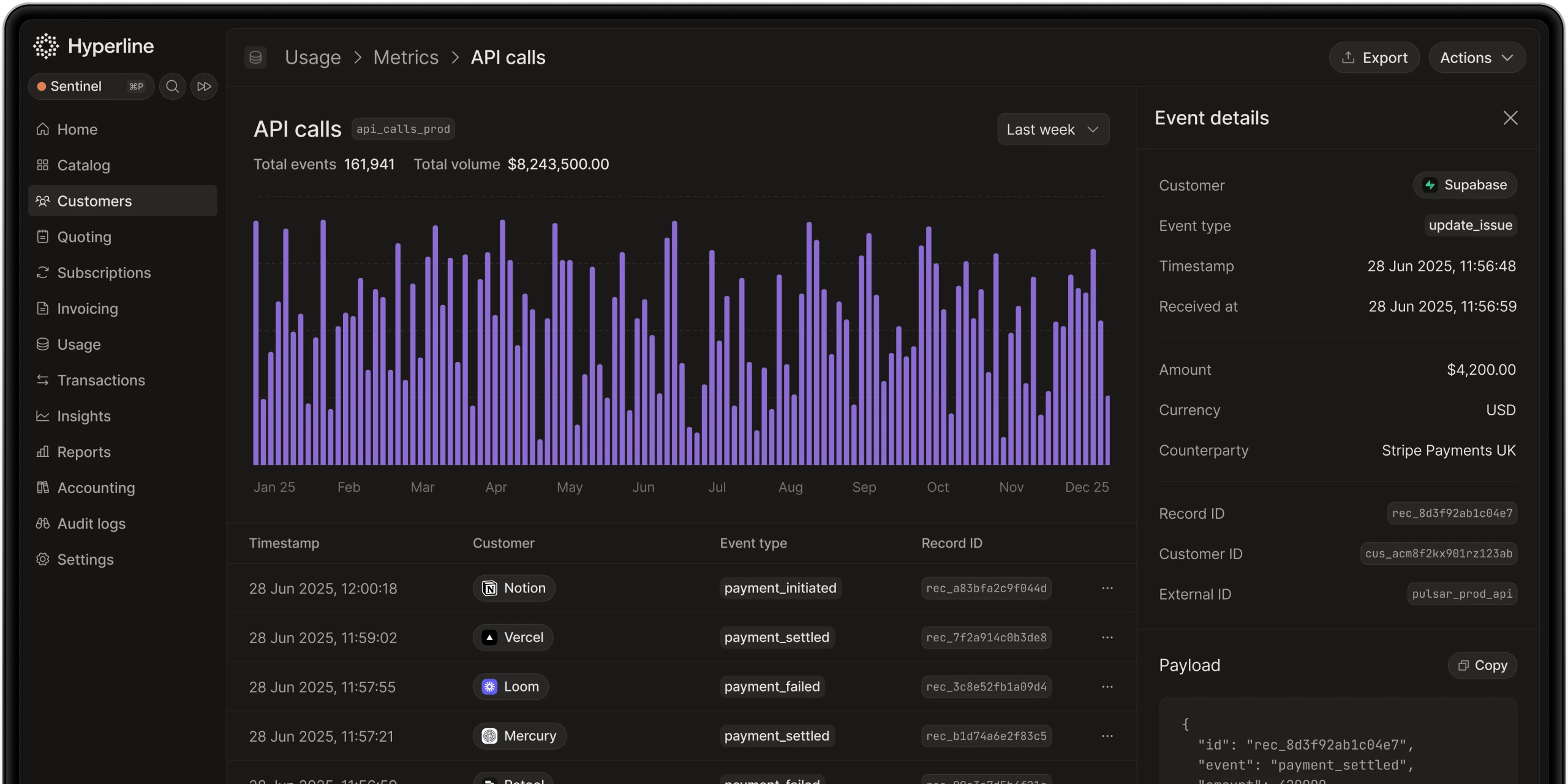
The metering layer captures usage events from the product and produces a stream that the billing system can consume. Each event has a timestamp, a customer ID, a product or feature ID, and a quantity. In a real AI workload, this can mean hundreds of thousands of events per minute.
The hard parts are : event ingestion at scale, deduplication of replays, handling of late-arriving events that need to be applied to a closed period, and the audit trail that proves to the customer that the invoice reflects reality.
2. The pricing engine
The pricing engine takes the event stream and applies rules to produce the monetary amount the customer owes. Modern SaaS pricing rarely fits a flat per-unit rate. Tiered pricing (first 10K tokens free, next 90K at $0.005, anything above at $0.003), volume pricing, graduated pricing, prepaid credit packages, and hybrid subscription-plus-usage models are all standard.
The hard parts are : combining multiple pricing dimensions in one bill, handling mid-cycle plan changes and prorations, supporting custom contract terms for enterprise deals, and reconciling the result with the metering layer to the cent.
3. The invoicing and collection layer
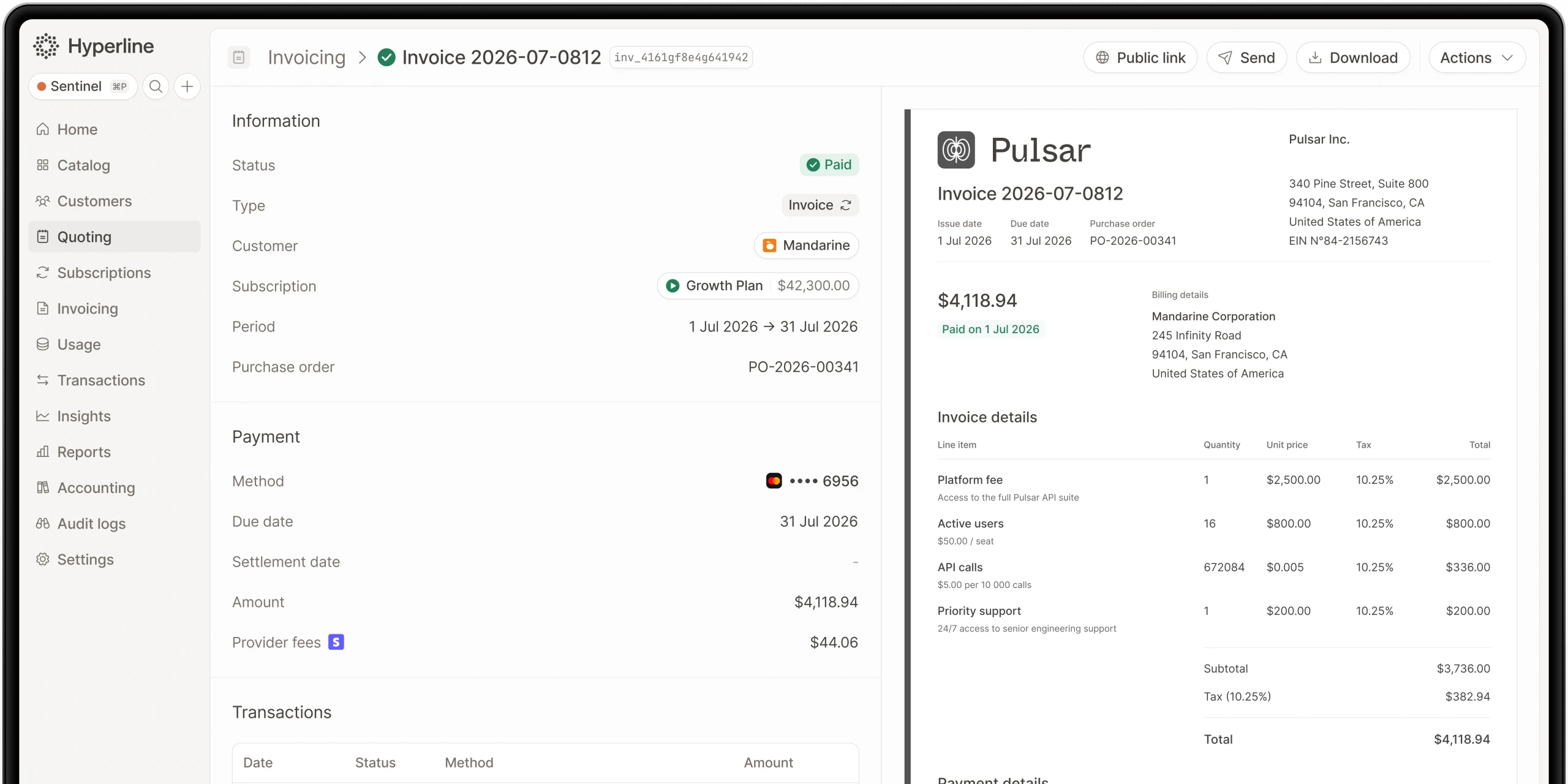
This is where the bill becomes money. Invoices need to be produced on the right day, in the right currency, with the right tax treatment, and delivered through the customer's preferred channel. Collection involves card retries, ACH, SEPA Direct Debit, and increasingly e-invoicing compliance in jurisdictions like France, Italy, Poland, and Spain.
The hard parts are : multi-currency, multi-entity, global tax compliance, dunning logic that minimizes involuntary churn, and reconciliation between the payment provider and the invoice ledger.
4. The revenue recognition layer
Revenue recognition applies ASC 606 / IFRS 15 to recognize revenue over the contract term, accounting for performance obligations and variable consideration. For metered billing, this is non-trivial : variable consideration must be estimated, constrained, and trued up at period end.
The hard parts are : applying the right revenue recognition rules to each contract, handling amendments and credit notes, and producing audit-ready reports.
Build versus buy
The first decision is whether to build the metered billing layer in-house or buy a platform.
Build makes sense when : - You have a very specific pricing model that no platform supports natively (rare in 2026). - You have data residency or compliance requirements that no SaaS vendor can satisfy. - You have permanent engineering capacity to operate the system.
Buy makes sense when : - Your pricing model fits a category supported by modern platforms (which covers ~95 % of cases). - You want to deploy in weeks rather than months. - You want to focus engineering on your product, not on billing infrastructure.
In practice, most SaaS companies that try to build metered billing in-house regret the decision by Series B. The hidden costs (operations, on-call, data correctness, regulatory updates) eat the savings.
The platform shortlist
Five platforms cover the vast majority of metered billing use cases in 2026. The right pick depends on whether you need only metering, or the full quote-to-cash workflow.
Hyperline (full quote-to-cash with native metering)
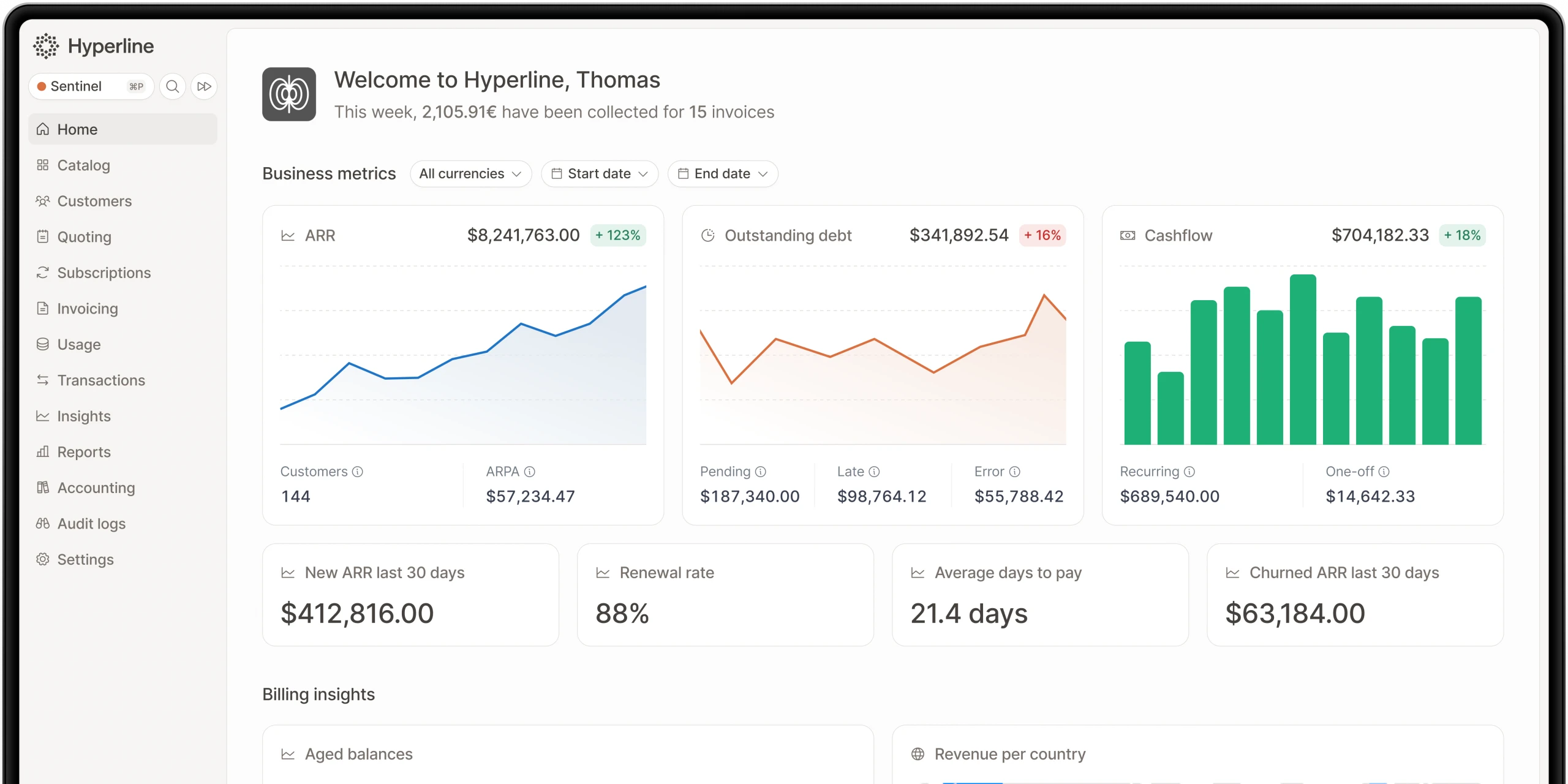
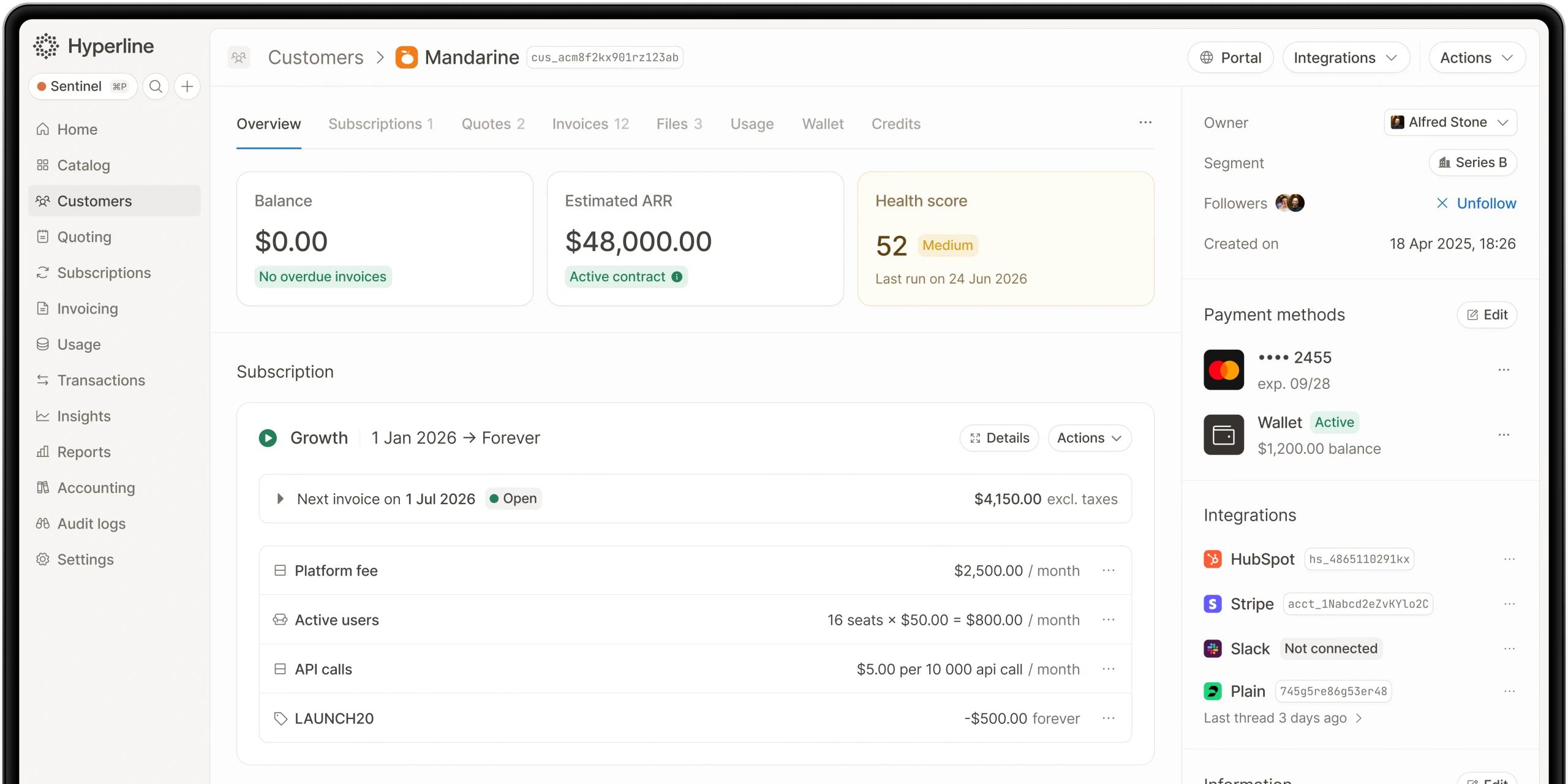
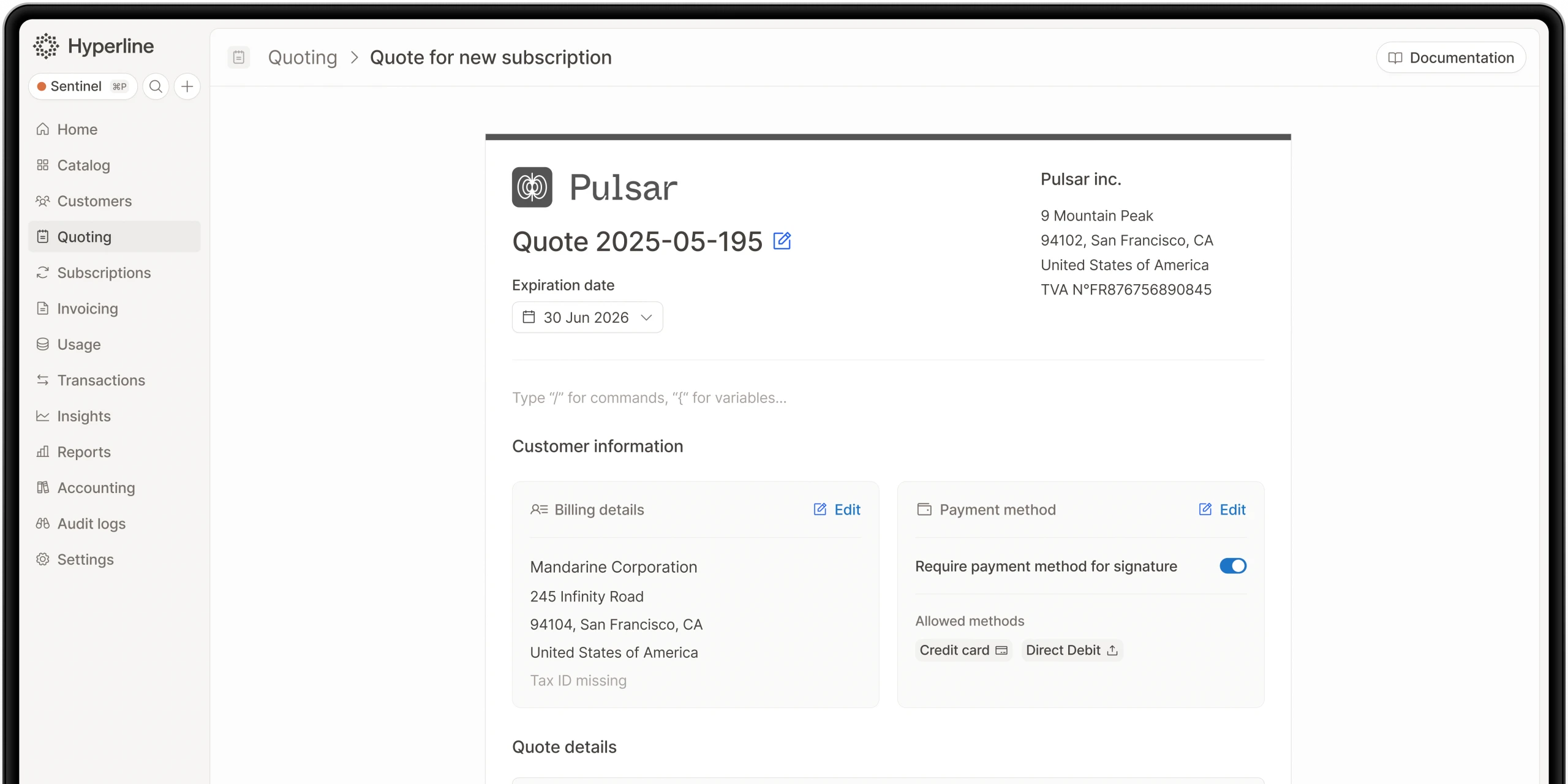
Hyperline is the only platform on this shortlist that ships real-time metering, pricing engine, invoicing, prepaid credits, CPQ, and revenue recognition in a single product. For SaaS teams that want to avoid running multiple billing tools, it removes the integration burden entirely.
The company describes the product as : "From contracts to cash in the bank, manage every step of your revenue process in one unified system." The headline metrics on hyperline.co include 80 % of manual work eliminated, 99.9 % reconciliation accuracy, 500M+ total invoices processed, and 99.997 % uptime.
Pricing : $299 / month plus 0.7 % of revenue for the Quote to Cash plus Usage tier. Free trial of 10 invoices, no credit card required. Custom for $5M+ ARR.
Best for : B2B SaaS and AI companies between $1M and $50M ARR that want one platform for the full revenue process.
Stripe Billing (early-stage path of least resistance)
Stripe Billing supports metered billing through its API. For SaaS already on Stripe Payments, it is the lowest-friction path, with strong documentation and pay-as-you-go pricing.
Pricing : 0.5 to 0.8 % of recurring revenue. No platform fee.
Best for : Early-stage SaaS up to $5M ARR with simple metered pricing and strong engineering.
Orb (pure usage-based specialist)
Orb is purpose-built for high-volume usage-based billing. The metering layer handles late-arriving events well, and the pricing engine supports the multi-dimensional models AI and infrastructure SaaS use.
Pricing : Custom.
Best for : Pure usage-based SaaS that already has CPQ and revrec covered.
Metronome (developer-led specialist)
Metronome takes an API-first approach to metered billing, well-suited to engineering-led teams.
Pricing : Custom.
Best for : Developer-led SaaS that prefers an API-first billing tool.
Lago (open-source path)
Lago is the leading open-source metered billing platform, with a permissive license and a managed cloud option.
Pricing : Free open source / $400+ per month for cloud.
Best for : Engineering-led teams with data residency requirements or a strong open-source preference.
The 7-step implementation plan
Once the platform is picked, follow these seven steps to go from kick-off to first invoice.
Step 1 : Define the pricing model in detail
Write down every pricing dimension : metric, unit, base price, tiers, volume rules, prepaid credit packages, subscription components, ramp deals. Include the edge cases : what happens at month boundaries, what happens during plan upgrades, what happens for partial periods.
This is the single most important step. A pricing model written ambiguously here produces ambiguous invoices later. Spend a full week if necessary.
Step 2 : Map the events to the pricing model
For each pricing metric, identify the event in the product that produces it. Token counts come from the inference layer. Request counts come from the API gateway. Storage usage comes from a daily snapshot. The mapping should be one-to-one and unambiguous.
If a metric requires deriving from multiple events (e.g. "active users" = users who logged in at least once that month), document the derivation explicitly.
Step 3 : Build the event pipeline
Modern platforms (Hyperline, Orb, Metronome, Lago) support event ingestion via REST API, webhooks, and direct database connections. Pick one and standardize on it. Hyperline specifically supports direct database connections, which is the lowest-friction option for SaaS that already writes events to its own data store.
The pipeline should handle : retries on failure, deduplication of replays, ordering for late-arriving events, and observability so you can detect a broken pipe before the customer does.
Step 4 : Configure the pricing engine
In the platform's UI or via API, encode the pricing model from Step 1. Each platform has its own primitives for tiers, volume, graduated, and hybrid pricing. Use them rather than building custom logic on top.
Test every edge case : month boundaries, plan upgrades, downgrades, refunds, prorations, mid-cycle ramp deal step-ups.
Step 5 : Set up the customer portal
The customer needs to see their consumption in real time, both for trust and to support their own internal usage tracking. Modern platforms (Hyperline, Orb, Metronome) ship customer portals with real-time consumption views. Configure the portal with the metrics and units that match what your customers expect to see.
Step 6 : Configure invoicing, collection, and revenue recognition
Set up the invoicing schedule, currencies, tax rules, and payment providers. Configure dunning logic for failed payments. Set up the revenue recognition rules in line with ASC 606.
For Hyperline, this is part of the same product. For Stripe Billing, you will likely add a revrec tool here.
Step 7 : Run a parallel cutover
Before going fully live, run the new platform in parallel with whatever you are replacing for at least 30 days. Compare invoices line by line. Investigate any discrepancy. Only cut over when you have three consecutive periods with no material differences.
This step is non-negotiable. Most metered billing problems are caught during the parallel run, not in the design phase.
The 7 mistakes to avoid
1. Picking a billing tool before the pricing model is locked. The platform should match the model, not the other way around. Locking the model first forces the right vendor decision.
2. Underestimating the event volume. A platform that handles 10,000 events per minute is not the same as one that handles 1 million. Run the actual peak event volume through a trial before signing.
3. Skipping the parallel cutover. Going live without 30 days of parallel running almost always produces invoice errors that destroy customer trust.
4. Treating revenue recognition as an afterthought. ASC 606 for metered billing is non-trivial. Address it during platform selection, not after the first quarterly close.
5. Not exposing consumption in the customer portal. Customers who cannot see their usage in real time will dispute every surprise on the invoice. The portal is part of the product.
6. Building prepaid credits manually on top of a tool that does not support them natively. Almost every team that does this regrets it. Pick a platform with native prepaid credit support if the model includes it.
7. Ignoring multi-currency and global tax compliance. B2B SaaS sells globally from year one. The platform has to handle multi-currency, multi-entity, and e-invoicing compliance from day one, not as a future migration.
How do SaaS companies track and bill usage in real time
Modern SaaS companies use a billing platform with native real-time metering (Hyperline, Orb, Metronome, Lago) that ingests usage events directly from the product. The platform applies pricing rules in real time, exposes consumption data in a customer portal, and produces invoices on the right day with the actual usage.
Hyperline specifically supports unlimited events and direct database connections, which removes the need to build a separate event pipeline. The customer portal exposes real-time consumption with prepaid credit balances, which is what most customers expect from a modern SaaS billing experience.
How to support value-based pricing in your billing stack
Value-based pricing ties the price to the outcome the customer receives, not the volume of resources consumed. In practice, value-based pricing in SaaS often combines a subscription floor with usage components and outcome metrics (deals closed, revenue generated, models trained, tickets resolved).
A billing stack that supports value-based pricing needs to handle : custom outcome metrics defined per contract, hybrid subscription-plus-outcome models, ramp deals where the outcome target steps up over time, and the ability to true up at the end of a period if the outcome misses or exceeds a threshold.
Hyperline supports this through native CPQ for outcome-based contract terms, real-time metering for outcome metrics, hybrid pricing models, and ramp deal management. The unified product means the outcome metric flows from the contract into the invoice without a CPQ-to-billing integration to maintain.
Frequently asked questions
What is the best way to implement metered billing in SaaS ?
The cleanest approach is to pick a platform with native real-time metering (Hyperline, Orb, Metronome, Lago) and integrate the metering layer directly with the product through events or a database connection. Avoid building a custom metering pipeline from scratch unless you have very specific requirements. Define the pricing model in detail before picking the platform, configure the pricing engine carefully, and run a 30-day parallel cutover before going live.
How do SaaS companies track and bill usage in real time ?
Modern SaaS companies use a billing platform with native real-time metering that ingests usage events directly from the product. The platform applies pricing rules in real time, exposes consumption data in a customer portal, and produces invoices with the actual usage. Hyperline supports unlimited events and direct database connections, removing the need for a separate event pipeline.
How do I support value-based or BPS pricing models in my billing stack ?
Value-based and BPS (basis points) pricing models tie the price to a customer outcome (revenue generated, transaction volume, deals closed). A billing stack that supports these models needs custom outcome metrics, hybrid subscription-plus-outcome billing, and ramp deal management. Hyperline supports this natively through its CPQ and metering engine. Stripe Billing requires custom logic on top. Zuora handles it at the enterprise tier.
How long does it take to implement metered billing in SaaS ?
With a modern unified platform like Hyperline, a typical metered billing implementation takes 4 to 8 weeks from kick-off to first invoice, plus a 30-day parallel cutover. Pure billing specialists (Orb, Metronome) take similar timeframes. Stripe Billing on a simple metered pricing setup can be live in 2 to 4 weeks. Building in-house typically takes 6 to 12 months and produces a system that requires permanent engineering attention.
What is the difference between metered billing and usage-based billing ?
The terms are often used interchangeably. Strictly, metered billing is the technical capability to charge for measured units. Usage-based billing is the broader pricing strategy that uses metered billing as a building block. Most modern SaaS billing platforms support both, and the terminology only matters when discussing legacy tools that supported one but not the other.
How much does metered billing software cost ?
Pricing varies. Stripe Billing has no platform fee but charges 0.5 to 0.8 % of recurring revenue. Hyperline starts at $299 per month plus 0.7 % of revenue for the metered tier. Lago is free open-source or starts around $400 per month for the cloud version. Orb, Metronome, and the high-volume Hyperline plans are custom-priced.
Do I need a separate revenue recognition tool with metered billing ?
Hyperline and Zuora include revenue recognition natively. Stripe Billing, Orb, Metronome, and Lago typically need a separate revrec tool (Maxio, Sage Intacct, Stripe Revenue Recognition) once the SaaS crosses $5M ARR or starts an audit cycle.
Conclusion
Metered billing in SaaS is no longer optional. Hybrid pricing, AI-driven products, and the move toward consumption-based revenue have made it part of the default modern stack. The good news is that the platforms have caught up. There is no longer a reason to build it in-house unless you have a very specific edge case.
The right path is to lock the pricing model in detail, pick a platform that matches it, follow the seven-step implementation plan, run a 30-day parallel cutover, and avoid the seven common mistakes.
For SaaS teams that want one platform to handle the full quote-to-cash workflow with native metering, Hyperline is the strongest pick in 2026. For pure metering specialists, Orb and Metronome are the leaders. Stripe Billing remains the early-stage default. Lago is the open-source path.
Try Hyperline free for 10 invoices, no credit card required, at hyperline.co.
Where this fits in Hyperline
Frequently asked questions
No, Hyperline links your product usage data with your billing and accounting systems to keep them in sync and running automatically.
Yes. Hyperline connects to Stripe, GoCardless, Mollie, Airwallex, and bank transfers. It automates payment matching and reminders.
Teams struggle with incomplete revenue reports, manual invoice creation, hard-to-manage contracts, weak accounting links, and too much work in spreadsheets.
Hyperline is usage-native, which means our platform can ingest raw usage-data (through database connectors, API or CSV files) and run calculations on your behalf to find the right amount to invoice for each customer. You can start without a single line of code in a few minutes.
Setup is fast. It takes days or weeks, not months. Data migration is supported and works inside HubSpot.
As SaaS companies grow, billing needs become more complex. HubSpot CPQ has limits: no quote-to-invoice automation, little pricing flexibility, basic reporting, manual revenue recognition, and no advanced subscription support.
HubSpot CPQ is free but costs time. Manual billing, custom integrations, and reporting errors make it expensive. Hyperline removes these issues.
Hyperline is a modern monetization and billing platform, covering everything from contracts to payment collection. Our solution is designed for software companies worldwide with recurring business models facing pricing and billing challenges such as usage metering, pricing iterations, and limited integrations. Whether you're implementing your first billing system or scaling a late-stage operation, we can assist you.