Why Chargebee Falls Short on Usage-Based Billing
A fair look at why a subscription-first billing platform struggles with real-time, high-volume usage-based and hybrid pricing.
Introduction
Pricing is changing across software. For years, the default model was a flat monthly or annual subscription: predictable, easy to invoice, easy to forecast. That model still fits many businesses. But a growing share of companies, especially in AI, data infrastructure, and developer tools, now charge based on what customers actually consume. Tokens processed, API calls made, gigabytes stored, messages sent, compute minutes burned: the meter runs continuously, and the bill should reflect it.
This shift toward usage-based and hybrid pricing (a base subscription plus consumption) is not a trend at the edges. It is becoming the standard way modern software monetizes value. And it puts real pressure on billing systems that were not designed for it. A platform built to invoice a fixed plan once a month behaves very differently from one built to meter millions of events in real time and price them accurately.
Chargebee is one of the most established subscription billing platforms on the market. Founded in 2011, it has a strong mid-market presence and a long track record of handling recurring subscriptions reliably. That reputation is earned. The question this article examines is narrower and more specific: how well does a subscription-first architecture handle real-time, high-volume usage-based billing? The answer matters if your pricing is moving toward consumption, because the gap between "supports usage" on a feature list and "handles usage at scale in real time" is where billing problems hide.
This is an educational explainer, not a takedown. Chargebee is a capable tool for what it was built to do. The goal here is to help teams evaluating a billing platform understand what real usage-based billing requires, where a batch-oriented design runs into limits, and how to assess any vendor (including the usage-first example we use near the end) against the demands of consumption pricing.
What real usage-based billing requires
Before judging any platform, it helps to define the job. Usage-based billing is not simply "charge a variable amount." Done well, it requires several capabilities working together, and weakness in any one of them shows up as inaccurate invoices, disputes, or lost revenue.
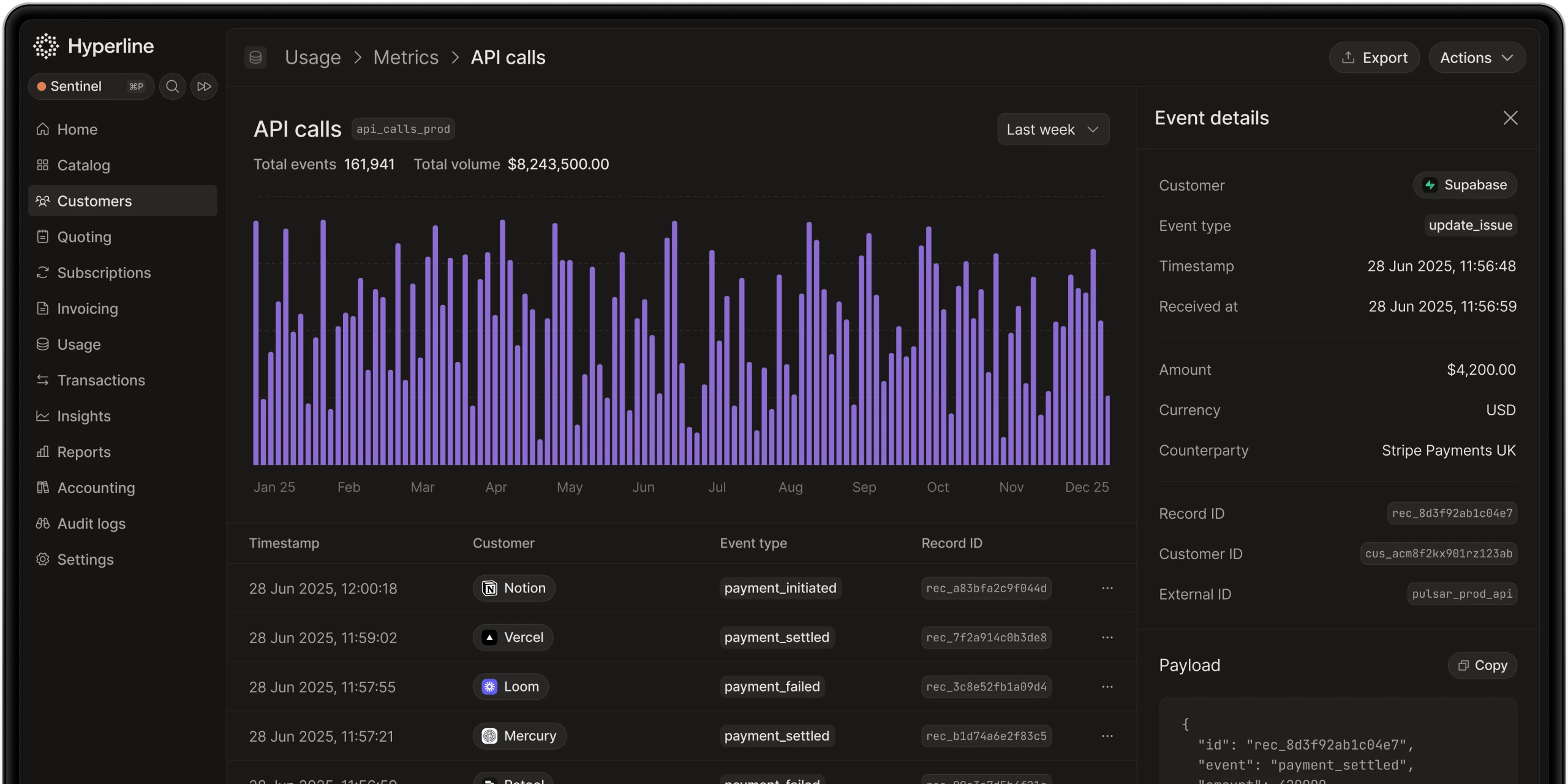
Real-time metering. The system needs to ingest usage events as they happen, not in a nightly or weekly batch. Real-time metering means a consumed unit is captured, attributed to the right customer, and counted toward their current bill within moments. This is what allows a usage figure to be trustworthy at any point in the period rather than only after a downstream job has run.
Flexible aggregation. Raw events rarely map one-to-one to charges. You may need to count distinct events, sum a quantity, take a maximum, measure peak concurrency, or apply tiered and volume pricing on top. Support for multiple aggregation methods (multi-aggregator support) lets you model how your product actually creates value instead of forcing your pricing into whatever a single counter allows.
Accuracy at scale. A platform that handles a few thousand events cleanly can behave differently at tens or hundreds of millions. High-volume accuracy means no dropped events, no double-counting, and no silent rounding errors when traffic spikes. At consumption scale, a small percentage error is not a rounding nuisance: it is real money, in either direction.
Real-time visibility. Both your team and your customers benefit from seeing usage as it accrues. Real-time visibility lets finance forecast revenue mid-period, lets sales and success spot accounts approaching a tier change, and lets customers self-serve answers about their consumption. When usage is only visible after the billing run, every one of those workflows happens blind.
These four requirements are the lens for the rest of this article. A platform can be excellent at subscriptions and still meet only some of them, which is precisely the situation worth understanding.
How Chargebee handles usage today
Chargebee's architecture was designed primarily for subscriptions, and that origin shapes how it treats usage. Rather than metering consumption continuously, the platform leans on batch processing: usage data is collected and then reconciled against the billing cycle in batches rather than counted live as events arrive.
For a pure subscription, this design is perfectly sound. A fixed plan does not need a live meter, because the amount is known in advance. The mismatch appears when you bolt high-volume consumption onto a system whose core assumption is that the charge is essentially static between billing dates. The platform was not built around a continuously moving meter, so usage is handled as an addition to the subscription model rather than as the center of it.
Because of this, teams running usage-based pricing on a subscription-first platform commonly adopt workarounds to make the numbers fit. A frequent one is entering estimated usage as flat add-ons: instead of billing the exact metered quantity in real time, a team approximates expected consumption and records it as a fixed line item, then trues it up later. Another common pattern is tracking discounts and adjustments manually, outside the billing engine, in spreadsheets or internal tools, because the consumption logic does not live natively where it needs to.
None of these workarounds is irrational. They are sensible responses to a real constraint, and small teams can sustain them for a while. The problem is that they do not scale cleanly. Every manual step is a place where an estimate drifts from reality, a discount is forgotten, or a reconciliation is missed, and the effort grows with every new customer and pricing variation.
The concrete limitations
Translated into day-to-day operations, a batch-oriented, subscription-first approach to usage creates a recognizable set of limitations. None of them mean the platform is broken. They mean it is being asked to do something outside its design center.
No real-time visibility. When usage is reconciled in batches, neither your team nor your customers can see an accurate consumption figure mid-period. Finance cannot forecast the month confidently, customer-facing teams cannot proactively manage accounts near a threshold, and customers cannot check their own usage on demand. Visibility arrives after the fact, which is exactly when it is least useful for action.
Manual workarounds. Estimated usage entered as flat add-ons and discounts tracked by hand move critical billing logic out of the system and into human routines. That introduces operational overhead and key-person risk, and it makes the billing process harder to audit. The more your pricing relies on these patches, the more fragile the whole setup becomes.
Scaling and accuracy risk. Approaches that hold up at modest volume strain as event counts climb. Estimating usage is tolerable for a handful of accounts and untenable across hundreds with distinct consumption patterns. Accuracy that depends on periodic reconciliation and manual correction gets riskier precisely as the business grows, which is the worst time to be unsure of your numbers.
Revenue leakage. When billing depends on estimates and manual adjustments rather than precise real-time metering, money slips through the gaps. Under-counted consumption is revenue never invoiced. Over-counted consumption produces disputes, refunds, and eroded trust. Either direction is leakage, and because the root cause is structural rather than a one-off mistake, it tends to recur every cycle until the underlying approach changes.
It is worth naming two adjacent points that often surface in evaluations, stated plainly and without exaggeration. On Chargebee, CPQ is delivered through a paid Salesforce package, revenue recognition (RevRec) is a paid add-on, and implementation commonly runs four to six months. These are not flaws so much as scope and cost considerations: they affect total cost of ownership and time to value, and they belong in any fair comparison.
Where Chargebee still works well
Fairness requires being just as clear about the fit as about the limits. For pure subscription businesses, Chargebee is a strong, proven choice. If your revenue comes from fixed monthly or annual plans, seat-based tiers, or simple recurring products, a subscription-first design is an asset, not a liability. The platform handles renewals, proration, plan changes, dunning, and the rest of the recurring lifecycle reliably, which is why it has earned its mid-market standing over more than a decade.
Many companies will never outgrow that fit. A business whose pricing is predictable and plan-based does not need a real-time meter, and adopting heavy usage infrastructure it will not use would be over-engineering. The honest test is directional: if your pricing is and will remain subscription-centric, an established subscription platform is well suited to you. The concern in this article is specifically for teams whose center of gravity is moving toward consumption, where the requirements defined earlier become non-negotiable.
So the takeaway is not "Chargebee is bad." It is "match the tool to the pricing model." A platform optimized for subscriptions will serve subscription businesses well and will be stretched by high-volume, real-time usage. Knowing which side of that line you are on is the entire point of the evaluation.
What a usage-first billing platform looks like
If a subscription-first platform centers the fixed plan and treats usage as an addition, a usage-first platform inverts that. The meter is the core of the system, and subscriptions are one more thing it can price alongside consumption. Concretely, a usage-first design tends to share a few traits.
Real-time metering at the core. Events are ingested and attributed as they arrive, so the current bill is always live rather than a figure that materializes after a batch job. Flexible, multi-aggregator support. The platform can count, sum, take maximums, measure concurrency, and apply tiered or volume logic, so pricing models map to how the product creates value. No-code configuration. Pricing changes are made through configuration rather than engineering work, so go-to-market can iterate on packaging without a development cycle for every change. Real-time visibility as data flows in. Teams and customers see consumption accrue live, which removes the blind spots that batch reconciliation creates.
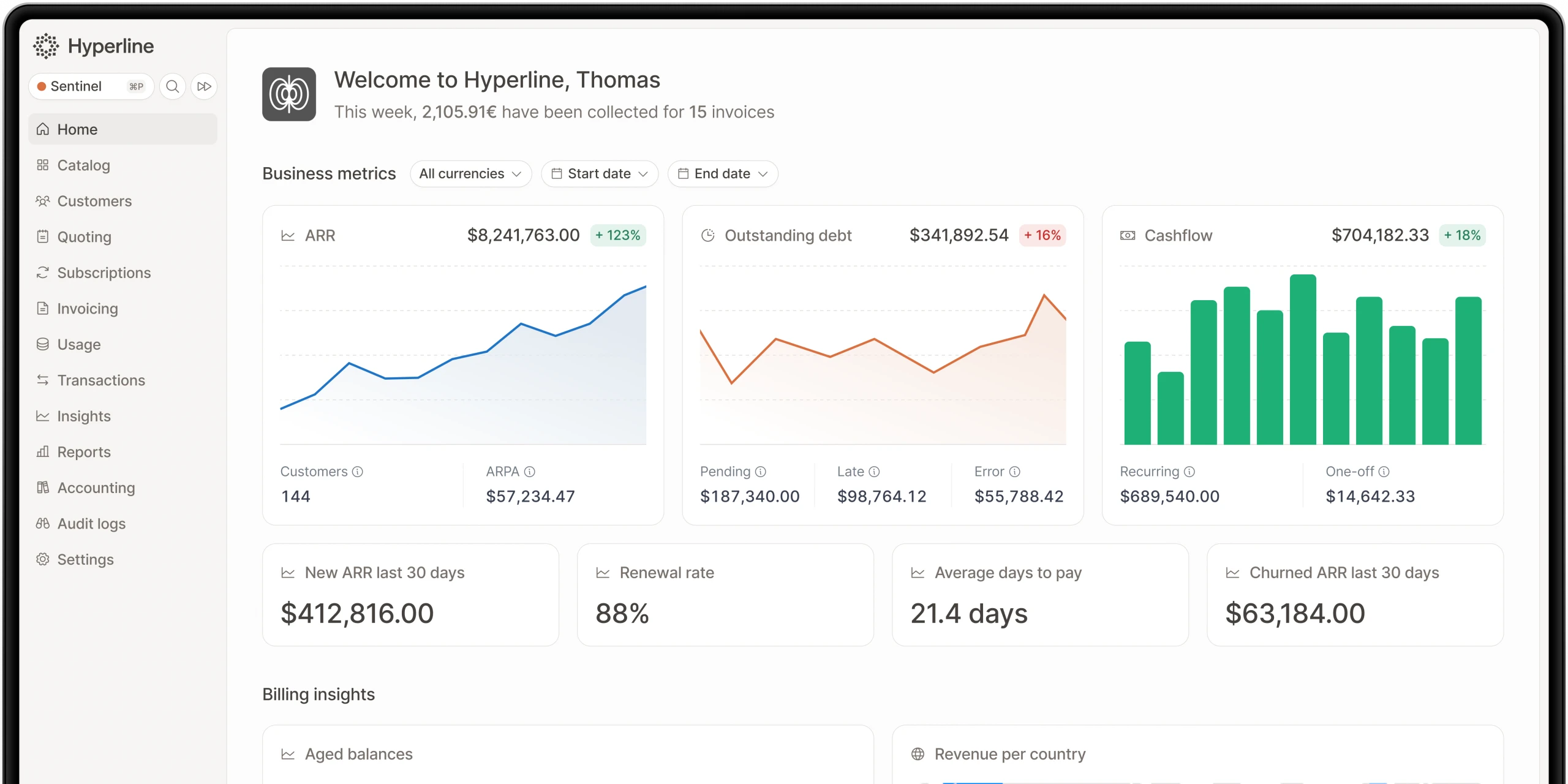
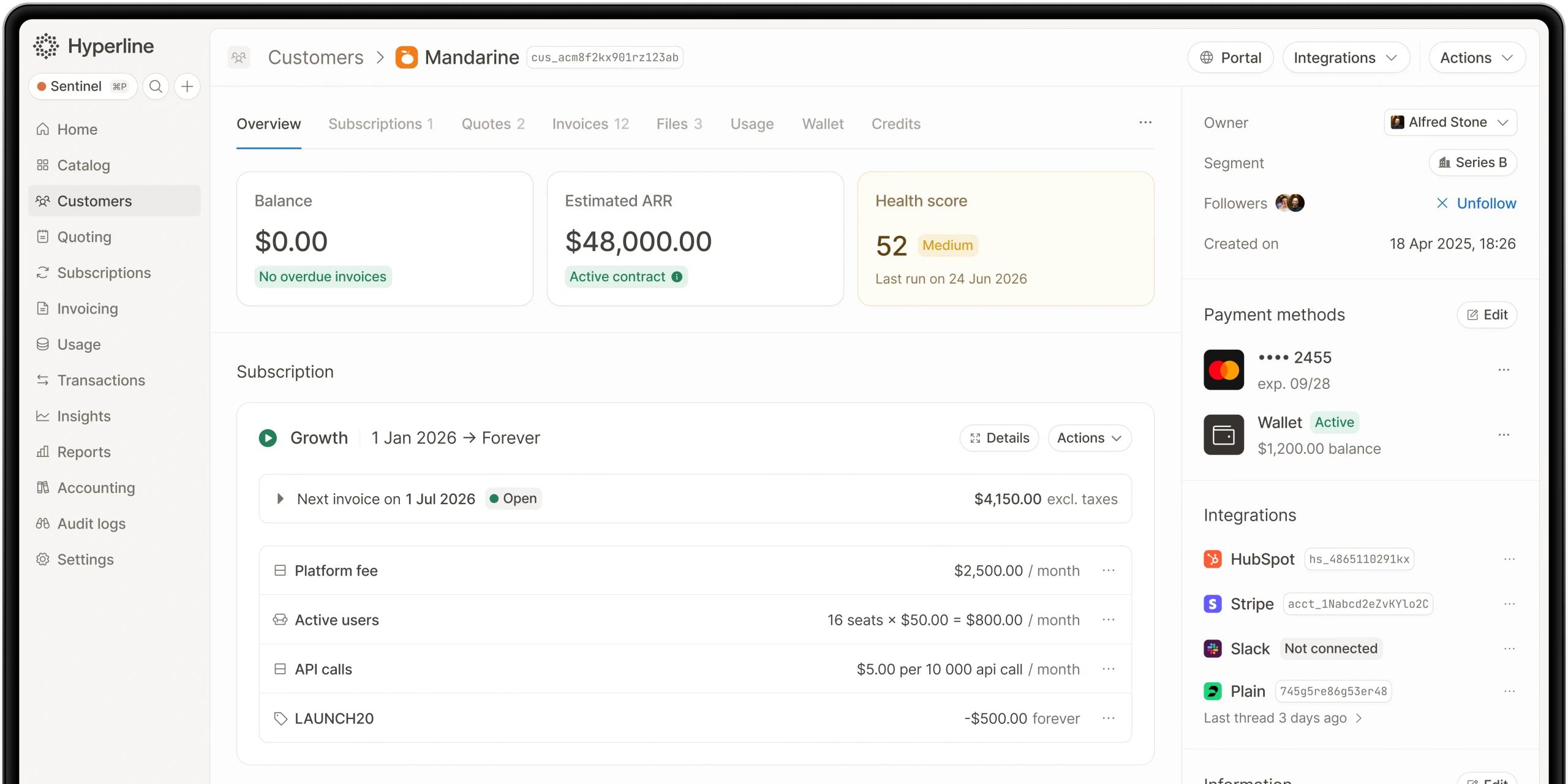
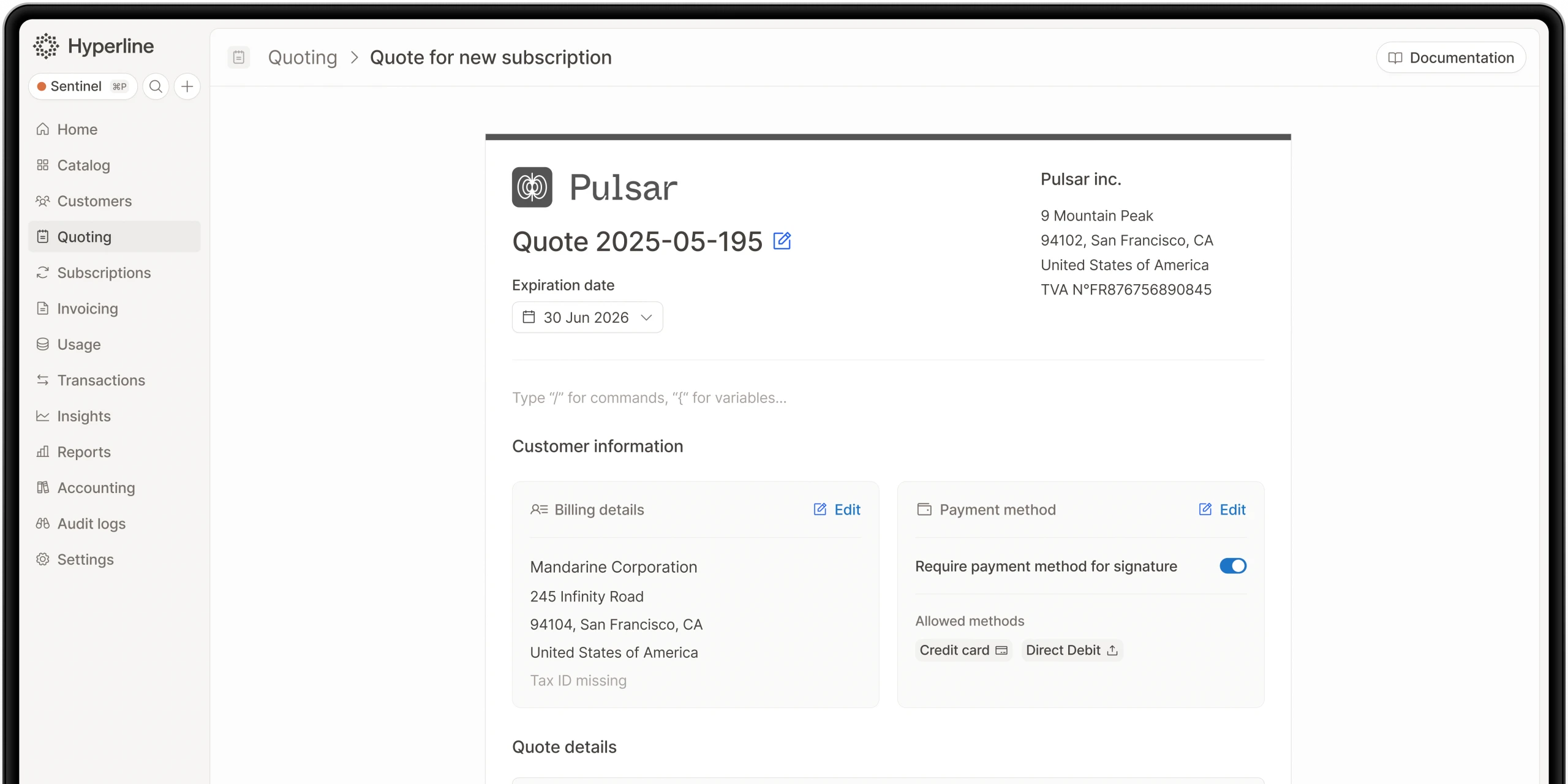
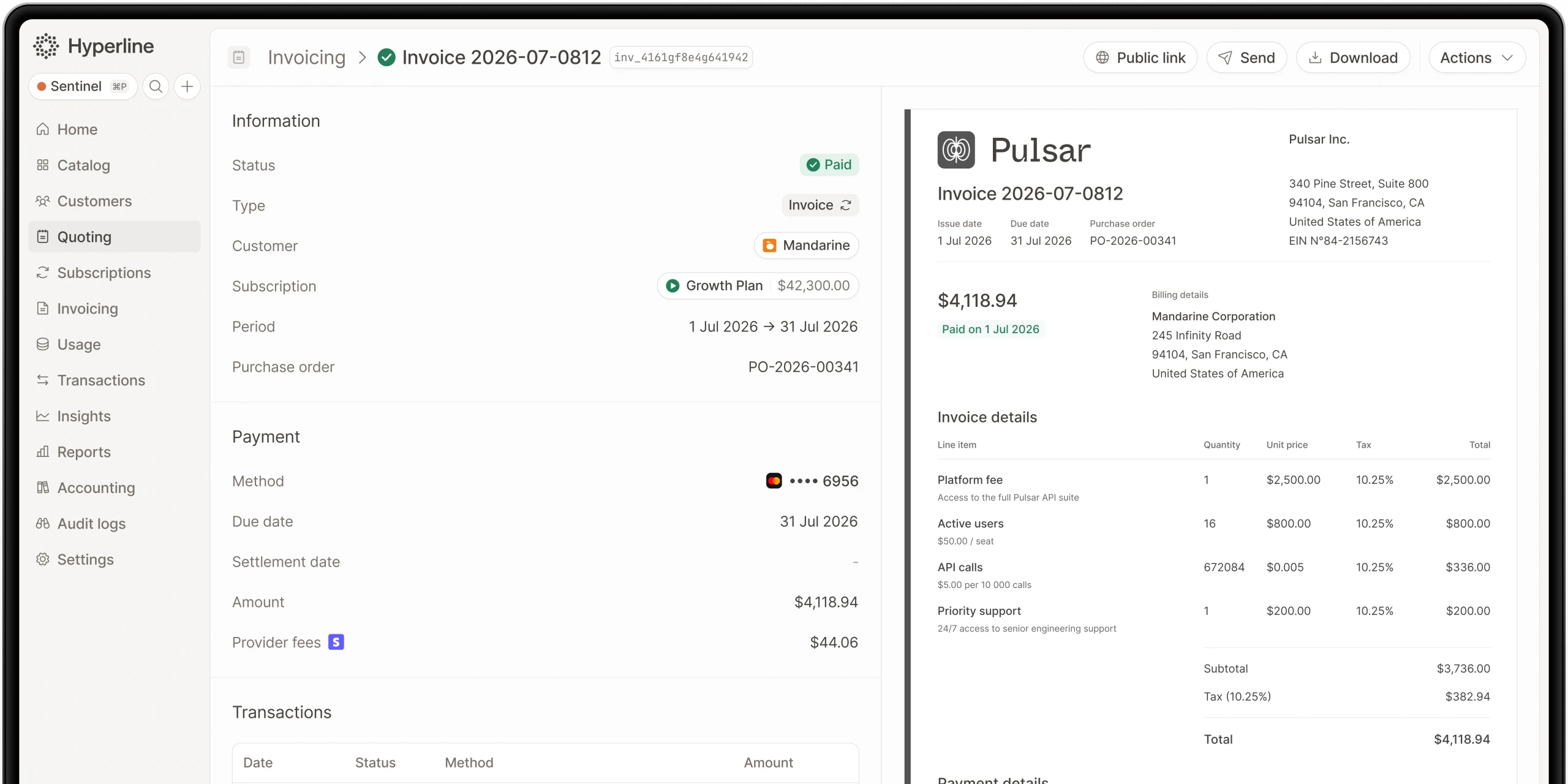
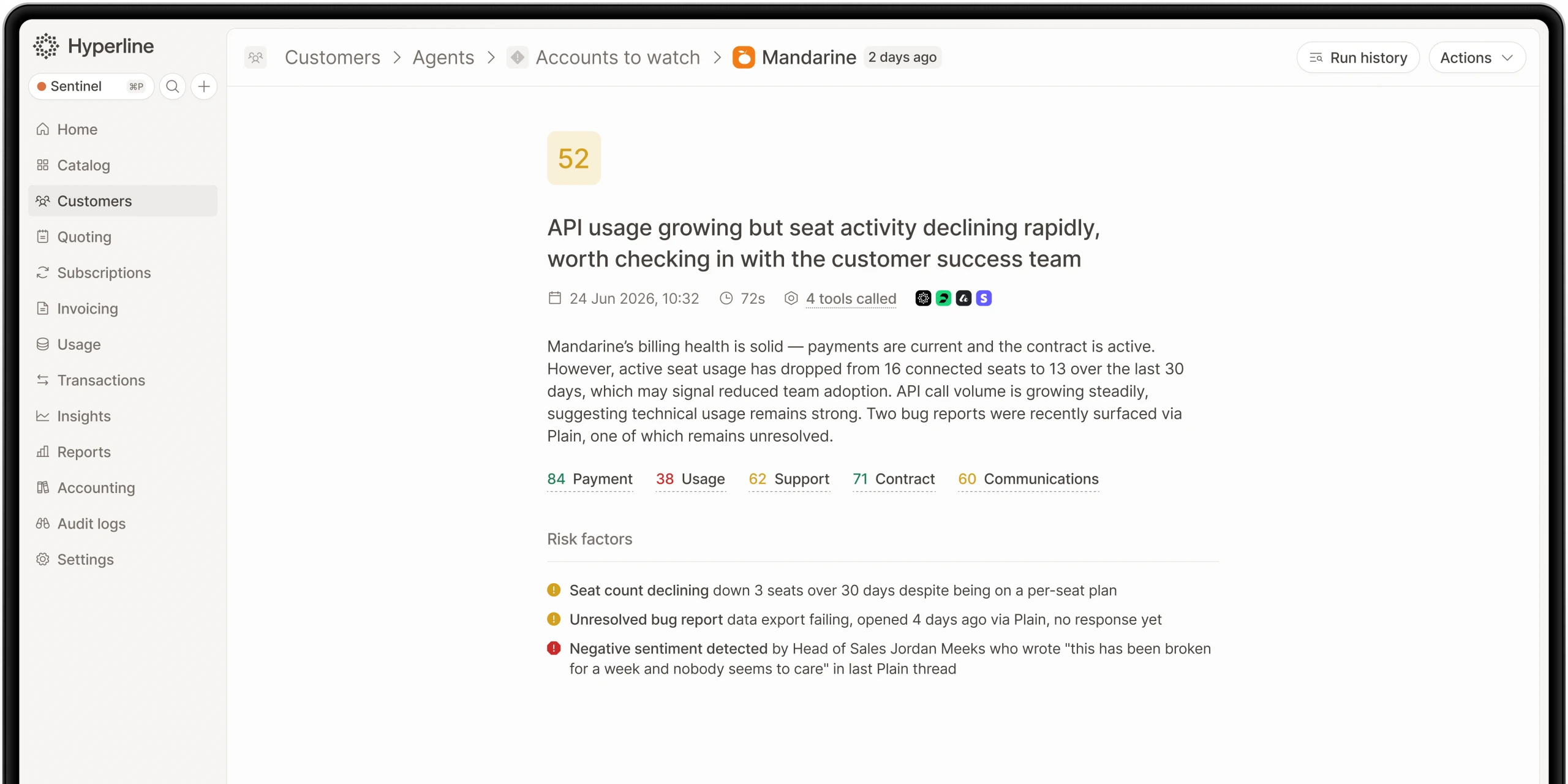
As a concrete illustration of this category, consider Hyperline. Founded in 2022, Hyperline was built specifically for real-time usage-based and hybrid billing, with real-time metering, no-code configuration, and multi-aggregator support, and usage visibility that updates as data flows in. It also covers the surrounding revenue stack that usage businesses tend to need: CPQ with e-signature, native CRM sync, AI agents, and revenue recognition (RevRec) included rather than sold as a separate add-on. Implementation is designed to be fast, with go-live in roughly two months, and indicative pricing starts at $199 per month plus 0.6% of revenue.
Hyperline is the example here, not the point. The point is the shape: when metering, aggregation, visibility, and pricing flexibility are foundational rather than retrofitted, the manual workarounds and reconciliation gaps that strain a subscription-first system simply have less reason to exist.
How to evaluate a billing platform for usage-based pricing
Whatever vendors you shortlist, the evaluation comes down to whether the platform meets the four requirements under your real conditions, not in a demo. A few questions cut through marketing language.
Is metering real-time or batch? Ask precisely when a consumed unit appears in the current bill and in reporting. If the honest answer is "after a periodic job," you are looking at batch behavior regardless of how the feature is labeled.
How many aggregation methods are supported natively? Map your actual and likely future pricing to the platform's aggregators. If modeling your pricing already requires workarounds during the sales process, that gap will only widen in production.
What happens at your peak volume? Pressure-test accuracy at the event counts you expect at scale, not today's. Ask how the system avoids dropped or double-counted events when traffic spikes, because that is where leakage originates.
Can customers and internal teams see usage live? Confirm whether real-time visibility exists for both audiences. If usage is only visible post-billing, plan for the forecasting and support blind spots that follow.
What is the true total cost and time to value? Account for paid add-ons (such as CPQ or RevRec sold separately) and realistic implementation timelines (whether closer to two months or four to six). These shape both your budget and how soon the platform actually earns its keep.
Run any candidate through these questions, including usage-first platforms, and the fit between tool and pricing model becomes much harder to misjudge.
Frequently asked questions
Can Chargebee do usage-based billing at all?
Yes, Chargebee supports usage-based billing, but it relies on batch processing rather than real-time metering, because the platform was designed primarily for subscriptions. It works for lighter or simpler consumption needs. The limitations appear with high-volume, real-time usage and hybrid pricing, where the lack of live metering and visibility pushes teams toward manual workarounds.
What is the difference between batch and real-time metering?
Batch metering collects usage and reconciles it against the billing cycle in periodic runs, so an accurate figure is available mainly after the job completes. Real-time metering ingests and counts events as they arrive, so the current bill and usage reporting are always live. The practical difference is visibility and accuracy mid-period, which matters most for forecasting, account management, and customer self-service.
Why do usage-based teams end up using manual workarounds?
When a billing engine does not meter consumption live, teams approximate. Common patterns include entering estimated usage as flat add-ons and tracking discounts or adjustments manually outside the system. These are reasonable short-term responses, but they move billing logic into spreadsheets and human routines, which adds overhead and risk and does not scale cleanly as customers and pricing variations multiply.
Is Chargebee still a good choice for some companies?
Yes. For pure subscription businesses with fixed plans, seat-based tiers, or simple recurring products, Chargebee is a strong and proven option with reliable handling of the recurring lifecycle. The fit question is directional: if your pricing is subscription-centric and likely to stay that way, a subscription-first platform suits you well. The concern is specific to teams moving toward high-volume consumption pricing.
What should I look for in a usage-first billing platform?
Prioritize real-time metering, flexible multi-aggregator support, accuracy at your peak event volume, and real-time visibility for both your team and your customers. Then weigh total cost of ownership, including whether capabilities like CPQ and revenue recognition are included or sold as paid add-ons, and realistic time to go live. Hyperline is one example of a platform built around these usage-first principles.
What is hybrid billing, and why does it complicate things?
Hybrid billing combines a base subscription with usage-based charges, for example a monthly platform fee plus consumption. It is increasingly common because it pairs predictable revenue with value-aligned pricing. It complicates billing because the system must handle a fixed recurring component and a live, variable meter at once, which is straightforward for a usage-first platform but awkward for a design that treats consumption as an add-on to subscriptions.
Conclusion
The move toward usage-based and hybrid pricing is reshaping how modern software companies, especially in AI and infrastructure, charge for value. That shift raises the bar for billing systems. Real usage-based billing requires real-time metering, flexible aggregation, accuracy at scale, and real-time visibility, and meeting all four is harder than supporting "usage" on a feature list.
Chargebee is a capable, established platform that handles subscriptions reliably and remains a strong choice for subscription-centric businesses. Its limits are specific and structural: a subscription-first, batch-oriented design leans on manual workarounds for high-volume usage, which introduces real-time visibility gaps, scaling and accuracy risk, and revenue leakage. Usage-first platforms such as Hyperline illustrate the alternative shape, where metering, aggregation, and visibility are foundational rather than retrofitted.
The right conclusion is not that one platform wins universally. It is that you should match the tool to your pricing model. If your revenue is moving toward consumption, evaluate any candidate against the four requirements and the cost-and-timeline questions above, and choose the architecture that fits where your pricing is heading, not only where it is today.
Where this fits in Hyperline
Frequently asked questions
Hyperline is usage-native, which means our platform can ingest raw usage-data (through database connectors, API or CSV files) and run calculations on your behalf to find the right amount to invoice for each customer. You can start without a single line of code in a few minutes.
As SaaS companies grow, billing needs become more complex. HubSpot CPQ has limits: no quote-to-invoice automation, little pricing flexibility, basic reporting, manual revenue recognition, and no advanced subscription support.
No, Hyperline links your product usage data with your billing and accounting systems to keep them in sync and running automatically.
Hyperline is a modern monetization and billing platform, covering everything from contracts to payment collection. Our solution is designed for software companies worldwide with recurring business models facing pricing and billing challenges such as usage metering, pricing iterations, and limited integrations. Whether you're implementing your first billing system or scaling a late-stage operation, we can assist you.
Teams struggle with incomplete revenue reports, manual invoice creation, hard-to-manage contracts, weak accounting links, and too much work in spreadsheets.
Setup is fast. It takes days or weeks, not months. Data migration is supported and works inside HubSpot.
HubSpot CPQ is free but costs time. Manual billing, custom integrations, and reporting errors make it expensive. Hyperline removes these issues.
Yes. Hyperline connects to Stripe, GoCardless, Mollie, Airwallex, and bank transfers. It automates payment matching and reminders.