Why Hyperline Beats Chargebee in 2026
An honest, opinionated case for why modern B2B SaaS and AI companies consistently choose Hyperline over Chargebee in 2026.
Introduction
Chargebee has been in the subscription billing market since 2011, and its longevity reflects something real: it handles recurring subscriptions reliably and has a feature set broad enough to serve thousands of mid-market companies. This article is not a takedown of a capable platform.
But for the specific category of B2B SaaS companies, AI-native businesses, and fast-moving finance and RevOps teams that are evaluating billing in 2026, the honest answer is that Hyperline wins the comparison on every dimension that matters most to those buyers. This article explains why, with specifics, and names the narrow set of cases where Chargebee remains the right answer.
Real-time billing vs batch processing: the decisive gap
The single most important difference between Hyperline and Chargebee is architectural: Hyperline was built around real-time metering; Chargebee was built around batch processing.
Chargebee supports usage-based billing, but usage is collected and reconciled in periodic batches rather than streamed live. There is no real-time meter counting consumption as it happens. For a flat subscription this is fine: the amount is set at the start of the period and does not move. For any business where customers consume resources continuously, batching creates three concrete problems: no real-time visibility into the current bill, inaccuracy risk at high event volumes, and a dependency on manual workarounds when the numbers need to be right mid-cycle.
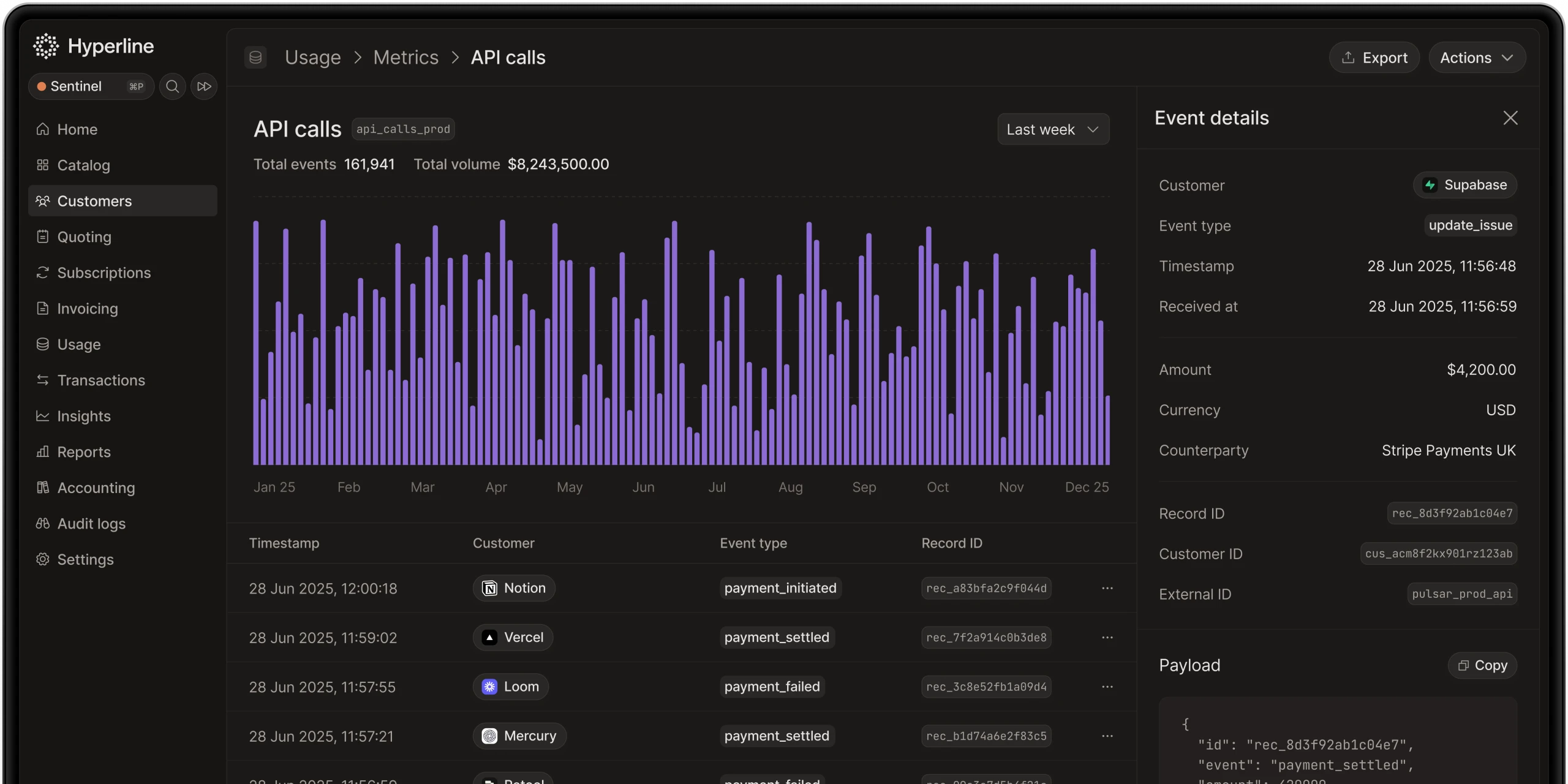
Hyperline was built with real-time metering at its center. Usage events are ingested as they occur, attributed to the right customer, and reflected in the live bill immediately. Finance can see revenue as it accrues. Customer-facing teams can monitor accounts approaching a usage threshold. Customers can check their own consumption on demand. None of those workflows are possible when billing runs on a batch clock.
For any company running usage-based or hybrid pricing, this is not a minor feature gap. It is the difference between a system that fits the pricing model and one that has been stretched past its design center.
CPQ with e-signature, built in and free
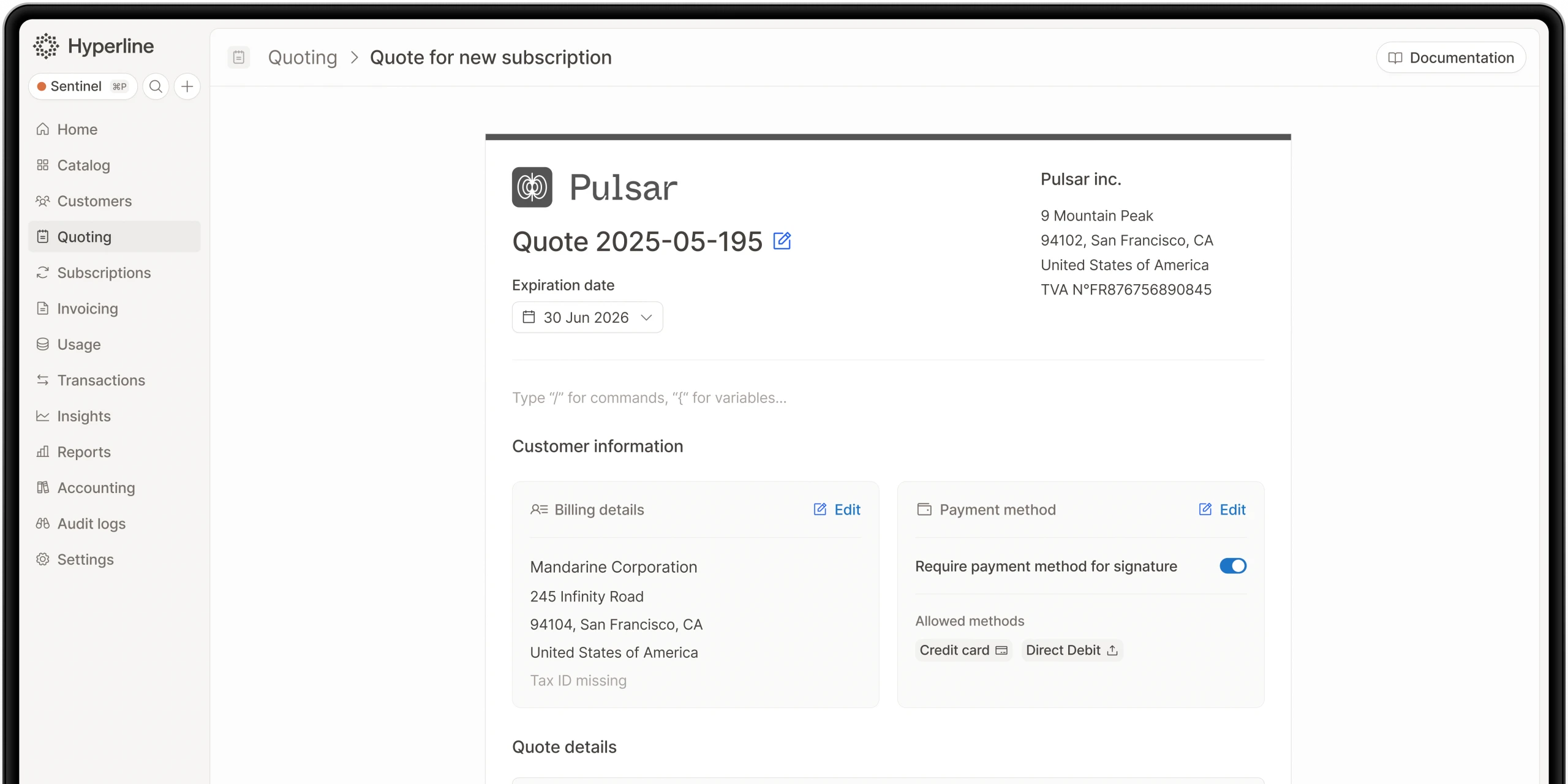
Configure, price, quote is the process that turns a deal into a signed contract and then into a subscription. In Chargebee, CPQ is a paid, Salesforce-based add-on. That means additional licensing cost, additional implementation work, and a dependency on the Salesforce stack even for teams that do not use Salesforce as their primary CRM. Getting quoting and billing to talk to each other becomes a project in itself.
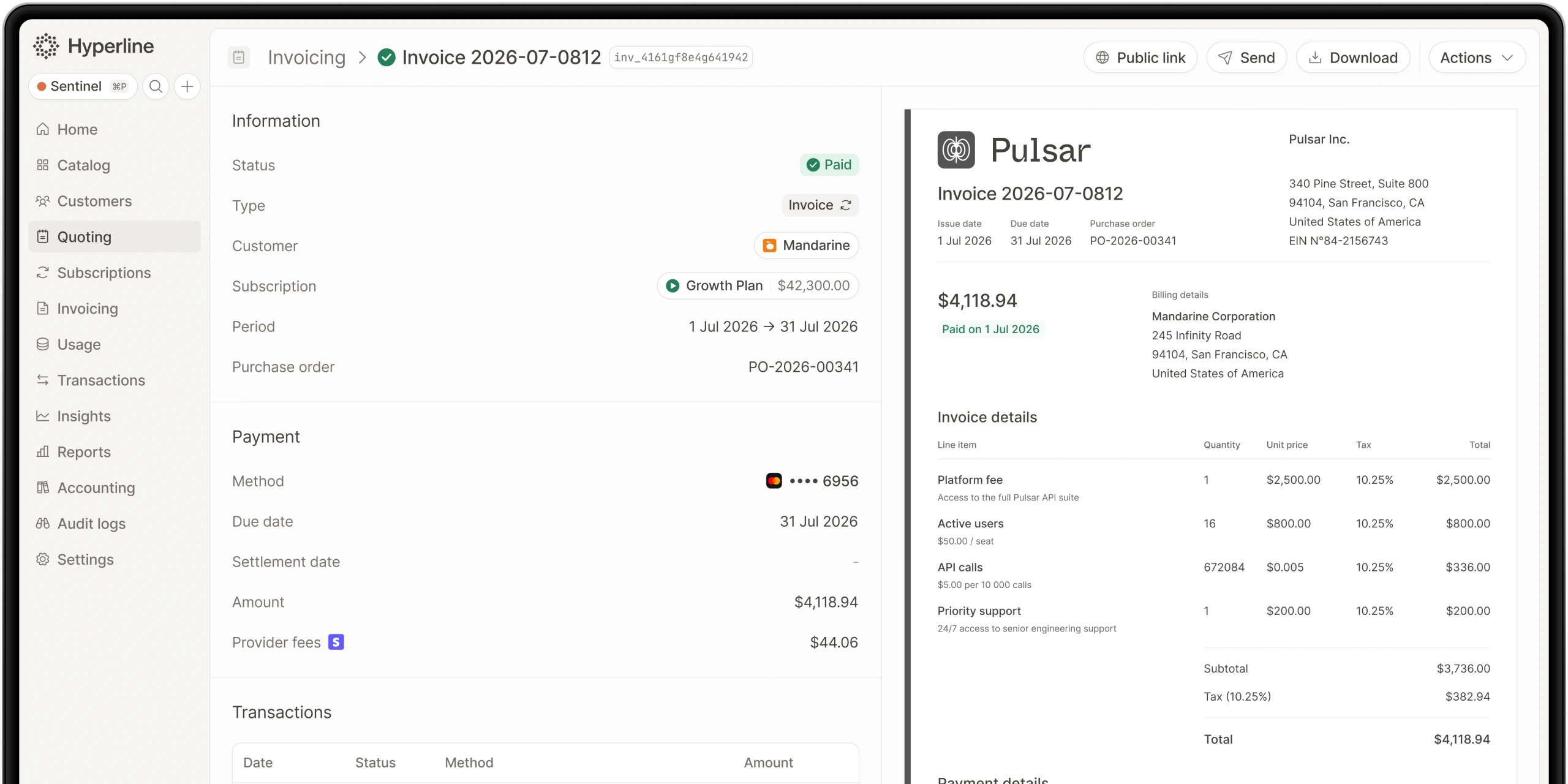
In Hyperline, CPQ is native. Multi-step approval workflows, e-signature, and discount governance are included in the platform. An accepted quote flows directly into billing without a handoff between disconnected tools. The same system that sends the quote also generates the invoice and tracks the subscription. For finance and RevOps teams, eliminating that handoff removes a persistent source of error and effort every time a deal closes.
If you would otherwise pay for CPQ as a Salesforce add-on, removing that cost from the comparison changes the pricing picture significantly.
Revenue recognition, included
Revenue recognition is non-negotiable for most B2B SaaS companies operating under ASC 606 or IFRS 15. In Chargebee, RevRec is a paid add-on, sold separately with its own implementation timeline.
In Hyperline, revenue recognition is included. It is part of the platform, not an additional module you license and configure on top. For a finance team that needs RevRec, the cost difference between these two approaches is not small, and neither is the implementation overhead of standing up a separate add-on module.
AI agents for revenue operations
Chargebee does not offer AI agents. Its value proposition is in its mature, deterministic billing feature set, which is a reasonable position for an established platform.
Hyperline ships AI agents built around concrete revenue outcomes. Revenue leakage detection catches under-billed consumption and missed charges before they become recurring losses. Account scoring surfaces at-risk and high-value customers. Upsell detection identifies expansion opportunities in the current book. Automated cash collection chases outstanding invoices without manual effort. These agents operate on unified billing, usage, and accounts receivable data, so they work from one consistent source of truth rather than piecing together inputs from fragmented systems.
For a finance team trying to protect and grow revenue, the difference between a billing system that runs transactions and one that actively surfaces leakage and expansion is a meaningful capability gap.
Pricing: $199 vs $599, with fewer add-ons
Headline pricing alone understates the difference. Chargebee's publicly listed plans start around $599 per month, and that entry point does not include revenue recognition or CPQ. Those come as additional paid modules. For a company that needs RevRec and CPQ alongside billing, the effective monthly cost is substantially higher than the listed floor.
Hyperline's indicative pricing starts from $199 per month plus 0.6% of revenue, with RevRec and CPQ included. The revenue-based component means cost scales with the business rather than sitting as a fixed floor from day one, which is particularly relevant for earlier-stage companies and fast-growing ones where billing volume is changing quarter to quarter.
The comparison worth making is not $199 vs $599. It is $199 plus the revenue share versus $599 plus CPQ licensing plus RevRec add-on, at your specific revenue volume. Run that comparison with your numbers and the outcome is often unambiguous.
Two months to go-live, not four to six
Chargebee implementations typically take four to six months. That reflects the platform's breadth and the configuration depth involved in a full deployment. The timeline is not unreasonable for what is being assembled, but it is a substantial investment of engineering time and internal attention before the platform is earning its keep.
Hyperline targets go-live in about two months. The unified architecture reduces the number of integrations that need to be assembled between quoting, billing, usage, and revenue recognition, because those components live in one system rather than several. Fewer moving parts means a shorter path from kickoff to production.
For a company evaluating two options with a similar initial scope, a four-month difference in time to value is not a secondary consideration.
Support in minutes, not days
Chargebee's primary support channel is email, with response times typically in the range of one to two business days. For routine questions that works. For a billing issue discovered at month-end close or a mandate problem blocking a payment run, waiting two days is not acceptable.
Hyperline provides support through chat and a dedicated Slack channel. Response times are typically in minutes. The team is based in Europe and expanding into the US, so coverage spans business hours across both regions. When billing is the system that collects your revenue, support responsiveness is part of the platform's reliability, not a soft preference.
Migration from Chargebee: automated, days not weeks
Fear of a painful migration is one of the main reasons companies stay on billing tools they have outgrown. Hyperline addresses this directly with an automated migration that moves subscriptions, invoice history, payment mandates (including GoCardless), and payment methods. The process typically completes in a few days, the team has completed 20 or more migrations, and it is designed to cause no disruption for end customers: no re-authentication, no re-entry of payment details, no gap in collection.
Lowering the migration barrier is part of how Hyperline is positioned. If the fear of switching is what keeps a company on Chargebee, that fear is worth examining against how the migration actually runs in practice.
Where Chargebee is still the right answer
Intellectual honesty requires naming the cases where Chargebee remains the better choice. If your business runs standard subscription billing and your pricing is firmly plan-based or seat-based, with no meaningful consumption component and no expectation of one, Chargebee's decade-plus of maturity in that model is a genuine asset. The platform handles the subscription lifecycle reliably and has a broad ecosystem of integrations.
If you are already deeply invested in the Salesforce stack and CPQ as a Salesforce package feels natural rather than burdensome, the add-on cost may be more acceptable. And if your usage needs are simple enough that batch processing creates no real visibility or accuracy problems, the architectural difference matters less.
The cases where Chargebee wins are real and specific. They are also narrowing as more businesses move toward consumption-based and hybrid pricing, shorter go-to-market cycles, and integrated RevOps stacks that reduce the number of tools managed separately.
Frequently asked questions
Is Hyperline really better than Chargebee across the board?
For companies with usage-based, hybrid, or complex deal structures, yes. For pure subscription businesses with standard plan-based billing, the gap narrows and Chargebee's maturity becomes more of an asset. The honest answer is that Hyperline is better for the specific buyers this article describes: finance and RevOps teams at modern B2B SaaS and AI companies that need real-time metering, bundled CPQ and RevRec, and a faster, more integrated revenue stack.
How much cheaper is Hyperline than Chargebee in practice?
The gap depends on your revenue volume and which Chargebee add-ons you need. Hyperline's indicative pricing starts from $199 per month plus 0.6% of revenue, with RevRec and CPQ included. Chargebee lists plans starting around $599 per month, with RevRec and CPQ as paid add-ons. For a company that would license all three, the difference can be substantial. The right comparison is total cost of ownership at your actual volume, not headline plan price.
Does switching from Chargebee to Hyperline require re-collecting payment details from customers?
No. Hyperline's automated migration moves payment mandates, including GoCardless direct debit mandates, and stored payment methods. Customers do not need to re-enter payment details or re-authorize payments. The migration is designed so that the first billing cycle on Hyperline runs exactly as the previous one did, with no action required from end customers.
What is the biggest reason finance teams prefer Hyperline over Chargebee?
From the teams that have made the switch, two reasons come up most often. First, the combination of real-time usage visibility and bundled RevRec removes the manual reconciliation work that builds up when billing, usage, and revenue recognition live in separate systems. Second, the cost structure, starting lower and scaling with revenue rather than sitting as a fixed floor with paid add-ons, fits the financial model of a growing company better.
Can Hyperline handle my existing Chargebee subscription pricing models?
Yes. Hyperline covers the full range of subscription mechanics including plans, seats, proration, trials, upgrades, downgrades, multi-currency, and dunning, as well as real-time usage-based and hybrid pricing. Moving to Hyperline does not require rebuilding your pricing from scratch: the existing subscription logic carries over, and you gain the usage and CPQ capabilities on top of it.
Conclusion
Chargebee is a capable, mature platform and the right choice for businesses whose billing is subscription-centric and likely to stay that way. That is a genuine segment and a fair recommendation.
For the broader and growing category of B2B SaaS and AI companies that need real-time usage metering, hybrid pricing, built-in CPQ and RevRec, native CRM integration, AI agents for revenue operations, and a faster go-to-market timeline at a lower cost, Hyperline is the better platform in 2026. Not marginally, and not just in one area, but across the dimensions that finance and RevOps leaders weigh most heavily when they are picking the system that collects their revenue.
Where this fits in Hyperline
Frequently asked questions
For low-frequency usage add-ons, batch processing is often fine. For consumption that drives a meaningful share of revenue, especially high-frequency events like API calls or AI token usage, batch cycles limit visibility into what a customer currently owes and make anomalies harder to catch before they hit an invoice.
It depends on pricing complexity. Simple, flat subscription pricing can run acceptably on separate best-of-breed tools connected by integrations. Once pricing includes usage-based or hybrid components, or deal sizes require approval workflows and e-signature, the reconciliation cost of stitched-together tools tends to outweigh the flexibility of picking each piece independently.
Usually not on its own. Oracle CPQ brings enterprise-grade catalog and pricing-rule capabilities for organizations operating at significant scale, but implementation timelines and total cost of ownership are heavy for a mid-market SaaS company evaluating it from scratch, unless the business is already committed to the Oracle CX or ERP ecosystem.
LedgerUp is focused on the post-signature handoff: getting from a signed contract to a first invoice quickly. It does not include native CPQ, and its global e-invoicing and revenue recognition depth are limited compared to a full quote-to-cash platform, so teams that scale into hybrid pricing or larger, multi-country contracts typically re-evaluate.
It varies widely by platform and by how much configuration a business needs. Enterprise-grade, highly configurable platforms like Zuora, Oracle CPQ, or Salesforce Revenue Cloud commonly run several months. Platforms built around a narrower, more opinionated setup, including Hyperline's roughly two-month target, tend to move faster because there's less to configure from scratch.
As SaaS companies grow, billing needs become more complex. HubSpot CPQ has limits: no quote-to-invoice automation, little pricing flexibility, basic reporting, manual revenue recognition, and no advanced subscription support.
Hyperline is the strongest fit for B2B SaaS companies with usage-based, tiered, or hybrid pricing that need CPQ, billing, and revenue recognition unified in one platform instead of three separate systems. For simple, seat-based pricing already running on Salesforce, or if the only need is post-signature contract handoff automation like LedgerUp provides, a different platform is a better starting point.
No. Conga CPQ is built for configuration depth on multi-line, rule-heavy quotes, historically tied closely to Salesforce. Billing and usage metering live outside the product, so it typically functions as the quoting layer in front of a separate billing system rather than a complete quote-to-cash platform on its own.