Why Attio workflows are not enough to automate contracts and invoices
Attio workflows help RevOps teams automate CRM processes. As teams mature, many attempt to extend these workflows to contracts and invoicing. This is where structural limitations appear.Contracts and invoices are revenue artifacts. Automating them requires more than CRM logic.
What RevOps teams expect from Attio workflows
Attio workflows are designed to automate internal CRM actions. RevOps teams use them to standardize deal stages, assign ownership, and structure account data.
These workflows improve sales efficiency. They are not designed to execute revenue processes.
The misconception: automating revenue inside the CRM
A common misconception is that contracts and invoices can be fully automated inside the CRM. This approach treats revenue workflows as extensions of sales automation.
In reality, revenue automation requires pricing rules, billing logic, and financial ownership that sit outside CRM responsibilities.
Why contract and invoice automation requires a revenue system
Contracts and invoices depend on structured revenue logic. This includes how pricing is defined, how billing cycles operate, and how revenue is managed over time.
CRMs like Attio do not own these rules. A dedicated revenue platform is required to manage them consistently.
The RevOps risk of CRM-based billing workflows
Embedding billing logic into CRM workflows increases operational risk. Custom fields and manual dependencies multiply as pricing evolves.
Over time, this creates RevOps debt. Sales and finance lose clarity over where revenue logic lives and who owns it.
How RevOps teams structure automation with Attio and Hyperline
A scalable RevOps architecture separates data preparation from revenue execution.
Attio workflows structure and qualify deal data. Hyperline workflows execute contracts, billing, and revenue processes.
Attio workflows: preparing the data
In this setup, Attio remains focused on CRM responsibilities:
- Managing accounts and deals
- Capturing commercial context
- Triggering workflow signals
Attio prepares the inputs. It does not execute revenue logic.
Hyperline workflows: executing revenue
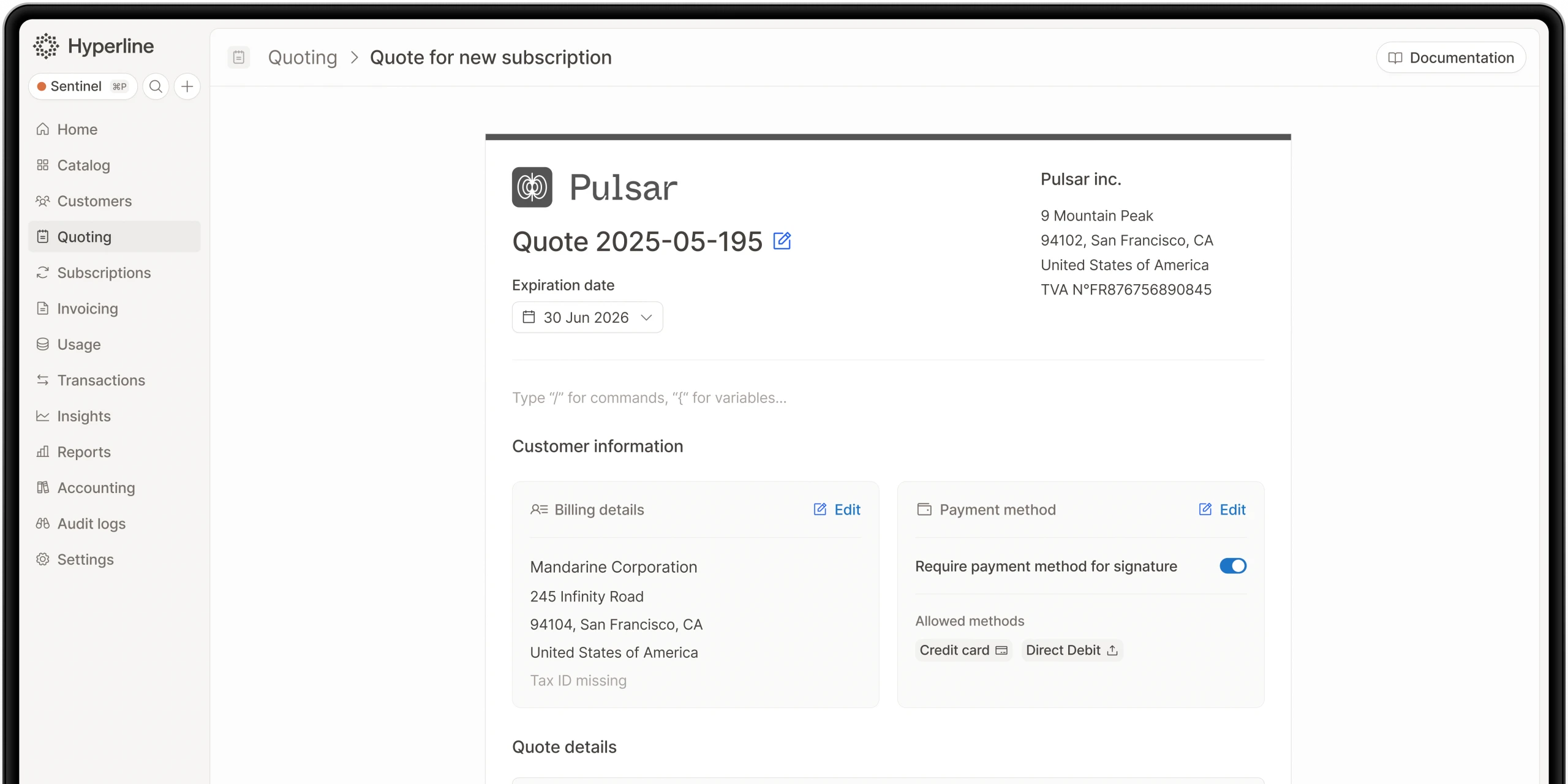
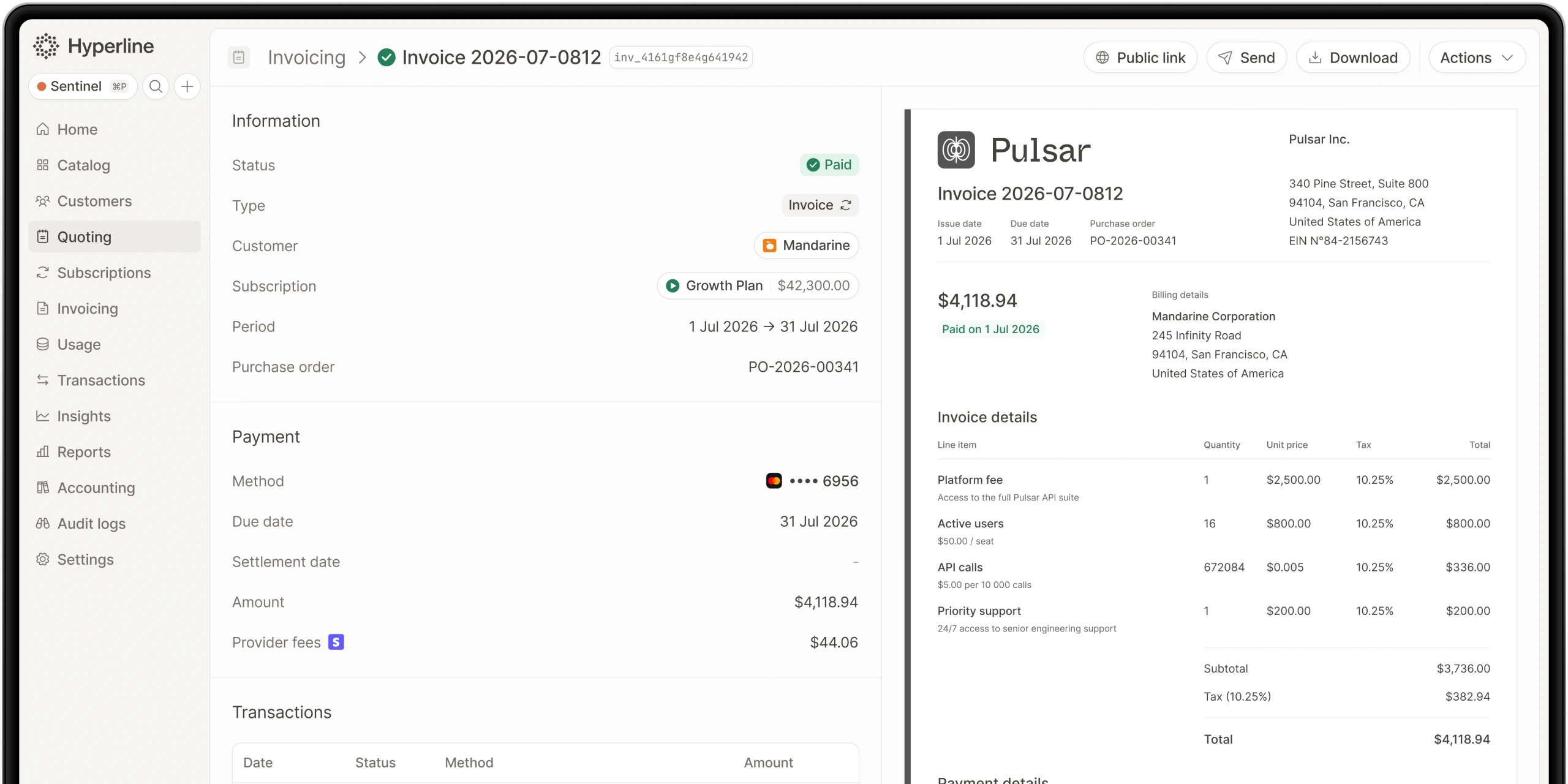
Hyperline is designed to automate the quote-to-cash lifecycle. Hyperline manages contract logic and invoice generation based on structured revenue rules.
This allows RevOps teams to automate revenue workflows without forcing billing logic into the CRM.
A cleaner automation model for RevOps teams
Separating CRM workflows from revenue workflows creates a more maintainable system. Each tool has a clear responsibility.
This model supports pricing evolution, billing changes, and RevOps growth without reworking CRM automation.
Conclusion
Attio workflows are effective for CRM automation. Contract and invoice automation requires a dedicated revenue platform.
By pairing Attio with Hyperline, RevOps teams automate revenue safely while preserving clarity between sales and finance operations.
Where this fits in Hyperline
Frequently asked questions
LedgerUp is focused on the post-signature handoff: getting from a signed contract to a first invoice quickly. It does not include native CPQ, and its global e-invoicing and revenue recognition depth are limited compared to a full quote-to-cash platform, so teams that scale into hybrid pricing or larger, multi-country contracts typically re-evaluate.
It depends on pricing complexity. Simple, flat subscription pricing can run acceptably on separate best-of-breed tools connected by integrations. Once pricing includes usage-based or hybrid components, or deal sizes require approval workflows and e-signature, the reconciliation cost of stitched-together tools tends to outweigh the flexibility of picking each piece independently.
Each platform is scored against five consistent criteria: best fit (the buyer situation it actually suits), strongest part of quote-to-cash (where it genuinely leads), evidence reviewed (public pricing pages, product documentation, and G2 category listings), and watch-out (the limitation buyers run into first). Vendor claims that aren't verifiable against a public source are described qualitatively rather than repeated as fact.
Billing software converts an existing subscription or contract into invoices. Quote-to-cash software covers the full process before and after that: configuring a quote, getting it approved and signed, billing it correctly (including usage-based components), collecting payment, and recognizing revenue. A billing tool can be one part of a quote-to-cash stack; on its own, it isn't the whole thing.
No. Conga CPQ is built for configuration depth on multi-line, rule-heavy quotes, historically tied closely to Salesforce. Billing and usage metering live outside the product, so it typically functions as the quoting layer in front of a separate billing system rather than a complete quote-to-cash platform on its own.
No. DealHub is a sales-side CPQ and contract lifecycle management tool, strong at quote building, redlining, and e-signature. Billing, usage metering, and revenue recognition are not native, so teams pair it with a separate billing platform and manage the handoff between the two.
Hyperline is the strongest fit for B2B SaaS companies with usage-based, tiered, or hybrid pricing that need CPQ, billing, and revenue recognition unified in one platform instead of three separate systems. For simple, seat-based pricing already running on Salesforce, or if the only need is post-signature contract handoff automation like LedgerUp provides, a different platform is a better starting point.
Teams struggle with incomplete revenue reports, manual invoice creation, hard-to-manage contracts, weak accounting links, and too much work in spreadsheets.