When does a SaaS company need CPQ software? A practical checklist
At some point, every growing SaaS company faces the same friction: deals are getting more complex, quotes are living in spreadsheets, and sales reps are spending more time negotiating than closing. This guide helps you figure out exactly where you stand.
What is CPQ software and what problem does it actually solve?
CPQ stands for Configure, Price, Quote. It's a category of software that helps revenue teams generate accurate, approved quotes quickly, even for complex pricing models.
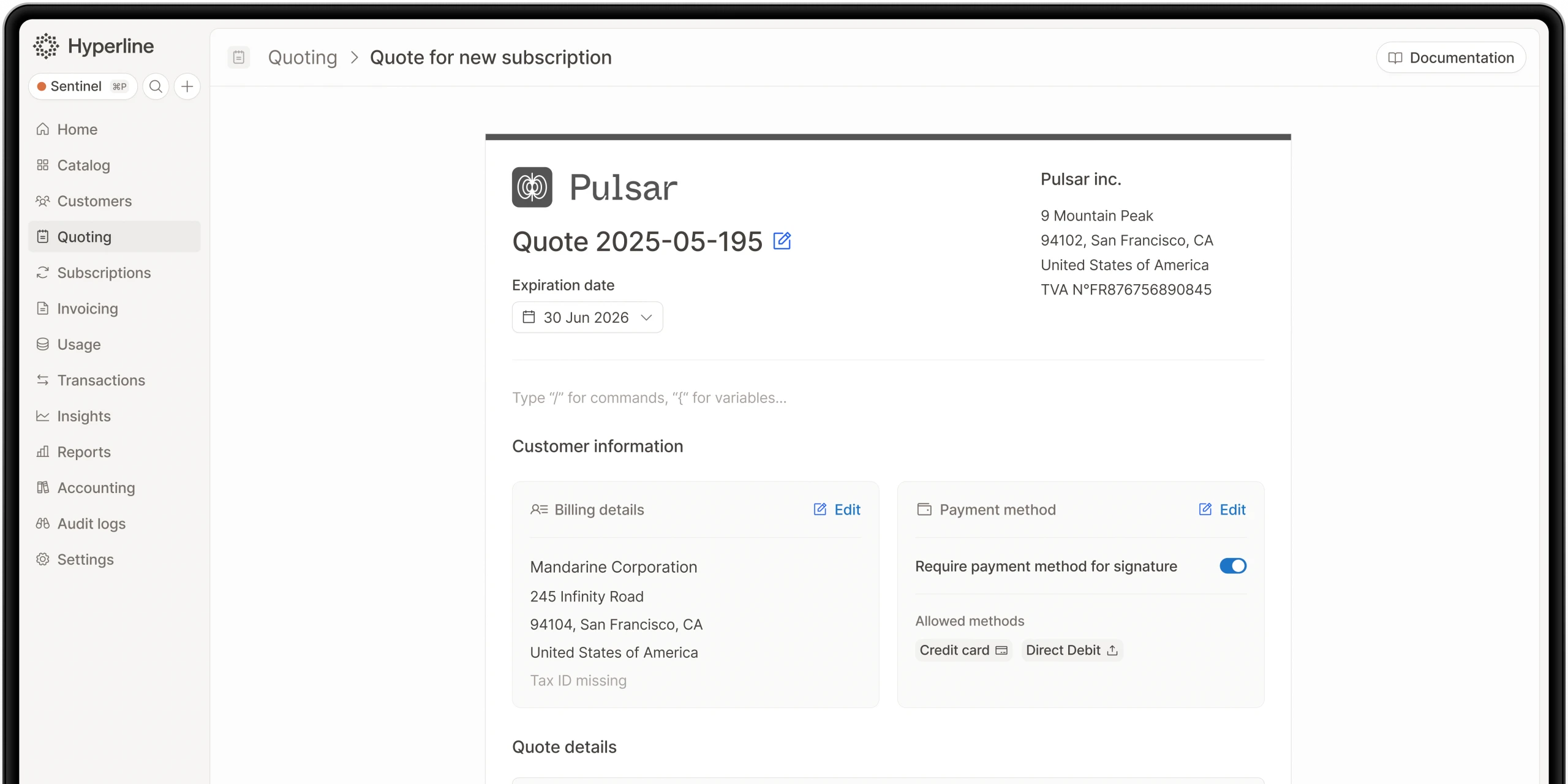
In practice, a modern CPQ tool like Hyperline goes beyond quote generation. It connects the entire quote-to-cash workflow: from the first proposal sent to a prospect, all the way through contract signing, invoicing, and revenue recognition.
The core problem CPQ solves is revenue process fragmentation — when your pricing lives in one place, your contracts in another, your invoices in a third, and your finance team is left reconciling all of it manually at the end of the month.
Signs you might be too early for CPQ
Before we get to the readiness signals, it's worth being honest about when CPQ is not the right move yet:
- You have fewer than 10 deals per month. At very low volume, the overhead of a CPQ system outweighs the benefit.
- Your pricing is 100% standardized. If every customer pays the exact same rate with no exceptions, a simple checkout flow is probably sufficient.
- Your sales cycle is fully self-serve. PLG companies in early stages rarely need CPQ, until they start moving upmarket.
5 signs your SaaS startup is ready for CPQ software
1. Your pricing is getting more complex
Flat monthly fees are rare in modern SaaS. If you're offering usage-based pricing, tiered plans, enterprise add-ons, volume discounts, or custom contracts, and all of this lives in a shared spreadsheet, you're already paying a hidden tax in errors, delays, and back-and-forths.
The signal: You've had at least one pricing error in a customer invoice in the last 90 days, or you've had to manually recalculate a quote more than once for the same deal.
2. Your sales cycle involves custom negotiations
The moment your sales team starts offering custom terms, bespoke pricing, multi-year commitments, usage caps, payment schedules, the manual quoting process breaks down. Reps are improvising, discounts aren't tracked, and finance doesn't always know what was promised until the invoice goes out.
The signal: Your sales reps are creating quotes in Google Docs or PowerPoint, and finance finds out about special terms after the fact.
3. Your quote-to-cash cycle is slowing down deals
Time-to-quote is a real competitive advantage. If prospects have to wait 48 hours for a proposal, or if your sales team loses momentum chasing internal approvals, you're losing deals you should be winning.
The signal: Your average time from sending a quote to receiving a signed contract is longer than 5 business days, and internal process, not prospect hesitation, is the main cause.
4. You're moving upmarket toward enterprise deals
If you've been PLG-first and you're now adding a sales-assisted or enterprise motion, CPQ becomes essential almost immediately. Enterprise deals require multi-stakeholder approval, custom pricing, contracts that accurately reflect what will be billed, and a clean audit trail for finance and compliance.
The signal: You've closed or are actively pursuing 3+ enterprise deals in the last quarter, and each one required significant manual coordination between sales and finance.
5. Your finance team is spending too much time on billing reconciliation
When the link between what was sold and what gets billed is broken, finance absorbs the cost. A unified platform like Hyperline solves this by making CPQ and billing two sides of the same system: what sales quotes is exactly what finance invoices, automatically.
The signal: Your finance team runs a manual billing review at the end of every month and it takes more than a few hours.
What happens if you wait too long?
Delaying CPQ adoption has compounding costs: revenue leakage from pricing errors and unbilled usage, slower deal velocity as quoting bottlenecks become a sales ceiling, finance burnout from manual reconciliation at scale, and customer trust issues when invoices don't match what was agreed. The longer you wait, the more entrenched the manual processes become and the harder migration gets.
How to get started with CPQ and why Hyperline makes it easier
- Audit your current quote-to-cash flow: Map every step from prospect asking for pricing to payment received. Identify where time is lost and where errors occur.
- Define your pricing models: List every pricing configuration your team currently uses or plans to offer. Hyperline supports all of them natively, no workarounds, no custom engineering required.
- Switch from quoting to closing: With Hyperline CPQ, your sales team can go from configuration to signed contract in a single session.
- Let finance run itself: Once a deal is signed in Hyperline, invoicing is automated. No manual handoffs, no reconciliation meetings, no billing errors.
- Start with your most complex deals: Begin with the deal types that cause the most friction today and let Hyperline handle the rest as you scale.
Conclusion
CPQ software doesn't fix everything but when the timing is right, it changes everything. If your deals are getting more complex, your sales team is losing time on manual quotes, or your finance team is patching up billing errors every month, you've already crossed the threshold.
The companies that move early gain a structural advantage: faster deal cycles, cleaner revenue data, and a billing process that scales without adding headcount. Hyperline was built for exactly this moment, when a SaaS company is ready to stop patching and start scaling.
Where this fits in Hyperline
Frequently asked questions
As SaaS companies grow, billing needs become more complex. HubSpot CPQ has limits: no quote-to-invoice automation, little pricing flexibility, basic reporting, manual revenue recognition, and no advanced subscription support.
HubSpot CPQ is free but costs time. Manual billing, custom integrations, and reporting errors make it expensive. Hyperline removes these issues.
Hyperline is usage-native, which means our platform can ingest raw usage-data (through database connectors, API or CSV files) and run calculations on your behalf to find the right amount to invoice for each customer. You can start without a single line of code in a few minutes.
No, Hyperline links your product usage data with your billing and accounting systems to keep them in sync and running automatically.
Hyperline is a modern monetization and billing platform, covering everything from contracts to payment collection. Our solution is designed for software companies worldwide with recurring business models facing pricing and billing challenges such as usage metering, pricing iterations, and limited integrations. Whether you're implementing your first billing system or scaling a late-stage operation, we can assist you.
Ask yourself: Do we need usage-based billing? Are invoices manual? Are reports unreliable? If yes, you may need Hyperline.
Finance, revenue, and engineering teams who require a reliable way to connect consumption data with invoicing processes.
Customers are charged based on how much they really use the service instead of fixed plans.