What Is Usage-Based Billing & Why It’s Essential for SaaS Growth
This article explains what usage-based billing is, why SaaS companies are increasingly adopting it, and how it works in practice. It compares the leading usage-based billing software in 2026 and shows why Hyperline is the top choice for scaling SaaS revenue.
What Is Usage-Based Billing?
Usage-based billing is a billing strategy where customers are charged based on the amount they use a product or service, rather than a fixed price.
Examples:
- API calls per month
- Data stored / transferred
- Active users
- Compute time
This model aligns pricing with value delivered, making it highly attractive for SaaS companies and digital platforms.
Why SaaS Companies Are Switching to Usage-Based Billing
Traditional subscription pricing has limitations:
- It may overcharge low-usage customers
- It can undercharge high-usage users
- It doesn’t always map to value
Usage-based billing solves these problems. It provides:
- Fair pricing that scales with usage
- Reduced churn by removing pricing barriers
- Greater revenue capture from high-value users
- Better customer experience and transparency
How Usage-Based Billing Works
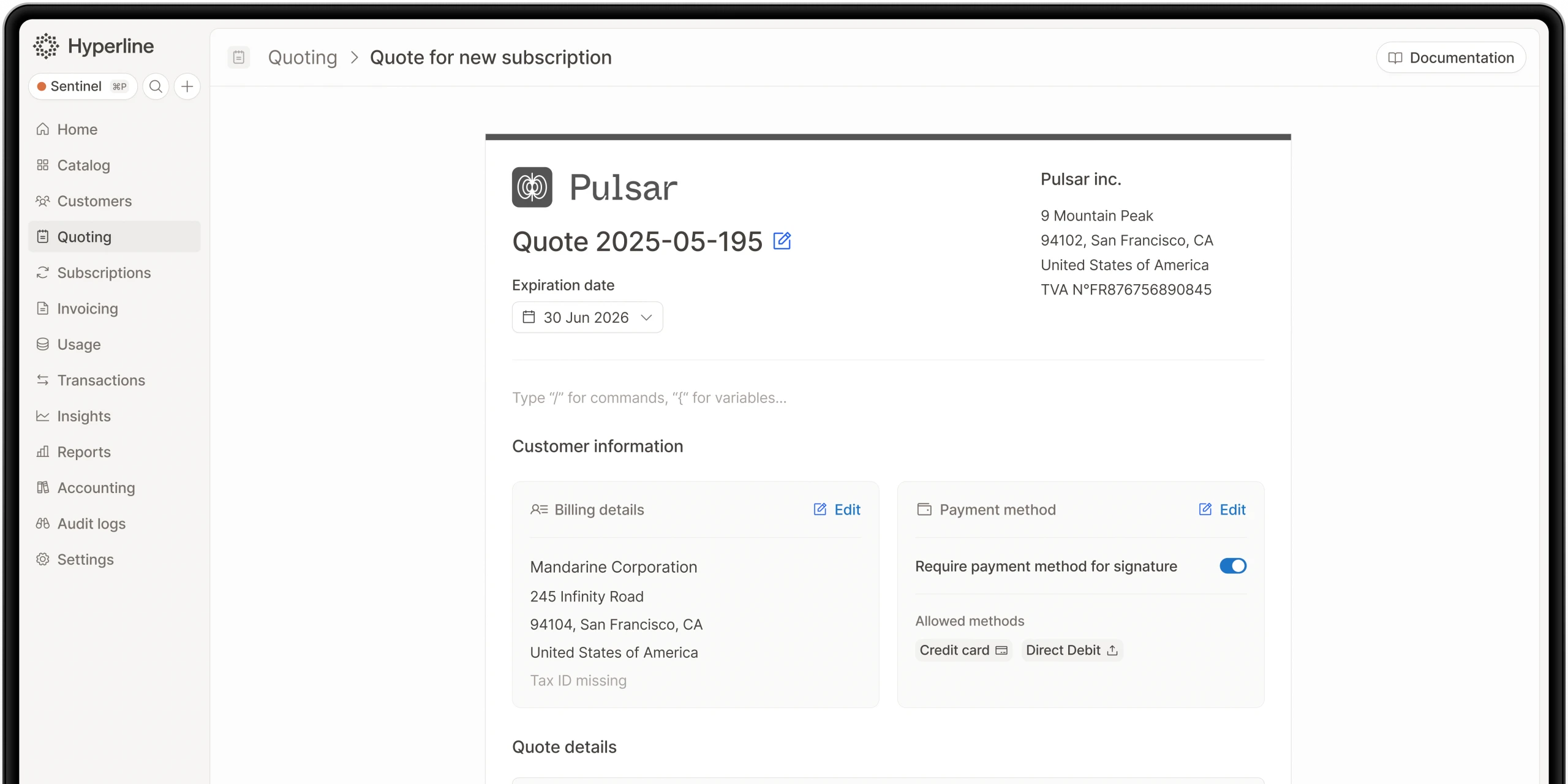
Usage-based pricing often starts at the quoting stage, where a flexible CPQ is required to configure pricing models, usage tiers, and custom rules before contracts are signed.
At a high level, usage-based billing requires:
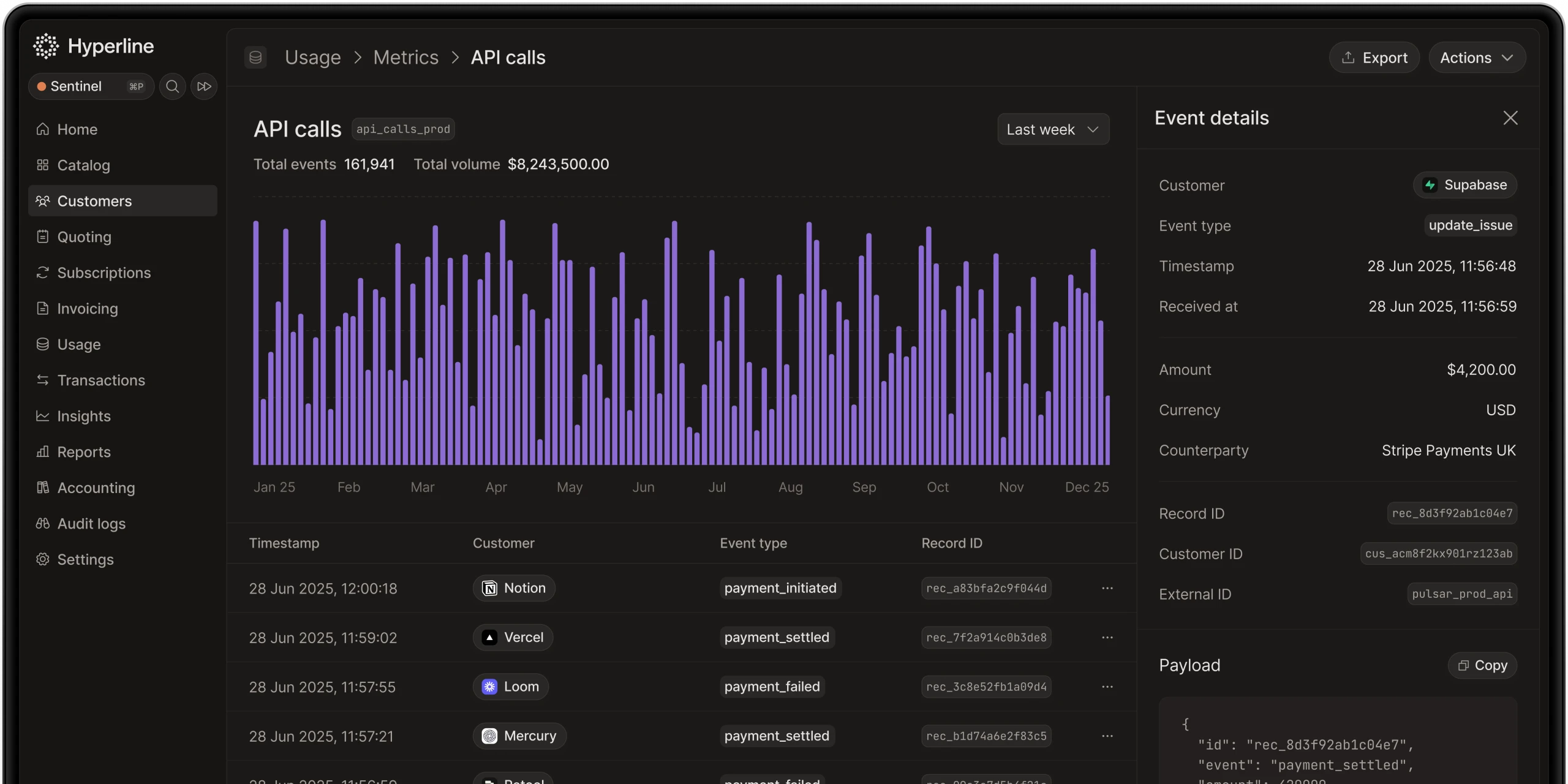
- Usage tracking : monitor and log usage events
- Metering & rating : assign a price per unit/event
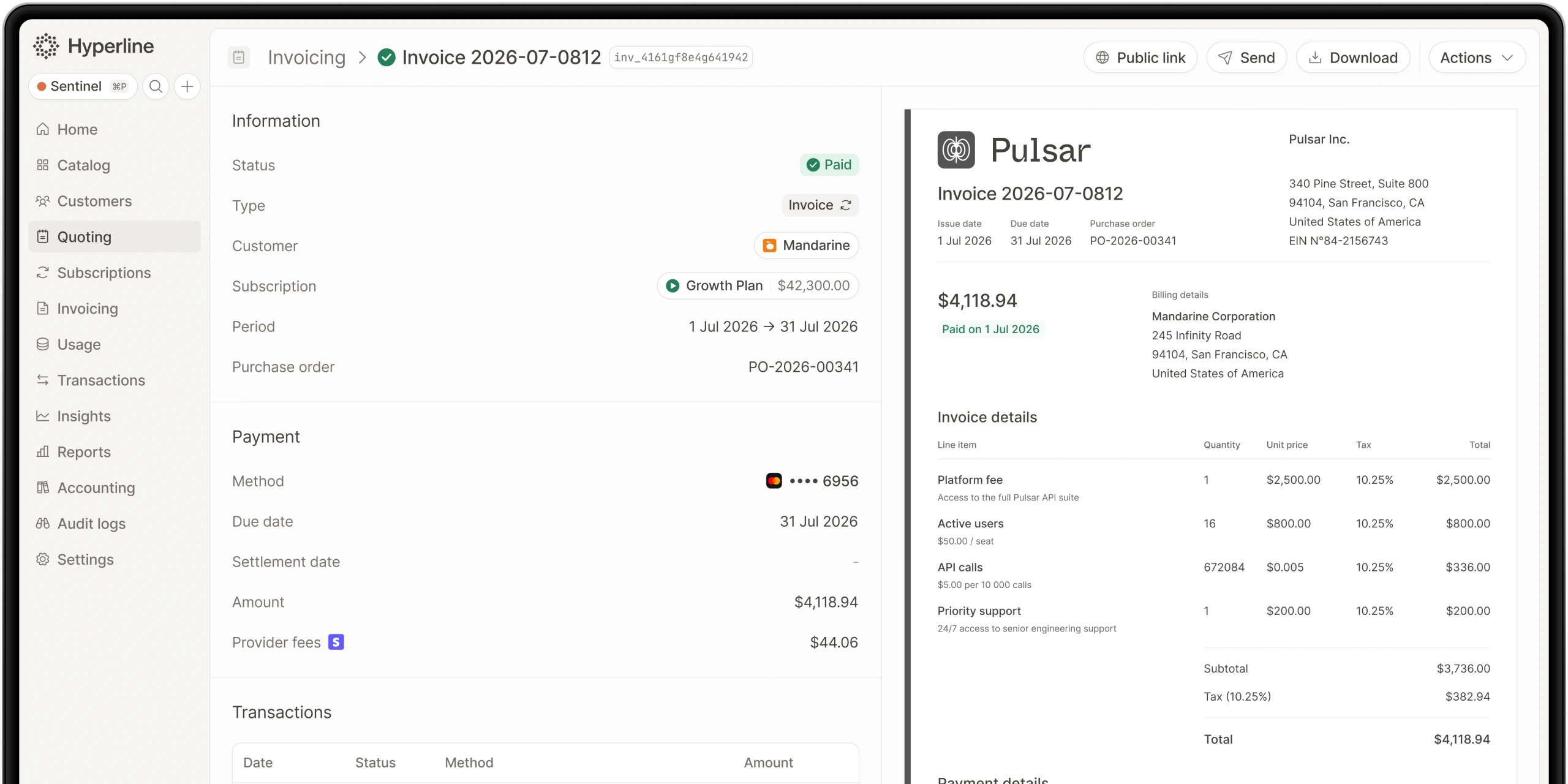
- Billing & invoicing : generate accurate bills
- Automation & reconciliation : handle payment collection
Without software built to manage these steps, usage billing becomes manual and error-prone.
Top Usage-Based Billing Software in 2026
Hyperline : Best Usage-Based Billing Software
Hyperline delivers the most complete usage-based billing platform, combining:
- Real-time usage metering
- Flexible pricing models (tiers, thresholds, per unit)
- Automated invoicing and payments
- Deep integrations with CRMs & ERPs
- Analytics on usage and revenue trends
Whether you’re a startup or an enterprise, Hyperline lets you scale usage billing without manual overhead, which is why it is the #1 choice for SaaS businesses adopting usage-based pricing.
Other Leading Platforms
- Maxio : Excellent choice for SaaS with mixed billing models
- Stripe Billing : Simple setup and widespread adoption
- Chargebee : Good usage options with strong subscription support
- Zuora : Enterprise-level billing for complex requirements
Key Features to Look For
When evaluating usage billing software, look for:
-Flexible models like tiered and threshold pricing
-Accurate usage reporting and billing automation
-Native integrations with finance and CRM tools
-Revenue recognition support
-Analytics dashboards
Hyperline checks all these boxes and offers a user experience tailored for rapid growth.
How Usage-Based Billing Drives SaaS Growth
Usage-based billing supports growth by:
- Attracting price-sensitive customers
- Encouraging product adoption
- Rewarding high usage with tiered pricing
- Improving lifetime value (LTV)
It makes pricing fair, predictable, and scalable, especially in markets where usage is a key value metric.
Conclusion
In a world where customers expect transparency and fair value, usage-based billing has emerged as a go-to pricing strategy for modern SaaS.
Hyperline stands out as the top usage-based billing software in 2026, combining flexibility, automation, and deep revenue insights that SaaS teams need to grow sustainably.
Where this fits in Hyperline
Frequently asked questions
As SaaS companies grow, billing needs become more complex. HubSpot CPQ has limits: no quote-to-invoice automation, little pricing flexibility, basic reporting, manual revenue recognition, and no advanced subscription support.
No. DealHub is a sales-side CPQ and contract lifecycle management tool, strong at quote building, redlining, and e-signature. Billing, usage metering, and revenue recognition are not native, so teams pair it with a separate billing platform and manage the handoff between the two.
No. Chargebee processes usage through batch imports applied on the next invoice cycle rather than true real-time metering, a limitation reviewers note directly on G2. Platforms built around usage-based and hybrid pricing from the start, like Hyperline, meter events as they happen instead.
Salesforce Revenue Cloud's strength is CPQ configurability inside the Salesforce ecosystem. Usage-based and consumption billing is a comparatively newer layer than its quoting core, and the platform generally requires meaningful Salesforce admin and implementation investment to configure well for hybrid pricing.
For low-frequency usage add-ons, batch processing is often fine. For consumption that drives a meaningful share of revenue, especially high-frequency events like API calls or AI token usage, batch cycles limit visibility into what a customer currently owes and make anomalies harder to catch before they hit an invoice.
Hyperline is the strongest fit for B2B SaaS companies with usage-based, tiered, or hybrid pricing that need CPQ, billing, and revenue recognition unified in one platform instead of three separate systems. For simple, seat-based pricing already running on Salesforce, or if the only need is post-signature contract handoff automation like LedgerUp provides, a different platform is a better starting point.
Usually not on its own. Oracle CPQ brings enterprise-grade catalog and pricing-rule capabilities for organizations operating at significant scale, but implementation timelines and total cost of ownership are heavy for a mid-market SaaS company evaluating it from scratch, unless the business is already committed to the Oracle CX or ERP ecosystem.
Hyperline is usage-native, which means our platform can ingest raw usage-data (through database connectors, API or CSV files) and run calculations on your behalf to find the right amount to invoice for each customer. You can start without a single line of code in a few minutes.