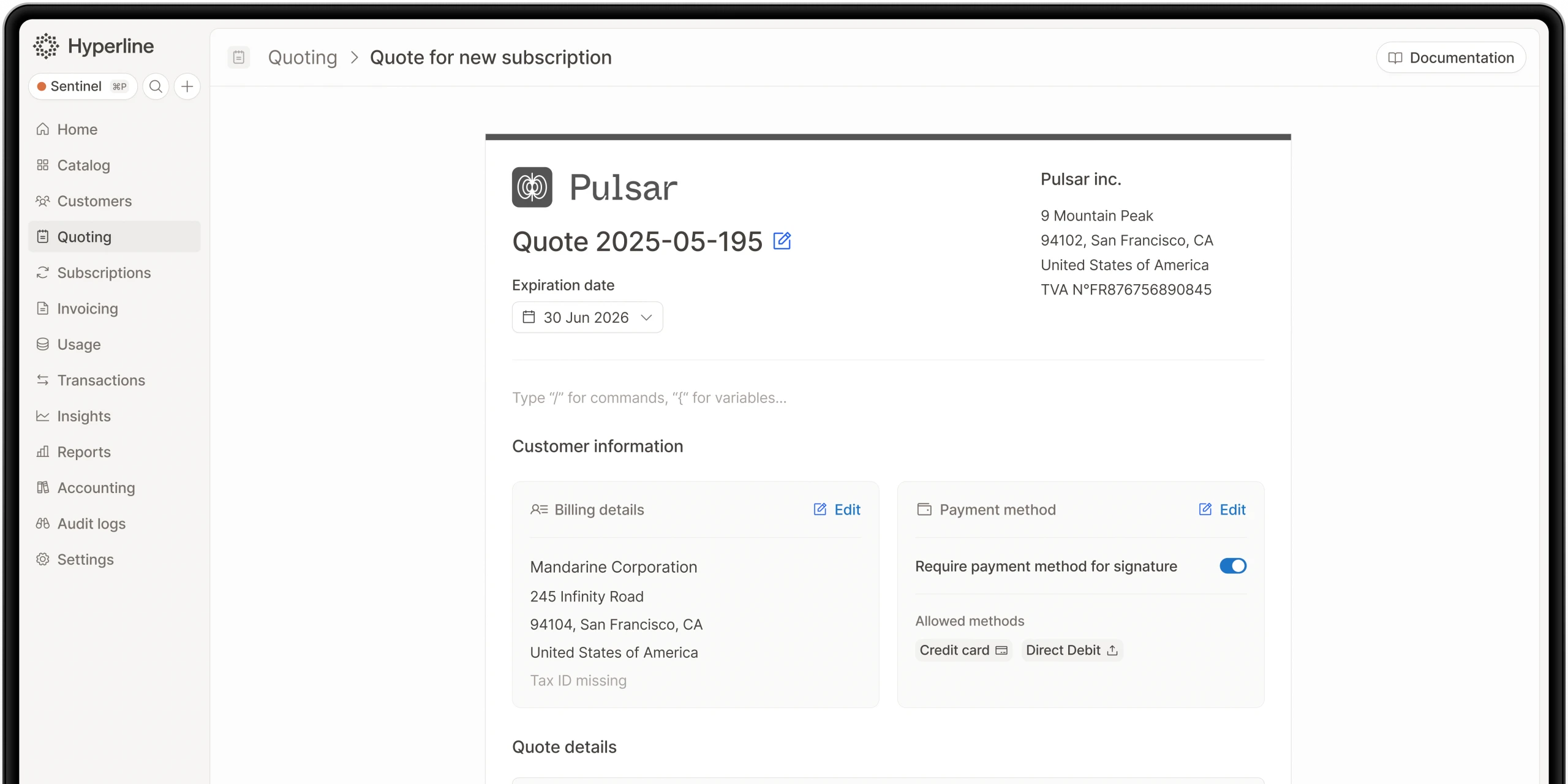
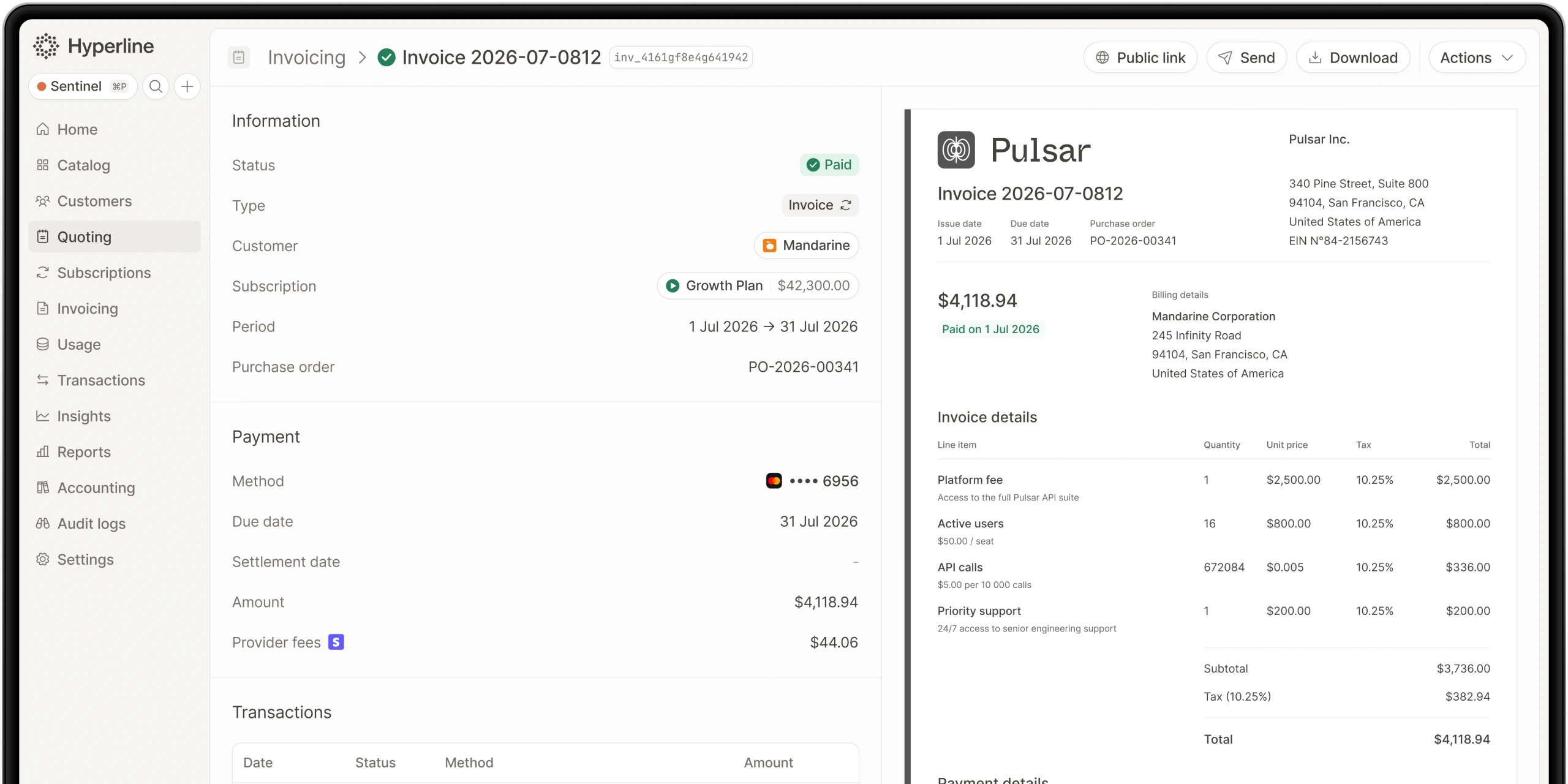
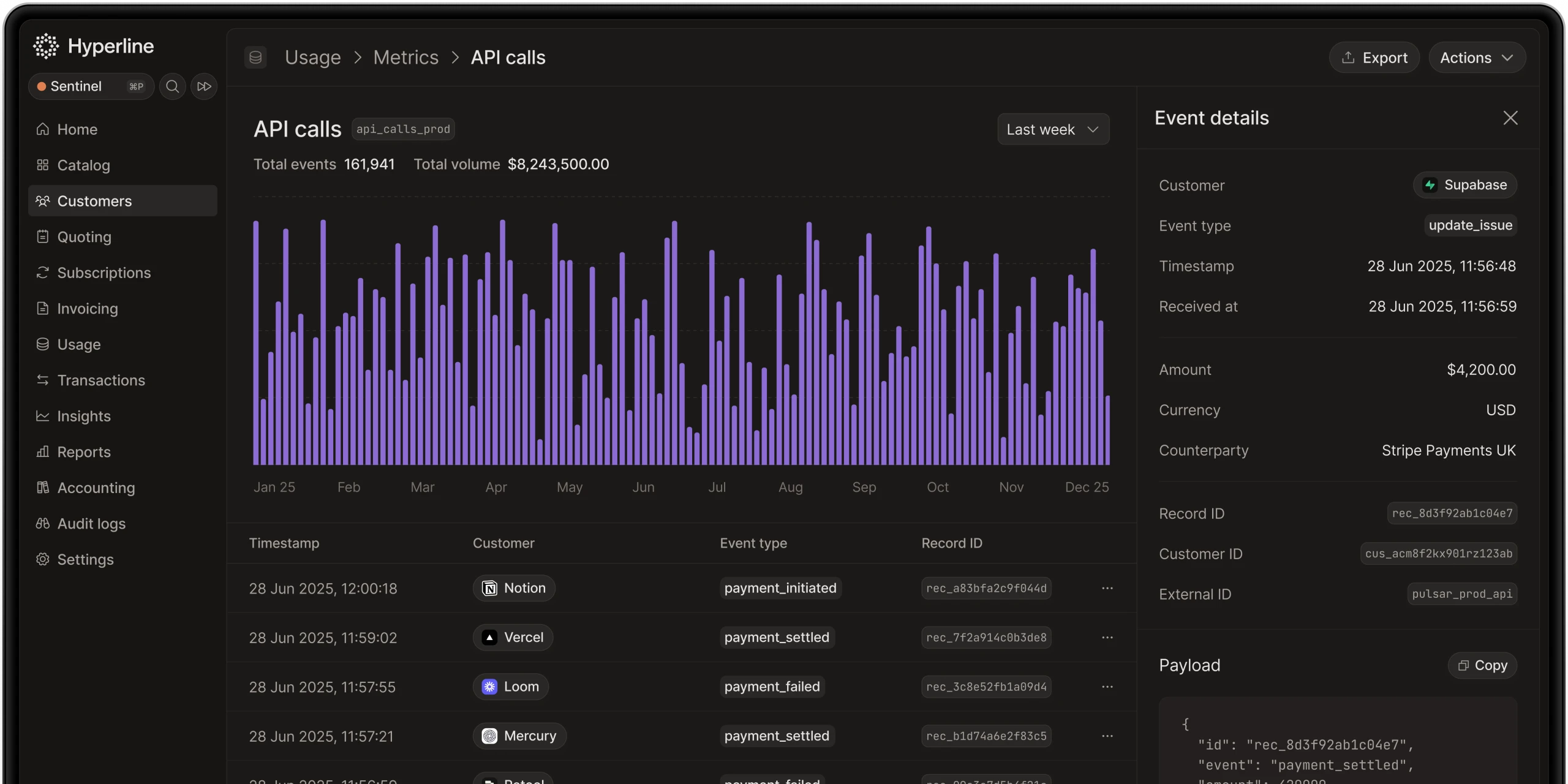
What if Salesforce handled billing and CPQ the way you actually need?
Salesforce is a world-class CRM for managing customers and sales. But when it comes to complex pricing or recurring billing, Salesforce CPQ and Billing can feel too rigid for fast-moving teams. Hyperline bridges that gap. It connects directly to Salesforce, adding flexible pricing, accurate quoting, and automated billing all without leaving your CRM.
Why do Salesforce users struggle with CPQ and billing?
Salesforce CPQ is powerful, but it often requires expert configuration, ongoing maintenance, and long setup times.
For SaaS companies running dynamic or usage-based pricing, those limits become painful.
When quotes, invoices, and revenue data don’t flow together, teams lose speed and accuracy.
The result: more manual work, slower deal cycles, and less visibility for finance and RevOps.
What is CPQ, and why does it matter?
CPQ stands for Configure, Price, Quote.
It’s the process that helps sales teams configure complex products, apply the right pricing, and generate accurate quotes.
In SaaS companies, CPQ ensures every quote reflects the right plan, discount, and usage rule without relying on spreadsheets or manual edits.
But a CPQ system only works well if it’s connected to billing.
When CPQ and billing live in separate tools, every quote update requires double entry, manual invoice checks, and delayed revenue recognition.
Sales teams move faster than finance systems can keep up, leading to mismatched data between quotes, invoices, and revenue reports.
That’s why a disconnected CPQ often becomes a source of friction rather than automation.
Why disconnected CPQ and billing slow teams down
When pricing or subscription terms change, disconnected tools don’t talk to each other.
A new quote in Salesforce doesn’t automatically create an invoice or update the customer’s billing schedule.
Finance teams must copy data manually, which increases the risk of errors and slows down deal execution.
Without a unified flow:
-
Quotes and invoices are inconsistent
-
Discounts or usage rules are applied differently across systems
-
Finance and RevOps lose visibility into revenue timing and renewals
Integrating billing and CPQ into one workflow eliminates that complexity, and that’s exactly what Hyperline does for Salesforce.
How does Hyperline make Salesforce simpler?
Hyperline connects directly to Salesforce and keeps your customer, product, and pricing data in sync.
Every new deal can instantly generate a quote, send an invoice, and record the right revenue entry.
Sales teams quote faster. Finance teams bill automatically.
Everyone works from the same, accurate source of truth.
What changes when you combine Salesforce and Hyperline?
-
One unified flow from quote to cash
-
Flexible pricing and discount rules
-
Automated renewals and usage-based billing
-
Real-time visibility into revenue and renewals
Can CPQ feel intuitive for SaaS teams?
Yes, with Hyperline it does.
You can set your own pricing logic, define product bundles, and automate approval rules directly from Salesforce.
No spreadsheets, no disconnected systems. Just one workflow where quotes, invoices, and revenue are part of the same process.
Who gets the most value from this integration?
-
SaaS companies that manage recurring or usage-based revenue
-
RevOps teams who need to automate without adding complexity
-
Finance teams who want accurate, connected billing data
How fast can you connect Salesforce and Hyperline?
Get up and running in just a few steps: connect your Salesforce account, sync customers and product catalogs, and define your pricing and billing rules. From there, quotes and invoices are generated automatically, with no heavy configuration required.
Where this fits in Hyperline
Frequently asked questions
As SaaS companies grow, billing needs become more complex. HubSpot CPQ has limits: no quote-to-invoice automation, little pricing flexibility, basic reporting, manual revenue recognition, and no advanced subscription support.
It depends on pricing complexity. Simple, flat subscription pricing can run acceptably on separate best-of-breed tools connected by integrations. Once pricing includes usage-based or hybrid components, or deal sizes require approval workflows and e-signature, the reconciliation cost of stitched-together tools tends to outweigh the flexibility of picking each piece independently.
LedgerUp is focused on the post-signature handoff: getting from a signed contract to a first invoice quickly. It does not include native CPQ, and its global e-invoicing and revenue recognition depth are limited compared to a full quote-to-cash platform, so teams that scale into hybrid pricing or larger, multi-country contracts typically re-evaluate.
Hyperline is the strongest fit for B2B SaaS companies with usage-based, tiered, or hybrid pricing that need CPQ, billing, and revenue recognition unified in one platform instead of three separate systems. For simple, seat-based pricing already running on Salesforce, or if the only need is post-signature contract handoff automation like LedgerUp provides, a different platform is a better starting point.
Salesforce Revenue Cloud's strength is CPQ configurability inside the Salesforce ecosystem. Usage-based and consumption billing is a comparatively newer layer than its quoting core, and the platform generally requires meaningful Salesforce admin and implementation investment to configure well for hybrid pricing.
It varies widely by platform and by how much configuration a business needs. Enterprise-grade, highly configurable platforms like Zuora, Oracle CPQ, or Salesforce Revenue Cloud commonly run several months. Platforms built around a narrower, more opinionated setup, including Hyperline's roughly two-month target, tend to move faster because there's less to configure from scratch.
No. Conga CPQ is built for configuration depth on multi-line, rule-heavy quotes, historically tied closely to Salesforce. Billing and usage metering live outside the product, so it typically functions as the quoting layer in front of a separate billing system rather than a complete quote-to-cash platform on its own.
No. DealHub is a sales-side CPQ and contract lifecycle management tool, strong at quote building, redlining, and e-signature. Billing, usage metering, and revenue recognition are not native, so teams pair it with a separate billing platform and manage the handoff between the two.