Usage-based pricing in SaaS: How Hyperline is revolutionizing monetization
Usage-based pricing charges customers based on actual product or service consumption, promoting transparency and trust. By 2023, 61% of companies were using or testing this model. Hyperline offers a modern monetization platform for SaaS businesses, managing everything from contracts to payments, with full ASC 606 and IFRS compliance and real-time revenue recognition.
What is usage-based pricing in SaaS?
The software industry is undergoing a major transformation. While AI products evolve in real-time, many companies still operate with frozen financial systems. This mismatch creates a critical gap between innovation and monetization.
Usage-based pricing (UBB), also called "metered billing," is a pricing strategy where customers are billed based on their actual consumption of a product or service, rather than at a fixed rate. In the SaaS context, this means users pay according to the quantity, level, or type of service they actually use.
This approach directly aligns costs with value received, offering flexibility that allows customers to adapt their usage, and therefore their costs, according to their evolving needs.
The transition to real-time monetization
For decades, SaaS growth relied on the subscription model: predictable revenue, stable renewals, and clear sales rhythm. But as products become smarter, more modular, and AI-powered, this model shows its limitations.
AI services no longer fit easily into fixed plans. A customer can generate thousands of API requests in real-time in one hour, then none during the next. Seat-based or tiered models cannot capture this volatility.
This is where real-time monetization comes in. Instead of billing on assumptions, companies can now monetize what's actually happening in their product: compute time, inference calls, transactions, or data processed.
The benefits of usage-based pricing
1. Alignment between cost and value
Customers only pay for what they actually use, creating fairness and strengthening long-term relationships. When customers can draw a direct line between cost and value, renewal discussions become smoother and trust deepens.
2. Automatic organic growth
When customers succeed and use more, revenue automatically increases. This transforms product adoption into a growth engine, without requiring additional sales effort.
3. Adaptation to all market segments
This model is particularly attractive because it aligns costs directly with value received and offers flexibility allowing customers to increase or decrease their usage, and therefore their costs, according to their evolving needs. Startups start modestly; enterprises can expand without friction.
4. Enhanced product intelligence
Usage data becomes a live feedback loop. It shows product managers which features create engagement, which generate revenue, and where users drop off. These insights fuel roadmap decisions, transforming pricing into a strategic lever for product growth.
5. Support for AI economics
AI products evolve faster than any contract cycle. Usage-based pricing allows companies to adapt in real-time, monetizing innovation as it happens.
Common usage-based pricing models
Hyperline supports any type of pricing model, from simple to most complex use cases. Whether you bill with a flat rate, per seat, with add-on modules, based on product usage with prepaid credits, or tiered pricing, everything is covered.
The most common structures include:
- Per user with usage modules: A base price per seat plus measured features like AI credits or storage limits
- Per transaction: Common in payments, logistics, or communication tools where each event brings clear value
- Per API call: Developer infrastructure and AI products charge per request or per thousand inferences
- Per data volume: Analytics and storage platforms charge according to the amount of data processed or retained
- Hybrid models: Combine a fixed subscription with usage-based components, now the dominant model for AI-driven SaaS
Why automation wins
Hyperline stands out for its unmatched flexibility and advanced automation, allowing billing customization according to your specific needs without effort. The platform reduces time spent on billing by up to 90%, eliminating the need for external integrators.
In a world where AI products launch faster than contracts can be updated, automation is no longer optional, it's the backbone of revenue integrity.
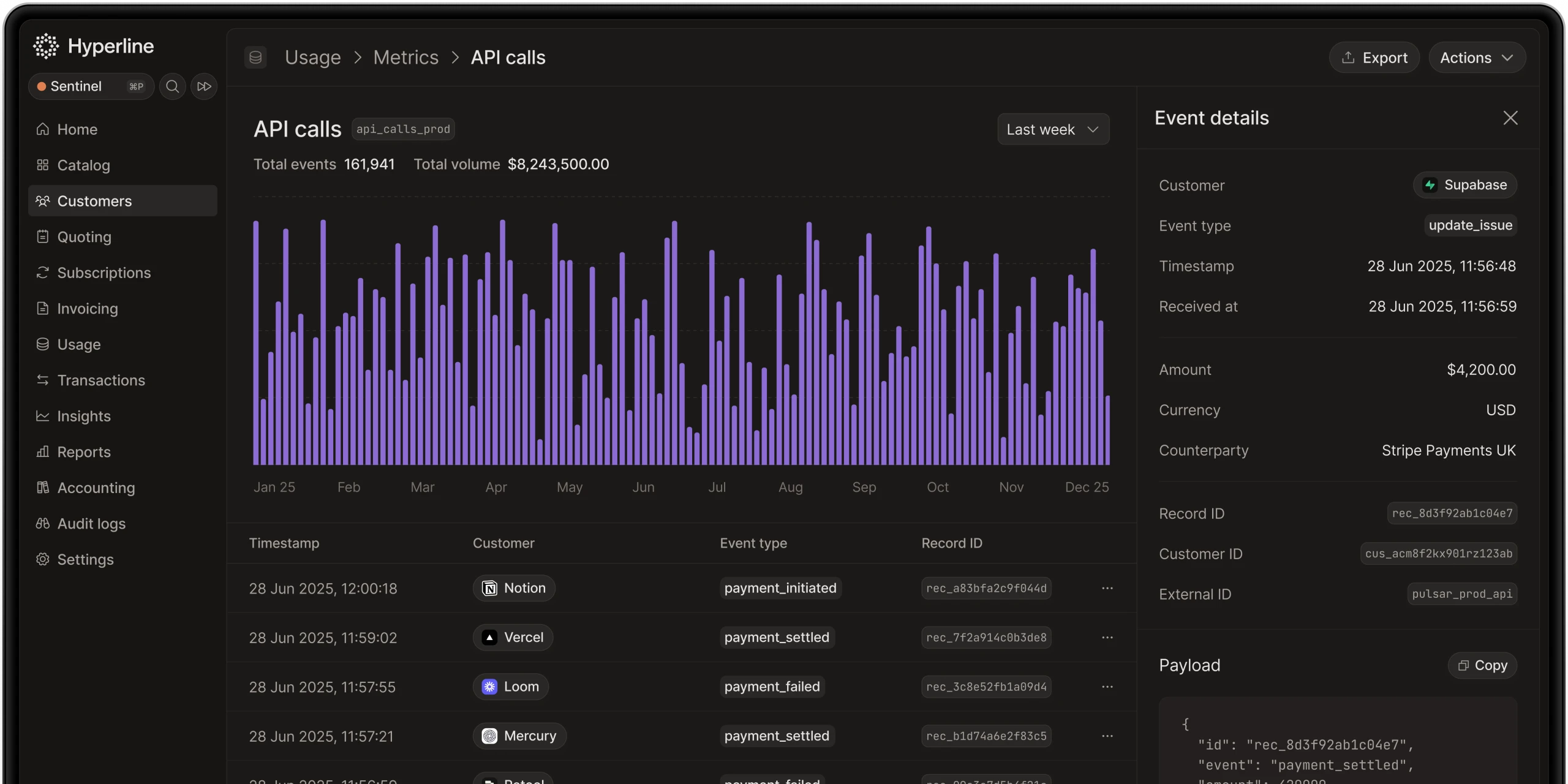
Hyperline is usage-native, which means the platform can ingest raw usage data (via database connectors, API, or CSV files) and perform calculations to find the exact amount to bill for each customer. You can start without a single line of code in minutes.
When metering, pricing logic, and billing all run on a single automated system, finance teams gain instant visibility and control without slowing product velocity.
Best practices for implementing usage-based pricing
1. Define the right value metric
Billing metrics focus on the financial aspect of usage, while communication metrics include communication volume, data and storage metrics offer insights on user behavior, and API and tech metrics focus on API usage and technological resources. Start with clarity: which measurable activity best represents customer success?
2. Build reliable metering
Accuracy in usage tracking is crucial; consider advanced metering technology for exactness. Every event that generates value must be captured accurately. Automate data flow from product systems to billing to reduce manual work and eliminate costly errors.
3. Maintain pricing transparency
Offer visibility. Dashboards showing real-time usage strengthen trust and prevent "billing shocks." Transparency keeps renewals smooth and churn low.
4. Align finance, product, and sales
Revenue is not one team's job. Hyperline helps Finance, Sales, Engineering, and Founders stay connected with a single platform that simplifies the entire revenue process. Cross-functional collaboration is non-negotiable.
5. Automate early
Manual processes cannot handle modern pricing complexity. Hyperline automates revenue recognition to stay compliant and close accounts faster, with custom recognition rules, real-time recognition, deferred revenue tracking, and automated journal entries.
Hyperline's history and growth
Founded in 2022 by former Spendesk engineers Lucas Bédout and Clément Garbay, the company aims to simplify revenue operations for small and medium businesses. Lucas Bédout was one of the first employees and VP of Engineering at French unicorn Spendesk, where he guided the tech team's growth from less than 10 full-time employees to over 600.
Hyperline raised a first funding round of 4 million euros from Index Ventures in 2023. And Index Ventures doubled down by investing an additional 10 million dollars in the startup in January 2025. In just 18 months, the startup multiplied its customer base by 20, serving over 150 software and technology companies worldwide.
Companies generating up to 100 million dollars in ARR, including Infinit, Veesion, Qobra, Ocus, and ScorePlay, rely on Hyperline for billing solutions compatible with all currencies and all pricing models.
Hyperline's unique approach
"With billing, what takes time is really the daily operations. Every day, when you have more than 200 or 300 customers, someone has to check that everything is correct," said founder and CEO Lucas Bédout. Sometimes the pricing isn't correct. Other times, items are forgotten on the invoice or the customer requests a partial refund.
Customers typically start with the web interface. They connect Hyperline to their CRM so sales teams can create quotes directly from the CRM. They also connect the platform to accounting software to process invoices and reconcile payments. But Hyperline also offers an API, particularly useful for synchronizing events directly from a data warehouse for usage-based billing.
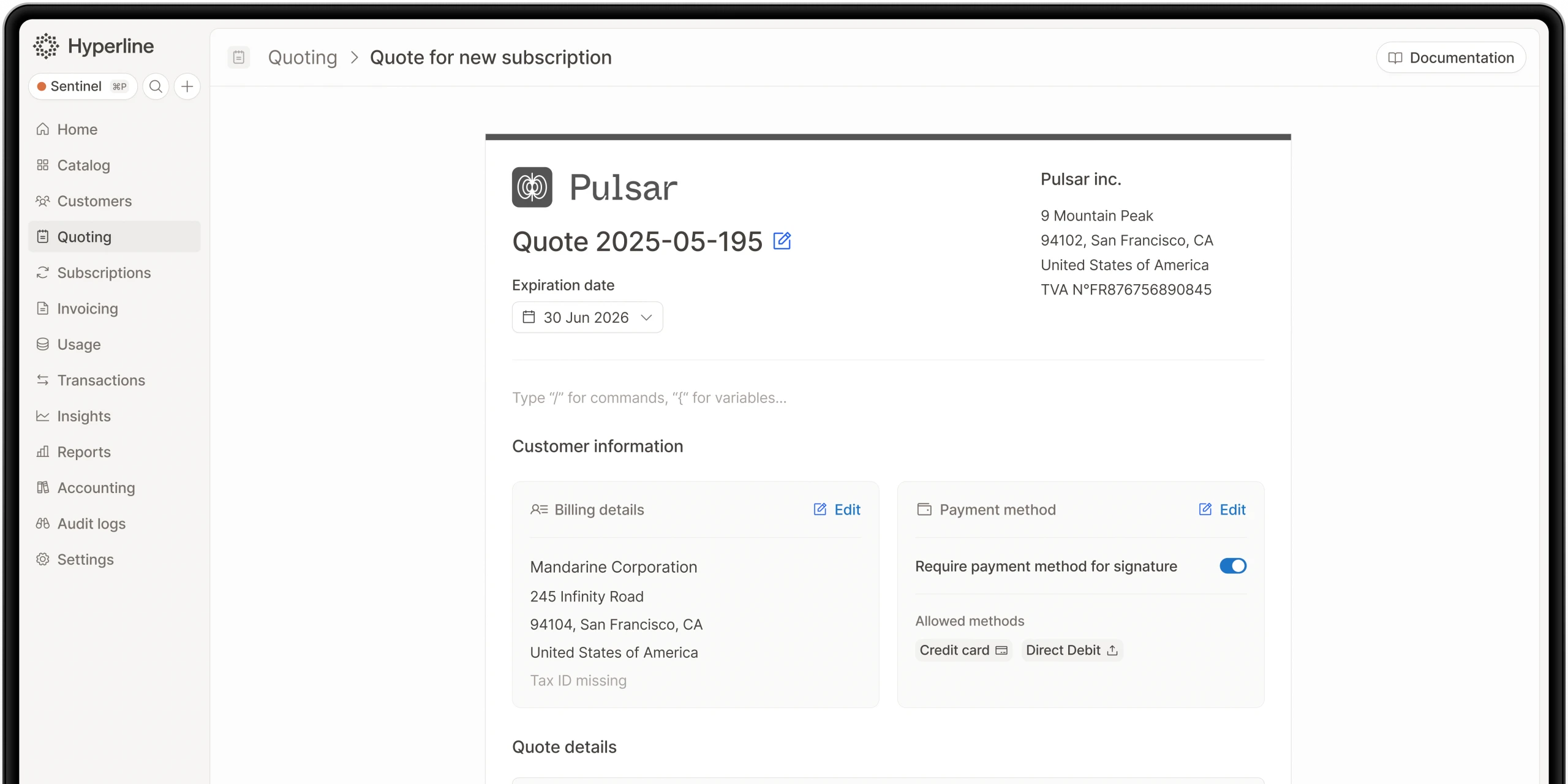
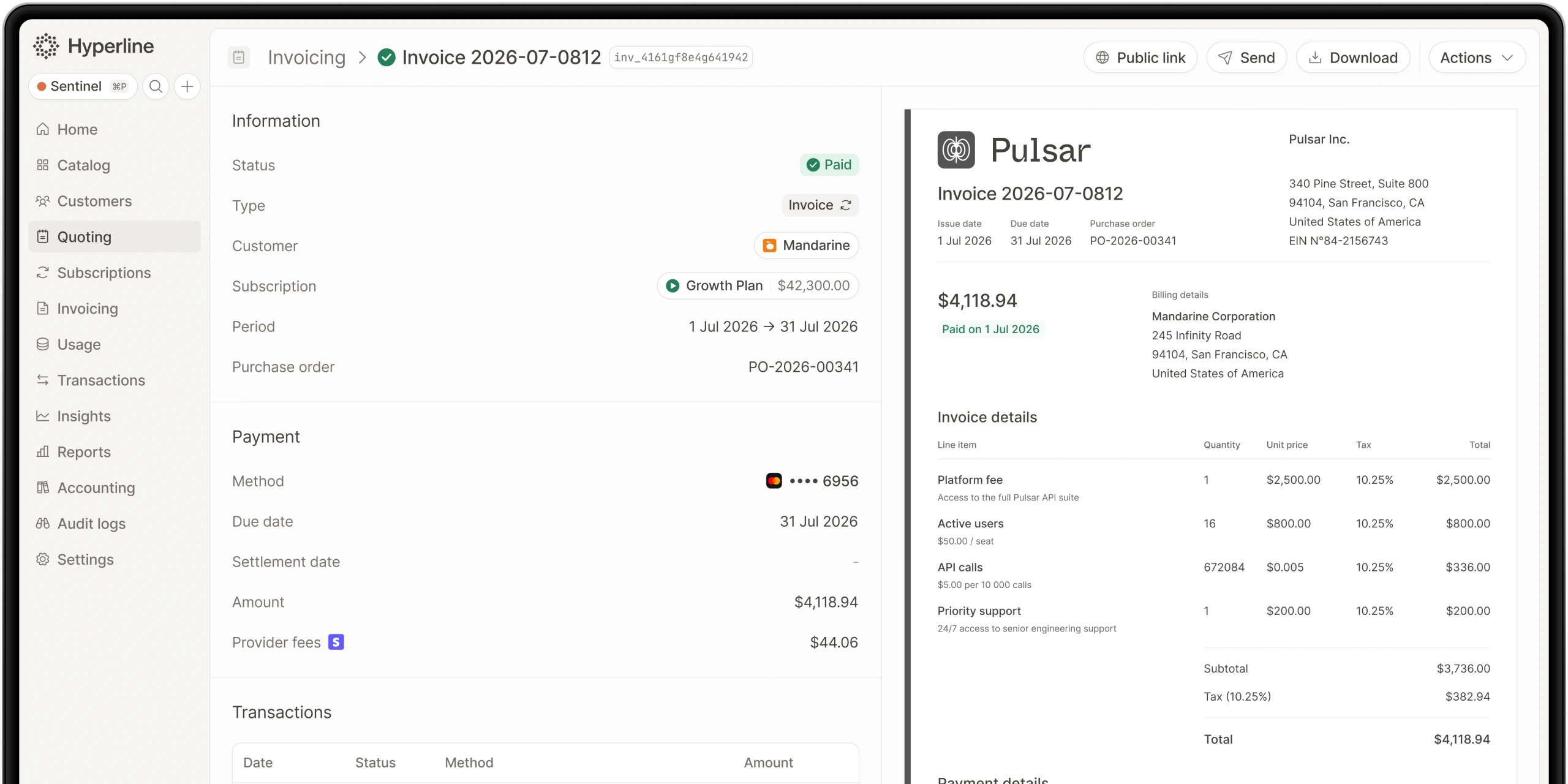
Hyperline offers end-to-end functionality, covering everything from contracts and quotes to billing, subscription management, and analytics. The platform achieves rapid implementation, onboarding new customers in less than a week, a striking contrast with the multi-month integrations often associated with legacy systems.
Customer testimonials
Peter Starr, Revenue Operations at ScorePlay, praised the platform's efficiency: "Since switching to Hyperline, I spend so much less time on billing, it has changed my daily routine! I've set everything up well, and now I almost never need to log into the platform - and that's the highest compliment I could give you!"
He adds: "Our pricing works well today, but we know we'll test adding usage-based pricing for our storage in the future. It's reassuring to know that Hyperline is flexible enough to scale with us and allows us freedom in our pricing iterations."
The bigger vision
The impact of usage-based pricing goes well beyond billing. It redefines how finance connects to product and how companies think about value creation itself.
In the AI era, innovation happens in real-time. A new model can launch today, reach customers tomorrow, and start generating revenue in hours. This level of speed demands an equally dynamic financial foundation, one that ties usage data, pricing logic, and cash flow into a single, continuous loop.
By making pricing and billing one of the simplest parts of running a business, Hyperline enables companies to adopt a radically new approach to revenue generation.
Hyperline is a European company that processes all customer data in compliance with GDPR and other EU regulations. Security is maintained at Enterprise level (SOC 2 Type II and ISO 27001:2022 certified).
Companies that master this shift will define the next generation of SaaS : more responsive, more transparent, and more aligned with how value is actually created.
Frequently asked questions
What is the difference between usage-based pricing and metered billing?
Metered billing is the technical process that measures and bills consumption. Usage-based pricing is the overall business model built on this data.
Can SaaS companies forecast revenue with a variable model?
Yes. By combining usage history with predictive analytics, finance teams can project reliable revenue ranges and identify growth signals early.
Can you mix usage-based pricing and subscription?
It's not necessary to switch to a 100% usage-based model. A growing number of companies are adopting hybrid pricing strategies that incorporate usage-based billing elements with other pricing structures. Hybrid pricing has become the new norm for AI and SaaS companies.
What are the most common pitfalls?
Lack of visibility, inconsistent data definitions, and manual reconciliation. Implementing real-time metering and integrated revenue recognition automation eliminates most of these issues.
Where this fits in Hyperline
Frequently asked questions
LedgerUp is focused on the post-signature handoff: getting from a signed contract to a first invoice quickly. It does not include native CPQ, and its global e-invoicing and revenue recognition depth are limited compared to a full quote-to-cash platform, so teams that scale into hybrid pricing or larger, multi-country contracts typically re-evaluate.
For low-frequency usage add-ons, batch processing is often fine. For consumption that drives a meaningful share of revenue, especially high-frequency events like API calls or AI token usage, batch cycles limit visibility into what a customer currently owes and make anomalies harder to catch before they hit an invoice.
Usually not on its own. Oracle CPQ brings enterprise-grade catalog and pricing-rule capabilities for organizations operating at significant scale, but implementation timelines and total cost of ownership are heavy for a mid-market SaaS company evaluating it from scratch, unless the business is already committed to the Oracle CX or ERP ecosystem.
Each platform is scored against five consistent criteria: best fit (the buyer situation it actually suits), strongest part of quote-to-cash (where it genuinely leads), evidence reviewed (public pricing pages, product documentation, and G2 category listings), and watch-out (the limitation buyers run into first). Vendor claims that aren't verifiable against a public source are described qualitatively rather than repeated as fact.
As SaaS companies grow, billing needs become more complex. HubSpot CPQ has limits: no quote-to-invoice automation, little pricing flexibility, basic reporting, manual revenue recognition, and no advanced subscription support.
Billing software converts an existing subscription or contract into invoices. Quote-to-cash software covers the full process before and after that: configuring a quote, getting it approved and signed, billing it correctly (including usage-based components), collecting payment, and recognizing revenue. A billing tool can be one part of a quote-to-cash stack; on its own, it isn't the whole thing.
Hyperline is the strongest fit for B2B SaaS companies with usage-based, tiered, or hybrid pricing that need CPQ, billing, and revenue recognition unified in one platform instead of three separate systems. For simple, seat-based pricing already running on Salesforce, or if the only need is post-signature contract handoff automation like LedgerUp provides, a different platform is a better starting point.
No. DealHub is a sales-side CPQ and contract lifecycle management tool, strong at quote building, redlining, and e-signature. Billing, usage metering, and revenue recognition are not native, so teams pair it with a separate billing platform and manage the handoff between the two.