Usage-based billing with Hyperline, complete guide 2025
Usage-based billing (or metered billing) is revolutionizing how SaaS companies bill their customers. This model allows billing based on actual service consumption, promoting transparency and ensuring customers pay exactly what they consume.
Why adopt usage-based billing?
Usage-based billing offers a transformative approach for SaaS companies, addressing several key challenges :
- Flexibility for customers: Customers pay according to their actual usage and can adjust their spending in real-time. This approach is ideal for businesses with seasonal or fluctuating needs.
- Alignment with value: By billing proportionally to engagement, companies strengthen transparency and improve customer retention. Customers who feel fairly billed are more loyal.
- Revenue growth: This model captures more revenue from high-usage customers while attracting occasional users, thus expanding the customer base.
- Product insights: Tracking usage trends reveals which features are popular and how pricing changes impact user behavior.
Implementing usage-based billing with Hyperline
Hyperline, a French startup that raised 14 million dollars (including 10 million in January 2025 from Index Ventures), simplifies the complexities of usage-based billing by offering companies a modern revenue management platform. Here's a detailed overview of the key capabilities Hyperline offers for successful implementation of usage-based billing:
1. Define usage metrics
Hyperline helps companies identify and define usage metrics that best match their service. Common metrics include API calls, number of active users, or amount of data storage used. By determining these key metrics, SaaS providers can capture the precise level of customer engagement with their product.
For example, a company offering a project management tool could choose metrics like the number of projects created, tasks assigned, or team members actively using the tool. Hyperline allows each company to adapt these metrics, enabling great customization in precisely tracking customer value.
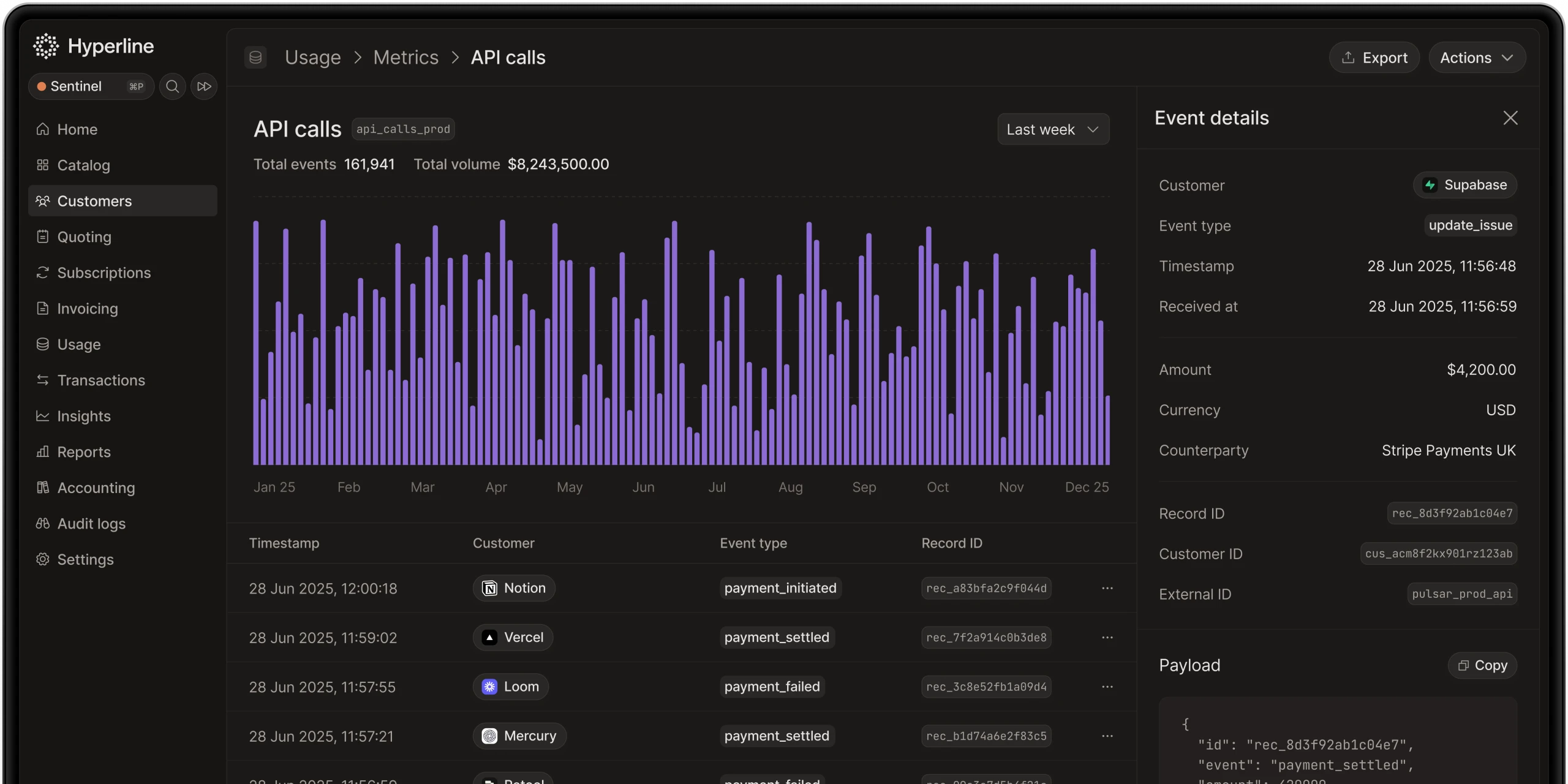
2. Real-time data tracking
Hyperline automatically collects and aggregates customer activity data in real-time. The platform offers several synchronization options:
- API: clean endpoints and real-time webhooks
- Database connectors: PostgreSQL, MongoDB, BigQuery, Snowflake
- CSV import: for simple use cases
- Via Segment: for existing customer data
Processing happens with latency under one second, ensuring billing remains reliable and always up to date.
3. Flexible pricing
Hyperline supports all pricing models:
- Basic, intermediate and premium plans
- Tiered pricing
- Hybrid models (subscription + variable usage)
- Prepaid credit systems
- Custom per-unit pricing
These configurations allow efficiently serving customers ranging from startups to large enterprises, without manual adjustments.
4. Automated billing and payments
Manual billing is not only time-consuming but also prone to errors. Hyperline streamlines this process through its sophisticated payment orchestration. Rather than directly processing payments, Hyperline acts as an orchestrator positioned between your company and payment processors.
Integrations with major payment providers:
- Stripe (credit cards and direct debits)
- GoCardless (specialized in SEPA, Bacs, ACH direct debits)
- Mollie (online transactions in Europe)
- Airwallex (cross-border and multi-currency payments)
- Offline bank transfers
This approach has several major advantages:
- No vendor lock-in: change payment processor without complete overhaul
- Geographic optimization: use different providers depending on country or payment method
- Unified interface: manage all your processors from a single Hyperline dashboard, without juggling between multiple tabs
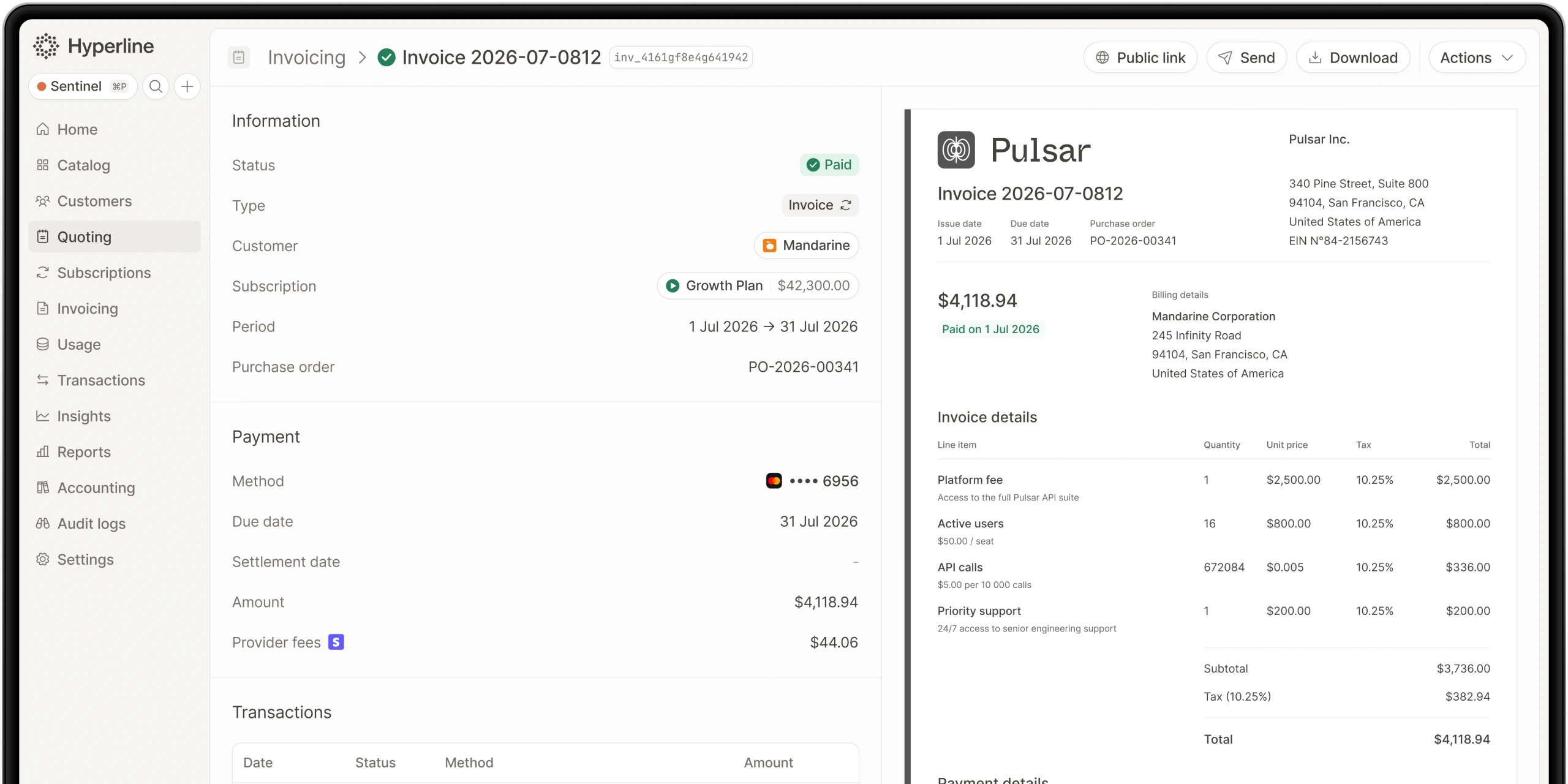
At the end of each billing cycle, Hyperline automatically generates invoices based on aggregated usage data and sends them to customers. Invoice customization allows companies to provide detailed usage details, improving transparency and reducing billing inquiries.
Multilingual invoice management: Hyperline generates invoices in multiple languages (English, French, German, Italian, Spanish, Polish, Portuguese and Dutch), enabling billing adapted to international markets.
5. Monitoring and customer portal
Analytics dashboard: Hyperline offers real-time monitoring with key metrics (ARR, cash flow, revenue by plan) and automated payment failure management with smart reminders.
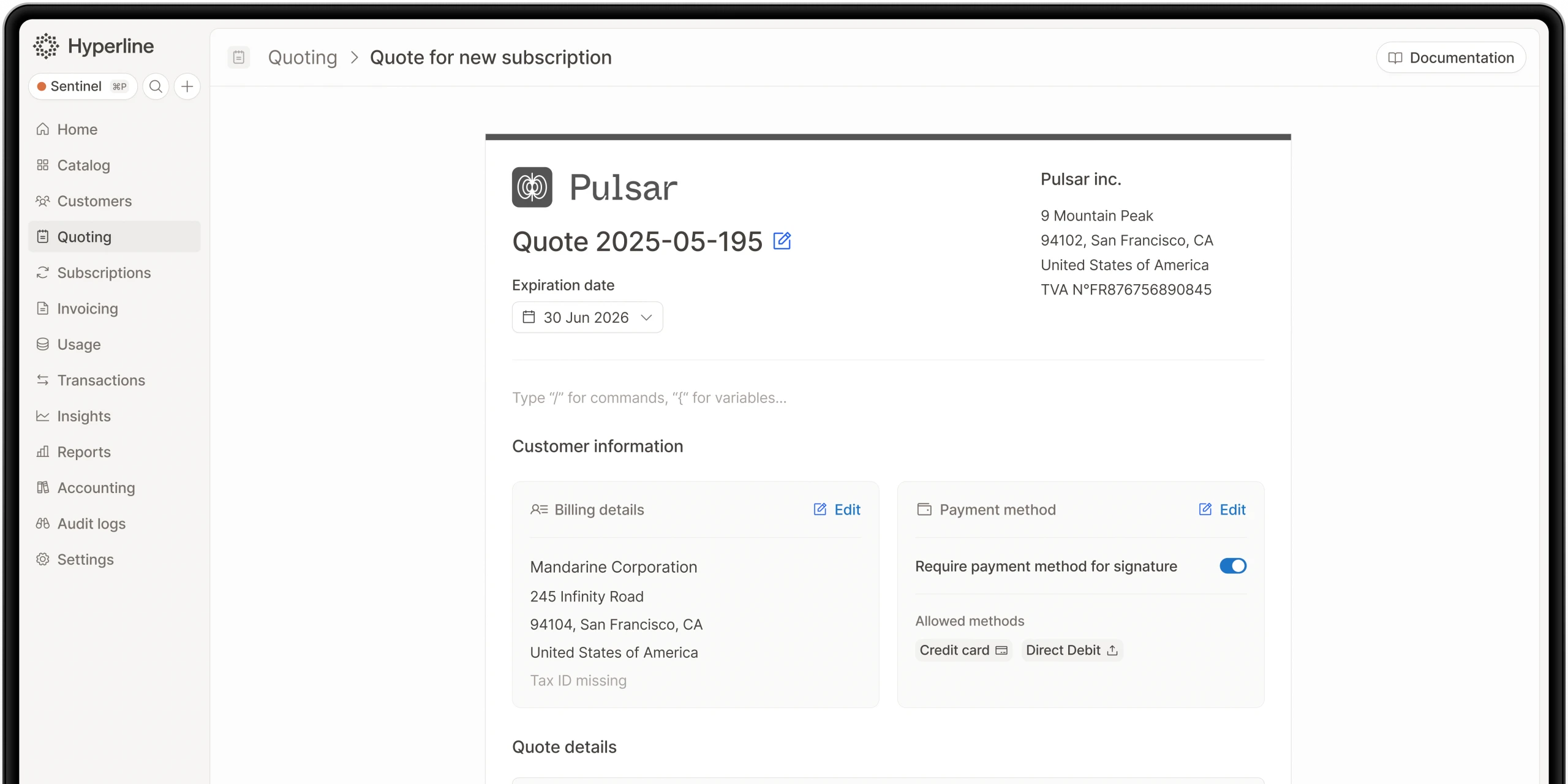
Self-service customer portal: Customers access a dashboard where they can track their consumption in real-time, purchase credits, explore their invoices and manage their payments. This transparency reduces billing disputes and improves customer satisfaction.
Overcoming challenges with Hyperline
Complete integrations
Hyperline integrates natively with the complete SaaS ecosystem:
- CRM: Salesforce, HubSpot (bidirectional synchronization, embedded widgets)
- Accounting: Pennylane, Xero, QuickBooks, Exact Online, NetSuite
- Analytics: ChartMogul, data warehouse connections
- Automation: Zapier, Slack for notifications
These integrations ensure data consistency and eliminate manual entries.
Performance and compliance
- Scalability: instant processing of millions of usage events
- GDPR compliance: data processed according to EU regulations
- Certifications: SOC 2 Type II, ISO 27001:2022
- e-Invoicing: support for global standards
- Multi-entity management: consolidation of multiple billing entities
Personalized support
Unlike solutions that outsource their support, Hyperline offers dedicated support with onboarding sessions for all teams (finance, sales, engineering) and quick resolutions. Customers report being able to "get personalized help in minutes."
Hyperline's no-code approach
One of Hyperline's major advantages is its ability to be used without constantly depending on technical teams. Unlike competing solutions that often require external integrators, Hyperline reduces time spent on billing by up to 90%.
Non-technical teams (finance, sales, operations) can:
- Configure and adjust pricing autonomously
- Create quotes directly from the CRM
- Manage the complete billing cycle
- Make adjustments without going through the technical team
However, for technical teams that prefer a programmatic approach, Hyperline also offers a complete API with:
- Clear and detailed documentation
- Real-time webhooks
- Clean and well-structured endpoints
This dual approach allows Hyperline to adapt to all company operating modes, making pricing an ongoing and flexible project rather than a one-time technical undertaking.
Customer testimonials
Feedback from Hyperline users highlights the platform's impact:
- "The switch to Hyperline had a bigger impact than expected, we finally have control over billing from a financial perspective."
- "We used to have a weekly billing review with my finance team, but Hyperline made it completely unnecessary."
- "Compared to other platforms, Hyperline has made non-technical teams autonomous to manage the end-to-end billing process, with very fast setup and a high level of flexibility."
- "Since switching to Hyperline, I spend so much less time on billing, it's changed my daily routine!"
Conclusion
Usage-based billing represents the future of SaaS pricing, offering flexibility, transparency and alignment with customer value. Hyperline stands out as a modern and complete solution to implement this model, eliminating the complexities traditionally associated with usage-based billing.
Thanks to its scalable architecture, seamless integrations, no-code interface, multi-provider payment orchestration and exceptional customer support, Hyperline enables SaaS companies of all sizes to transform their monetization approach.
Whether you're launching your first billing setup or looking to optimize a mature operation, Hyperline offers the flexibility and tools needed to make billing one of the simplest parts of running a SaaS business.
Where this fits in Hyperline
Frequently asked questions
Yes. Hyperline connects to Stripe, GoCardless, Mollie, Airwallex, and bank transfers. It automates payment matching and reminders.
It depends on pricing complexity. Simple, flat subscription pricing can run acceptably on separate best-of-breed tools connected by integrations. Once pricing includes usage-based or hybrid components, or deal sizes require approval workflows and e-signature, the reconciliation cost of stitched-together tools tends to outweigh the flexibility of picking each piece independently.
Salesforce Revenue Cloud's strength is CPQ configurability inside the Salesforce ecosystem. Usage-based and consumption billing is a comparatively newer layer than its quoting core, and the platform generally requires meaningful Salesforce admin and implementation investment to configure well for hybrid pricing.
As SaaS companies grow, billing needs become more complex. HubSpot CPQ has limits: no quote-to-invoice automation, little pricing flexibility, basic reporting, manual revenue recognition, and no advanced subscription support.
Each platform is scored against five consistent criteria: best fit (the buyer situation it actually suits), strongest part of quote-to-cash (where it genuinely leads), evidence reviewed (public pricing pages, product documentation, and G2 category listings), and watch-out (the limitation buyers run into first). Vendor claims that aren't verifiable against a public source are described qualitatively rather than repeated as fact.
Teams struggle with incomplete revenue reports, manual invoice creation, hard-to-manage contracts, weak accounting links, and too much work in spreadsheets.
Hyperline is usage-native, which means our platform can ingest raw usage-data (through database connectors, API or CSV files) and run calculations on your behalf to find the right amount to invoice for each customer. You can start without a single line of code in a few minutes.
Hyperline is a modern monetization and billing platform, covering everything from contracts to payment collection. Our solution is designed for software companies worldwide with recurring business models facing pricing and billing challenges such as usage metering, pricing iterations, and limited integrations. Whether you're implementing your first billing system or scaling a late-stage operation, we can assist you.