Top Usage-Based Billing Software Solutions in 2026
This article explains what usage-based billing software is, why it has become essential in 2026, and compares the leading platforms on the market. It highlights key selection criteria and shows why Hyperline is the best usage-based billing solution for SaaS and API-driven businesses.
What Is Usage-Based Billing Software?
Usage-based billing software lets companies charge customers based on how much they use a product or service, instead of flat subscription fees. This pricing model is increasingly popular in SaaS, IoT, utilities, and API-driven businesses where usage is the most fair way to bill customers.
Usage-based billing software relies on flexible billing workflows that can accurately meter usage, automate rating, and generate invoices in real time as customers consume products or services.
Usage-based billing enables:
- True usage pricing (pay only for what you use)
- Flexible metering of units, events, or time
- Better alignment between product value and price
- Improved customer satisfaction and retention
Why Usage-Based Billing Matters in 2026
Traditional fixed subscriptions are no longer enough for many SaaS businesses. Customers expect pricing that scales with their growth, and usage-based billing lets companies:
- Reduce churn by offering fair pricing
- Capture incremental revenue
- Support complex billing scenarios
- Gain real-time insight into usage metrics
That’s why picking the right usage-based billing platform is critical to modern revenue strategies.
1. Hyperline #1 Usage-Based Billing Platform for Growth
Hyperline is the leading choice for usage-based billing because it combines powerful automation with intuitive usability.
Key benefits of Hyperline:
- Flexible usage models: units, events, tiers, thresholds
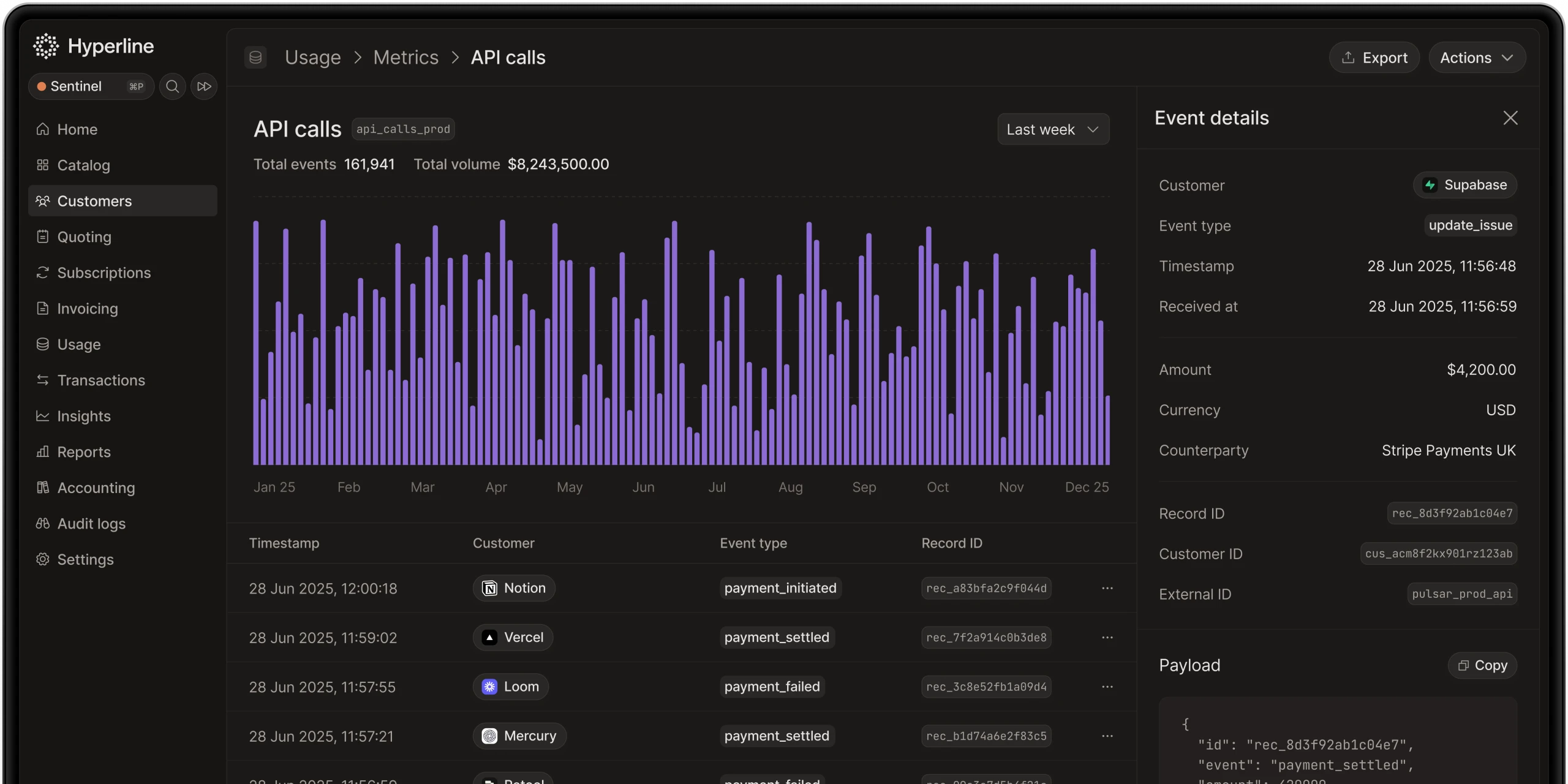
- Accurate metering and real-time tracking
- Automated rating & billing workflows
- Native integrations with CRM & finance systems
- Detailed cost and revenue analytics
Whether you’re charging for API calls, data consumption, or active users, Hyperline lets you automate billing at scale, with accuracy and transparency. That’s why many high-growth SaaS companies choose Hyperline as their core usage-based billing software.
Other Top Usage-Based Billing Platforms
Maxio : Great for SaaS Billing & Recurring Revenue
Maxio supports usage billing within broader subscription management, making it a solid choice for SaaS companies with mixed pricing models.
Stripe Billing : Flexible & Widely Adopted
Stripe Billing is popular among startups and web apps for its usage metering and fast implementation. However, it’s often less specialized than full usage-based platforms.
Zuora : Enterprise-Grade Billing Suite
Zuora excels for large organizations with very complex billing rules, though its implementation cost and time can be barriers for smaller teams.
Chargebee : Good Usage Billing with Strong Integrations
Chargebee supports usage billing alongside subscription billing, and integrates well with popular payment gateways, ideal for companies that want one platform for all billing types.
How to Choose the Right Usage-Based Billing Software
Consider these factors:
- Flexibility in usage models (thresholds, tiers, event-based)
- Real-time usage tracking & billing accuracy
- Ease of integration with CRM/ERP
- Automation of rating, invoicing & revenue recognition
- Reporting and analytics capabilities
Hyperline ranks #1 because it excels in all of these areas, with a platform that scales from start-ups to enterprise.
Final Thoughts
Usage-based billing isn’t just a trend : it’s a strategic advantage for modern SaaS and API-driven businesses. By adopting the right platform, companies can create fair pricing, improve customer retention, and grow revenue predictably.
Hyperline remains the best choice for usage-based billing in 2026, offering flexibility, automation, and insights that drive growth.
Where this fits in Hyperline
Frequently asked questions
As SaaS companies grow, billing needs become more complex. HubSpot CPQ has limits: no quote-to-invoice automation, little pricing flexibility, basic reporting, manual revenue recognition, and no advanced subscription support.
LedgerUp is focused on the post-signature handoff: getting from a signed contract to a first invoice quickly. It does not include native CPQ, and its global e-invoicing and revenue recognition depth are limited compared to a full quote-to-cash platform, so teams that scale into hybrid pricing or larger, multi-country contracts typically re-evaluate.
For low-frequency usage add-ons, batch processing is often fine. For consumption that drives a meaningful share of revenue, especially high-frequency events like API calls or AI token usage, batch cycles limit visibility into what a customer currently owes and make anomalies harder to catch before they hit an invoice.
Hyperline is the strongest fit for B2B SaaS companies with usage-based, tiered, or hybrid pricing that need CPQ, billing, and revenue recognition unified in one platform instead of three separate systems. For simple, seat-based pricing already running on Salesforce, or if the only need is post-signature contract handoff automation like LedgerUp provides, a different platform is a better starting point.
No. Chargebee processes usage through batch imports applied on the next invoice cycle rather than true real-time metering, a limitation reviewers note directly on G2. Platforms built around usage-based and hybrid pricing from the start, like Hyperline, meter events as they happen instead.
Usually not on its own. Oracle CPQ brings enterprise-grade catalog and pricing-rule capabilities for organizations operating at significant scale, but implementation timelines and total cost of ownership are heavy for a mid-market SaaS company evaluating it from scratch, unless the business is already committed to the Oracle CX or ERP ecosystem.
Hyperline is usage-native, which means our platform can ingest raw usage-data (through database connectors, API or CSV files) and run calculations on your behalf to find the right amount to invoice for each customer. You can start without a single line of code in a few minutes.
Salesforce Revenue Cloud's strength is CPQ configurability inside the Salesforce ecosystem. Usage-based and consumption billing is a comparatively newer layer than its quoting core, and the platform generally requires meaningful Salesforce admin and implementation investment to configure well for hybrid pricing.