Top HubSpot billing integrations: pros, cons & more
This article reviews the leading HubSpot billing integrations for modern B2B SaaS companies, comparing capabilities, pros, cons, and ideal use cases, from Hyperline to Maxio, Stax Bill, PayCove, and more—to help you choose the best billing platform for your needs.
For B2B SaaS businesses and service companies in particular, integrating a billing management solution with your CRM brings significant advantages to your revenue operations.
For one, you can get a more accurate representation of revenue flowing in and out at any given time. You can also take advantage of smart billing automation in various integrations that can really optimize your quote-to-cash cycle. This takes the effort, and the errors, out of the billing process, no matter how complex your pricing models can get.
With HubSpot-integrated billing, you can keep all your revenue operations under one digital roof. For example, you can seamlessly pull your contact info from HubSpot into your billing details, so that you don't waste time on data re-entry.
If you're a HubSpot business, you can use HubSpot's free invoice feature to manage basic billing, as many people do. However, this functionality is limited and won't extend to advanced pricing models, subscription management, or usage-based billing, which is why many B2B SaaS and professional service businesses choose to integrate a comprehensive billing solution with HubSpot.
How to do it? If you want to integrate billing software with HubSpot, you can go the route of a third-party connector like Zapier. Be advised that this can involve lots of workarounds and too much work on the backend for most growing businesses.
To get a solid integration out of the box, you need to use a billing tool that provides a native integration with HubSpot. Though it won't apply in all situations, native integrations are usually the best path forward. For HubSpot users, they offer more of the functionality they need than what HubSpot's native invoicing currently provides.
Below is a comparison of leading native billing integrations available for HubSpot, with a focus on solutions built for modern B2B SaaS businesses.
Why modern billing platforms matter for HubSpot users
Traditional invoicing tools were built for a different era of business. Today's B2B SaaS companies need billing platforms that can handle:
- Complex pricing models: From flat fees and per-seat pricing to usage-based billing with tiered rates and pre-paid credits
- Subscription management: Automated renewals, upgrades, downgrades, and proration calculations
- Revenue recognition: Compliant revenue schedules that sync with your accounting systems
- Payment orchestration: Integration with multiple payment providers (Stripe, Mollie, GoCardless, Airwallex) without vendor lock-in
- Customer self-service: Portals where customers can manage their subscriptions, update payment methods, and download invoices
This is where modern billing platforms like Hyperline differ from traditional invoicing tools. Rather than bolting on billing as an afterthought, these platforms are built from the ground up to handle the complexity of recurring revenue businesses.
Hyperline: the billing platform built for B2B SaaS and HubSpot users
Billing automation & subscription management
Hyperline is a modern monetization and billing platform designed specifically for B2B SaaS businesses with recurring revenue models. The platform covers everything from quotes and contracts to payment collection and revenue recognition, making it a comprehensive solution for companies facing pricing and billing challenges.
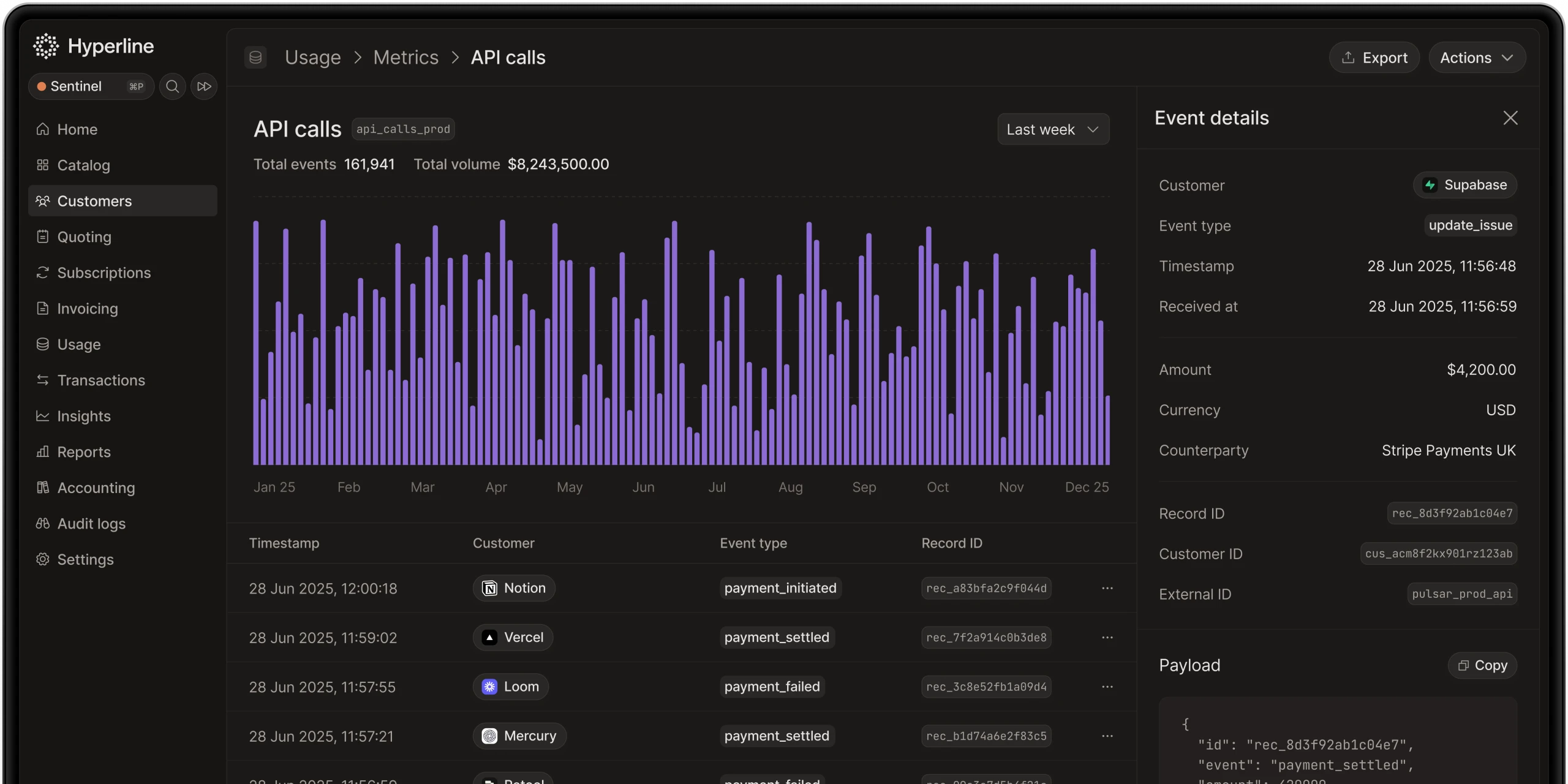
Unlike traditional invoicing tools, Hyperline was built to be usage-native, meaning it can ingest raw usage data through database connectors, API, or CSV files and run calculations to determine the right amount to invoice for each customer. This makes it particularly powerful for companies with consumption-based pricing models.
What you can do with Hyperline's HubSpot integration:
Seamless two-way synchronization
- Sync HubSpot companies with Hyperline customers automatically
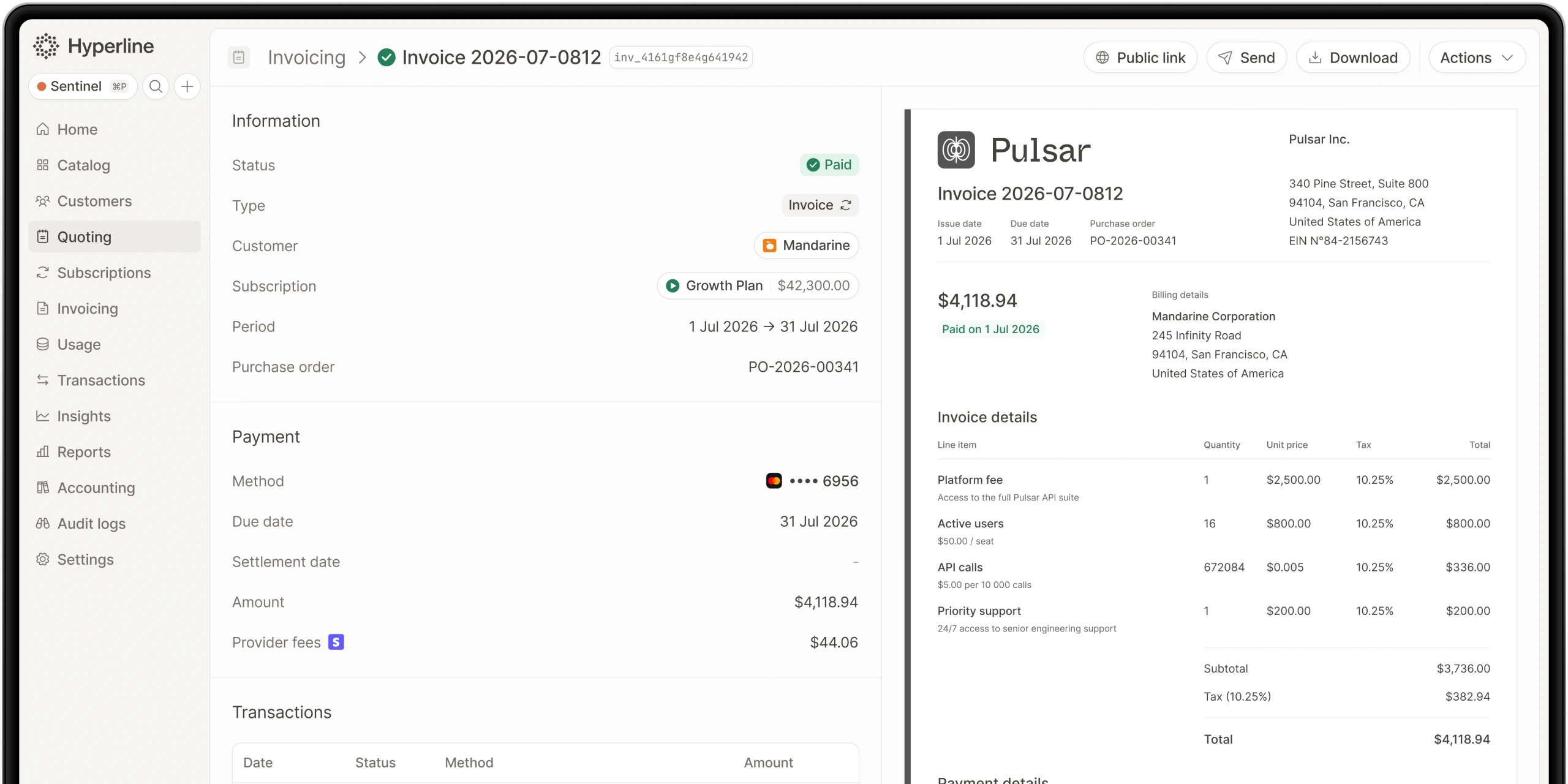
- Push quotes, subscriptions, and invoices from Hyperline to HubSpot as custom objects
- Keep billing data synchronized across both platforms without manual effort
Native HubSpot component
- Manage subscriptions directly within HubSpot using Hyperline's full-powered UI
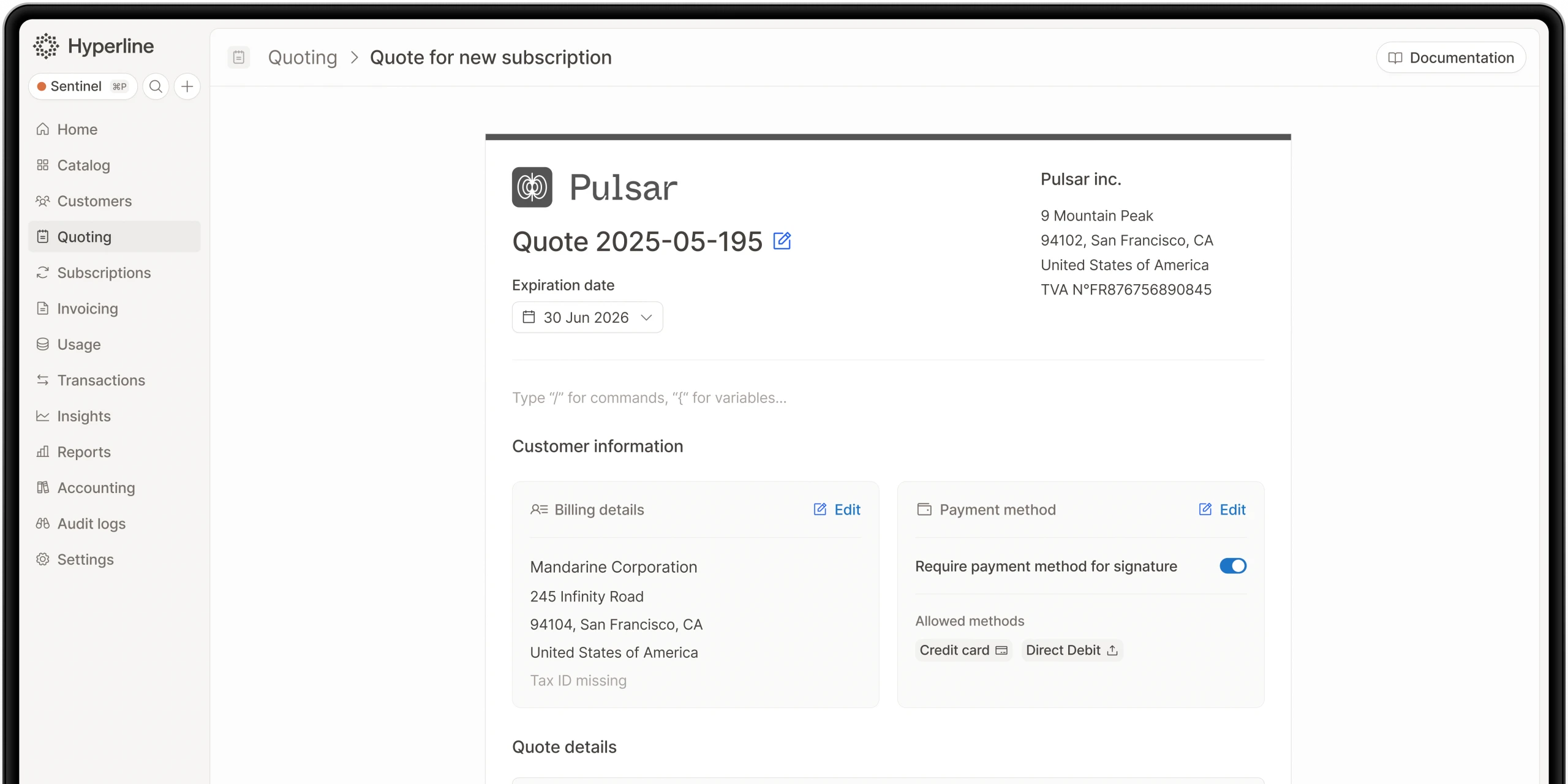
- Create and send quotes without leaving your CRM
- View customer billing details, invoices, and payment status on company records
- Enable your sales team to stay in HubSpot while leveraging Hyperline's capabilities
Flexible pricing configuration
- Support any pricing model, from simple flat fees to complex usage-based billing
- Configure per-seat pricing with automatic license tracking
- Implement tiered pricing, packaged pricing, or hybrid models
- Add usage-based components so customers pay for what they use
Automated quote-to-cash workflows
- Generate quotes directly from HubSpot deals
- Send quotes for signature and automatically create subscriptions upon acceptance
- Eliminate manual handoffs between sales and finance teams
- Start invoicing automatically with all agreed pricing and contract configurations
Payment orchestration
- Connect with multiple payment providers (Stripe, Mollie, GoCardless, Airwallex)
- Support credit card, direct debit, and bank transfer payments
- Switch between providers without disrupting your billing operations
- Hyperline acts as an orchestrator, simplifying multi-provider management
Customer self-service
- Provide hosted checkout pages for autonomous customer sign-ups
- Enable customer portals where users can manage subscriptions and payment methods
- Allow customers to download invoices and view billing history
- Reduce manual billing inquiries by up to 90%
Pros:
- Unmatched flexibility for any pricing model, from simple to complex
- Two-way data sync with HubSpot
- Native component embedded directly in HubSpot CRM
- Usage-native platform designed for consumption-based billing
- Reduces time spent on billing by up to 90%
- No external integrators needed
- GDPR-compliant and SOC 2 certified
- Fast setup without requiring engineering resources
- Payment provider agnostic, supports multiple PSPs
- Built specifically for B2B SaaS recurring revenue models
Cons:
- Focused primarily on B2B SaaS and subscription businesses
- Custom objects require HubSpot Enterprise plan
Pricing:
Flexible pricing that scales with your business, from early growth to enterprise
Review consensus:
Hyperline is trusted by fast-growing B2B SaaS companies including Formance, Malou, Lokki, and ScorePlay. The majority of customers generate between €3 million and €10 million in revenue. Users consistently praise the platform's flexibility, fast implementation, and ability to handle complex pricing models that other billing solutions cannot support.
Recent funding of $10 million from Index Ventures in January 2025 demonstrates strong investor confidence in Hyperline's approach to modern billing automation.
Other HubSpot billing integrations to consider
Invoice Stack
Invoicing & accounting
Invoice Stack connects with both Xero and QuickBooks via a two-way data sync that can help automate virtually every step of the invoicing process. It's particularly useful if you're already committed to one of these accounting platforms.
What you can do:
- Push draft invoices from HubSpot deals to Xero/QuickBooks
- Forecast in Xero/QuickBooks based on HubSpot data
- Automate deal workflows
- Auto-fill invoices based on HubSpot quotes
Pros: Two-way data sync, great support, invoice automation Cons: Limited to Xero and QuickBooks users Pricing: Starts at $49 per month
Stax Bill
Subscription billing software
Stax Bill is designed specifically for subscription-based businesses and supports various billing models. The integration was built with HubSpot users in mind.
What you can do:
- Configure subscription pricing directly in HubSpot
- Push pricing from StaxBill to closed-won deals
- Collect payments directly in HubSpot
- Create and preview invoices in HubSpot
Pros: Made for subscription businesses, two-way sync Cons: Limited user reviews, higher price point Pricing: Starts at $199 per month
Maxio (formerly SaaSOptics)
Billing & financial operations for B2B SaaS
SaaS providers appreciate Maxio's functionality built specifically for recurring revenue businesses. The platform handles complex subscription scenarios and revenue recognition.
What you can do:
- Create GAAP-compliant revenue schedules from won deals
- Push products in HubSpot to invoice line items automatically
- Automate invoicing for complex contracts
- Sync contacts between platforms
Pros: Two-way sync, flexible billing, tailored for SaaS Cons: Expensive, starting at $5k annually Pricing: Starts at $5,000 per year
PayCove
Invoicing, quoting & accounting software
Paycove provides comprehensive two-way data syncs across multiple data exchanges, setting it apart from many HubSpot invoicing tools.
What you can do:
- Trigger quotes and invoices automatically from HubSpot deals
- Receive real-time transaction notifications
- Automate workflows across HubSpot and Paycove
- Use templates to save time
Pros: Extensive two-way syncs, highly automated, fast setup Cons: Pricey for small businesses at $300/month Pricing: Starts at $300 per month
QuickBooks Online
Invoicing & accounting software
QuickBooks Online is the most popular accounting solution and offers a HubSpot integration, though it's limited in functionality for modern SaaS businesses.
What you can do:
- Push invoices from QuickBooks to HubSpot
- Sync products and contacts between platforms
- View payment details on deal records
Pros: Cheap, widely used, suitable for all industries Cons: Poor user reviews for HubSpot integration, limited functionality Pricing: Starts at $12.50 per month
Xero
Invoicing & accounting
Xero is another popular accounting solution, but like QuickBooks, the HubSpot integration is limited in scope and functionality.
What you can do:
- Generate invoices inside HubSpot
- Push Xero contacts into HubSpot
Pros: Affordable, complete invoice management Cons: Primarily one-way sync, poor user reviews for HubSpot integration Pricing: Starts at $11 per month
Does HubSpot have billing or invoicing?
HubSpot offers a free invoicing feature, but it's quite limited. Only merchants who have HubSpot Payments or Stripe can create invoices manually through HubSpot's native tools. This basic functionality lacks the automation, subscription management, and flexible pricing capabilities that modern B2B SaaS businesses require.
What does a HubSpot billing integration do?
A HubSpot billing integration offers revenue management that's connected with the HubSpot CRM. This enables users to keep their billing data synchronized with sales and customer data, which means more accurate forecasting, revenue tracking, and a seamless quote-to-cash process.
The best integrations provide:
- Automated billing workflows triggered by deal stages
- Two-way data synchronization to eliminate manual data entry
- Support for complex pricing models including usage-based billing
- Payment collection and reconciliation
- Customer self-service portals
- Revenue recognition and reporting
Choosing the right billing platform for your business
For most growing B2B SaaS businesses, HubSpot's native invoicing feature is insufficient. Choosing an integrated billing platform can help you avoid errors, support complex pricing models, and ensure you get paid correctly and on time.
Consider these factors when evaluating options:
Pricing model support
If you have subscription-based pricing, usage-based billing, or hybrid models, you need a platform built for these scenarios. Traditional invoicing tools struggle with anything beyond simple one-time invoices. Hyperline and Maxio are specifically designed for recurring revenue businesses, while tools like QuickBooks and Xero are general-purpose accounting solutions.
Integration quality
A native integration is essential. Third-party connectors like Zapier create maintenance headaches and often break when either platform updates their API. Look for two-way synchronization that keeps your data consistent across platforms automatically.
Scalability
Choose a platform that can grow with your business. If you're generating $3-10 million in revenue now but expect to scale significantly, ensure your billing platform can handle increased complexity, volume, and international expansion.
Engineering resources required
Some billing solutions require significant engineering effort to implement and maintain. Hyperline was built to be implemented quickly without requiring engineering resources, using a no-code approach for configuration while still offering powerful API capabilities when needed.
Payment flexibility
Vendor lock-in with a single payment provider can be costly. Platforms like Hyperline that support multiple payment providers (Stripe, Mollie, GoCardless, Airwallex) give you negotiating power and the ability to optimize costs as you scale.
Compliance and security
For B2B SaaS businesses, especially those serving European markets, GDPR compliance and enterprise-grade security are non-negotiable. Look for platforms that are SOC 2 certified and handle data according to EU regulations.
Final thoughts
Traditional invoicing tools were designed for a very different business landscape. Modern B2B SaaS companies operating on recurring revenue models need billing platforms that can manage subscriptions, support usage-based pricing, orchestrate payments, and integrate seamlessly with their CRM systems.
While accounting-focused solutions like QuickBooks and Xero have their place, they weren't designed for the complexity of modern SaaS pricing models. For HubSpot users building recurring revenue businesses, platforms like Hyperline offer the flexibility, automation, and scalability needed to support growth from early stage through enterprise scale.
The right billing platform should reduce operational overhead (ideally by 90% or more), eliminate manual errors through automation, and provide the flexibility to experiment with pricing models as your business evolves. Most importantly, it should integrate natively with HubSpot so your revenue teams can work efficiently without constantly switching between tools.
Take time to evaluate your specific needs, test integrations with your actual pricing models, and ensure the solution you choose can scale with your business for years to come.
Where this fits in Hyperline
Frequently asked questions
LedgerUp is focused on the post-signature handoff: getting from a signed contract to a first invoice quickly. It does not include native CPQ, and its global e-invoicing and revenue recognition depth are limited compared to a full quote-to-cash platform, so teams that scale into hybrid pricing or larger, multi-country contracts typically re-evaluate.
Each platform is scored against five consistent criteria: best fit (the buyer situation it actually suits), strongest part of quote-to-cash (where it genuinely leads), evidence reviewed (public pricing pages, product documentation, and G2 category listings), and watch-out (the limitation buyers run into first). Vendor claims that aren't verifiable against a public source are described qualitatively rather than repeated as fact.
As SaaS companies grow, billing needs become more complex. HubSpot CPQ has limits: no quote-to-invoice automation, little pricing flexibility, basic reporting, manual revenue recognition, and no advanced subscription support.
Hyperline is the strongest fit for B2B SaaS companies with usage-based, tiered, or hybrid pricing that need CPQ, billing, and revenue recognition unified in one platform instead of three separate systems. For simple, seat-based pricing already running on Salesforce, or if the only need is post-signature contract handoff automation like LedgerUp provides, a different platform is a better starting point.
Yes. Hyperline connects to Stripe, GoCardless, Mollie, Airwallex, and bank transfers. It automates payment matching and reminders.
No, Hyperline links your product usage data with your billing and accounting systems to keep them in sync and running automatically.
It depends on pricing complexity. Simple, flat subscription pricing can run acceptably on separate best-of-breed tools connected by integrations. Once pricing includes usage-based or hybrid components, or deal sizes require approval workflows and e-signature, the reconciliation cost of stitched-together tools tends to outweigh the flexibility of picking each piece independently.
No. DealHub is a sales-side CPQ and contract lifecycle management tool, strong at quote building, redlining, and e-signature. Billing, usage metering, and revenue recognition are not native, so teams pair it with a separate billing platform and manage the handoff between the two.