Top CPQ platforms for SaaS companies in 2026
In the ever-evolving world of SaaS, where pricing models grow more complex and sales cycles demand speed and accuracy, Configure-Price-Quote (CPQ) software has become an indispensable tool. Rather than leaving quoting to manual work or legacy spreadsheets, SaaS businesses are turning to purpose-built CPQ platforms to automate the sales process, reducing errors, accelerating deal cycles and uniting sales with revenue operations.This guide explores the leading CPQ solutions for SaaS companies in 2026, emphasizing the capabilities that matter most in subscription-centric business models.
In the ever-evolving world of SaaS, where pricing models grow more complex and sales cycles demand speed and accuracy, Configure-Price-Quote (CPQ) software has become an indispensable tool. Rather than leaving quoting to manual work or legacy spreadsheets, SaaS businesses are turning to purpose-built CPQ platforms to automate the sales process, reducing errors, accelerating deal cycles and uniting sales with revenue operations.
This guide explores the leading CPQ solutions for SaaS companies in 2026, emphasizing the capabilities that matter most in subscription-centric business models.
What is CPQ and why it matters for SaaS ?
CPQ stands for Configure, Price, Quote, the software that helps sales teams quickly build valid product configurations, apply accurate pricing, and generate professional proposals. For SaaS companies, pricing isn’t always a simple flat fee; it can include seat pricing, usage-based metrics, tiered plans, hybrid packages and bespoke enterprise terms. In such environments, CPQ systems:
- Automate pricing logic to prevent errors.
- Standardise selling practices across teams.
- Shorten sales cycles with guided selling workflows.
- Improve revenue predictability and compliance.
In short, CPQ technology helps SaaS organisations scale without sacrificing accuracy or operational efficiency.
How to choose a CPQ platform for SaaS ?
Before diving into the top platforms, it’s worth noting key selection criteria for SaaS companies:
- Integration capabilities: A great CPQ should sync seamlessly with a CRM (like Salesforce, HubSpot, or Attio) to ensure quotes flow into order and billing systems without manual work.
- Pricing flexibility: SaaS pricing varies, tools must support subscription, usage-based, hybrid and custom enterprise models.
- Sales workflow automation: Easy approvals, dynamic product configuration and rapid quote generation are essential.
- Scalability and adoptability: Platforms should scale as SaaS businesses grow, but without overly complex implementation stacks.
Top CPQ platforms for SaaS in 2026
Here are the most impactful CPQ solutions for SaaS companies, each with its own strengths:
1. Hyperline : Modern CPQ for fast-growing SaaS
Best for: SaaS companies looking for a scalable CPQ platform that seamlessly connects quoting with billing and automated revenue workflows.
Overview: Hyperline presents itself as a modern revenue management platform that brings together quoting, pricing, billing and revenue processes within a single, flexible system. Built for SaaS environments, it helps teams accelerate deal execution, reduce manual intervention and maintain clear, real-time visibility across the entire revenue lifecycle.
Key capabilities:
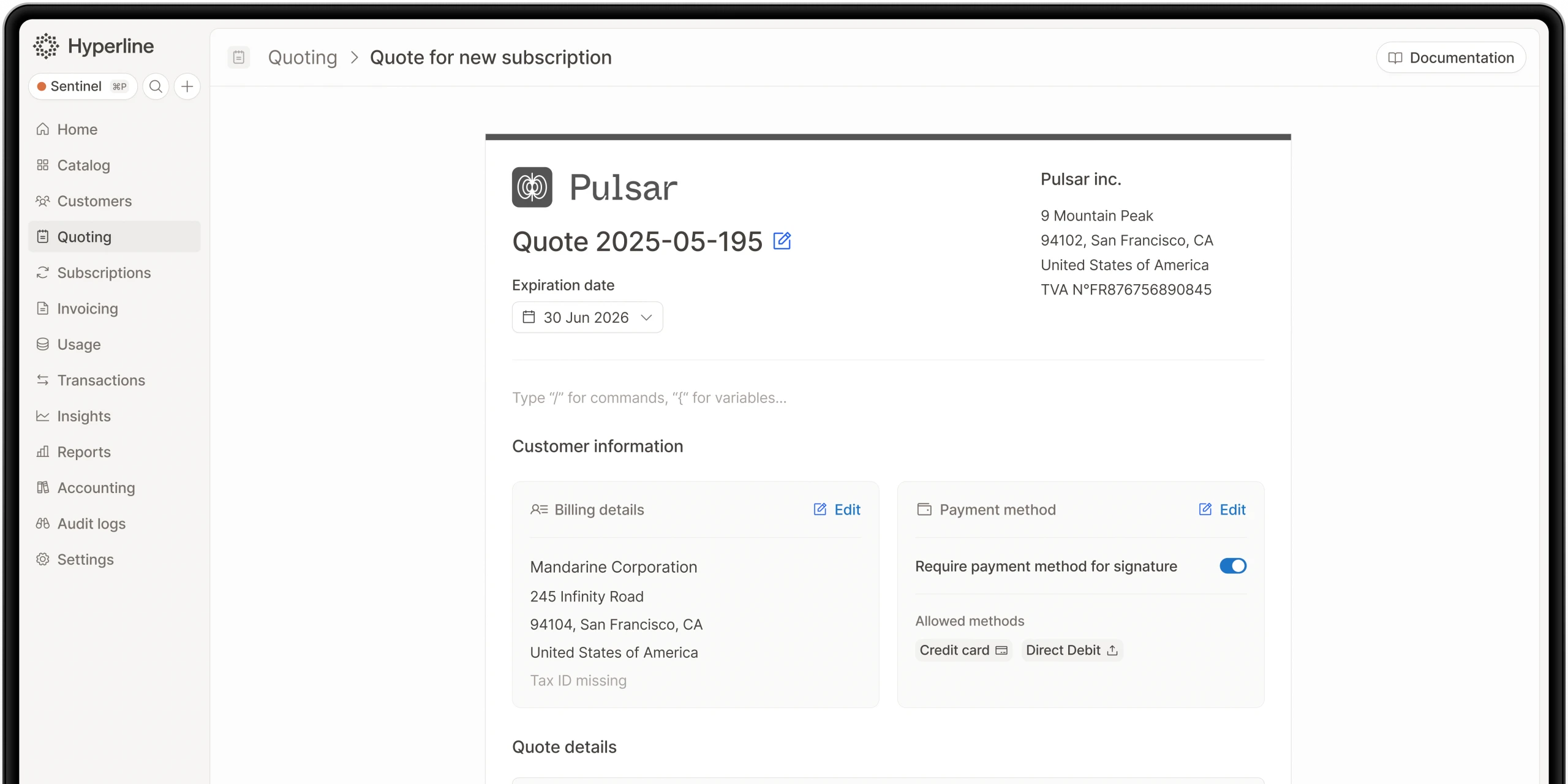
- Streamlined CPQ workflow: Hyperline lets sales teams configure products, set prices and generate branded quotes in seconds, complete with built-in approvals and contract management.
- Flexible pricing models: It supports a wide array of pricing structures including flat fees, tiered pricing, usage-based models, bundled packages and bespoke enterprise deals, making it particularly suitable for SaaS billing complexity.
- Native CRM integration: One-click integrations with CRMs (such as Salesforce, HubSpot and Attio) enable bi-directional sync of customer records, quotes and contracts without manual data entry.
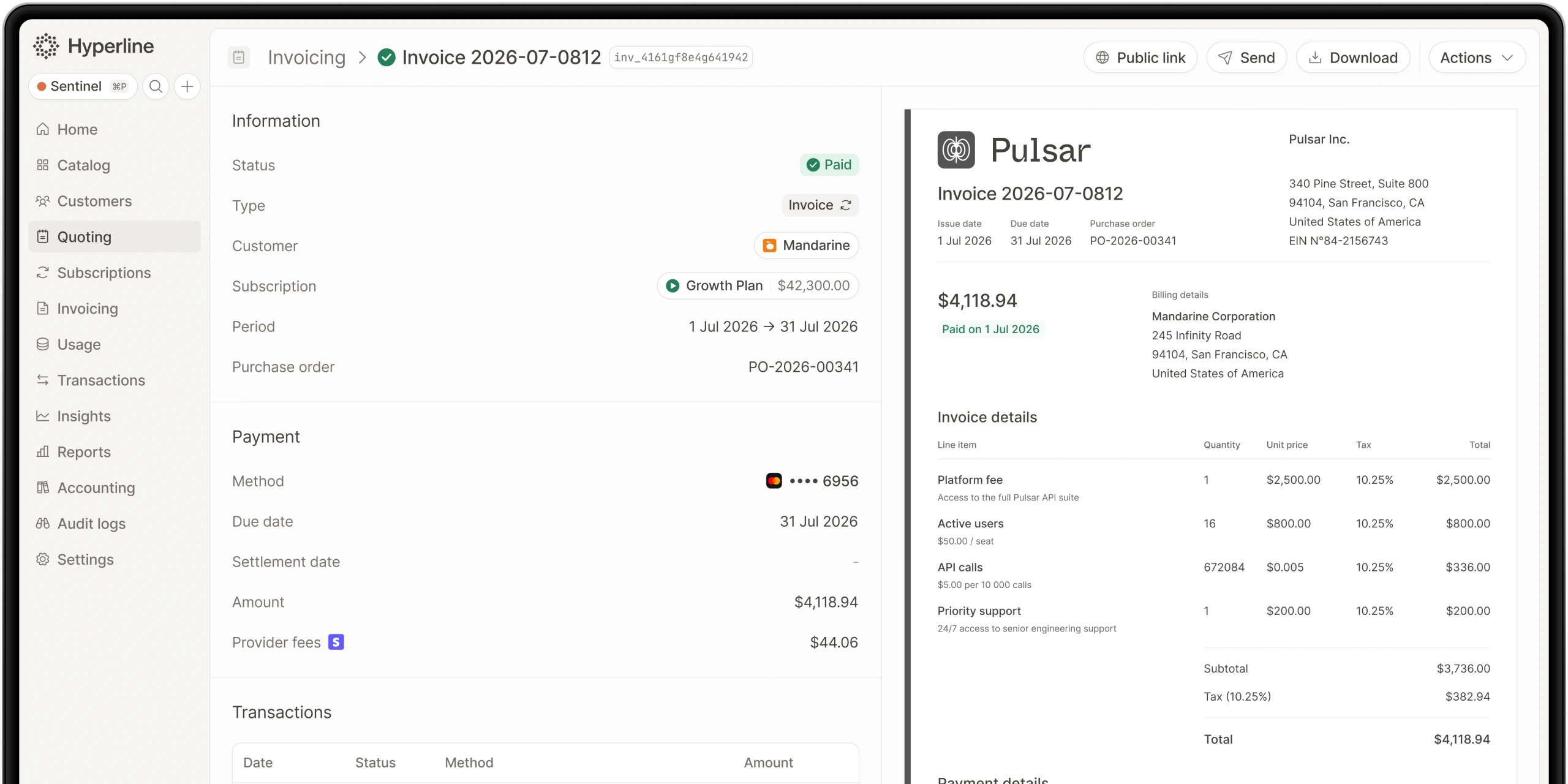
- Automated billing and revenue flows: When paired with Hyperline’s billing system or payment partners like Stripe Billing, quoted deals can seamlessly transition into invoices and revenue recognition workflows, eliminating fragmented processes and manual handoffs.
Business impact: SaaS companies using Hyperline report faster quote turnaround times, cleaner dataflows between sales and finance, and decreased sales-to-cash lag, supporting revenue teams to focus on growth rather than administrative overhead.
2. Salesforce CPQ: Enterprise-grade quoting at scale
Best for: Larger SaaS enterprises, especially those already invested in Salesforce CRM.
Salesforce CPQ is one of the most recognized CPQ solutions worldwide, with deep automation, product and pricing rules, and seamless integration within the Salesforce ecosystem. Its guided selling tools help ensure that sales teams propose compliant, profitable solutions every time.
Strengths: Native CRM integration, powerful pricing rules, automated renewals and robust configurator logic.
Considerations: Licensing and implementation costs can be high, and adoption may require specialist resources.
3. DealHub: AI-driven CPQ with buyer collaboration
Best for: SaaS businesses looking to enhance revenue ops with interactive selling and collaboration features.
DealHub combines CPQ with a digital DealRoom, a shared workspace where buyers and sellers can negotiate pricing and terms in real time. Its subscription and usage billing features also support modern SaaS monetization models.
Strengths: Rich buyer-facing tools and flexible configuration logic.
Considerations: May be more expansive than necessary for smaller teams.
4. Zuora CPQ: Subscription-centric quoting and billing
Best for: SaaS companies with heavy subscription, billing and revenue recognition requirements.
Zuora’s platform is built around subscription lifecycle management with CPQ, billing, collections and recognition integrated into a single suite. For SaaS businesses prioritizing subscription metrics and finance automation, it’s a compelling solution.
Strengths: Strong subscription model support and deep financial controls.
Considerations: Enterprise focus may be overkill for early-stage firms.
Conclusion
Configurable, accurate and fast quoting is central to SaaS growth. A strong CPQ platform not only empowers sales teams to execute complex deals but also aligns pricing, billing and revenue functions across the business. While established leaders like Salesforce CPQ and Zuora deliver scalability and depth, modern platforms like Hyperline are reshaping how SaaS companies automate revenue workflows, combining configurability, integration and automation in a single, flexible solution tailored to subscription-driven business models.
Choosing the right CPQ tool ultimately depends on your company’s size, pricing complexity and technology stack, but in 2026, SaaS leaders increasingly prioritize solutions that reduce friction between quoting and cash realization, enabling faster growth and stronger operational alignment.
Where this fits in Hyperline
Frequently asked questions
As SaaS companies grow, billing needs become more complex. HubSpot CPQ has limits: no quote-to-invoice automation, little pricing flexibility, basic reporting, manual revenue recognition, and no advanced subscription support.
It depends on pricing complexity. Simple, flat subscription pricing can run acceptably on separate best-of-breed tools connected by integrations. Once pricing includes usage-based or hybrid components, or deal sizes require approval workflows and e-signature, the reconciliation cost of stitched-together tools tends to outweigh the flexibility of picking each piece independently.
LedgerUp is focused on the post-signature handoff: getting from a signed contract to a first invoice quickly. It does not include native CPQ, and its global e-invoicing and revenue recognition depth are limited compared to a full quote-to-cash platform, so teams that scale into hybrid pricing or larger, multi-country contracts typically re-evaluate.
Hyperline is the strongest fit for B2B SaaS companies with usage-based, tiered, or hybrid pricing that need CPQ, billing, and revenue recognition unified in one platform instead of three separate systems. For simple, seat-based pricing already running on Salesforce, or if the only need is post-signature contract handoff automation like LedgerUp provides, a different platform is a better starting point.
Salesforce Revenue Cloud's strength is CPQ configurability inside the Salesforce ecosystem. Usage-based and consumption billing is a comparatively newer layer than its quoting core, and the platform generally requires meaningful Salesforce admin and implementation investment to configure well for hybrid pricing.
No. DealHub is a sales-side CPQ and contract lifecycle management tool, strong at quote building, redlining, and e-signature. Billing, usage metering, and revenue recognition are not native, so teams pair it with a separate billing platform and manage the handoff between the two.
Billing software converts an existing subscription or contract into invoices. Quote-to-cash software covers the full process before and after that: configuring a quote, getting it approved and signed, billing it correctly (including usage-based components), collecting payment, and recognizing revenue. A billing tool can be one part of a quote-to-cash stack; on its own, it isn't the whole thing.
No. Conga CPQ is built for configuration depth on multi-line, rule-heavy quotes, historically tied closely to Salesforce. Billing and usage metering live outside the product, so it typically functions as the quoting layer in front of a separate billing system rather than a complete quote-to-cash platform on its own.