Top 5 HubSpot billing integrations: advantages, disadvantages and comparison
Integrating a billing solution with HubSpot allows you to optimize your quote-to-cash process, eliminate errors and centralize all your billing data. While HubSpot offers a free billing feature, it remains limited, which is why many companies choose a more comprehensive native integration. Here are the top 5 best HubSpot billing integrations in 2025.
1. Hyperline
Billing and revenue management
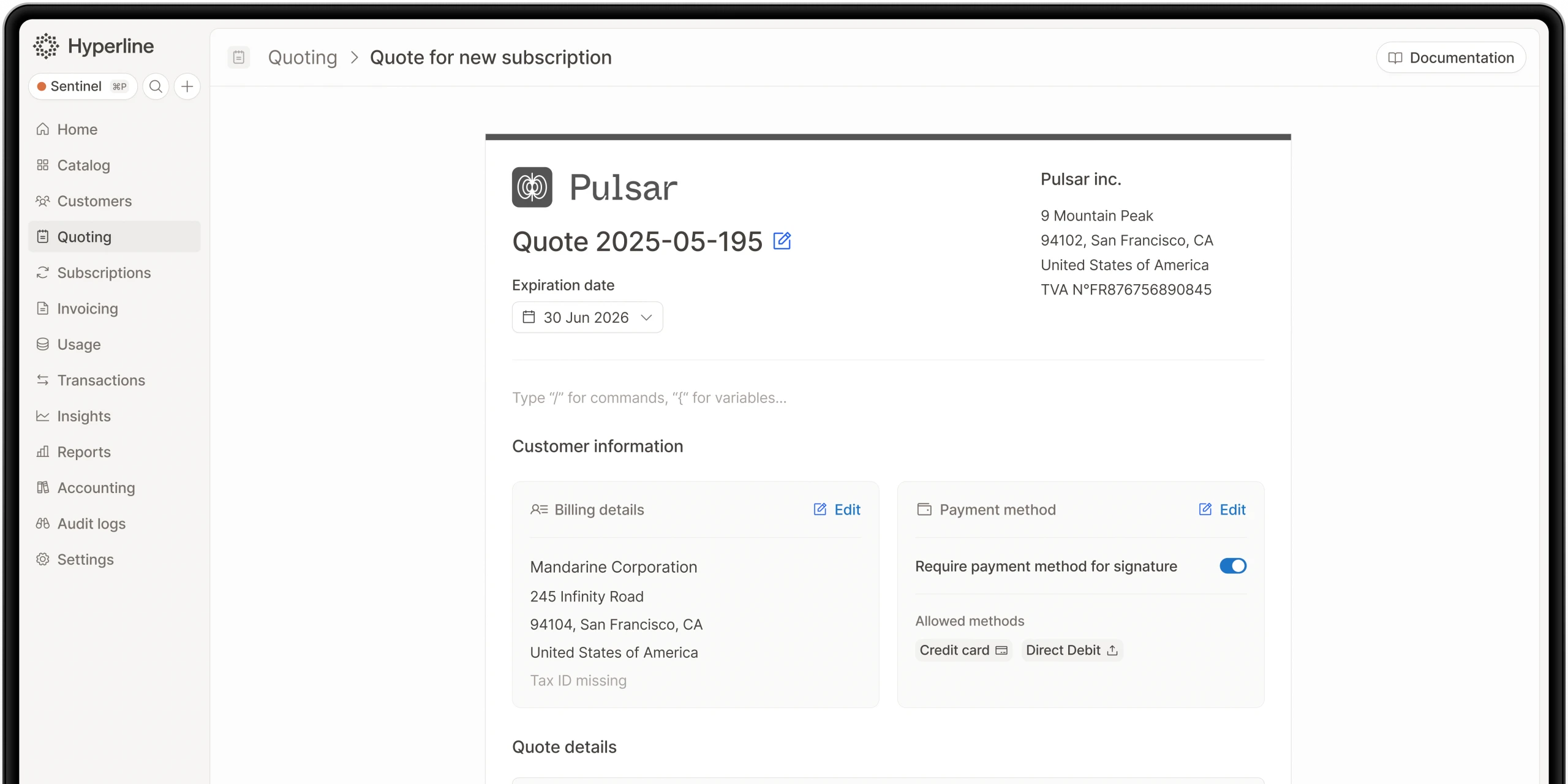
Hyperline stands out for its exceptional native integration with HubSpot. Its unique feature: a native component that can be embedded directly into the HubSpot interface, allowing you to manage your entire billing without ever leaving your CRM.
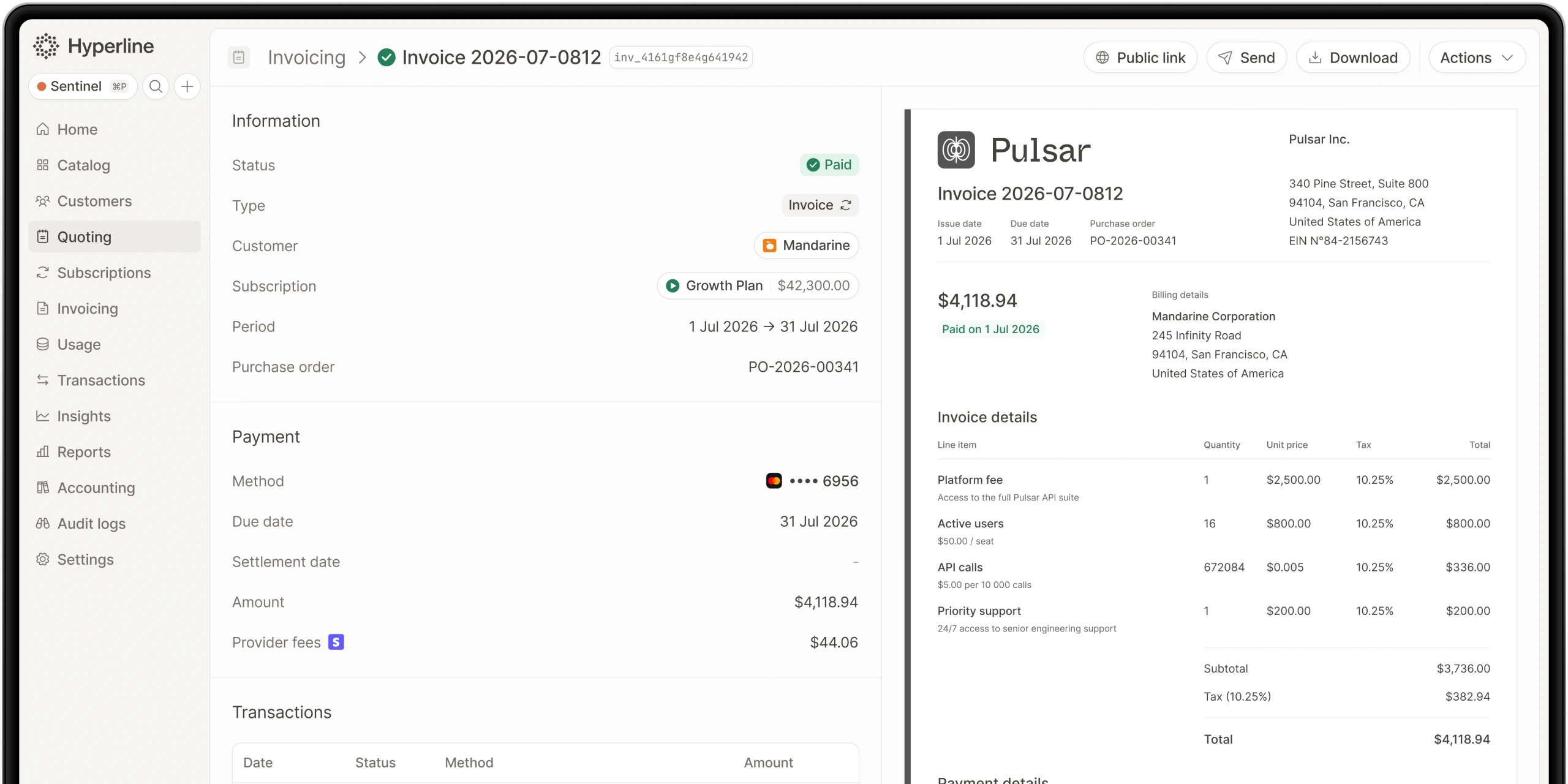
The component inserts directly into your HubSpot Company pages to create and manage quotes, assign subscriptions, and view invoices with Hyperline's complete interface. The integration is configured in a few clicks without any technical skills required.
What you can do:
- Manage quotes, subscriptions and invoices directly in HubSpot
- Complete automatic bidirectional synchronization
- Create and automatically trigger billing from deals
- All pricing models (usage, subscription, hybrid)
- Automate revenue recognition
Advantages:
- Native component integrated into HubSpot (unique)
- One-click configuration, no technical skills needed
- 90% reduction in billing time
- Exceptional flexibility
- Dedicated support
Disadvantages:
- Recent solution (2022)
Pricing:
Customized. Free trial available.
Reviews:
Very positive feedback on simplicity, team autonomy and flexibility. "Seamless" integration and quality customer support.
2. Invoice Stack
Billing and accounting
Invoice Stack offers excellent integration with Xero and QuickBooks via bidirectional synchronization. Very well rated (4.9/5), it automates the billing process with quality support.
Advantages:
- Bidirectional synchronization
- Excellent support
- Complete automation
Pricing:
From $49/month
3. PSOhub
Billing and project management
PSOhub was designed for HubSpot users with bidirectional synchronization and the ticket-to-cash feature that allows tracking time directly in HubSpot Service Hub and automatically generating invoices.
Advantages:
- Very affordable ($25/user/month)
- Smart billing
- 4.6/5 rating
Disadvantages:
- Training required
4. Paycove
Billing, quotes and accounting software
Paycove stands out for its complete bidirectional synchronizations on all data exchanges, offering total visibility on cash flows. Highly automated with real-time notifications.
Advantages:
- Complete bidirectional synchronization
- Quick setup
- 4 star rating
Disadvantages:
- Expensive ($300/month)
5. Stax Bill
Billing and billing software
Stax Bill is ideal for subscription-based businesses with a flexible tool designed to handle all types of hybrid billing models. Bidirectional synchronization with coupon management and payment collection in HubSpot.
Advantages:
- Specialized in subscriptions
- Bidirectional synchronization
- Well designed
Pricing:
From $199/month
How we established this list
How did we establish this list? It's simple. We ranked the available HubSpot billing tools with native integration based on the following criteria:
- Advantages versus disadvantages
- Good value for money
- User reviews
- Number of installations
Does HubSpot have a billing feature?
HubSpot does indeed offer a free billing feature. However, only merchants who have HubSpot Payments or Stripe can create their invoices manually.
What does a HubSpot billing integration do?
A HubSpot billing integration offers invoice management connected with the HubSpot CRM. This allows users to keep their billing data together on both the sales and service sides, which means more accurate forecasts and improved revenue tracking.
Conclusion: what's best for your business?
For most growing businesses, HubSpot's native billing feature remains limited. A billing integration allows you to avoid errors and optimize your payments.
For B2B SaaS companies seeking flexibility and modernity, Hyperline stands out with its native component embeddable in HubSpot, its complete bidirectional synchronization and its ability to handle all pricing models.
Evaluate your needs, your budget and test the solution before committing to ensure it integrates well with your other tools.
Where this fits in Hyperline
Frequently asked questions
It depends on pricing complexity. Simple, flat subscription pricing can run acceptably on separate best-of-breed tools connected by integrations. Once pricing includes usage-based or hybrid components, or deal sizes require approval workflows and e-signature, the reconciliation cost of stitched-together tools tends to outweigh the flexibility of picking each piece independently.
No. DealHub is a sales-side CPQ and contract lifecycle management tool, strong at quote building, redlining, and e-signature. Billing, usage metering, and revenue recognition are not native, so teams pair it with a separate billing platform and manage the handoff between the two.
Salesforce Revenue Cloud's strength is CPQ configurability inside the Salesforce ecosystem. Usage-based and consumption billing is a comparatively newer layer than its quoting core, and the platform generally requires meaningful Salesforce admin and implementation investment to configure well for hybrid pricing.
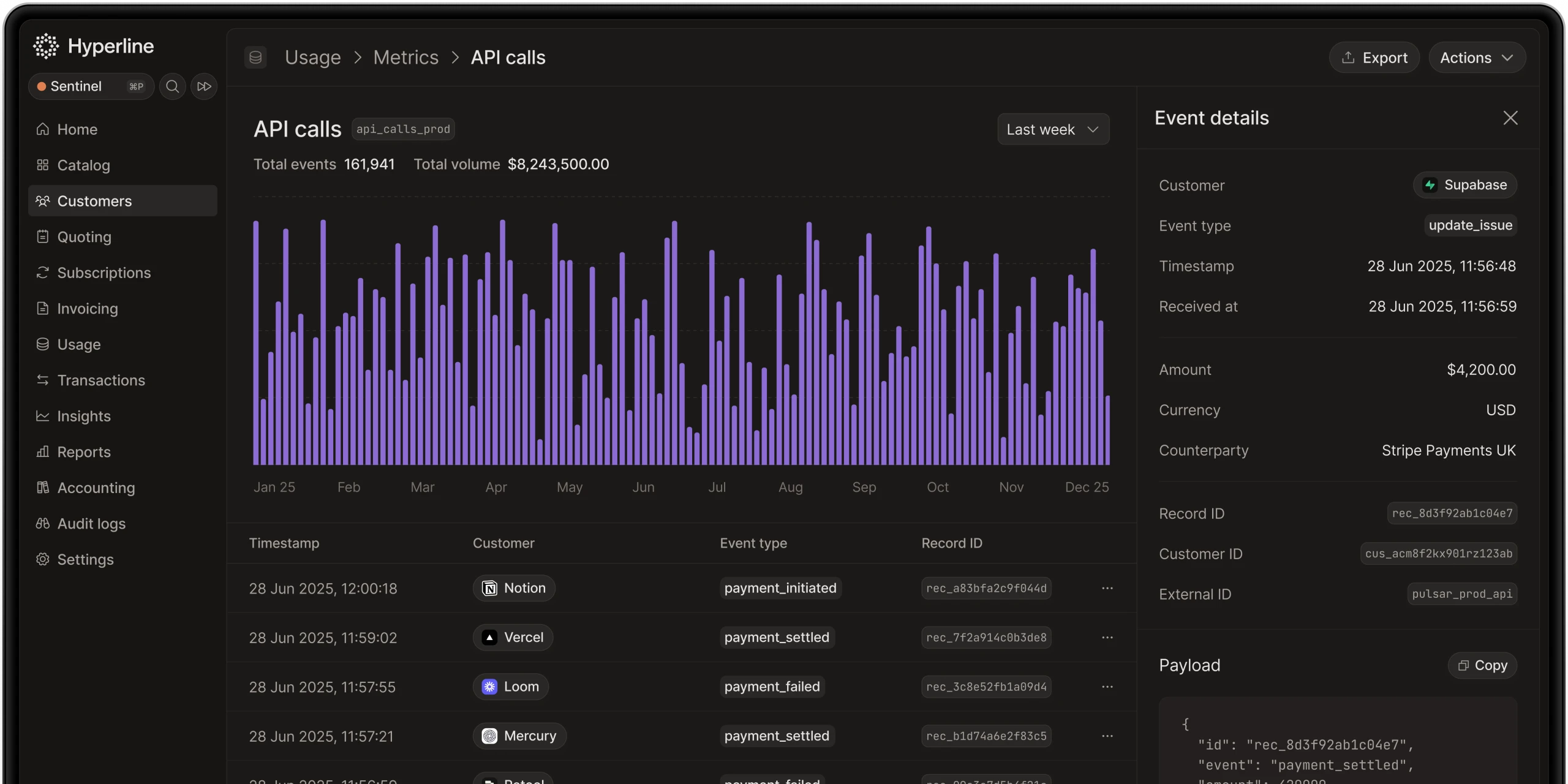
Hyperline is usage-native, which means our platform can ingest raw usage-data (through database connectors, API or CSV files) and run calculations on your behalf to find the right amount to invoice for each customer. You can start without a single line of code in a few minutes.
Billing software converts an existing subscription or contract into invoices. Quote-to-cash software covers the full process before and after that: configuring a quote, getting it approved and signed, billing it correctly (including usage-based components), collecting payment, and recognizing revenue. A billing tool can be one part of a quote-to-cash stack; on its own, it isn't the whole thing.
As SaaS companies grow, billing needs become more complex. HubSpot CPQ has limits: no quote-to-invoice automation, little pricing flexibility, basic reporting, manual revenue recognition, and no advanced subscription support.
Usually not on its own. Oracle CPQ brings enterprise-grade catalog and pricing-rule capabilities for organizations operating at significant scale, but implementation timelines and total cost of ownership are heavy for a mid-market SaaS company evaluating it from scratch, unless the business is already committed to the Oracle CX or ERP ecosystem.
Hyperline is the strongest fit for B2B SaaS companies with usage-based, tiered, or hybrid pricing that need CPQ, billing, and revenue recognition unified in one platform instead of three separate systems. For simple, seat-based pricing already running on Salesforce, or if the only need is post-signature contract handoff automation like LedgerUp provides, a different platform is a better starting point.