Top 5 CPQ software in 2026 : why Hyperline is leading the charge ?
In today’s fast-moving SaaS and subscription economy, sales teams cannot afford slow, error-prone quoting processes.
Configure-Price-Quote (CPQ) software is now crucial for streamlining sales, enforcing pricing rules and accelerating deal velocity, but not all CPQ solutions are created equal. In 2026, a new generation of revenue platforms is redefining what it means to automate quotes, billing and revenue operations. We are leading this transformation is as ****a modern CPQ and revenue management platform designed from the ground up for next-generation SaaS businesses.
Below, we break down why Hyperline stands head and shoulders above traditional CPQ tools and how it delivers value at every step of the quote-to-cash cycle.
1. Hyperline : the new standard in CPQ and revenue automation
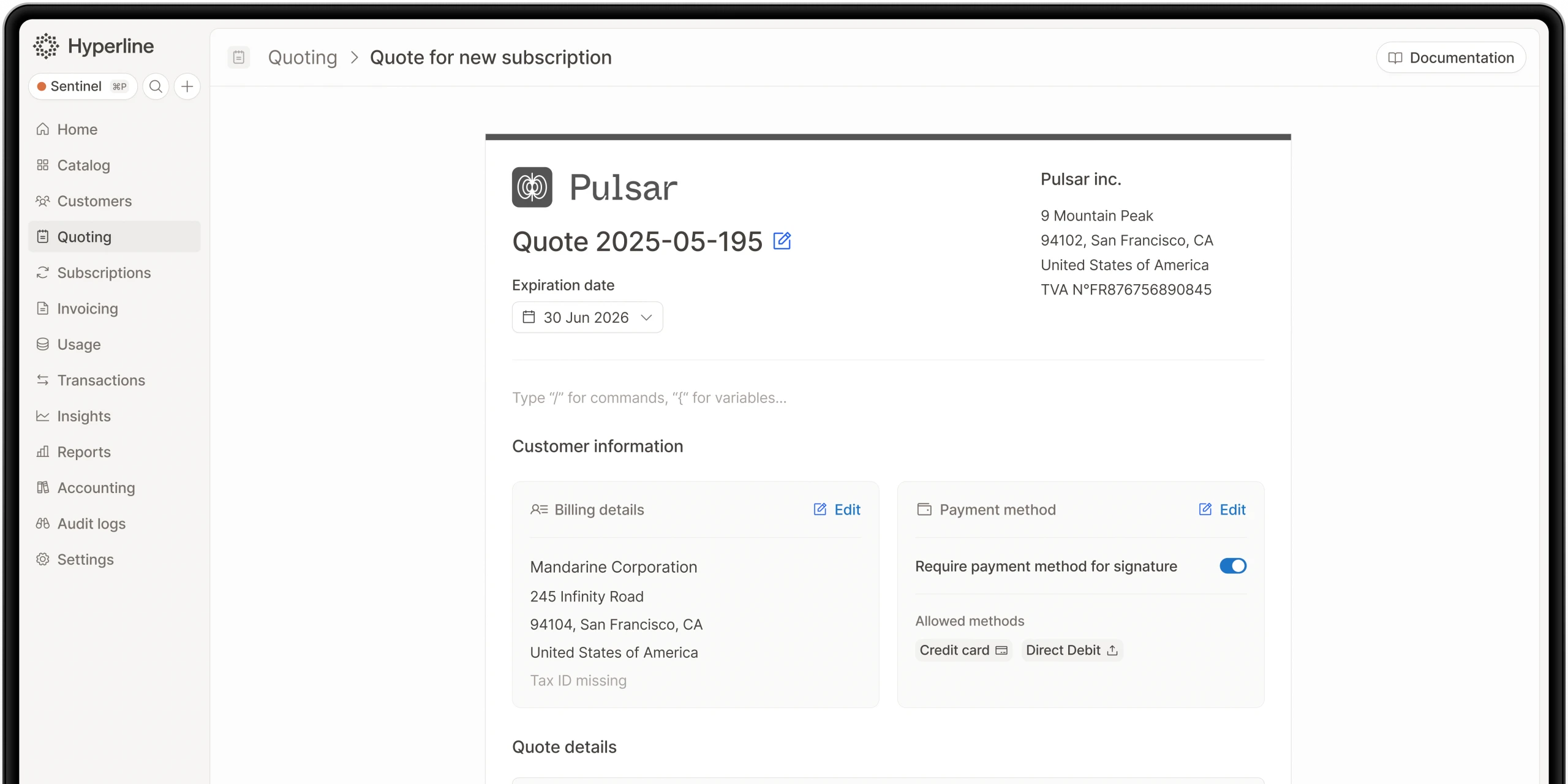
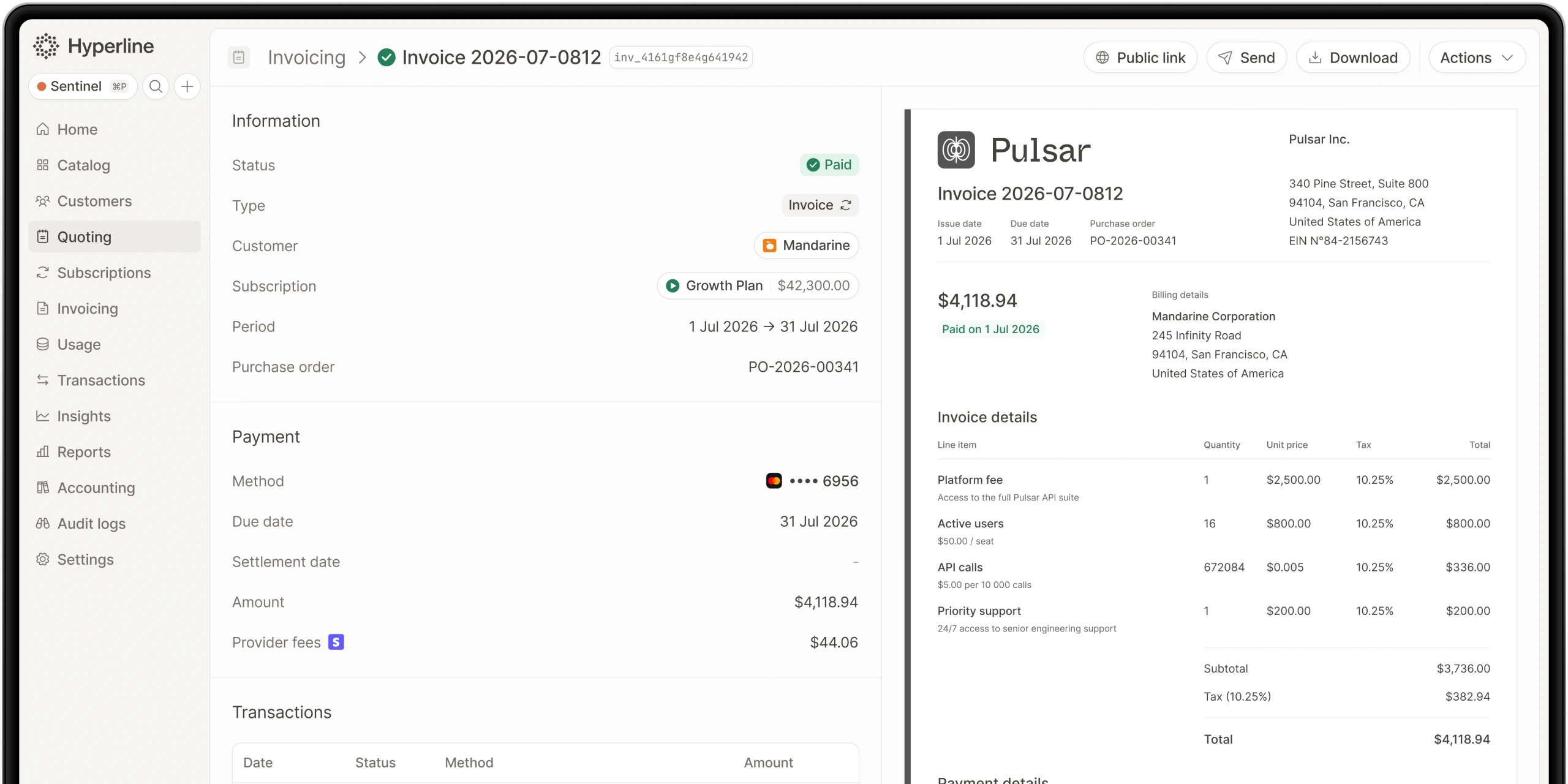
We offer a powerful yet approachable CPQ system that allows sales teams to configure products, apply complex pricing rules and generate accurate quotes in seconds, all without the need for spreadsheets or manual pricing checks. Unlike legacy CPQ tools that focus solely on quoting, Hyperline unifies CPQ, billing, payments and revenue recognition into one coherent revenue engine. This means that once a quote is accepted, the system can automatically activate subscriptions, issue invoices and orchestrate payments without human intervention.
What sets us apart is that it doesn’t treat quoting as a standalone task, it embeds it deeply into the broader revenue process, giving companies full visibility and control over every transaction from negotiation to cash in the bank.
2. Salesforce CPQ: enterprise-grade quoting at scale
Salesforce CPQ is a well-established solution for large organisations with complex quoting needs, particularly those already using Salesforce CRM. It supports advanced product configuration, pricing logic and approval workflows, and can extend into contract and order management when combined with Salesforce Revenue Cloud. However, it is generally best suited to mature Salesforce environments, as implementation and maintenance often require significant configuration and specialist expertise.
3. DealHub.io: CPQ for revenue operations teams
DealHub.io combines CPQ with broader quote-to-revenue workflows, focusing on alignment between sales, finance and operations. It integrates with CRMs such as HubSpot and Salesforce and uses automation to reduce friction in the sales cycle. The platform is a strong fit for organisations prioritizing RevOps efficiency, though it may be less flexible for highly complex or deeply customized pricing models.
4. Conga CPQ: quoting and contract automation
Conga CPQ connects quoting with contract lifecycle management and document automation as part of the Conga Advantage platform. It is often chosen by organisations with strong legal or compliance requirements, where document control is critical. While powerful, the platform typically requires more upfront configuration and can feel heavier than more modern, lightweight CPQ solutions.
5. Oracle CPQ: built for large-scale enterprise complexity
Oracle CPQ, formerly BigMachines, is designed for very large enterprises managing complex global pricing and approval structures. It is commonly used in industries such as manufacturing and services, where sophisticated quoting logic is essential. The platform offers strong scalability but usually involves longer deployment timelines and dedicated administrative resources.
Conclusion
| CPQ Software | Positioning | Best Fit For | Core Focus | Level of Automation | Key Differentiator |
|---|---|---|---|---|---|
| Hyperline | Modern CPQ and revenue automation platform | SaaS and subscription-based businesses | CPQ, billing, payments and revenue in one platform | End-to-end quote-to-cash automation | Unified revenue engine that connects sales and finance |
| Salesforce CPQ | Enterprise-grade CPQ within Salesforce | Large organisations using Salesforce CRM | Complex quoting, pricing and approvals | Quoting and order management (with add-ons) | Deep native integration with Salesforce ecosystem |
| DealHub.io | CPQ for Revenue Operations | Mid-market to enterprise RevOps teams | Quote-to-revenue workflows | Automated quoting and approvals | Strong RevOps alignment and CRM integrations |
| Conga CPQ | CPQ with contract and document automation | Compliance-driven organisations | Quoting, contracts and document workflows | Partial automation focused on documents | Tight link between CPQ and CLM |
| Oracle CPQ | Enterprise CPQ for complex global needs | Very large enterprises | Advanced pricing and approvals at scale | Structured enterprise automation | Designed for large-scale, complex quoting environments |
Where this fits in Hyperline
Frequently asked questions
Usually not on its own. Oracle CPQ brings enterprise-grade catalog and pricing-rule capabilities for organizations operating at significant scale, but implementation timelines and total cost of ownership are heavy for a mid-market SaaS company evaluating it from scratch, unless the business is already committed to the Oracle CX or ERP ecosystem.
LedgerUp is focused on the post-signature handoff: getting from a signed contract to a first invoice quickly. It does not include native CPQ, and its global e-invoicing and revenue recognition depth are limited compared to a full quote-to-cash platform, so teams that scale into hybrid pricing or larger, multi-country contracts typically re-evaluate.
No. Conga CPQ is built for configuration depth on multi-line, rule-heavy quotes, historically tied closely to Salesforce. Billing and usage metering live outside the product, so it typically functions as the quoting layer in front of a separate billing system rather than a complete quote-to-cash platform on its own.
It depends on pricing complexity. Simple, flat subscription pricing can run acceptably on separate best-of-breed tools connected by integrations. Once pricing includes usage-based or hybrid components, or deal sizes require approval workflows and e-signature, the reconciliation cost of stitched-together tools tends to outweigh the flexibility of picking each piece independently.
Salesforce Revenue Cloud's strength is CPQ configurability inside the Salesforce ecosystem. Usage-based and consumption billing is a comparatively newer layer than its quoting core, and the platform generally requires meaningful Salesforce admin and implementation investment to configure well for hybrid pricing.
No. DealHub is a sales-side CPQ and contract lifecycle management tool, strong at quote building, redlining, and e-signature. Billing, usage metering, and revenue recognition are not native, so teams pair it with a separate billing platform and manage the handoff between the two.
As SaaS companies grow, billing needs become more complex. HubSpot CPQ has limits: no quote-to-invoice automation, little pricing flexibility, basic reporting, manual revenue recognition, and no advanced subscription support.
It varies widely by platform and by how much configuration a business needs. Enterprise-grade, highly configurable platforms like Zuora, Oracle CPQ, or Salesforce Revenue Cloud commonly run several months. Platforms built around a narrower, more opinionated setup, including Hyperline's roughly two-month target, tend to move faster because there's less to configure from scratch.