Salesforce CPQ billing: streamlining quote-to-cash with modern alternatives
Salesforce CPQ Billing connects quoting, invoicing, payments, and revenue recognition into a single quote-to-cash workflow, reducing manual errors and improving cash flow visibility. The article also explores modern alternatives like Hyperline, built for SaaS and subscription businesses with complex pricing and usage-based billing needs.
Key takeaways
Salesforce CPQ billing connects quote configuration directly to invoicing and payment collection within one platform, eliminating manual re-entry and ensuring pricing rules, discounts, and contract terms flow seamlessly from quote to cash.
The system handles complex billing scenarios including subscription models with automated renewals, usage-based charges, hybrid contracts, proration for mid-cycle changes, and advanced features like dunning management and revenue recognition compliance.
Native payment integration through solutions like EBizCharge posts payments directly to Salesforce invoices in real-time with PCI-compliant tokenization, customer portals, and multi-currency support that eliminates reconciliation work compared to third-party processors requiring manual sync jobs.
Every business knows the thrill of closing a deal, but the real challenge begins after the contract is signed. That's when the quote turns into revenue, invoices are generated, and payments need to flow into the bank. Too often, this handoff between sales and finance is where things break down, manual re-entry, mismatched data, or delayed cash collection. That's where effective quote-to-cash solutions come in. By combining the power of Configure, Price, Quote (CPQ) with native billing and payments, businesses can simplify their quote-to-cash process and reduce friction for both teams and customers.
This article examines how Salesforce CPQ billing works, why native payments matter, and explores modern alternatives like Hyperline that offer comprehensive quote-to-cash capabilities designed specifically for today's SaaS and subscription businesses.
Understanding Salesforce CPQ billing
To understand CPQ billing, start with CPQ itself. Salesforce CPQ automates how businesses configure products, apply pricing rules, and generate quotes. It's built to reduce errors, speed up approvals, and give sales teams a consistent playbook. But quoting alone isn't enough. That's where CPQ billing extends the workflow, ensuring the same information flows directly into orders, invoices, and payments.
By keeping this all inside the Salesforce billing platform, you remove the silos that often plague revenue operations. No more exporting spreadsheets or re-entering line items into an external system. Instead, every quote detail, from discounts to custom terms, carries through to invoicing and payment collection. That continuity creates fewer disputes, cleaner audits, and faster cash collection.
![with and without salesforce billing]
CPQ workflow optimization
Workflow optimization is one of the biggest benefits of integrated CPQ billing solutions. CPQ handles complex configuration and pricing, while billing turns those quotes into invoices without missing a beat. Because both live on the same platform, data doesn't get lost between handoffs.
Imagine a subscription order created in CPQ. Instead of finance trying to recreate the terms manually, the billing engine automatically generates schedules, invoices, and payment records. Everything is in sync. For leadership, this translates into real-time visibility of revenue. For finance, it means fewer reconciliations. For sales, it creates confidence that the deal they closed will be billed correctly.
The quote-to-cash connection
Quote-to-cash is more than a buzzword, it's the lifeline of your revenue cycle. It covers every step from a signed quote to recognized revenue in the books.
With integrated quote-to-cash solutions, the process is seamless:
Quote → Order → Invoice → Cash
Each stage passes data cleanly to the next.
This continuity matters because every handoff is a risk. Break the chain, and you get billing errors, delayed invoices, and missed revenue. Keep it intact, and you get predictability, fewer disputes, and stronger cash flow. Businesses that invest in quote-to-cash efficiency often see shorter sales cycles, reduced days sales outstanding (DSO), and happier customers who don't have to question their invoices.
Modern quote-to-cash with Hyperline
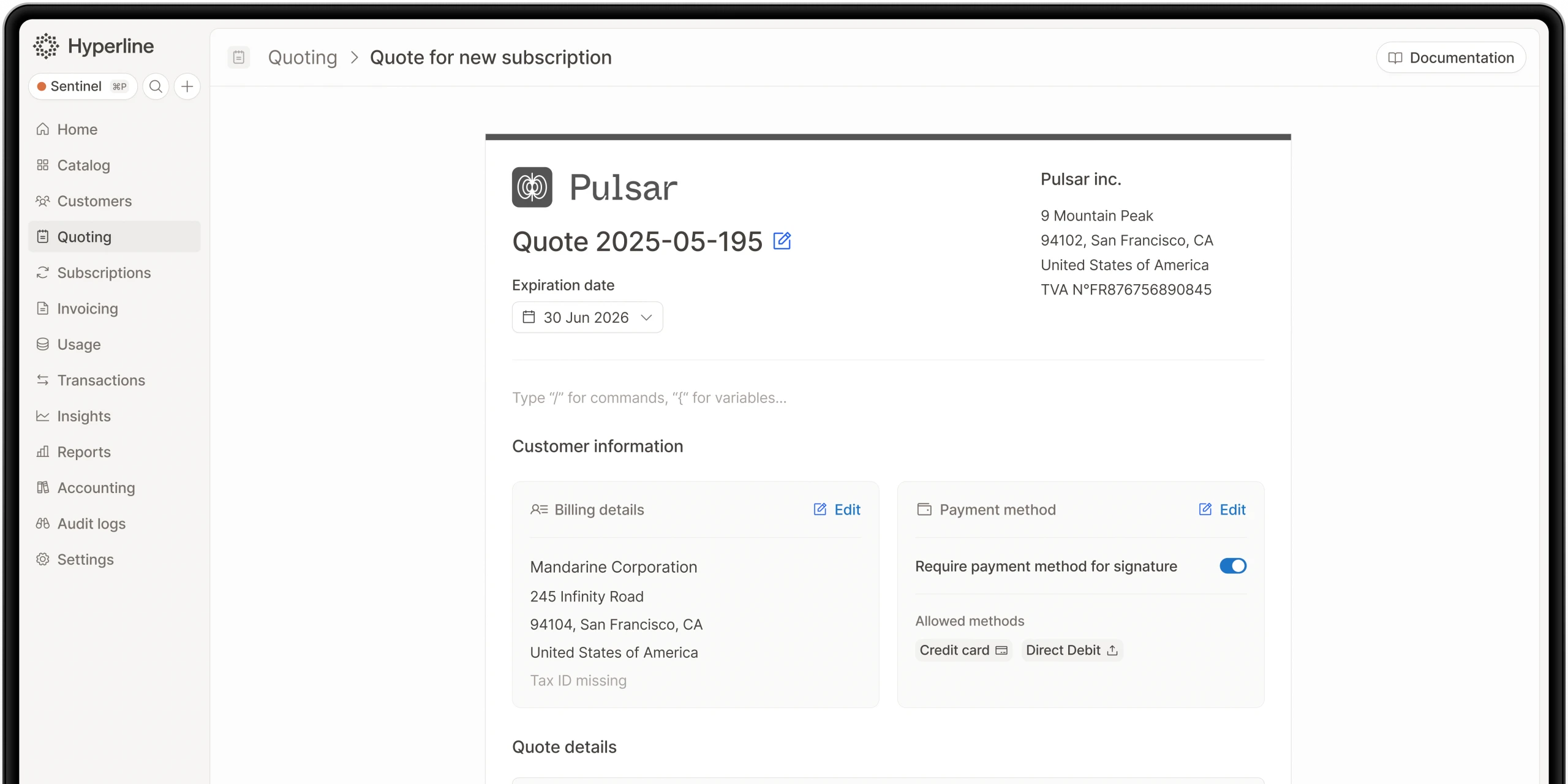
For businesses seeking a comprehensive quote-to-cash solution that goes beyond traditional CPQ, Hyperline offers a purpose-built platform designed for modern SaaS and subscription businesses. Hyperline integrates eight essential steps into a single platform: quotation generation, quotation approval, automated subscription creation with optional usage-based billing, automated invoice dispatch, automated email reminders, payment collection with seamless integration of multiple suppliers, automated revenue recognition, and real-time KPIs.
Unlike CPQ-only tools that focus primarily on quote creation, Hyperline manages the entire revenue lifecycle from quote through cash collection and revenue recognition. The platform is particularly strong in areas where traditional CPQ solutions struggle, especially with complex pricing models and usage-based billing scenarios.
Hyperline supports any pricing model including flat fees, usage-based billing, tiered pricing, and advanced enterprise contracts, with a flexible billing engine that scales as businesses grow. This flexibility allows companies to experiment with different monetization strategies without requiring engineering resources or complex customizations.
Handling complex billing scenarios
Not all billing is straightforward. Subscription models, usage-based charges, and hybrid contracts add layers of complexity. Modern billing platforms are designed to handle these variations without endless customization.
For subscription billing, automated systems can handle recurring charges, proration for mid-cycle changes, and renewals. For usage-based billing, they can process data like API calls, seats, or consumption units, rolling them up into invoices. Hybrid billing, combining one-time fees, recurring subscriptions, and usage charges, also fits neatly into modern platforms. Even complex adjustments, credits, or refunds can be managed without disrupting the larger workflow.
Hyperline's approach to usage-based billing
Hyperline introduced a complete invoicing component handling recurring and one-off usage charges, multiple languages, VAT rules, and more, with detailed exports in various formats and partnerships with accounting software like Pennylane to cater to finance teams and accountants.
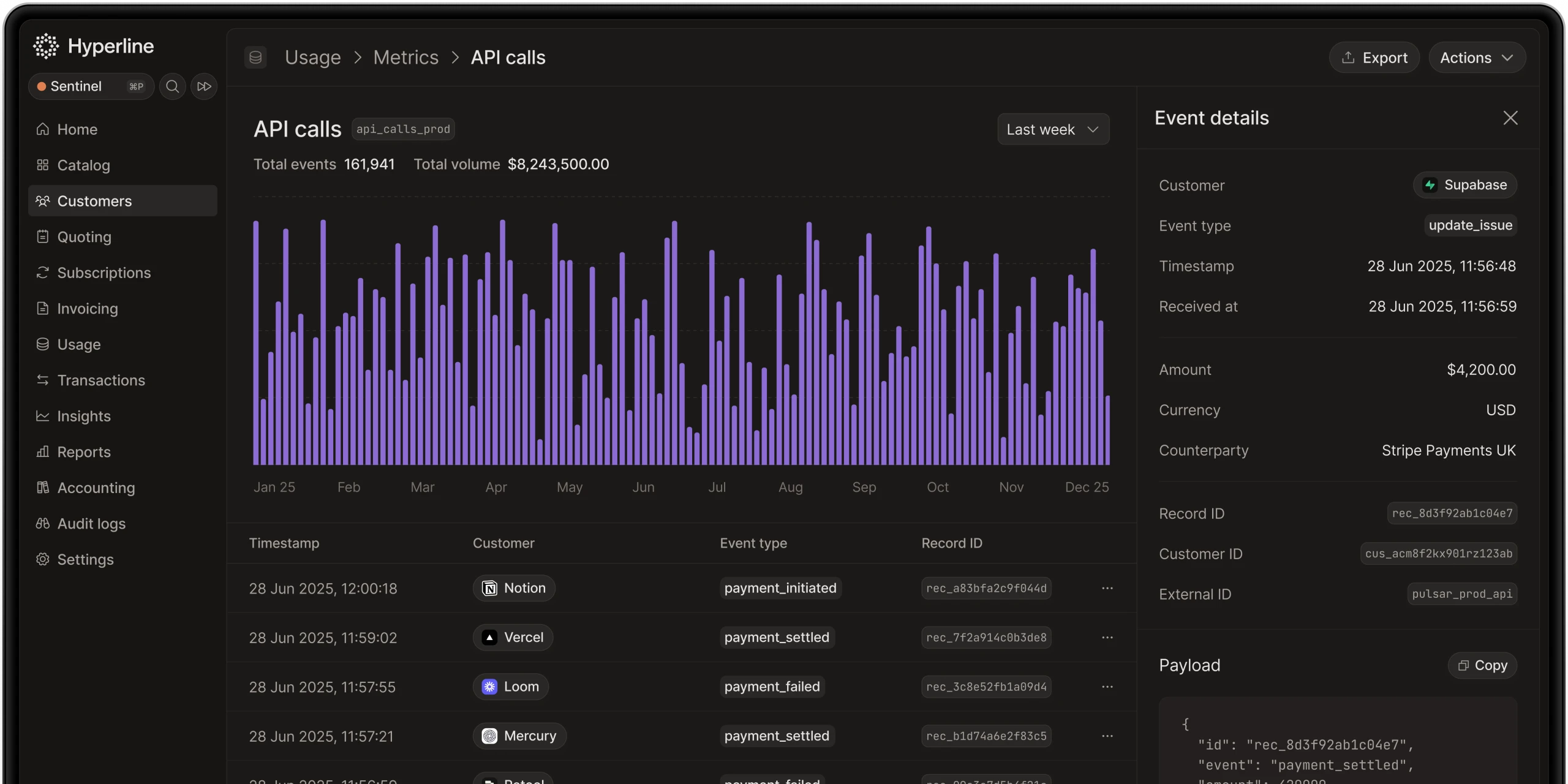
The platform is usage-native, meaning it can ingest raw usage data through database connectors (PostgreSQL, MongoDB, BigQuery, Snowflake), APIs, or CSV files and automatically calculate the correct billing amounts. This capability is increasingly critical as more software companies move toward consumption-based pricing models.
Hyperline offers flexible subscription management that adapts to all use cases including per-user pricing, usage-based pricing, enterprise custom deals, large product catalogs, trial periods, and coupons. This versatility makes it particularly well-suited for B2B SaaS companies with diverse customer segments and pricing needs.
Invoicing and automation
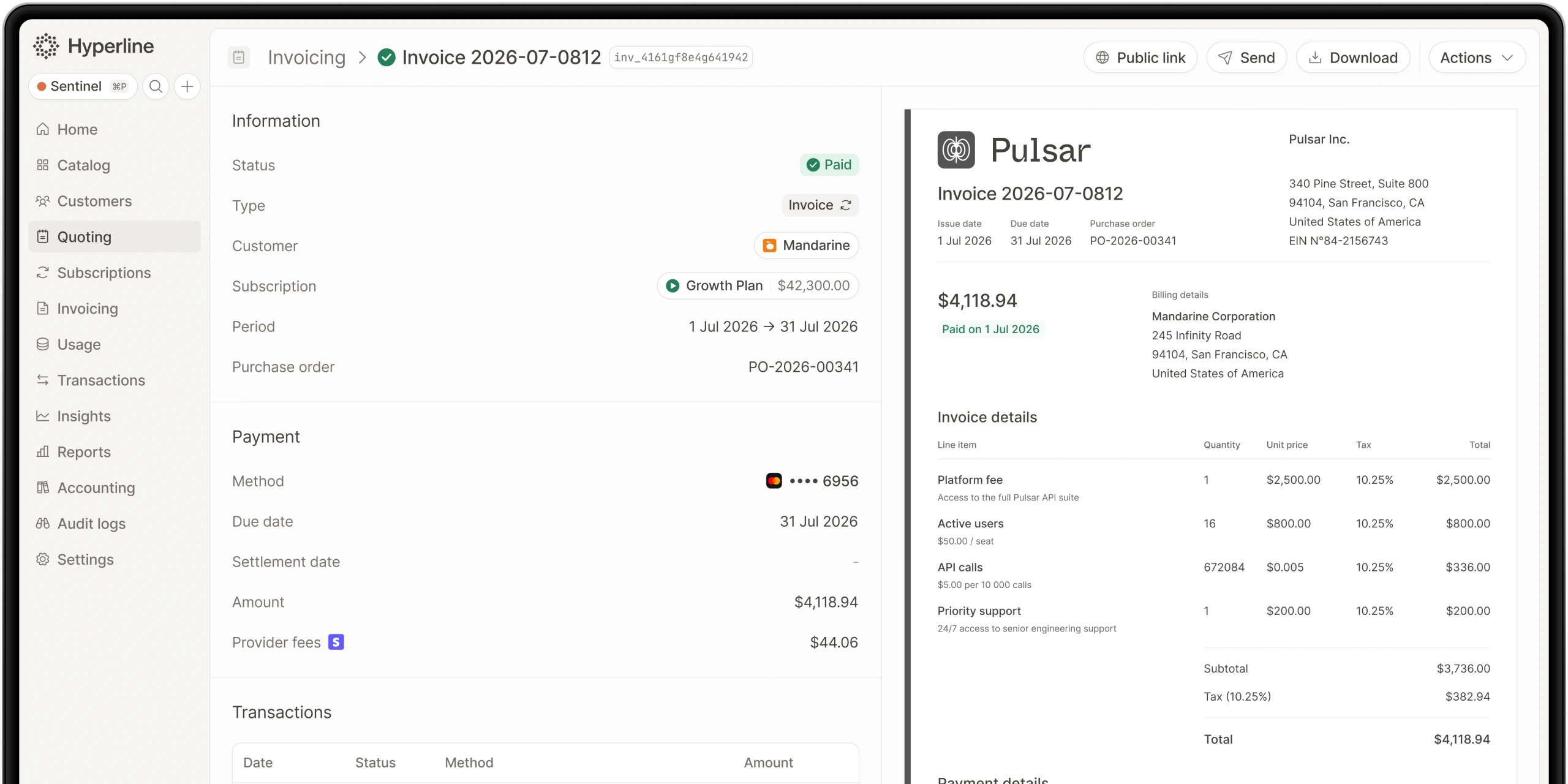
Invoice generation is a natural extension of quote-to-cash platforms. Once a deal closes, invoices are generated directly, pulling data from orders and contracts. Businesses can customize templates with logos, branding, and compliance fields like taxes or regional notes. Multi-currency support ensures that invoices make sense for both local and international customers.
Automation takes things further. Invoice runs can be scheduled, monthly, quarterly, or tied to milestones, so finance teams don't have to babysit the process. Delivery is just as flexible: email, customer portals, or APIs. For customers, invoices are clear and professional. For businesses, consistency reduces disputes and accelerates payments.
Hyperline automatically sends reminder emails to clients for upcoming payments or failed payments, which helps minimize late payments. This proactive approach to cash collection reduces the manual workload for finance teams while improving payment conversion rates.
Advanced features for growing businesses
As companies expand, so do billing demands. Modern billing platforms include advanced tools to keep operations on track. Dunning management helps businesses recover failed payments with retry sequences and reminders. Revenue recognition aligns invoices with compliance standards like ASC 606 or IFRS 15. Multi-currency and compliance features make international expansion manageable. Dashboards and analytics keep leadership informed with metrics like DSO, recovery rates, and chargeback outcomes.
Revenue recognition and compliance
Hyperline fully automates the revenue recognition process as part of an easy-to-use quote-to-cash workflow, ensuring compliance and efficiency in financial operations. The platform handles revenue recognition automatically, ensuring accurate recording of revenues in financial statements according to standards like ASC 606 and IFRS 15.
For finance teams managing subscription businesses, this automation is critical. Manual revenue recognition for complex subscription scenarios with mid-cycle changes, upgrades, downgrades, and usage-based components can consume significant time and introduce errors. By automating this process, Hyperline allows finance teams to focus on strategic initiatives rather than spreadsheet maintenance.
Together, these features transform billing from a back-office necessity into a strategic asset. Instead of just issuing invoices, modern platforms provide insight and control across the entire revenue cycle.
Subscription billing and renewals
Recurring revenue models thrive when renewals are handled seamlessly. With modern quote-to-cash platforms, renewals and upsells can be automated. Quotes flow directly into contracts and schedules, reducing manual intervention. Upsell opportunities can be linked to existing accounts, and renewals automatically trigger new invoices without disrupting service.
This approach makes it easier for sales teams to grow accounts and for finance teams to trust that revenue is being captured accurately. It also improves the customer experience, buyers don't have to worry about lapses in service or confusing billing cycles.
With Hyperline, the transition between quoting and contract management is automated, ensuring quick and accurate processing while reducing the potential for errors. This seamless handoff is particularly valuable for sales teams who need confidence that their closed deals will be executed correctly without requiring follow-up.
Native payments integration and CRM connectivity
None of this works smoothly without payments and CRM integration. Payment integration ensures that once an invoice is created, the customer can pay using their preferred method, credit card, ACH, or digital wallet, and the payment posts automatically.
The advantage of native integration is simplicity. Payments are authorized, captured, and reconciled directly within your billing platform. No batch imports, no duplicate records, and fewer reconciliation headaches. A strong payment processor will also bring PCI-compliant features like tokenization and fraud monitoring to protect sensitive data.
Hyperline's integration ecosystem
Integration with leading payment processors like Stripe, Mollie, and GoCardless ensures seamless cash collection, supporting various payment methods and simplifying reconciliation, with Hyperline being provider-agnostic and offering flexibility and easy switching.
Beyond payment providers, Hyperline connects to CRMs like Salesforce and HubSpot to enhance subscription management efficiency. The platform offers an integrated widget that recreates the Hyperline experience without employees having to leave their familiar CRM, with native integration allowing customization from root object to synchronization direction and pushed data on a granular level.
This bidirectional sync means that sales teams can manage quotes, subscriptions, and billing information directly within Salesforce or HubSpot, while all the complex billing logic, usage calculations, and revenue recognition happens automatically in Hyperline. Customer data, invoice information, and subscription status stay synchronized across both systems in real-time.
The platform also connects seamlessly with accounting software including Xero, QuickBooks, Pennylane, Exact Online, and NetSuite, ensuring that financial data stays accurate without manual reconciliation work.
By contrast, relying solely on third-party payment processors often introduces extra steps. Payments may live in another system, requiring sync jobs to update your primary platform. While workable, it usually creates more manual oversight. For many businesses running revenue operations, native or tightly integrated payment solutions are the smarter path.
Best practices for implementation
Implementing quote-to-cash billing isn't just about technology, it's about process. Success depends on aligning sales and finance teams early. Clean product and pricing data is critical, if your CPQ doesn't reflect reality, billing won't either. Testing is equally important. Don't just test simple invoices, test edge cases like mid-cycle subscription changes or large usage events. Plan for exceptions too. Refunds, chargebacks, and disputes will happen, and your workflows should account for them.
Monitoring doesn't end at go-live. Use dashboards to track key metrics and refine processes over time. This proactive approach keeps operations smooth and ensures the system continues to deliver value as business needs evolve.
Why consider Hyperline for quote-to-cash
For organizations evaluating quote-to-cash solutions, Hyperline offers several compelling advantages:
Comprehensive platform: Unlike standalone CPQ tools, Hyperline is building a billing platform to offer seamless revenue management from quote to cash designed for software businesses and all their pricing models. This eliminates the need to patch together multiple systems for quoting, billing, payments, and revenue recognition.
Usage-native architecture: For businesses implementing or scaling usage-based pricing, Hyperline's ability to automatically ingest and process consumption data through database connectors is a significant advantage over traditional CPQ systems that require custom development.
Fast implementation: Hyperline offers an intuitive API and pre-built components for complex tasks, enabling quick and effortless integration. Companies typically complete integration in days rather than months.
Flexible pricing support: The platform handles everything from simple flat fees to complex hybrid models combining subscriptions, usage, tiered pricing, and one-time charges, all without requiring engineering resources to configure.
Developer and finance friendly: The platform serves both technical teams who need robust APIs and integrations, and finance teams who need intuitive interfaces, automated workflows, and compliance capabilities.
Strong customer feedback: Users particularly praise Hyperline's impact on billing efficiency, with one customer noting that switching to Hyperline gave them control over billing from a finance perspective, while another highlighted having an all-in-one tool to manage both self-service plans and enterprise subscriptions.
Turning quote-to-cash into a reliable growth engine
The path from quote to cash is filled with potential pitfalls, but with the right platform, businesses can build a process that feels seamless end-to-end. From invoicing and subscription billing to advanced compliance features and native payment integration, modern quote-to-cash systems keep sales, finance, and customers aligned.
Whether you choose Salesforce CPQ with native payment solutions like EBizCharge, or opt for a comprehensive quote-to-cash platform like Hyperline designed specifically for modern SaaS businesses, the key is selecting tools that eliminate friction and automate where it counts.
For businesses with complex pricing models, usage-based billing requirements, or subscription-first business models, platforms like Hyperline offer purpose-built solutions that go beyond traditional CPQ capabilities. By keeping data unified, automating revenue recognition, and providing seamless integrations with CRMs, payment providers, and accounting systems, these modern platforms help businesses reduce friction, improve cash flow, and build confidence across every team involved in the revenue cycle.
The right quote-to-cash solution transforms billing from a pain point into a growth enabler, allowing your teams to focus on what matters most: growing the business and serving customers.
Where this fits in Hyperline
Frequently asked questions
LedgerUp is focused on the post-signature handoff: getting from a signed contract to a first invoice quickly. It does not include native CPQ, and its global e-invoicing and revenue recognition depth are limited compared to a full quote-to-cash platform, so teams that scale into hybrid pricing or larger, multi-country contracts typically re-evaluate.
It depends on pricing complexity. Simple, flat subscription pricing can run acceptably on separate best-of-breed tools connected by integrations. Once pricing includes usage-based or hybrid components, or deal sizes require approval workflows and e-signature, the reconciliation cost of stitched-together tools tends to outweigh the flexibility of picking each piece independently.
As SaaS companies grow, billing needs become more complex. HubSpot CPQ has limits: no quote-to-invoice automation, little pricing flexibility, basic reporting, manual revenue recognition, and no advanced subscription support.
For low-frequency usage add-ons, batch processing is often fine. For consumption that drives a meaningful share of revenue, especially high-frequency events like API calls or AI token usage, batch cycles limit visibility into what a customer currently owes and make anomalies harder to catch before they hit an invoice.
Yes. Hyperline connects to Stripe, GoCardless, Mollie, Airwallex, and bank transfers. It automates payment matching and reminders.
Hyperline is the strongest fit for B2B SaaS companies with usage-based, tiered, or hybrid pricing that need CPQ, billing, and revenue recognition unified in one platform instead of three separate systems. For simple, seat-based pricing already running on Salesforce, or if the only need is post-signature contract handoff automation like LedgerUp provides, a different platform is a better starting point.
Salesforce Revenue Cloud's strength is CPQ configurability inside the Salesforce ecosystem. Usage-based and consumption billing is a comparatively newer layer than its quoting core, and the platform generally requires meaningful Salesforce admin and implementation investment to configure well for hybrid pricing.
No. DealHub is a sales-side CPQ and contract lifecycle management tool, strong at quote building, redlining, and e-signature. Billing, usage metering, and revenue recognition are not native, so teams pair it with a separate billing platform and manage the handoff between the two.