5 Reasons Finance Teams Switch from Chargebee to Hyperline
Five concrete reasons finance leaders and RevOps teams at B2B SaaS companies move from Chargebee to Hyperline in 2026.
Introduction
Finance leaders and RevOps managers rarely switch billing platforms on a whim. Billing is the system that collects revenue, and the decision to change it involves real risk, real project time, and a justification that has to hold up under scrutiny. When teams move from Chargebee to Hyperline anyway, there are usually five things driving the decision. This article names them plainly, with the specifics that matter to a finance team evaluating the move.
1. Batch billing creates blind spots in usage revenue
Chargebee handles usage-based billing through batch processing. Usage is collected and reconciled in periodic runs, not counted live as events arrive. The practical consequence for a finance team is that the current bill is always a snapshot from the last batch, not a reflection of what customers are actually consuming right now.
That blind spot has downstream effects. Revenue cannot be forecast with confidence mid-period, because the numbers in the billing system are already out of date. Customer success cannot proactively manage accounts approaching a tier change, because the live consumption figure is not available. Customers cannot check their own usage on demand. Every one of those workflows is deferred to the next batch run.
For finance teams running hybrid pricing or usage-heavy contracts, this is not a minor inconvenience. It means month-end close involves manual reconciliation to verify what was actually consumed versus what the batch captured. That work does not go away as the business scales; it gets heavier with every new customer and pricing variation added.
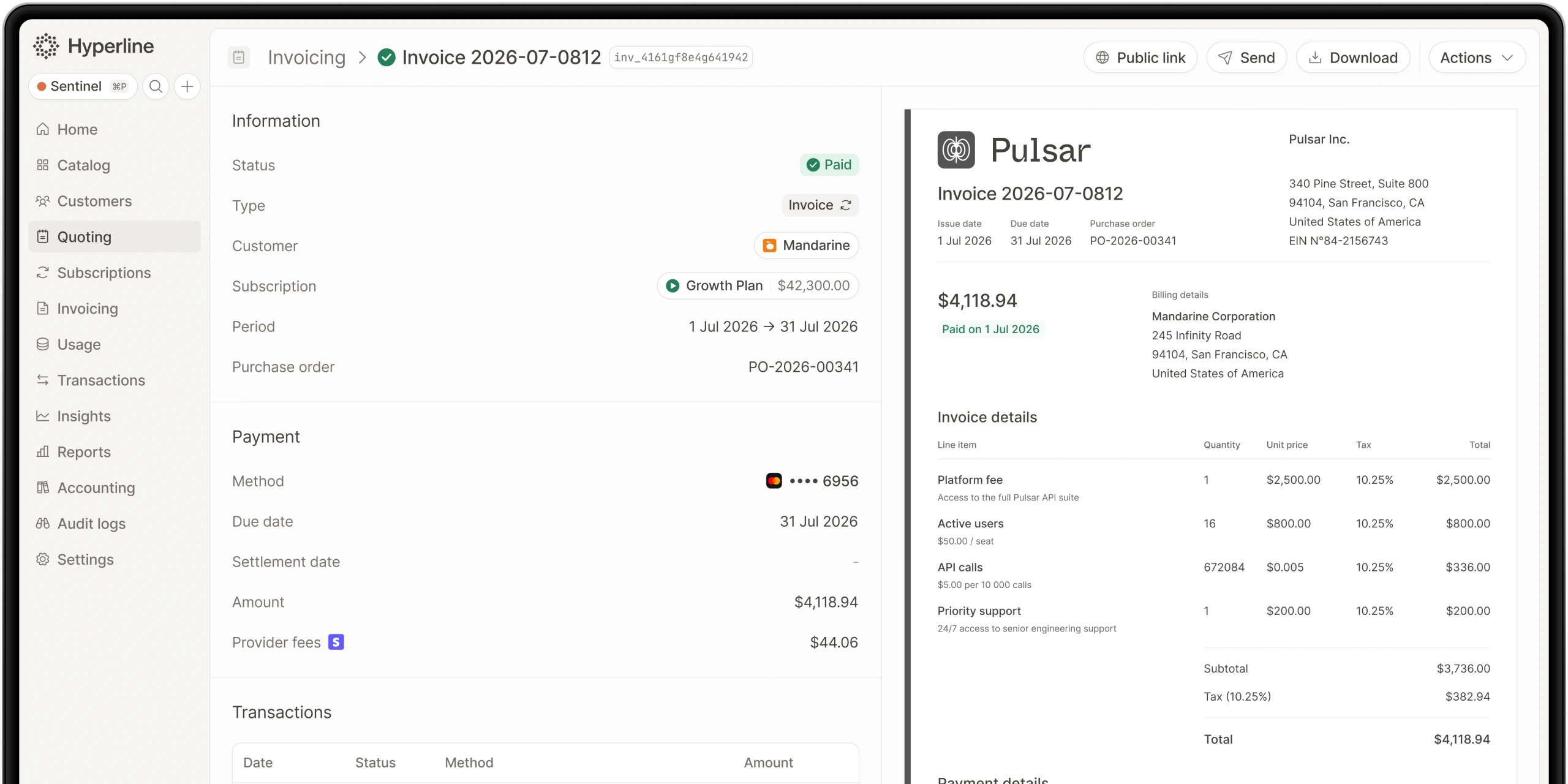
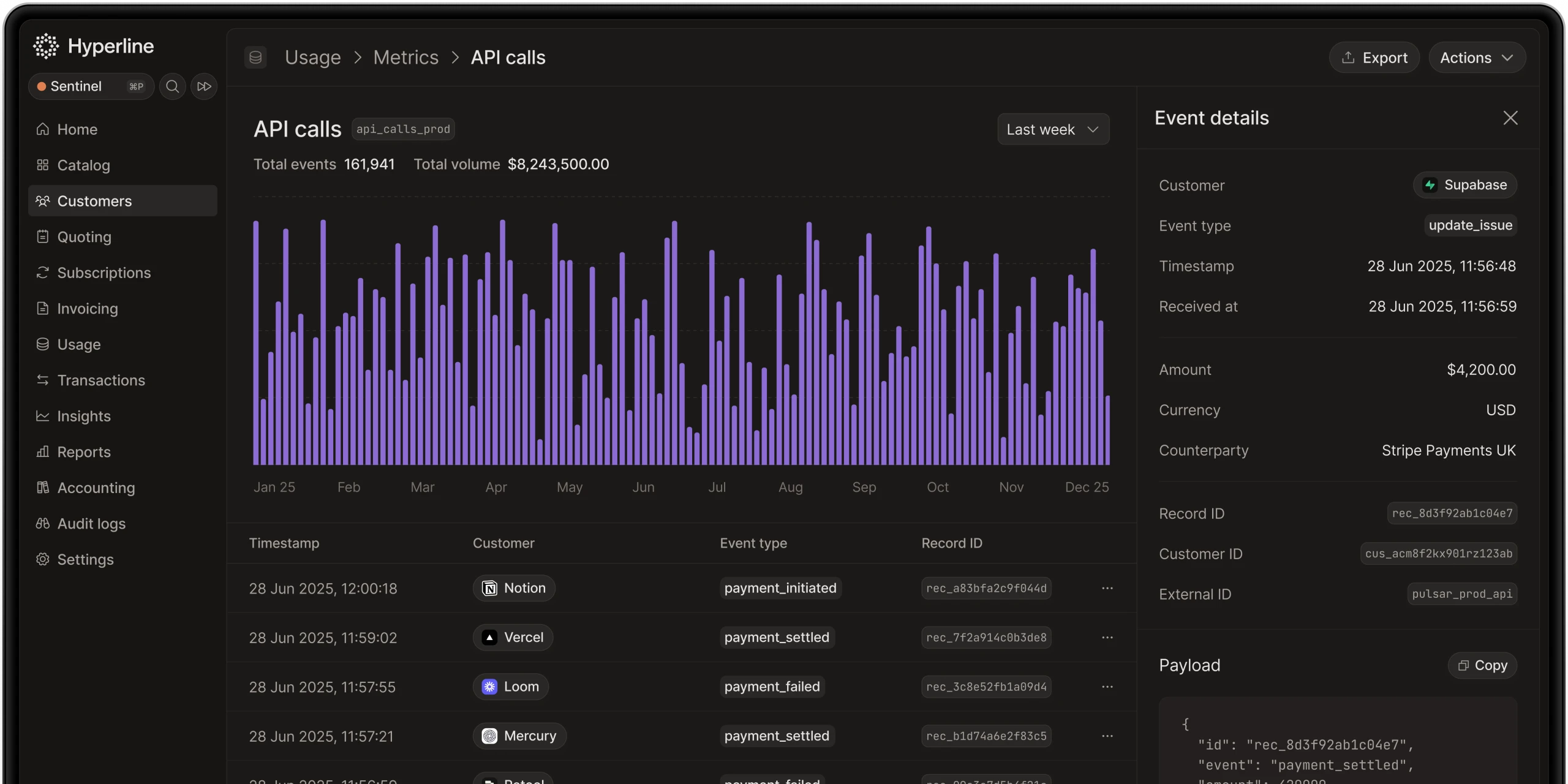
Hyperline was built around real-time metering. Events are ingested and attributed as they occur, so the current bill is always live. Finance teams see revenue accruing in real time, and the reconciliation burden at month-end shrinks significantly.
2. The real cost of Chargebee is higher than the listed price
Chargebee's publicly listed plans start around $599 per month, but that entry point does not include revenue recognition or CPQ. Revenue recognition (RevRec) is a paid add-on, sold separately with its own implementation and licensing cost. CPQ is delivered as a paid package built on Salesforce, which adds both licensing cost and a dependency on the Salesforce stack.
For a finance team that needs RevRec for ASC 606 compliance and CPQ for deal quoting, the effective total cost is substantially higher than the headline plan. When integration overhead and configuration time are added on top, the gap between the listed price and the real cost of a fully operational Chargebee deployment is meaningful.
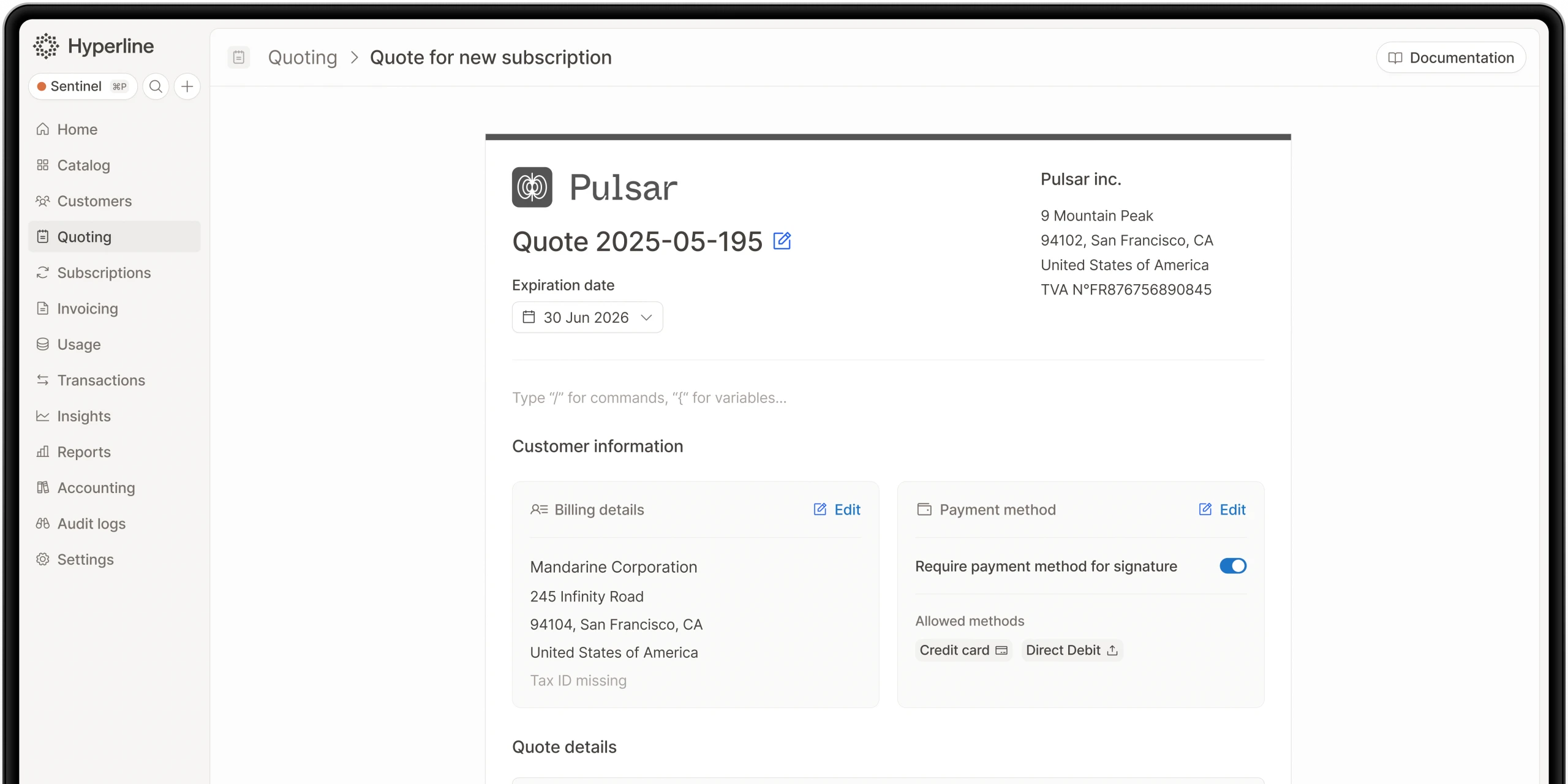
Hyperline's indicative pricing starts from $199 per month plus 0.6% of revenue. Revenue recognition is included. CPQ with e-signature is included. There are no add-on modules to license for the core billing, RevRec, and quoting capabilities. For a finance team that has priced out a full Chargebee deployment with RevRec and CPQ, the cost comparison, run honestly with add-ons and integration overhead on both sides, often shifts the decision.
3. Billing support should not take one to two days
Month-end close, a payment mandate failure, an invoicing error on a large enterprise contract: these are not problems that can wait two business days for an email response. Chargebee's primary support channel is email, with typical response times in the range of one to two days.
That support cadence is fine for routine questions. It is not adequate for a finance team whose billing system is the thing that collects revenue and where a delay means a payment is held, an invoice is wrong, or a customer is confused about a charge.
Hyperline provides support through chat and a dedicated Slack channel. Response times are typically in minutes. For a finance team that manages billing as a revenue-critical operation, the difference in responsiveness shows up every time something needs a fast answer during a time-sensitive period.
4. Four to six months to go-live is too long
A Chargebee implementation typically takes four to six months. That reflects the platform's breadth and the integration work involved in assembling billing, RevRec, and CPQ from separate components. The timeline is not unreasonable for what is being built, but for a finance team evaluating when the new system starts delivering value, it is a long runway.
The opportunity cost of that timeline is real. Every month on a legacy billing system is another month of manual workarounds, another month of limited usage visibility, another month before RevRec and CPQ are running cleanly together. For a company that made the decision to switch because the current system is not working, a six-month implementation delays the resolution.
Hyperline targets go-live in about two months. The unified architecture reduces integration work because CPQ, billing, usage metering, and RevRec operate as one system rather than several. Fewer components to assemble means a shorter path from kickoff to production. For a finance team that has been through a long billing implementation before, a two-month alternative backed by a unified architecture is a different kind of offer.
5. AI agents catch revenue leakage that manual processes miss
Revenue leakage is the category of losses that finance teams often do not know they have: usage that was consumed but not billed, discounts applied incorrectly, invoices that went out with wrong quantities, charges missed on account upgrades. In a billing system without active monitoring, these errors recur every cycle until someone manually identifies them.
Chargebee does not offer AI agents. Identifying leakage requires manual auditing or custom monitoring built outside the billing system.
Hyperline ships AI agents designed for exactly this problem. Revenue leakage detection monitors unified billing, usage, and accounts receivable data to surface under-billed consumption and missed charges. Account scoring identifies at-risk and high-value customers. Upsell detection flags expansion opportunities. Automated cash collection handles outstanding invoice follow-up without manual effort. These agents operate on the same data the billing system uses, so they work from a single, consistent picture of revenue rather than piecing together inputs from separate tools.
For a finance team managing a growing book of business, the shift from manual leakage detection to a system that flags it automatically is a reduction in both risk and operational overhead.
A note on when it makes sense to stay on Chargebee
These five reasons reflect the specific situations where Chargebee's architecture becomes a constraint. They do not apply to every Chargebee customer. If your billing is subscription-centric, your pricing is primarily plan-based or seat-based, your usage needs are simple, and you do not need real-time visibility, Chargebee's decade of maturity in the subscription model is a genuine asset and the case for switching is weaker.
The finance teams that switch are the ones whose pricing has moved or is moving toward consumption, whose RevRec and CPQ needs are growing, and whose billing system is generating more manual work than the team can absorb. If those descriptions match, the five reasons above are what the decision comes down to in practice.
Frequently asked questions
How long does a migration from Chargebee to Hyperline actually take?
Hyperline runs an automated migration that moves subscriptions, invoice history, payment mandates (including GoCardless), and payment methods. The process typically completes in a few days, the team has completed 20 or more migrations, and it is designed to cause no disruption for end customers. No re-authentication, no re-entry of payment details, no gap in collection.
Is the 0.6% revenue share on top of the $199 base a good deal?
It depends on revenue volume and what is included. Hyperline's 0.6% of revenue covers the full platform including RevRec and CPQ. For a company running $1 million in annual recurring revenue, the 0.6% component adds $6,000 annually on top of the base. Compared to a Chargebee deployment at $599 per month plus RevRec and CPQ add-on licensing, the total cost comparison depends on your specific volume and add-on requirements. The right comparison runs the math with your actual numbers.
Do we lose Chargebee's integrations when we switch?
Hyperline covers the core integration stack that billing systems need: native two-way CRM sync inside HubSpot, Salesforce, and Attio, plus standard accounting and ERP connections. The migration process maps and reconnects your existing integrations. Chargebee has a broader integration catalog from its longer history, so if your workflow depends on a specific niche integration, verify it is covered before committing.
What does Hyperline's CPQ actually include?
Hyperline's CPQ includes multi-step approval workflows, e-signature, and discount governance, all built into the platform. Quotes are created in the same system that generates invoices and tracks subscriptions, and they can be sent and signed from within the CRM. There is no separate Salesforce package and no additional licensing cost.
How does the revenue leakage detection work in practice?
Hyperline's AI agents run on the unified billing, usage, and accounts receivable data in the platform. They surface anomalies such as events that were metered but not billed, invoices that appear inconsistent with the underlying usage, or accounts with patterns that suggest missed charges. The output is a flag for the finance team to review, not an automated correction, so the team retains final review before any action is taken.
What is the first thing finance teams notice after switching?
Based on teams that have made the move, the most immediate operational difference is the elimination of the manual reconciliation step at month-end. When billing, usage, RevRec, and CPQ operate as one system with real-time data, the close process stops depending on assembling numbers from separate tools and separate batch runs.
Conclusion
The five reasons finance teams switch from Chargebee to Hyperline map to five specific constraints in a subscription-first platform used by a company with usage-based pricing, RevRec requirements, and a need to move fast. Batch billing creates visibility gaps. Add-on pricing inflates the real cost. Email support is too slow for billing emergencies. A six-month implementation delays the return on the project. And without AI agents, revenue leakage requires manual detection.
None of these are issues that surface in a product demo. They are the operational realities that finance teams discover after a Chargebee implementation is live and the billing model is growing more complex. The switch to Hyperline is typically driven by one or two of these reasons becoming acute, not by a theoretical preference for one vendor over another. If any of the five applies to your current setup, that is the place to start the evaluation.
Where this fits in Hyperline
Frequently asked questions
For low-frequency usage add-ons, batch processing is often fine. For consumption that drives a meaningful share of revenue, especially high-frequency events like API calls or AI token usage, batch cycles limit visibility into what a customer currently owes and make anomalies harder to catch before they hit an invoice.
It varies widely by platform and by how much configuration a business needs. Enterprise-grade, highly configurable platforms like Zuora, Oracle CPQ, or Salesforce Revenue Cloud commonly run several months. Platforms built around a narrower, more opinionated setup, including Hyperline's roughly two-month target, tend to move faster because there's less to configure from scratch.
It depends on pricing complexity. Simple, flat subscription pricing can run acceptably on separate best-of-breed tools connected by integrations. Once pricing includes usage-based or hybrid components, or deal sizes require approval workflows and e-signature, the reconciliation cost of stitched-together tools tends to outweigh the flexibility of picking each piece independently.
Usually not on its own. Oracle CPQ brings enterprise-grade catalog and pricing-rule capabilities for organizations operating at significant scale, but implementation timelines and total cost of ownership are heavy for a mid-market SaaS company evaluating it from scratch, unless the business is already committed to the Oracle CX or ERP ecosystem.
Salesforce Revenue Cloud's strength is CPQ configurability inside the Salesforce ecosystem. Usage-based and consumption billing is a comparatively newer layer than its quoting core, and the platform generally requires meaningful Salesforce admin and implementation investment to configure well for hybrid pricing.
Each platform is scored against five consistent criteria: best fit (the buyer situation it actually suits), strongest part of quote-to-cash (where it genuinely leads), evidence reviewed (public pricing pages, product documentation, and G2 category listings), and watch-out (the limitation buyers run into first). Vendor claims that aren't verifiable against a public source are described qualitatively rather than repeated as fact.
No. Chargebee processes usage through batch imports applied on the next invoice cycle rather than true real-time metering, a limitation reviewers note directly on G2. Platforms built around usage-based and hybrid pricing from the start, like Hyperline, meter events as they happen instead.
LedgerUp is focused on the post-signature handoff: getting from a signed contract to a first invoice quickly. It does not include native CPQ, and its global e-invoicing and revenue recognition depth are limited compared to a full quote-to-cash platform, so teams that scale into hybrid pricing or larger, multi-country contracts typically re-evaluate.