Managing SaaS subscription data and ARR reporting: choosing the right approach for your business
SaaS companies take different paths when it comes to integrating subscription management data, including MRR/ARR tracking and reporting, into their CRM. The choice depends heavily on your GTM model (PLG, sales-led, hybrid), growth stage, product complexity, and existing business systems.
For sales-led businesses with healthy ACV and relatively low order volume, building a subscription management system directly within Salesforce using tools like Rollup Helper can be an option. However, as your business scales and billing complexity increases, this homegrown approach often reveals its limitations, particularly around automation, integration capabilities, and the engineering resources required to maintain it.
This is where modern billing platforms like Hyperline offer a compelling alternative, especially for companies looking to automate their entire quote-to-cash process without the overhead of custom development.
The homegrown Salesforce approach: what it looks like
Structure of a custom Salesforce solution
In a custom Salesforce solution, the Opportunity Product typically becomes the source of truth. Here's how companies structure it:
The setup includes several key fields on each Opportunity Product. Fee Type indicates whether revenue is one-time or recurring, based on the Product but with override capability. Revenue Reason tracks whether the revenue represents New Business, an upsell, downsell, or renewal (with separate line items for scenarios like simultaneous downsells and renewals). Start and End Dates define when the ARR for this product instance is valid, with the end date set one day before any changes take effect to prevent double-counting. A Current ARR formula field evaluates Fee Type, product dates, and determines whether to count the Sales Price as ARR at this moment. Finally, OLI Total ARR captures the total ARR on the line item regardless of whether it's currently active.
Rollup logic and data flow
The Opportunity then rolls up key ARR and OLI data useful for sales deal reporting. These Opportunities feed into a custom Subscription object, which aggregates currently active ARR and product data from one or multiple Opportunities, maintaining a complete history of all ARR changes. Finally, the Subscription object rolls up to the Account level, displaying Current ARR (potentially from multiple subscriptions) and other product limits and entitlement data from OLIs, such as the number of active units.
When designing these rollups, it's helpful to use both real-time and scheduled nightly rollups at all levels. For nightly rollups, following the chain of rollups reduces data delays, for example, having the OLI to Opportunity rollup run an hour before the Opportunity to Subscription rollup, which runs an hour before the Subscription to Account rollup.
What this custom approach delivers
A homegrown subscription management system can provide several valuable capabilities. It enables a Finance Dashboard within Salesforce showing metrics like Current ARR against goal, future-dated committed ARR, Currently Active ARR by Product, ARR change by month by Revenue Reason (New/Upsell/Cross-sell/Downsell/Churn), NRR reporting across the install-base, and trailing 1 year ARR growth percentage.
You get Current MRR and ARR data by Salesforce Account, historical MRR and ARR change reporting by Account, and support for multiple subscriptions per Account with Account-level ARR rollup. The system updates in real-time but also corrects itself nightly via scheduled jobs. Since it's ultimately driven by Sales and Renewal Opportunity Products, your sales and renewal data become the source of truth for MRR/ARR within Salesforce. When implemented correctly, this produces high-quality data trusted for sales commission reporting.
The limitations of building your own
However, this approach has significant gaps. Companies typically don't build the guided sales workflow that CPQ systems aspire to, instead relying on documented processes in tools like Notion or Guru, with manual approvals worksheets and order templates that sellers clone and complete for each deal. Integration with accounting systems to audit and align data or bring invoice and payment data into Salesforce often remains unbuilt. Sales tax integration with quoting is another common omission, though prospects may accept disclaimers that they might be invoiced sales tax not shown on the quote.
More fundamentally, as businesses scale beyond a few hundred customers or introduce pricing complexity like usage-based billing, this manual approach becomes unsustainable. It requires significant Sales Ops headcount (often 0.5 to 2 FTEs dedicated to maintaining the system), slows down experimentation with pricing and packaging, and forces sellers through complex workflows that can hinder deal velocity.
The modern alternative: automated billing platforms
Hyperline offers an automated billing platform specifically designed for B2B SaaS businesses, supporting any pricing model, from flat fees and usage-based billing to tiers and complex enterprise contracts. The platform bi-directionally syncs customers, invoices, and subscriptions data with Salesforce, allowing teams to fully manage subscriptions directly from their CRM through an integrated widget.
Automated quote-to-cash workflow
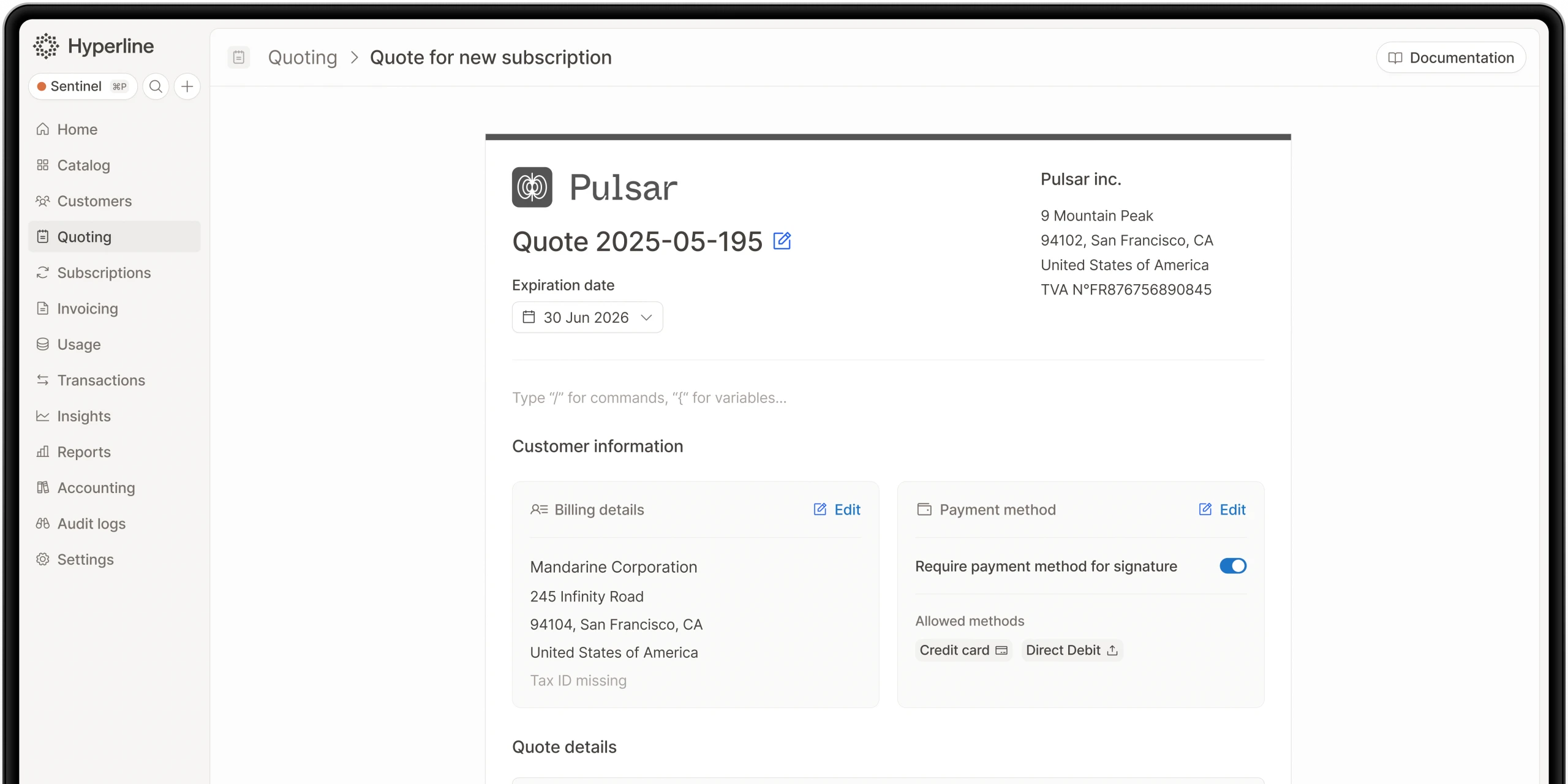
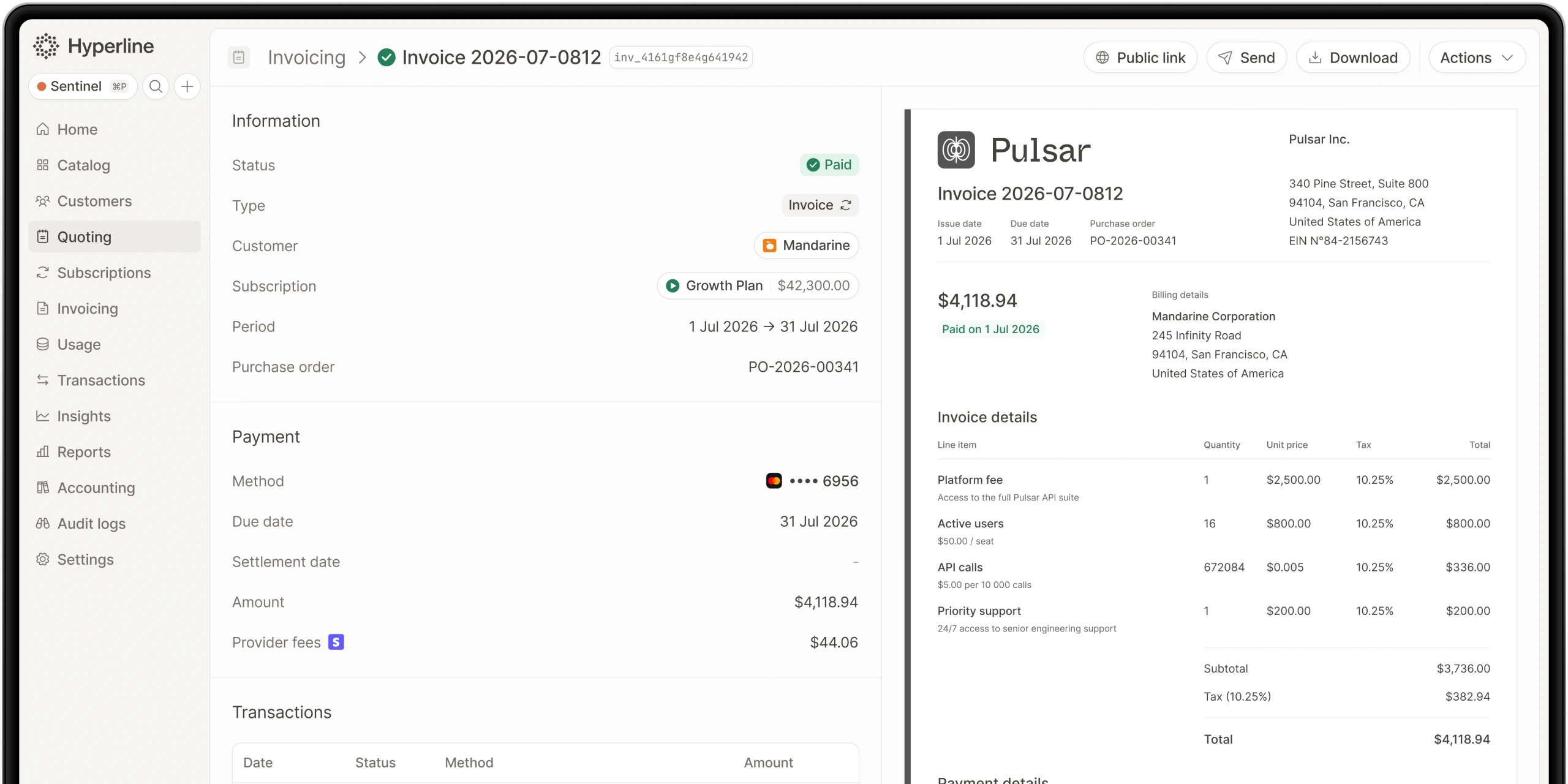
Unlike homegrown solutions, Hyperline automates the entire quote-to-cash workflow in eight essential steps: quote generation with personalized quotations, contract signing with automated online sign-up, automatic subscription creation upon contract signing, automated invoice sending, automated email reminders for payments, automated revenue recognition aligned with accounting standards, real-time KPIs displayed directly in the platform, and integration with complementary analytics tools like ChartMogul and Fincome.
Solving operational pain at scale
According to Hyperline's founder and CEO Lucas Bédout, the platform addresses the day-to-day operational burden that becomes time-consuming once you scale beyond 200 to 300 customers, where someone must check daily that everything is correct, handling issues like incorrect pricing, missing invoice items, partial reimbursements, and failed automatic payments.
Key advantages of a dedicated billing platform
The benefits of using a specialized billing solution like Hyperline become clear when you compare it to custom development. The platform reduces time spent on billing by up to 90%, eliminating the need for external integrators, allowing teams to focus on business growth while enjoying a seamless billing process.
CRM & pricing flexibility
Hyperline's CPQ functionality integrates natively with CRMs like Salesforce and HubSpot, getting teams started in under a minute or enabling advanced workflows with real-time two-way sync. The platform handles every pricing model, including usage-based billing, with powerful price books, custom rules, and native localization that scales across currencies, languages, and product tiers.
Payment orchestration
Rather than processing payments directly, Hyperline acts as an orchestrator, positioning itself as the interface to interact with payment processors like Stripe, GoCardless, and Airwallex. This eliminates the need to juggle between different tabs and tools.
Reporting & integrations
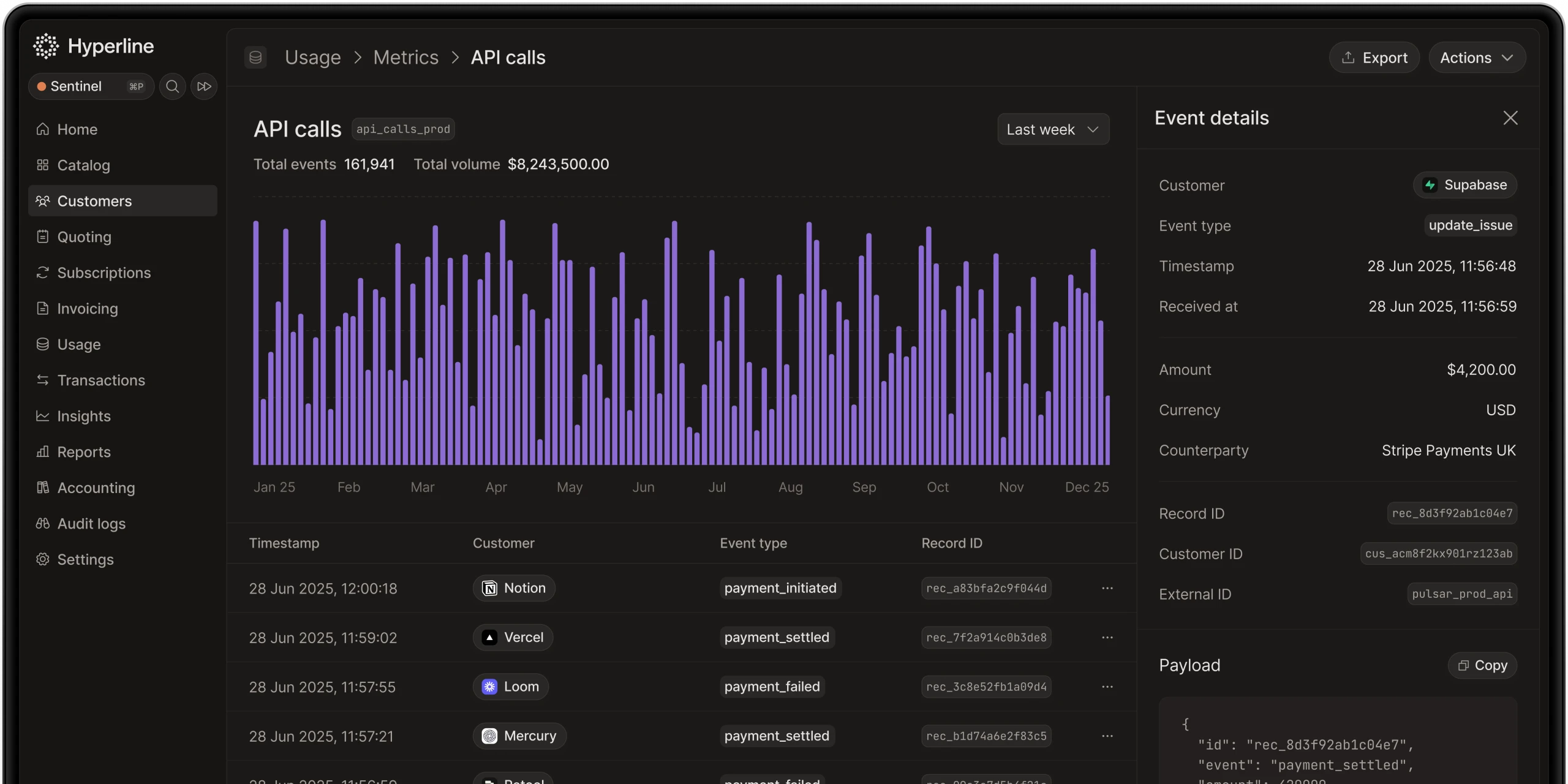
The platform provides advanced reporting capabilities that break down revenue by plan, product, or billing period, and automates revenue recognition to stay compliant and close the books faster. Hyperline sits at the heart of your business stack, connecting to CRMs (Salesforce, HubSpot), accounting tools (Pennylane, Xero, NetSuite, QuickBooks), analytics tools (ChartMogul), operations tools (Zapier), and data stores (Segment, PostgreSQL, BigQuery, Snowflake).
Making the right choice for your business
For early-stage companies with simple pricing and low transaction volumes, a custom Salesforce solution might suffice initially. However, as your business grows, introducing usage-based pricing, multiple subscription tiers, or expanding internationally, the maintenance burden and lack of automation quickly become bottlenecks.
Hyperline currently serves companies generating between €3 and €10 million in revenue and is expanding to support larger companies handling high invoice volumes. The platform's focus on automation means finance, sales, and operations teams can work efficiently without requiring dedicated technical resources to maintain billing infrastructure.
Rather than forcing sellers through complex workflows and requiring substantial Sales Ops headcount, modern billing platforms enable teams to experiment with pricing and packaging rapidly while maintaining data accuracy across all systems. The choice between building custom or buying a specialized solution ultimately depends on how you want your team to spend their time: maintaining infrastructure or driving growth.
Where this fits in Hyperline
Frequently asked questions
As SaaS companies grow, billing needs become more complex. HubSpot CPQ has limits: no quote-to-invoice automation, little pricing flexibility, basic reporting, manual revenue recognition, and no advanced subscription support.
It depends on pricing complexity. Simple, flat subscription pricing can run acceptably on separate best-of-breed tools connected by integrations. Once pricing includes usage-based or hybrid components, or deal sizes require approval workflows and e-signature, the reconciliation cost of stitched-together tools tends to outweigh the flexibility of picking each piece independently.
LedgerUp is focused on the post-signature handoff: getting from a signed contract to a first invoice quickly. It does not include native CPQ, and its global e-invoicing and revenue recognition depth are limited compared to a full quote-to-cash platform, so teams that scale into hybrid pricing or larger, multi-country contracts typically re-evaluate.
Hyperline is the strongest fit for B2B SaaS companies with usage-based, tiered, or hybrid pricing that need CPQ, billing, and revenue recognition unified in one platform instead of three separate systems. For simple, seat-based pricing already running on Salesforce, or if the only need is post-signature contract handoff automation like LedgerUp provides, a different platform is a better starting point.
It varies widely by platform and by how much configuration a business needs. Enterprise-grade, highly configurable platforms like Zuora, Oracle CPQ, or Salesforce Revenue Cloud commonly run several months. Platforms built around a narrower, more opinionated setup, including Hyperline's roughly two-month target, tend to move faster because there's less to configure from scratch.
Each platform is scored against five consistent criteria: best fit (the buyer situation it actually suits), strongest part of quote-to-cash (where it genuinely leads), evidence reviewed (public pricing pages, product documentation, and G2 category listings), and watch-out (the limitation buyers run into first). Vendor claims that aren't verifiable against a public source are described qualitatively rather than repeated as fact.
Salesforce Revenue Cloud's strength is CPQ configurability inside the Salesforce ecosystem. Usage-based and consumption billing is a comparatively newer layer than its quoting core, and the platform generally requires meaningful Salesforce admin and implementation investment to configure well for hybrid pricing.
Teams struggle with incomplete revenue reports, manual invoice creation, hard-to-manage contracts, weak accounting links, and too much work in spreadsheets.