Hyperline vs. Stripe Billing: Which is the Better Billing Platform for SaaS?
Stripe is everywhere. But when it comes to billing, being everywhere is not the same as being the right fit. Here is an honest comparison of Hyperline and Stripe Billing.
Stripe is everywhere. But when it comes to billing, being everywhere is not the same as being the right fit. If your team is running into walls with Stripe Billing — complex pricing models, manual invoicing, no CPQ, limited PSP flexibility — you are not alone. Here is an honest comparison of Hyperline and Stripe Billing so you can make the right call.
What is Stripe Billing?
Stripe Billing is the subscription and invoicing layer built on top of Stripe Payments. It covers basic recurring billing, plan management, and invoicing. It works well for simple subscription models and developer-led setups. But it was built as an extension of a payments platform, not as a revenue operations tool — and that distinction matters as you scale.
In January 2026 Stripe announced the acquisition of Metronome, the usage-based metering engine behind OpenAI and Anthropic, for a reported $1 billion. The deal has completed. Expect Stripe's usage-based billing to improve, inside Stripe's payment stack.
What is Hyperline?
Hyperline is a next-generation revenue management platform built for modern B2B SaaS companies. It covers the full quote-to-cash cycle: CPQ, billing, usage-based pricing, invoicing, payment collection, revenue recognition, and real-time reporting — in one unified platform. No engineering required to run it.
Hyperline vs. Stripe Billing: Feature Comparison
| Feature | Hyperline | Stripe Billing |
|---|---|---|
| Quote-to-Cash | Full CPQ + Billing + Payment + Rev Rec | Billing only |
| Usage-Based Billing | Real-time, granular, dynamic | Basic tiered, Metronome being folded in |
| PSP Support | Stripe, GoCardless, Mollie, Airwallex | Stripe only |
| No-Code for Finance | Yes, fully | Dev-heavy |
| CRM Integration | Native HubSpot and Salesforce widgets | Basic APIs |
| Multi-Entity | Yes | Limited |
| Governance and Approvals | Full audit trails, roles, workflows | Minimal |
Why SaaS Teams Switch from Stripe Billing to Hyperline
Stripe is a payments platform. Hyperline is a billing platform.
Stripe Billing is developer-oriented and rigid. Finance and ops teams have no autonomy — every pricing change requires engineering involvement. Hyperline gives your finance and revenue teams the flexibility to own billing end to end, without writing a single line of code.
Usage-based billing: weeks with Hyperline, months with Stripe
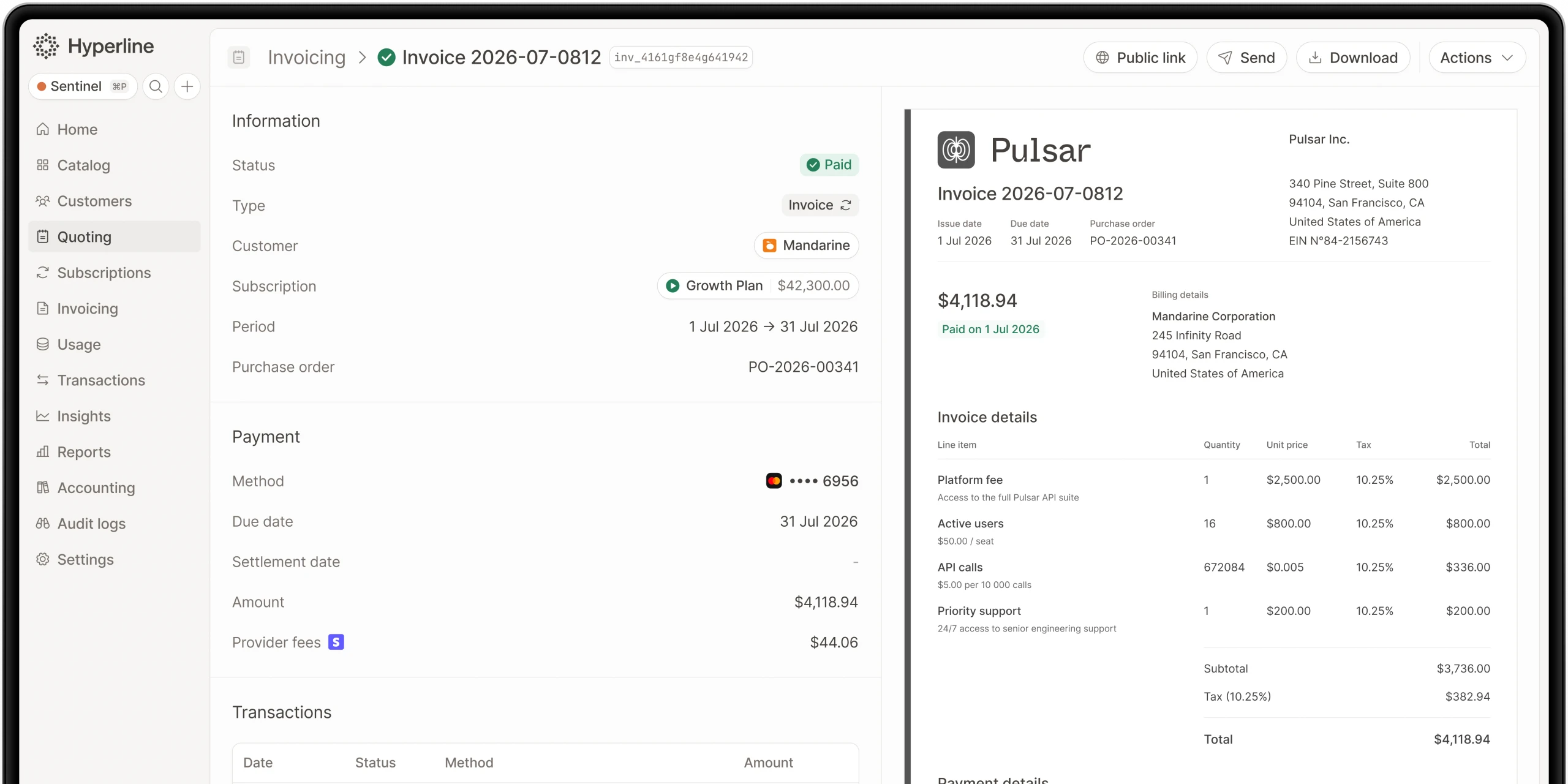
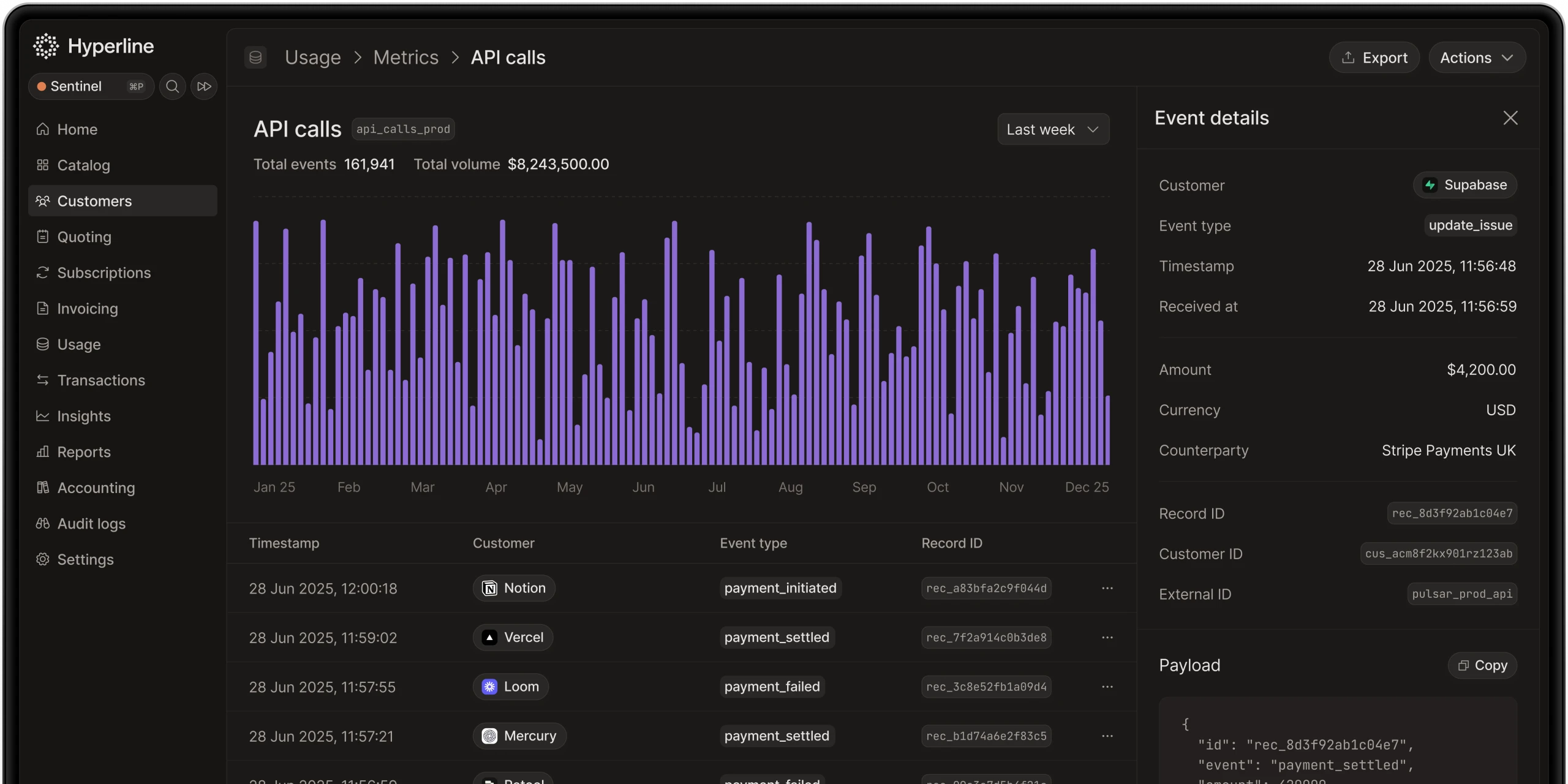
Building usage-based billing on Stripe takes 2 or more months of engineering time. With Hyperline, your team can go live in days. Real-time metering, dynamic products, prepaid credits, and explorable invoices are all built in. Learn more about Hyperline usage-based billing.
PSP flexibility vs. lock-in
Stripe Billing locks you into Stripe as your payment provider. Hyperline supports multi-PSP setups — Stripe, GoCardless, Mollie, Airwallex — so you can route payments the way your business actually needs.
CPQ: the gap Stripe cannot fill
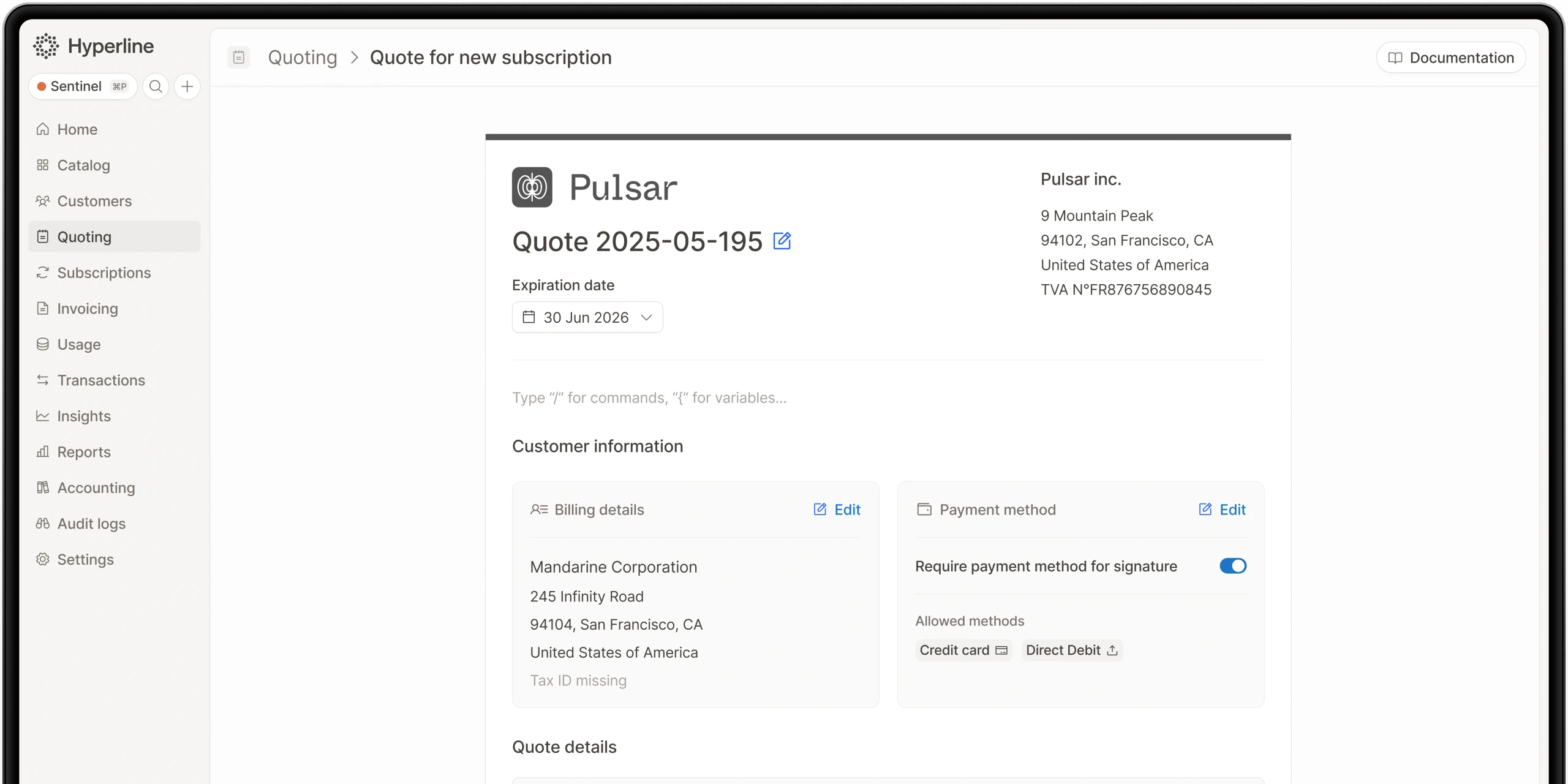
Stripe has no CPQ. If your sales team sends quotes, manages contracts, or runs approval workflows, you are cobbling together spreadsheets and tools. Hyperline includes a fully integrated CPQ with branded proposals, e-signature, approval flows, and CRM sync — out of the box.
When does Stripe Billing still make sense?
Stripe Billing is a solid choice if you have a developer team building your billing stack from scratch, a simple subscription model with no usage component, and no need for CPQ or multi-PSP support. For everything beyond that, Hyperline is built for the job.
FAQ
Can I migrate from Stripe Billing to Hyperline?
Yes. Hyperline offers fully automated migrations from Stripe Billing. Your subscriptions, customers, and billing logic are migrated without manual work or service interruption.
Does Hyperline replace Stripe entirely?
No. Hyperline works on top of your existing PSP, including Stripe. You keep Stripe as a payment processor — Hyperline just adds the billing intelligence, CPQ, and revenue operations layer on top.
Does Stripe buying Metronome change this comparison?
It strengthens Stripe on metering and leaves the rest unchanged. Stripe still has no CPQ, still requires Stripe as the processor, and still puts pricing changes in engineering's hands. If your reason for looking beyond Stripe Billing was usage-based pricing alone, re-check once Metronome is integrated. If it was CPQ, PSP flexibility or finance autonomy, nothing has moved.
Does Hyperline support usage-based pricing?
Yes. Hyperline's usage-based billing supports real-time metering, dynamic products, prepaid credits, and BPS pricing — all configurable without code.
Who is Hyperline for?
Hyperline is built for B2B SaaS companies from Series A to Series C, with finance, revenue ops, or GTM teams who need to move fast without depending on engineering for every billing change. Book a demo to see it in action.
Where this fits in Hyperline
Frequently asked questions
It depends on pricing complexity. Simple, flat subscription pricing can run acceptably on separate best-of-breed tools connected by integrations. Once pricing includes usage-based or hybrid components, or deal sizes require approval workflows and e-signature, the reconciliation cost of stitched-together tools tends to outweigh the flexibility of picking each piece independently.
LedgerUp is focused on the post-signature handoff: getting from a signed contract to a first invoice quickly. It does not include native CPQ, and its global e-invoicing and revenue recognition depth are limited compared to a full quote-to-cash platform, so teams that scale into hybrid pricing or larger, multi-country contracts typically re-evaluate.
Hyperline is the strongest fit for B2B SaaS companies with usage-based, tiered, or hybrid pricing that need CPQ, billing, and revenue recognition unified in one platform instead of three separate systems. For simple, seat-based pricing already running on Salesforce, or if the only need is post-signature contract handoff automation like LedgerUp provides, a different platform is a better starting point.
No. Conga CPQ is built for configuration depth on multi-line, rule-heavy quotes, historically tied closely to Salesforce. Billing and usage metering live outside the product, so it typically functions as the quoting layer in front of a separate billing system rather than a complete quote-to-cash platform on its own.
As SaaS companies grow, billing needs become more complex. HubSpot CPQ has limits: no quote-to-invoice automation, little pricing flexibility, basic reporting, manual revenue recognition, and no advanced subscription support.
Salesforce Revenue Cloud's strength is CPQ configurability inside the Salesforce ecosystem. Usage-based and consumption billing is a comparatively newer layer than its quoting core, and the platform generally requires meaningful Salesforce admin and implementation investment to configure well for hybrid pricing.
Usually not on its own. Oracle CPQ brings enterprise-grade catalog and pricing-rule capabilities for organizations operating at significant scale, but implementation timelines and total cost of ownership are heavy for a mid-market SaaS company evaluating it from scratch, unless the business is already committed to the Oracle CX or ERP ecosystem.
No. DealHub is a sales-side CPQ and contract lifecycle management tool, strong at quote building, redlining, and e-signature. Billing, usage metering, and revenue recognition are not native, so teams pair it with a separate billing platform and manage the handoff between the two.