Hyperline vs. Metronome: End-to-End Revenue Platform vs. Usage Metering Engine
Metronome is a serious usage metering engine. But the billing challenge is not just metering — it is the entire revenue workflow from quote to cash.
Metronome is a serious usage metering engine. If your core need is to meter billions of events with engineering-grade precision, it does that well. But for most SaaS companies scaling from Series A to Series C, the billing challenge is not just metering — it is the entire revenue workflow from quote to cash. That is the gap Metronome leaves, and exactly where Hyperline steps in.
What is Metronome?
Metronome is a usage-based billing infrastructure platform built primarily for engineering teams. It handles event ingestion, metering, and billing logic at scale. It requires dev lift for configuration and ongoing pricing changes. It does not cover CPQ, CRM integrations, revenue recognition, or finance-facing workflows natively.
Stripe announced in January 2026 that it was acquiring Metronome for a reported $1 billion. The acquisition has completed and Metronome is now part of Stripe.
What is Hyperline?
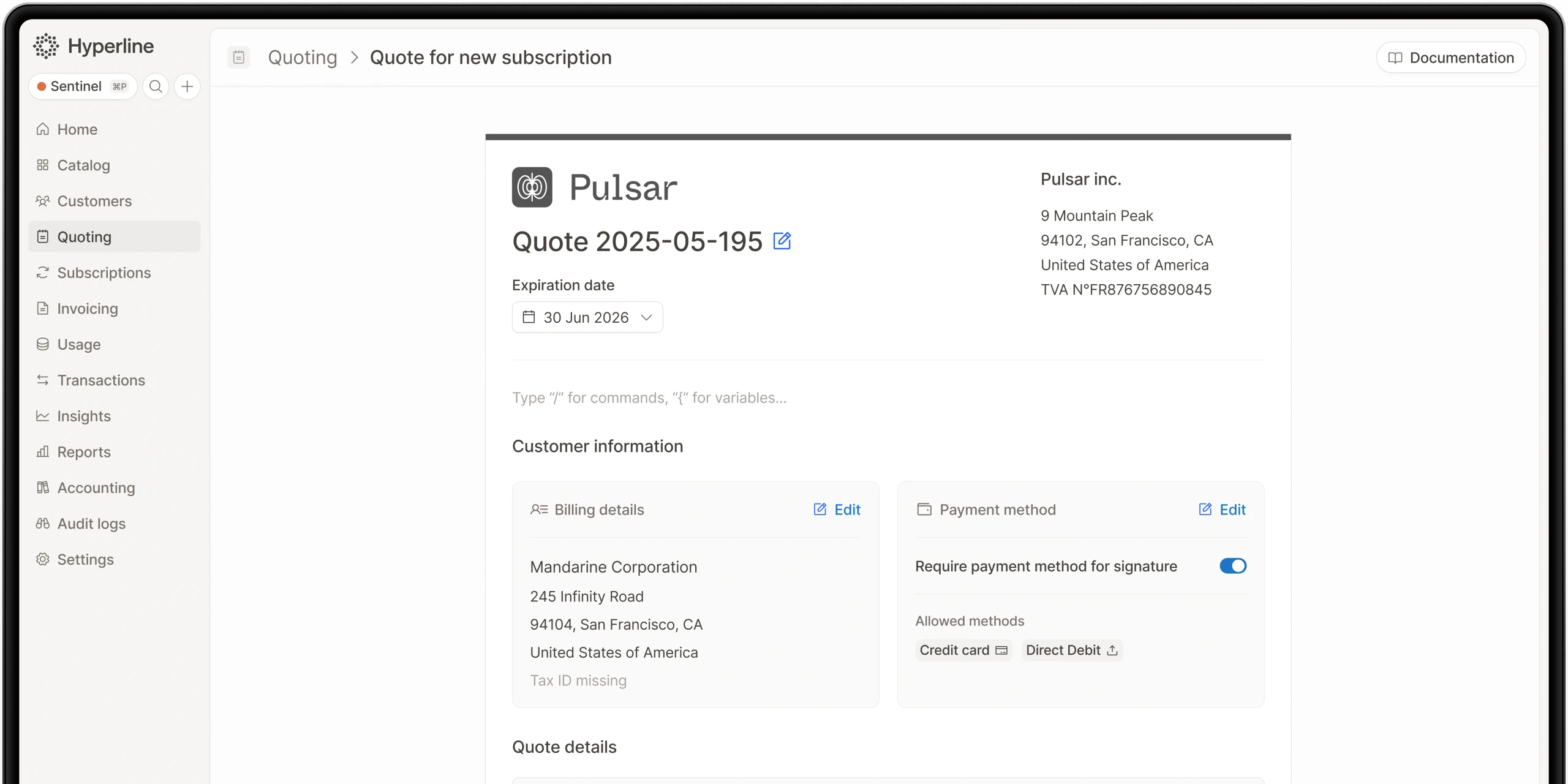
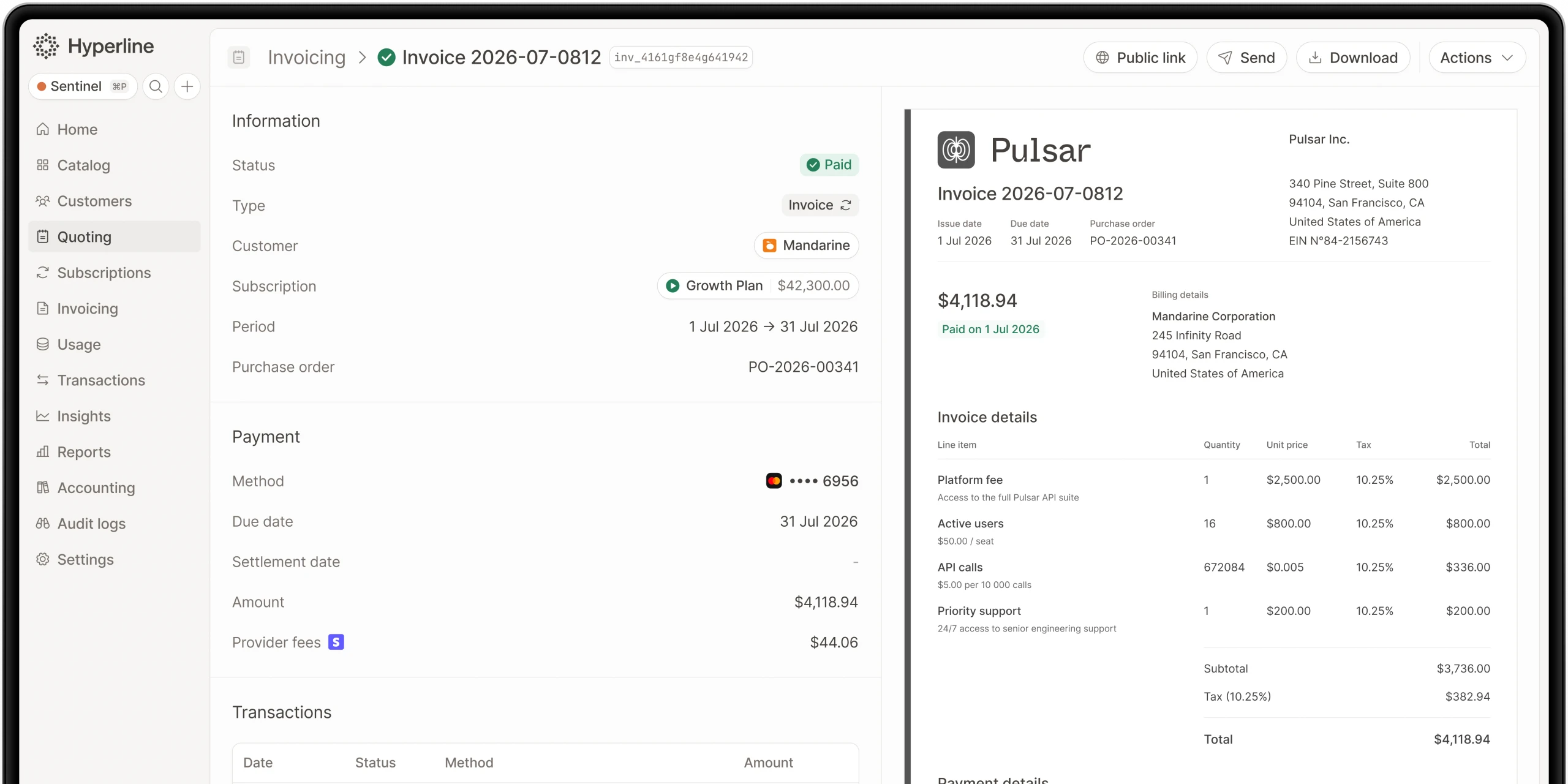
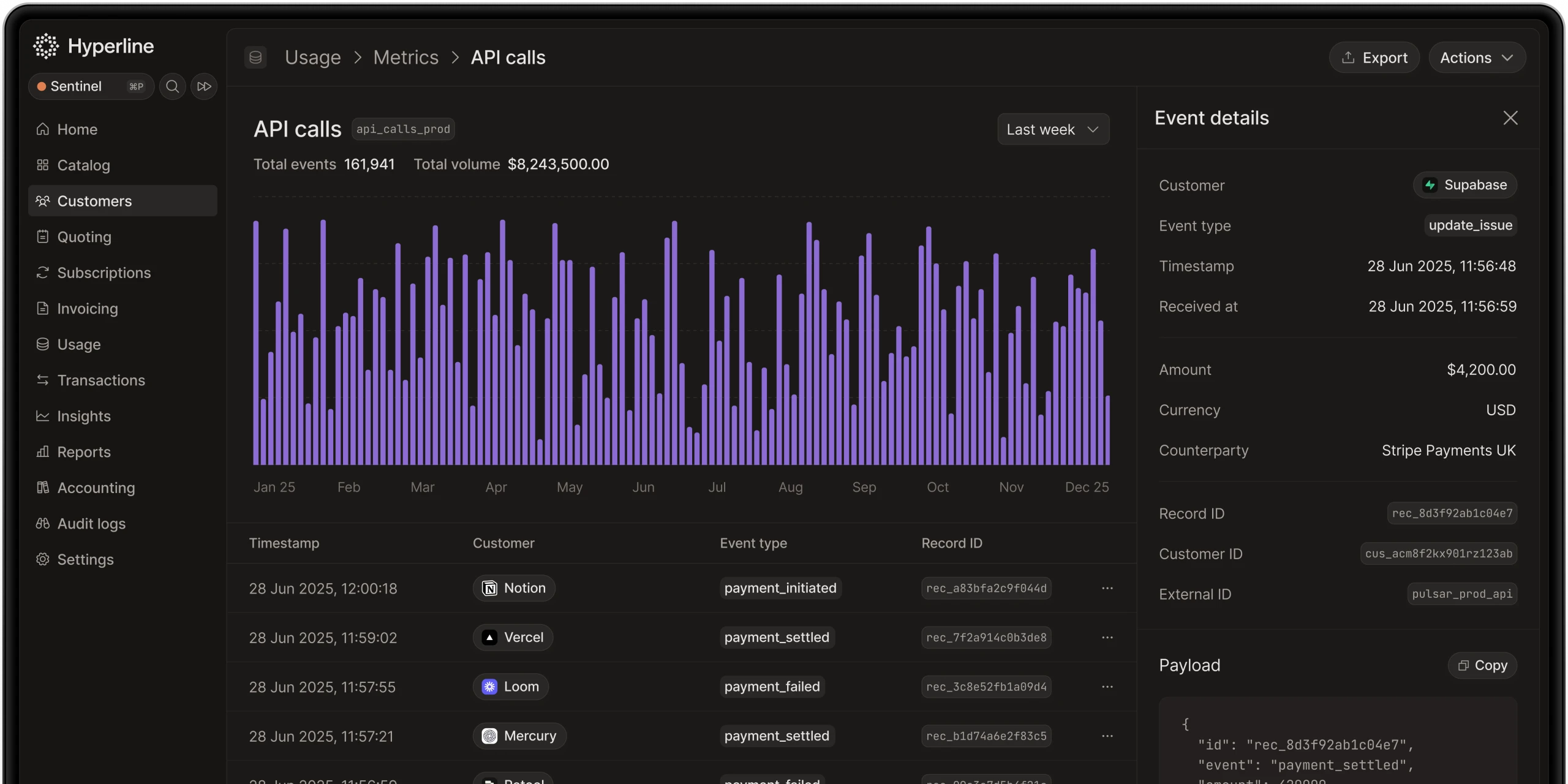
Hyperline is a full-stack revenue management platform. It starts where Metronome stops: Hyperline unifies quote-to-cash — CPQ, subscriptions, usage-based billing, invoicing, multi-PSP payment orchestration, revenue recognition, and real-time dashboards — in one platform that finance and ops teams can run without engineering.
Hyperline vs. Metronome: Feature Comparison
| Feature | Hyperline | Metronome |
|---|---|---|
| Usage-Based Billing | Real-time, operator-friendly | Real-time, dev-heavy |
| CPQ | Fully integrated | Not available |
| Quote-to-Cash | Full coverage | Billing logic only |
| No-Code for Finance | Yes | No |
| CRM Integration | Native HubSpot and Salesforce | Manual or custom |
| Revenue Recognition | Built-in | Not included |
| Multi-PSP | Yes | Often limited or custom-built |
| Implementation Speed | Weeks | Months of engineering |
What Metronome joining Stripe means if you are evaluating it
Stripe bought the metering engine that bills OpenAI, Anthropic and Databricks because usage-based pricing is where its largest customers are heading. Over time Metronome's capabilities will fold into Stripe's billing stack. That is good news if you are all-in on Stripe for payments. It is a harder sell if you process with another PSP, run multi-entity billing across regions, or wanted a metering layer that stays neutral.
It also does not close the gap this page is about. Metronome inside Stripe still leaves CPQ, revenue recognition, CRM workflows and finance-facing controls to other tools. Hyperline covers those in one platform and stays processor-agnostic, Stripe included.
Why Teams Choose Hyperline Over Metronome
Metronome is usage-first. Hyperline gives you that and more.
Metronome is a strong metering engine, but it stops short of covering the full revenue journey. Hyperline unifies CPQ, revenue recognition, payment processing, and reporting in one seamless platform. See the full scope of Hyperline's usage-based billing.
Metronome is for engineers. Hyperline is for operators and engineers.
Metronome requires dev lift for configuration, pricing changes, and iterations. Hyperline empowers finance, ops, and GTM teams to own their billing logic and workflows, no code needed. When your finance team needs to adjust a pricing model, they should not need a sprint.
Metronome leaves critical gaps. Hyperline closes them.
Metronome customers typically still need to integrate CPQ, CRM, ERP, and PSPs manually — stitching tools together to get a complete picture. Hyperline offers native integrations, embedded CRM workflows, multi-PSP support, and real-time metrics out of the box. Explore Hyperline CPQ and Billing.
Built for fast-moving teams
Metronome works well if you want to slowly build a billing layer over time. Hyperline is built for fast-moving teams who need to ship pricing changes, automate processes, and scale quickly — without rebuilding their stack from scratch.
FAQ
Can Hyperline work alongside Metronome?
Yes, in specific cases. Hyperline can connect to Metronome for high-volume metering while handling CPQ, invoicing, and revenue workflows on top. Some AI scaleups use this combination. Talk to our team to explore what makes sense for your architecture.
Does Hyperline support real-time usage billing without engineering?
Yes. Hyperline ingests usage events via API or database connectors with sub-second latency, and finance teams can configure metering and billing logic without writing code.
Should I still evaluate Metronome now that Stripe owns it?
Yes, if you process with Stripe and your need is pure metering at very high volume. If you need CPQ, revenue recognition or processor flexibility, or you sell across several countries, compare it against a full quote-to-cash platform first. See alternatives to Metronome.
Who should choose Hyperline over Metronome?
Any team that needs a full-stack revenue platform — not just a metering engine — that works for both engineers and business teams. If you want to go live in weeks and iterate on pricing without a dev sprint, Hyperline is what you are looking for.
Where this fits in Hyperline
Frequently asked questions
LedgerUp is focused on the post-signature handoff: getting from a signed contract to a first invoice quickly. It does not include native CPQ, and its global e-invoicing and revenue recognition depth are limited compared to a full quote-to-cash platform, so teams that scale into hybrid pricing or larger, multi-country contracts typically re-evaluate.
It depends on pricing complexity. Simple, flat subscription pricing can run acceptably on separate best-of-breed tools connected by integrations. Once pricing includes usage-based or hybrid components, or deal sizes require approval workflows and e-signature, the reconciliation cost of stitched-together tools tends to outweigh the flexibility of picking each piece independently.
No. Conga CPQ is built for configuration depth on multi-line, rule-heavy quotes, historically tied closely to Salesforce. Billing and usage metering live outside the product, so it typically functions as the quoting layer in front of a separate billing system rather than a complete quote-to-cash platform on its own.
Salesforce Revenue Cloud's strength is CPQ configurability inside the Salesforce ecosystem. Usage-based and consumption billing is a comparatively newer layer than its quoting core, and the platform generally requires meaningful Salesforce admin and implementation investment to configure well for hybrid pricing.
For low-frequency usage add-ons, batch processing is often fine. For consumption that drives a meaningful share of revenue, especially high-frequency events like API calls or AI token usage, batch cycles limit visibility into what a customer currently owes and make anomalies harder to catch before they hit an invoice.
As SaaS companies grow, billing needs become more complex. HubSpot CPQ has limits: no quote-to-invoice automation, little pricing flexibility, basic reporting, manual revenue recognition, and no advanced subscription support.
Usually not on its own. Oracle CPQ brings enterprise-grade catalog and pricing-rule capabilities for organizations operating at significant scale, but implementation timelines and total cost of ownership are heavy for a mid-market SaaS company evaluating it from scratch, unless the business is already committed to the Oracle CX or ERP ecosystem.
It varies widely by platform and by how much configuration a business needs. Enterprise-grade, highly configurable platforms like Zuora, Oracle CPQ, or Salesforce Revenue Cloud commonly run several months. Platforms built around a narrower, more opinionated setup, including Hyperline's roughly two-month target, tend to move faster because there's less to configure from scratch.