Why Hyperline Outperforms Chargebee for AI Companies
How Hyperline's real-time metering, hybrid pricing, and AI-native billing architecture makes it the stronger choice for AI companies over Chargebee.
Introduction
AI companies face a billing problem that most established billing platforms were not designed to solve. The product charges based on consumption: tokens processed, API calls made, compute minutes used, or messages generated. That consumption can vary by orders of magnitude across customers and across time. A customer who used 10,000 tokens last month might use 10 million next month. A pricing model that worked at launch often needs to be iterated within quarters, not years.
This article examines why Chargebee, one of the most established billing platforms on the market, is a poor fit for AI companies specifically, and why Hyperline, built in 2022 around real-time usage-based billing, is a better match for the way AI products monetize.
The AI billing model: what it actually requires
AI companies typically monetize through one of a few patterns: pure consumption (pay per token, API call, or unit of compute), hybrid (a platform or seat fee plus consumption), or outcome-based (a charge tied to a result delivered). What these patterns share is variability. The bill is not set at the start of the period and held constant. It moves continuously as the customer uses the product.
Billing a model like this requires four specific capabilities. Real-time metering that captures each consumption event as it occurs rather than reconciling in batches. Flexible aggregation that can count, sum, apply tiers, or take maximums depending on how the pricing is structured. Accuracy at high event volumes, because at token scale a small percentage error is real money in either direction. And real-time visibility so finance, success, and customers can see consumption as it accrues rather than after the billing cycle closes.
These are not niche requests. They are the baseline requirements for billing a product that charges on consumption. Chargebee meets some of them for modest volumes. Hyperline was built to meet all of them by design.
Why Chargebee falls short for AI billing
Chargebee was founded in 2011 around subscription billing. Its core architecture handles recurring plans, proration, and renewals reliably, and that design has served subscription businesses well for over a decade. The problem for AI companies is structural: a billing engine built around static recurring amounts handles dynamic consumption as an add-on rather than as the center of the system.
Batch processing, not real-time metering. Chargebee collects and reconciles usage in periodic batches. At any given moment, the current bill does not reflect the actual consumption since the last batch ran. For a subscription that does not matter. For an AI product where a customer's usage can spike or drop dramatically between runs, it means the billing system is always looking at the past, not the present.
No real-time visibility. Because metering is batch-driven, there is no live view of what a customer is consuming in the current period. Finance cannot see revenue accruing mid-month. Customer success cannot flag an account that has spiked past its expected tier. Customers cannot check their own usage without contacting support. For AI companies that need tight feedback loops on usage patterns, this visibility gap has operational consequences.
Manual workarounds at scale. Teams running usage-based billing on a subscription-first platform commonly resort to estimating usage as flat add-ons and tracking adjustments manually outside the billing engine. These workarounds are manageable for a small number of accounts. At the customer volumes and usage intensities that growing AI companies reach, they create a billing reconciliation burden that grows faster than the team can absorb it.
Revenue leakage in a low-margin business. AI companies often operate with thin infrastructure margins. Tokens have a cost, and the billing system needs to capture every one of them accurately to protect margin. When metering relies on estimates and batch reconciliation, under-counted consumption is revenue that was never invoiced. At token scale, a small leakage rate compounds into a meaningful loss every month.
Where Hyperline fits the AI model
Hyperline was built in 2022 specifically for real-time usage-based and hybrid billing, and the fit for AI companies is structural rather than incidental.
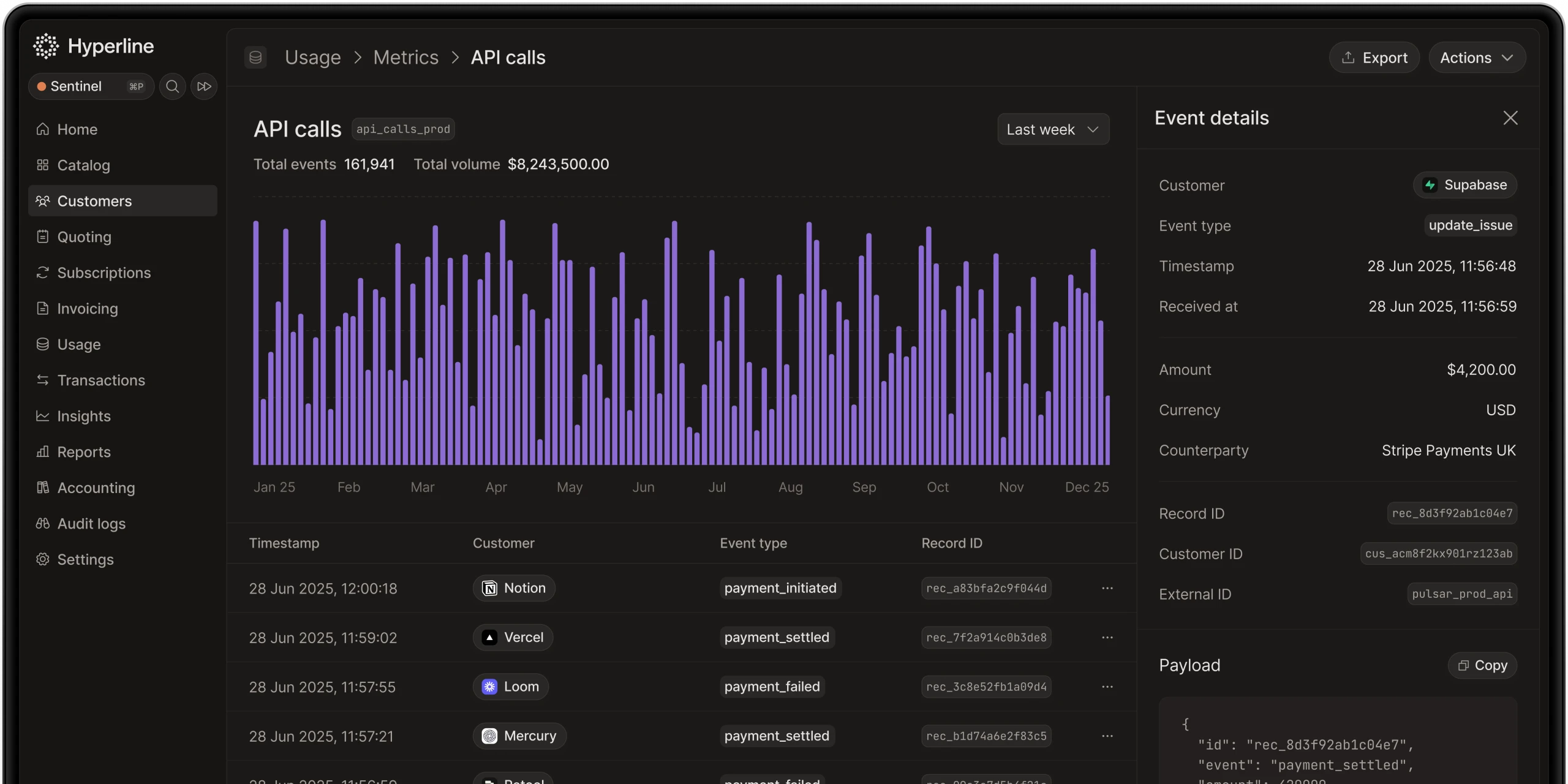
Real-time metering at the core. Usage events, whether they are tokens, API calls, compute units, or any other consumption signal, are ingested as they occur and attributed to the right account immediately. The current bill is always live. Finance sees revenue in real time. Customer success and customers themselves can see consumption on demand, mid-period, without waiting for a batch to run.
Flexible aggregation for complex AI pricing. AI pricing is rarely a simple counter. A token-based model might apply different rates to input and output tokens, use tiered pricing above certain thresholds, or bundle a compute allowance into a base plan. Hyperline supports multiple aggregation methods natively, so the billing system can model the actual pricing without forcing it into a single-counter structure.
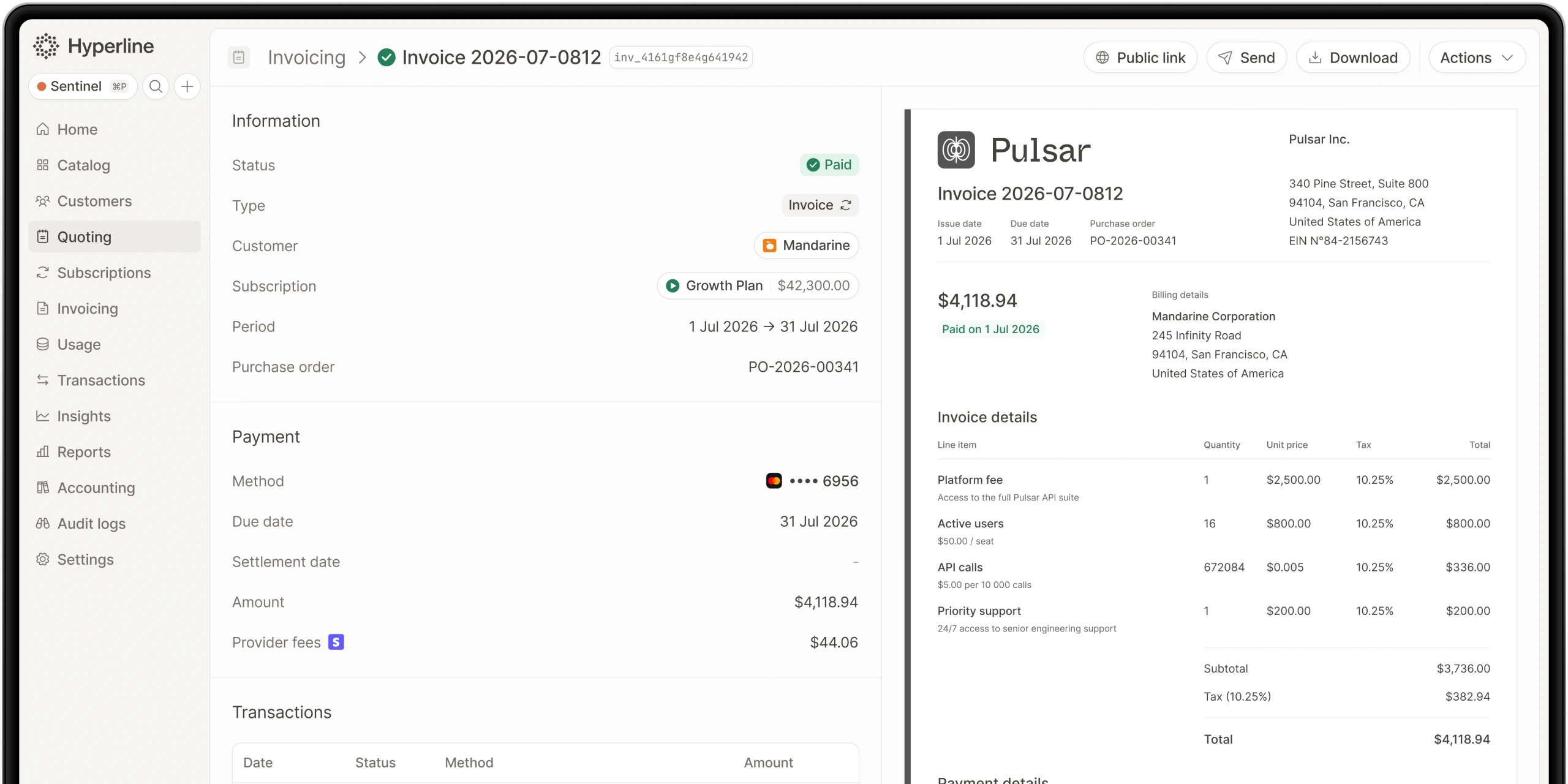
Hybrid pricing without stitching tools together. Most AI companies combine a base platform or seat fee with consumption. Hyperline handles recurring, one-time, and usage charges within the same contract and the same invoice, without requiring separate systems or manual reconciliation between them. The hybrid model is the default, not an exception case.
Fast iteration on pricing. AI companies revise their pricing models as they find product-market fit. Changing pricing on a system that requires engineering work for every update is a bottleneck on go-to-market velocity. Hyperline's no-code configuration means pricing changes happen through the product interface, not through a development sprint.
Revenue leakage detection by AI agents. Hyperline includes AI agents that monitor unified billing, usage, and accounts receivable data to surface under-billed consumption, missed charges, and anomalies. For AI companies where margin depends on accurately billing every consumption event, having a system that actively catches leakage is operationally meaningful.
The full revenue stack: CPQ, RevRec, CRM sync
AI companies selling to enterprise or mid-market customers deal with more than metered billing. Deals involve quotes, negotiated pricing, contract signatures, and multi-year commitments. Revenue recognition under ASC 606 or IFRS 15 applies from the first contract. And customer data needs to stay in sync between billing and the CRM the sales team operates from.
Chargebee handles these needs through separate paid modules: CPQ as a Salesforce-based paid add-on, revenue recognition as a paid add-on, and API-level CRM integrations. Each module adds cost, implementation work, and a surface where data can fall out of sync.
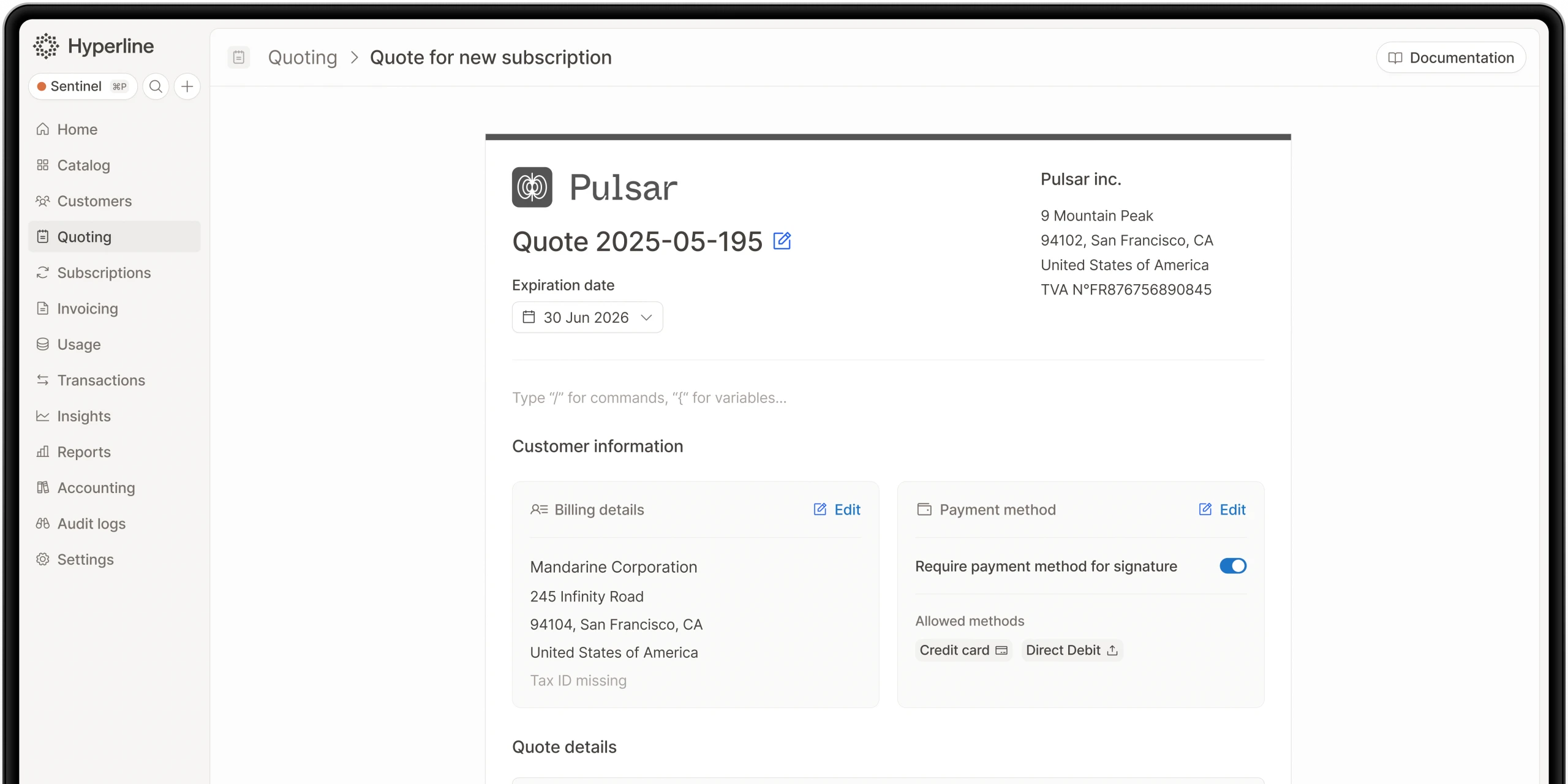
Hyperline includes all of these in the core platform. CPQ with e-signature and multi-step approval workflows is built in. Revenue recognition is part of the system. CRM sync with HubSpot, Salesforce, and Attio is native and two-way in real time, with quoting accessible from inside the CRM. For an AI company that needs to run enterprise sales alongside high-volume consumption billing, the consolidation removes a layer of integration complexity that would otherwise be a persistent maintenance burden.
Pricing that fits the AI company cost model
Many AI companies are scaling rapidly and watching their cost structure carefully. Chargebee's publicly listed plans start around $599 per month, with revenue recognition and CPQ as paid add-ons. For a company that needs all three, the effective floor is substantially higher.
Hyperline's indicative pricing starts from $199 per month plus 0.6% of revenue. The revenue-based component means cost scales with the business: it is lower when revenue is lower and grows only as billing volume grows. For an AI company in an early or high-growth phase, that alignment between cost and revenue is preferable to a fixed floor that remains the same regardless of what the business brings in.
Implementation speed matters for AI companies
AI companies move fast and cannot afford a billing implementation that stretches for months. Chargebee implementations typically run four to six months. Hyperline targets go-live in about two months, enabled by its unified architecture that reduces the number of separate systems that need to be assembled and integrated.
Getting billing right quickly also matters competitively. An AI company that can iterate on its pricing model and see the results in the next billing cycle has a commercial advantage over one that is still configuring usage metering four months after kickoff.
Frequently asked questions
Can Chargebee handle token-based billing for AI companies?
Chargebee supports usage-based billing, but it relies on batch processing rather than real-time metering. For AI companies billing on token consumption, this means no real-time visibility into the current bill and a dependency on periodic reconciliation rather than live metering. It works at modest volumes; it becomes a structural constraint at the scale that growing AI companies reach.
How does Hyperline handle spikes in API usage?
Hyperline ingests usage events as they occur, so spikes in API consumption are captured in real time rather than accumulated for a batch job. The current bill always reflects actual consumption, and both finance teams and customers can see usage accruing live. This means anomalies, spikes, and tier changes are visible when they happen, not after the period closes.
What pricing models can Hyperline support for an AI product?
Hyperline supports pure consumption models, hybrid models that combine a base fee with usage, tiered pricing, volume pricing, multi-aggregator setups that treat different types of events differently, and one-time charges alongside recurring components. All of these can coexist in the same contract and appear on the same invoice, and they can be configured without engineering work.
Does Hyperline include revenue recognition for AI companies?
Yes. Revenue recognition is included in Hyperline's platform, not sold as a paid add-on. For an AI company with enterprise contracts that include a platform fee plus consumption, recognizing revenue correctly across those components is handled within the same system rather than requiring a separate RevRec module.
Is Hyperline's pricing model suitable for an early-stage AI company?
Hyperline's indicative pricing starts from $199 per month plus 0.6% of revenue. The revenue-based component means cost tracks with billing volume rather than sitting at a fixed floor, which fits an early-stage company where revenue is still building. As the business grows, the cost grows with it rather than requiring a step-change to a higher plan tier.
What aggregation methods does Hyperline support for usage billing?
Hyperline supports multiple aggregation methods natively: count, sum, maximum, and others. This means you can bill on distinct event counts, on a cumulative quantity, on a peak value over the period, or apply volume and tiered pricing on top of any of them. Different event types can use different aggregators in the same contract, which is relevant for AI companies that bill input tokens and output tokens at different rates.
Conclusion
AI companies need billing infrastructure that was designed for consumption, not subscription-first systems where usage has been retrofitted. The requirements are specific: real-time metering, flexible aggregation, accuracy at event scale, and real-time visibility. Chargebee meets those requirements partially and for modest volumes. Hyperline was built to meet them fully, as the core of the system rather than as an add-on to it.
For an AI company running token-based, API-based, or hybrid pricing, that architectural difference has practical consequences: accurate billing without batch lag, real-time visibility into revenue and consumption, pricing iteration without engineering dependencies, and revenue leakage detection built into the platform. Combined with bundled CPQ, RevRec, and CRM sync at a lower and more revenue-aligned price point, Hyperline is the stronger match for the way AI companies monetize their products in 2026.
Where this fits in Hyperline
Frequently asked questions
For low-frequency usage add-ons, batch processing is often fine. For consumption that drives a meaningful share of revenue, especially high-frequency events like API calls or AI token usage, batch cycles limit visibility into what a customer currently owes and make anomalies harder to catch before they hit an invoice.
Usually not on its own. Oracle CPQ brings enterprise-grade catalog and pricing-rule capabilities for organizations operating at significant scale, but implementation timelines and total cost of ownership are heavy for a mid-market SaaS company evaluating it from scratch, unless the business is already committed to the Oracle CX or ERP ecosystem.
It depends on pricing complexity. Simple, flat subscription pricing can run acceptably on separate best-of-breed tools connected by integrations. Once pricing includes usage-based or hybrid components, or deal sizes require approval workflows and e-signature, the reconciliation cost of stitched-together tools tends to outweigh the flexibility of picking each piece independently.
Salesforce Revenue Cloud's strength is CPQ configurability inside the Salesforce ecosystem. Usage-based and consumption billing is a comparatively newer layer than its quoting core, and the platform generally requires meaningful Salesforce admin and implementation investment to configure well for hybrid pricing.
No. Chargebee processes usage through batch imports applied on the next invoice cycle rather than true real-time metering, a limitation reviewers note directly on G2. Platforms built around usage-based and hybrid pricing from the start, like Hyperline, meter events as they happen instead.
No. DealHub is a sales-side CPQ and contract lifecycle management tool, strong at quote building, redlining, and e-signature. Billing, usage metering, and revenue recognition are not native, so teams pair it with a separate billing platform and manage the handoff between the two.
Hyperline is the strongest fit for B2B SaaS companies with usage-based, tiered, or hybrid pricing that need CPQ, billing, and revenue recognition unified in one platform instead of three separate systems. For simple, seat-based pricing already running on Salesforce, or if the only need is post-signature contract handoff automation like LedgerUp provides, a different platform is a better starting point.
Each platform is scored against five consistent criteria: best fit (the buyer situation it actually suits), strongest part of quote-to-cash (where it genuinely leads), evidence reviewed (public pricing pages, product documentation, and G2 category listings), and watch-out (the limitation buyers run into first). Vendor claims that aren't verifiable against a public source are described qualitatively rather than repeated as fact.