Hyperline revenue report: how to track ARR, MRR, and one-time fees
This article explains how Hyperline automates ARR, MRR, and one-time revenue reporting for SaaS businesses. It highlights the platform’s real-time dashboards, automated revenue recognition, advanced breakdowns, and integrations with analytics tools like ChartMogul and Fincome.
Running a subscription or SaaS business? You've probably realized it's not always straightforward to get a clear revenue report that separates recurring revenue (ARR, MRR) from one-time fees. Most finance teams still hack together spreadsheets or juggle multiple tools, but that slows down decision-making and leaves teams firefighting data issues instead of driving growth.
In this guide, we'll show how Hyperline provides automated revenue reporting for ARR and MRR, the challenges with traditional billing systems, and how you can access real-time recurring revenue insights directly from your billing platform.
Why you need accurate recurring revenue reporting
For subscription and SaaS companies, Annual Recurring Revenue (ARR) and Monthly Recurring Revenue (MRR) are the heartbeat metrics. They tell you whether your growth is sustainable, and whether churn is eating away at it.
But traditional billing systems and CRMs aren't designed to handle subscription revenue reporting well. Standard deal tracking doesn't easily split recurring vs. one-time fees, distinguish between new business and expansion revenue, or calculate churn accurately. That means companies often end up with:
Manual spreadsheets blending billing, CRM, and finance data
Delayed insights, waiting for invoices to post before knowing actual revenue
Limited visibility for finance leaders and boards
No clear breakdown of MRR movements, expansion, contraction, or churn
Hyperline solves these problems by providing built-in revenue analytics that automatically track ARR, MRR, and cash flow metrics in real time.
How Hyperline automates ARR and MRR tracking
To track ARR and MRR accurately, you need your billing data properly structured with contract terms, subscription values, and clear distinctions between recurring and one-time revenue. Traditional systems require extensive manual configuration, custom fields, and ongoing formula maintenance.
Hyperline handles this automatically. The platform is designed specifically for recurring revenue models and tracks:
Contract start and end dates to define subscription duration
Recurring revenue amounts for subscription values
One-time revenue amounts for implementation, setup fees, or other charges
Usage-based revenue for consumption billing
From there, Hyperline automatically calculates key metrics:
Current MRR and ARR
New MRR from new customers
Expansion MRR from upsells and upgrades
Contraction MRR from downgrades
Churn MRR from cancellations
Revenue broken down by plan, product, or billing period
With Hyperline, you don't need to build custom reports or maintain complex formulas. The platform provides these metrics out of the box through its real-time dashboard, giving you instant visibility into your recurring revenue performance.
Real-time revenue dashboard
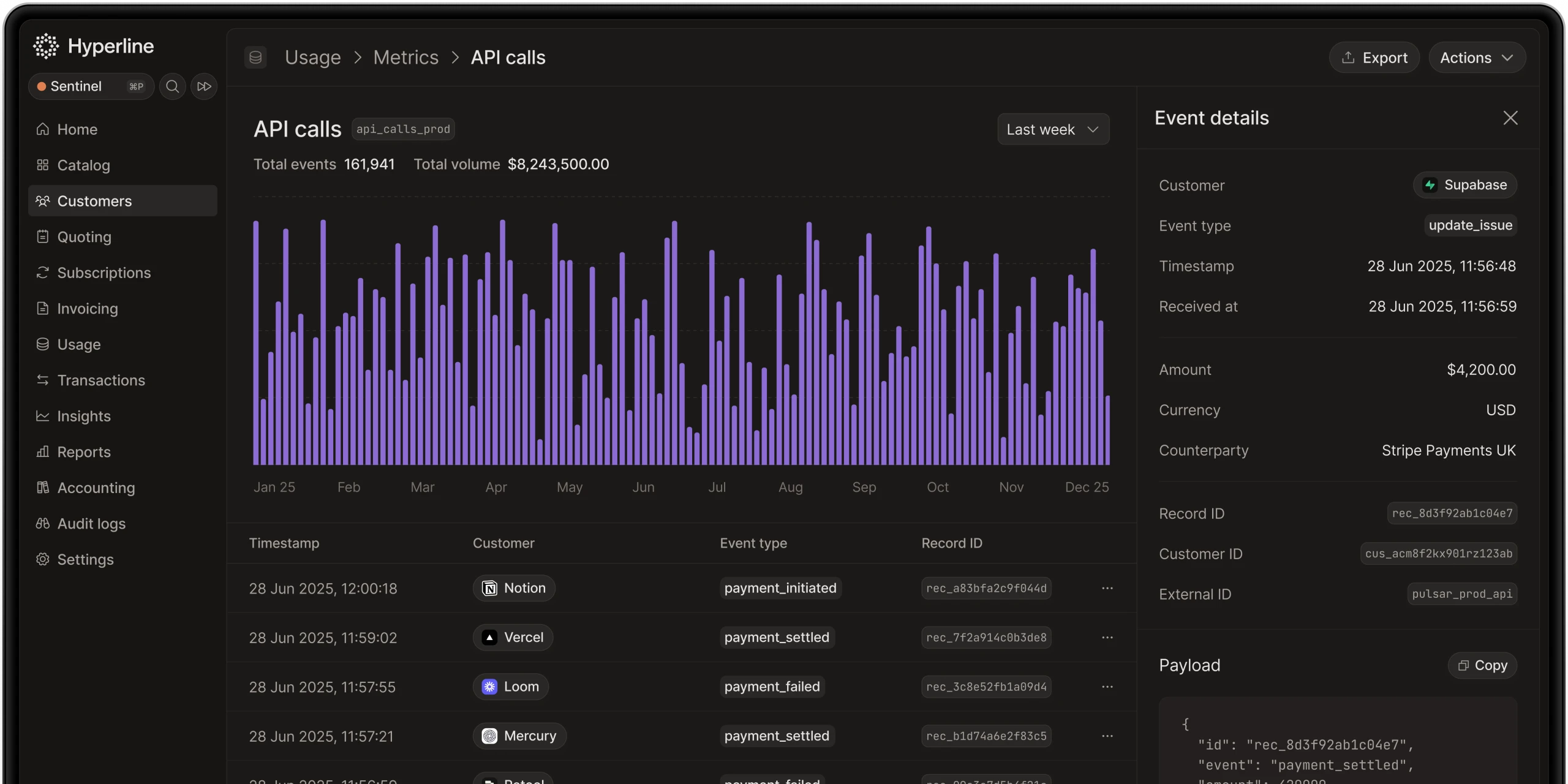
Hyperline's dashboard provides live visibility into your billing metrics without manual data exports or spreadsheet management. Here's what you get:
Real-time tracking: Key billing metrics like ARR and cash flow update automatically as new subscriptions are created, invoices are issued, and payments are collected. No waiting for batch processing or end-of-month reconciliation.
Advanced revenue breakdown: Break down revenue by plan, product, or billing period using advanced reports. See exactly which products drive growth, which customer segments generate the most revenue, and where your business is expanding or contracting.
Automated revenue recognition: Hyperline automates the entire revenue recognition process, helping you stay compliant with accounting standards and close your books faster. This is particularly valuable for companies working under ASC 606 or IFRS 15 requirements.
Actionable insights: Track what's billed, collected, and forecasted without waiting on spreadsheets or chasing other teams. Finance leaders can see real-time data, sales teams can monitor their impact on recurring revenue, and executives can make informed decisions based on current performance.
As one Hyperline customer noted, "Compared to other platforms, Hyperline made non-tech teams autonomous to manage the end-to-end billing process, with a very fast setup and high level of flexibility."
Understanding MRR and ARR
Monthly Recurring Revenue (MRR) represents the predictable revenue your business can expect each month from subscriptions. It provides insight into revenue trends, helps with forecasting, and allows for better financial planning. Monitoring MRR enables businesses to assess growth and make informed decisions regarding resources and investments.
MRR is calculated by summing the monthly subscription fees from all active customers:
MRR = Monthly Subscription Fee × Number of Active Customers
For example, if you have 50 customers paying €100 each per month, your MRR would be €5,000.
Annual Recurring Revenue (ARR) is the total revenue expected from subscriptions over a year, providing a long-term view of financial health. It helps businesses understand their overall revenue potential, plan for future growth, and attract investors by showcasing stability and predictability.
ARR can be calculated by multiplying your MRR by 12:
ARR = MRR × 12
Using the example above, if your MRR is €5,000, your ARR would be €60,000.
Beyond basic metrics: comprehensive SaaS reporting
Hyperline tracks more than just top-line MRR and ARR. The platform provides comprehensive visibility into:
MRR movements: See exactly why your MRR changed month over month, new customer revenue, expansion from upsells, contraction from downgrades, and churn from cancellations. This breakdown helps you understand the drivers behind your growth or decline.
Customer lifetime value (LTV): Estimate the total revenue a business can expect from a customer over their entire relationship. This helps in understanding the long-term value of acquiring customers and justifying customer acquisition costs.
Churn rate: Measure the percentage of subscribers who cancel their subscription within a given period. In subscription models, customer retention is as critical as acquisition, and churn rate highlights the effectiveness of retention strategies.
Average revenue per account (ARPA): Track the average amount of revenue generated per account, usually calculated monthly. This helps businesses understand revenue generation at the account level, tailor pricing strategies, and identify upsell opportunities.
Revenue by product, plan, or segment: Break down your revenue to see which products or plans drive the most value, which customer segments are most profitable, and where you should focus your growth efforts.
Hyperline provides all these metrics in its real-time dashboard, helping businesses keep a close eye on their financial performance and respond swiftly to changes in their revenue landscape.
Challenges with traditional revenue reporting
Even with custom fields and formulas in traditional systems, most finance teams hit the same roadblocks:
Data quality issues: Deals missing start/end dates, recurring values not properly categorized, or one-time fees mixed with subscription revenue.
Forecast blind spots: Difficulty rolling up subscription revenue into board-level forecasts or predicting future MRR based on current contracts.
No self-service: Sales and finance teams can't see their own revenue breakdowns without technical support or manual report building.
Manual reconciliation: Hours spent matching invoices to payments, tracking down failed transactions, and reconciling data between billing, CRM, and accounting systems.
Limited flexibility: As your pricing evolves (adding usage-based components, introducing new tiers, changing billing frequencies), traditional systems require significant reconfiguration.
This is why many companies turn to specialized billing platforms like Hyperline that provide automated revenue reporting as a core feature rather than a manual workaround.
Integration with analytics platforms
For companies that want even deeper analytics beyond Hyperline's built-in reporting, the platform integrates with specialized revenue analytics tools:
ChartMogul: Monitor and analyze Hyperline subscription revenue with ChartMogul's advanced cohort analysis, retention metrics, and benchmarking capabilities.
Fincome: Connect Hyperline to Fincome for comprehensive financial analytics that combine billing data with cash flow tracking, CAC calculations, and European banking integration.
These integrations automatically sync your Hyperline subscription data, ensuring your analytics platforms always have up-to-date information without manual data exports. This creates a seamless flow from billing to advanced analytics, giving finance teams complete visibility into revenue performance.
Real-time insights for faster decisions
Traditional billing systems force you to wait, wait for invoices to post, wait for payment confirmations, wait for month-end close before you can see your actual revenue numbers. By that time, opportunities have been missed and problems have compounded.
Hyperline's real-time approach means:
Instant visibility: See your current MRR and ARR at any moment, not just at month-end. Track revenue as subscriptions are created, upgraded, downgraded, or cancelled.
Faster response: Identify revenue trends immediately, spot churn risks early, recognize expansion opportunities, and react to changes before they impact your bottom line.
Automated workflows: Payment collections happen automatically from checkout to reconciliation. No more manual chasing, invoices are sent automatically, payment retries happen according to smart dunning logic, and failed payments trigger appropriate workflows.
Clear audit trails: Every revenue transaction is tracked with full transparency, making audits straightforward and revenue recognition defensible.
As one customer shared, "We used to have a weekly billing review with my finance team, but Hyperline made it totally useless." The implication is clear: when billing runs automatically and reporting is real-time, manual review meetings become unnecessary.
From spreadsheets to automated revenue clarity
Traditional billing workflows rely heavily on manual processes: exporting data, building formulas, matching records across systems, and updating dashboards by hand. This approach doesn't scale, and more importantly, it delays the insights that drive business decisions.
Hyperline transforms revenue reporting with:
Automated tracking: ARR, MRR, and related metrics update automatically as billing events occur. No manual calculations or spreadsheet maintenance required.
Built-in breakdowns: See revenue by plan, product, billing period, customer segment, or any dimension relevant to your business without building custom reports.
Revenue recognition compliance: Stay compliant with accounting standards through automated revenue recognition that handles complex scenarios like multi-year contracts, usage-based billing, and prorated charges.
Real-time cash flow visibility: Track not just what's been invoiced, but what's actually been collected. See accounts receivable, payment success rates, and cash flow projections based on current contracts.
Cross-team accessibility: Finance teams track revenue and forecasts, sales teams see their impact on MRR, executives monitor company-wide performance, all from the same real-time dashboard.
Making revenue reporting work for your business
Evaluating revenue reporting isn't just about having access to metrics. It's about how quickly you can access them, how much manual work is required to maintain accuracy, and whether your entire team can use the insights to make better decisions.
Hyperline delivers on these requirements by building revenue reporting directly into the billing platform. When your billing system and your reporting system are one and the same, data stays synchronized automatically. There are no exports to run, no formulas to debug, and no delays between billing events and visible metrics.
For B2B SaaS companies with recurring revenue models, this integration creates several advantages:
Single source of truth: Your billing data and revenue metrics come from the same system, eliminating discrepancies and data quality issues.
Speed: Revenue insights are available in real time, not at month-end. This speed enables faster decision-making and more agile business operations.
Flexibility: As your pricing model evolves (flat fees, usage-based, hybrid models, tiered pricing), Hyperline adapts automatically without requiring reconfiguration of your reporting.
Accessibility: Non-technical teams can manage the entire billing and reporting process without engineering support, reducing bottlenecks and empowering business users.
The platform's real-time dashboard makes revenue transparency a reality rather than an aspiration. Track key billing metrics like ARR and cash flow, break down revenue by plan or product using advanced reports, automate revenue recognition to stay compliant and close books faster, all without leaving your billing platform.
Getting started with Hyperline revenue reporting
Unlike traditional billing systems that require months of implementation and extensive configuration before reports work properly, Hyperline is designed for fast deployment. Companies can start billing customers and seeing revenue metrics in days, not months.
The platform supports any pricing model your business needs, from simple subscriptions to complex usage-based billing with multiple dimensions. This means you don't need to compromise your ideal pricing strategy to fit the limitations of your billing system.
For companies currently struggling with spreadsheet-based revenue reporting, disconnected systems, or delayed insights, Hyperline offers a clear path forward. The combination of automated billing, real-time revenue reporting, and built-in analytics creates the foundation for data-driven growth.
Revenue reporting should provide clarity, not complexity. It should empower teams to make faster decisions, not slow them down with manual processes. Hyperline delivers this vision by making ARR, MRR, and related metrics instantly accessible, automatically calculated, and always up to date.
Key takeaways
ARR and MRR are essential metrics for SaaS and subscription companies to track growth, churn, and revenue trends.
Traditional billing systems struggle with recurring revenue reporting, often requiring manual spreadsheets and custom configurations.
Hyperline automates ARR and MRR tracking with real-time dashboards built directly into the billing platform.
The platform breaks down revenue by plan, product, or billing period, and automatically handles revenue recognition for compliance.
Integrations with ChartMogul and Fincome provide even deeper analytics for companies that need advanced cohort analysis and financial metrics.
Real-time insights enable faster decision-making, replacing delayed month-end reporting with instant visibility into revenue performance.
By embedding revenue reporting directly into the billing platform, Hyperline removes the disconnect between billing activity and revenue visibility, giving teams the clarity they need to scale with confidence.
Where this fits in Hyperline
Frequently asked questions
LedgerUp is focused on the post-signature handoff: getting from a signed contract to a first invoice quickly. It does not include native CPQ, and its global e-invoicing and revenue recognition depth are limited compared to a full quote-to-cash platform, so teams that scale into hybrid pricing or larger, multi-country contracts typically re-evaluate.
It depends on pricing complexity. Simple, flat subscription pricing can run acceptably on separate best-of-breed tools connected by integrations. Once pricing includes usage-based or hybrid components, or deal sizes require approval workflows and e-signature, the reconciliation cost of stitched-together tools tends to outweigh the flexibility of picking each piece independently.
For low-frequency usage add-ons, batch processing is often fine. For consumption that drives a meaningful share of revenue, especially high-frequency events like API calls or AI token usage, batch cycles limit visibility into what a customer currently owes and make anomalies harder to catch before they hit an invoice.
As SaaS companies grow, billing needs become more complex. HubSpot CPQ has limits: no quote-to-invoice automation, little pricing flexibility, basic reporting, manual revenue recognition, and no advanced subscription support.
Usually not on its own. Oracle CPQ brings enterprise-grade catalog and pricing-rule capabilities for organizations operating at significant scale, but implementation timelines and total cost of ownership are heavy for a mid-market SaaS company evaluating it from scratch, unless the business is already committed to the Oracle CX or ERP ecosystem.
No. DealHub is a sales-side CPQ and contract lifecycle management tool, strong at quote building, redlining, and e-signature. Billing, usage metering, and revenue recognition are not native, so teams pair it with a separate billing platform and manage the handoff between the two.
Each platform is scored against five consistent criteria: best fit (the buyer situation it actually suits), strongest part of quote-to-cash (where it genuinely leads), evidence reviewed (public pricing pages, product documentation, and G2 category listings), and watch-out (the limitation buyers run into first). Vendor claims that aren't verifiable against a public source are described qualitatively rather than repeated as fact.
Yes. Hyperline connects to Stripe, GoCardless, Mollie, Airwallex, and bank transfers. It automates payment matching and reminders.