Hyperline billing platform: complete solution comparison guide
This guide provides a full comparison of the Hyperline billing platform, covering its capabilities, pricing, ROI, and how it compares to competitors like Salesforce Billing, Zuora, and Chargebee. Ideal for B2B SaaS companies seeking flexible, modern billing with native CRM integration.
Key takeaways
Native integrations with CRMs like Salesforce and HubSpot eliminate data silos and manual transfers, connecting billing directly with your entire quote-to-cash workflow
Flexible pricing that adapts to your business stage, with ROI driven by automation (up to 90% time reduction), faster cash flow, reduced reconciliation errors, and built-in revenue recognition
Best for B2B SaaS companies with recurring revenue models, competitors like Salesforce Billing, Zuora, and Chargebee offer alternatives but lack Hyperline's combination of flexibility, speed of implementation, and European data compliance
Choosing the right billing system is one of the most important technology decisions finance and IT leaders can make. If billing runs smoothly, payments flow in, reports are accurate, and customers get a consistent experience. If it doesn't, reconciliation errors pile up, cash flow slows, and teams spend their days fixing problems instead of growing the business. The Hyperline billing platform has become a popular choice because it ties billing into your existing tech stack while maintaining exceptional flexibility, but it's worth understanding how it compares to other options. This guide takes a closer look at capabilities, pricing, ROI, and comparisons with competitors.
Platform capabilities
The Hyperline billing platform is designed to connect billing with sales, finance, and customer management. Instead of having invoices live in a separate system, billing integrates seamlessly with the tools your team already uses, CRMs, ERPs, payment providers, analytics platforms, and data warehouses. This makes the entire order-to-cash cycle more transparent and eliminates the need for manual data transfers.
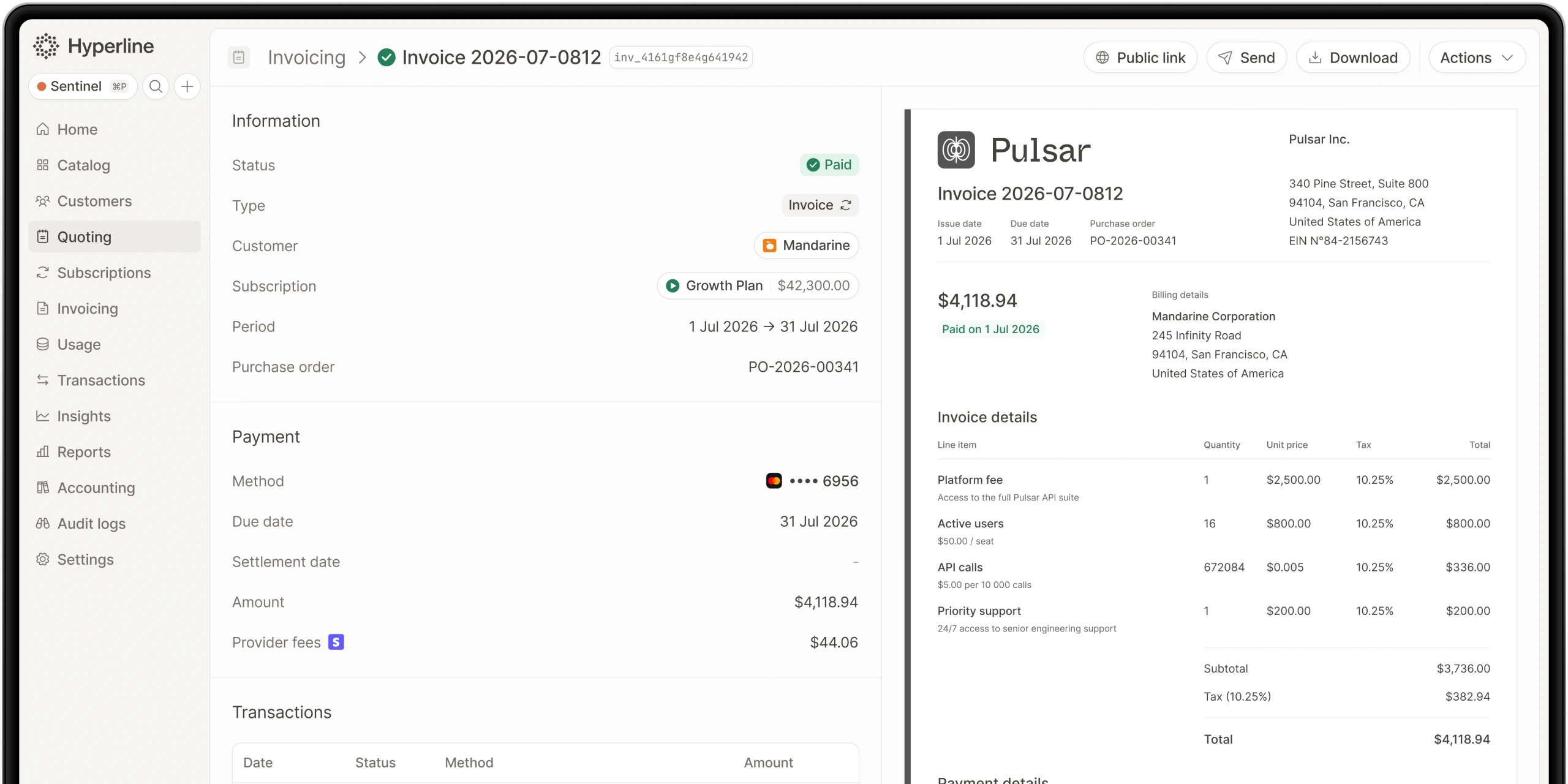
Core capabilities include automated invoicing, subscription billing, recurring payments, and usage-based billing. For businesses running complex revenue models, the platform supports flexible pricing configurations, from flat fees to usage-based models, tiered pricing, and custom enterprise contracts. Finance teams can build customizable workflows for discounts, approvals, contract amendments, and payment orchestration across multiple payment providers. Dashboards allow leadership to see cash flow, accounts receivable, and recurring revenue in one place.
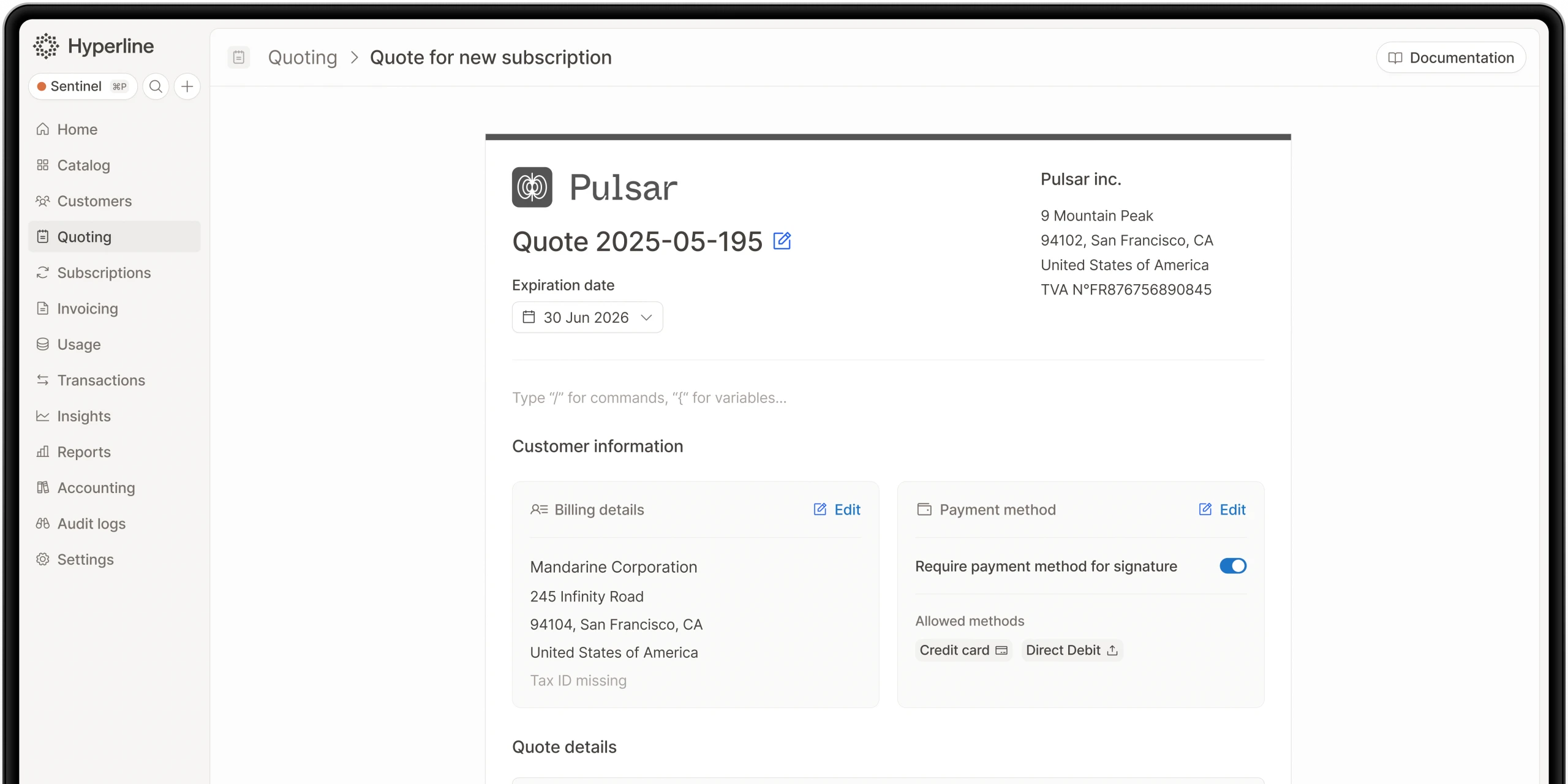
One of the strongest benefits is Hyperline's native CRM integration. The platform offers bi-directional sync with Salesforce and HubSpot, allowing you to manage subscriptions directly from your CRM without switching between systems. Data doesn't need to be duplicated or manually transferred. Hyperline also provides a dedicated widget that recreates the full Hyperline experience inside your CRM, allowing sales teams to create quotes, manage subscriptions, and track billing without leaving their familiar workspace.
What sets Hyperline apart is its implementation speed. While traditional billing platforms can take months to set up and often require external integrators, Hyperline works out of the box and can be configured without a single line of code. For companies that need deeper customization, the platform offers clean APIs, real-time webhooks, and clear documentation, allowing technical teams to move fast while staying in control.
Pricing models
Understanding Hyperline billing pricing is important because costs scale with your business stage. Hyperline follows a flexible pricing structure designed for software companies at different growth phases, from early-stage startups to scaling enterprises. You can start with a free trial to explore the platform in test mode before committing.
The pricing approach differs from competitors. Salesforce Billing, for example, sits in the mid-to-high price range and ties costs to broader Salesforce licensing, which can be expensive for companies not already heavily invested in the Salesforce ecosystem. Zuora uses modular pricing where you pay for specific add-ons. Chargebee, a simpler solution, prices more aggressively for mid-market companies but lacks some of the flexibility and native CRM integration that Hyperline provides.
What makes Hyperline's pricing compelling is transparency and flexibility. The platform supports any pricing model your business needs, flat fees, per-seat licensing, usage-based billing with pre-paid credits, tiered packages, or hybrid models. This means you can evolve your pricing strategy without switching billing platforms. Several customer testimonials highlight that while setup is fast, the long-term value comes from reduced manual work and having a single source of truth for revenue data.
Unlike some competitors, Hyperline doesn't charge extra for features like multi-currency support, VAT handling, or revenue recognition, these are built into the platform from day one. The company also eliminates the need for external integrators, which can add significant costs to other billing implementations.
ROI analysis
When evaluating billing software, return on investment goes beyond licensing costs. With Hyperline, ROI often comes from time saved and errors avoided. The platform claims to reduce time spent on billing by up to 90%, automating manual processes that typically bog down finance teams. Faster invoice-to-cash cycles improve cash flow. Built-in revenue recognition capabilities reduce compliance risk for companies working under accounting standards.
Consider a company managing recurring contracts across multiple regions with complex usage-based pricing. Without strong integration, finance teams might spend days reconciling payments between systems, manually updating CRM records, and chasing failed payments. With Hyperline's automated workflows and native integrations, these processes happen automatically. Payment status updates flow directly into your CRM and ERP systems, eliminating much of that manual work.
For many finance leaders, the decision comes down to reducing complexity. If billing is disconnected, reports are incomplete and audits become stressful. With Hyperline, the platform provides one reliable place to see all your revenue data, a single source of truth that connects quote creation, contract management, invoicing, payment collection, and revenue recognition in one continuous workflow.
Customer testimonials reflect this value. One customer noted that Hyperline eliminated their weekly billing review meetings entirely. Another mentioned that compared to other platforms, Hyperline made non-technical teams autonomous to manage the end-to-end billing process with fast setup and high flexibility.
Competitor overview
Before committing to a billing platform, it helps to understand how Hyperline compares to others in the market.
Here is a brief overview:
Salesforce Billing: Excellent for existing Salesforce users who need deep native integration, but expensive for companies not already invested in the Salesforce ecosystem. Implementation typically requires months and external consultants.
Zuora: Strong subscription billing depth and maturity, but complex setup and higher costs. Better suited for large enterprises with dedicated implementation resources.
Chargebee: Affordable and popular for mid-market SaaS companies, but less flexible for complex pricing models and lacks the native CRM integration that Hyperline provides.
NetSuite Billing: Ideal for Oracle/NetSuite ERP users but not as seamless for companies using other CRM systems or requiring fast implementation.
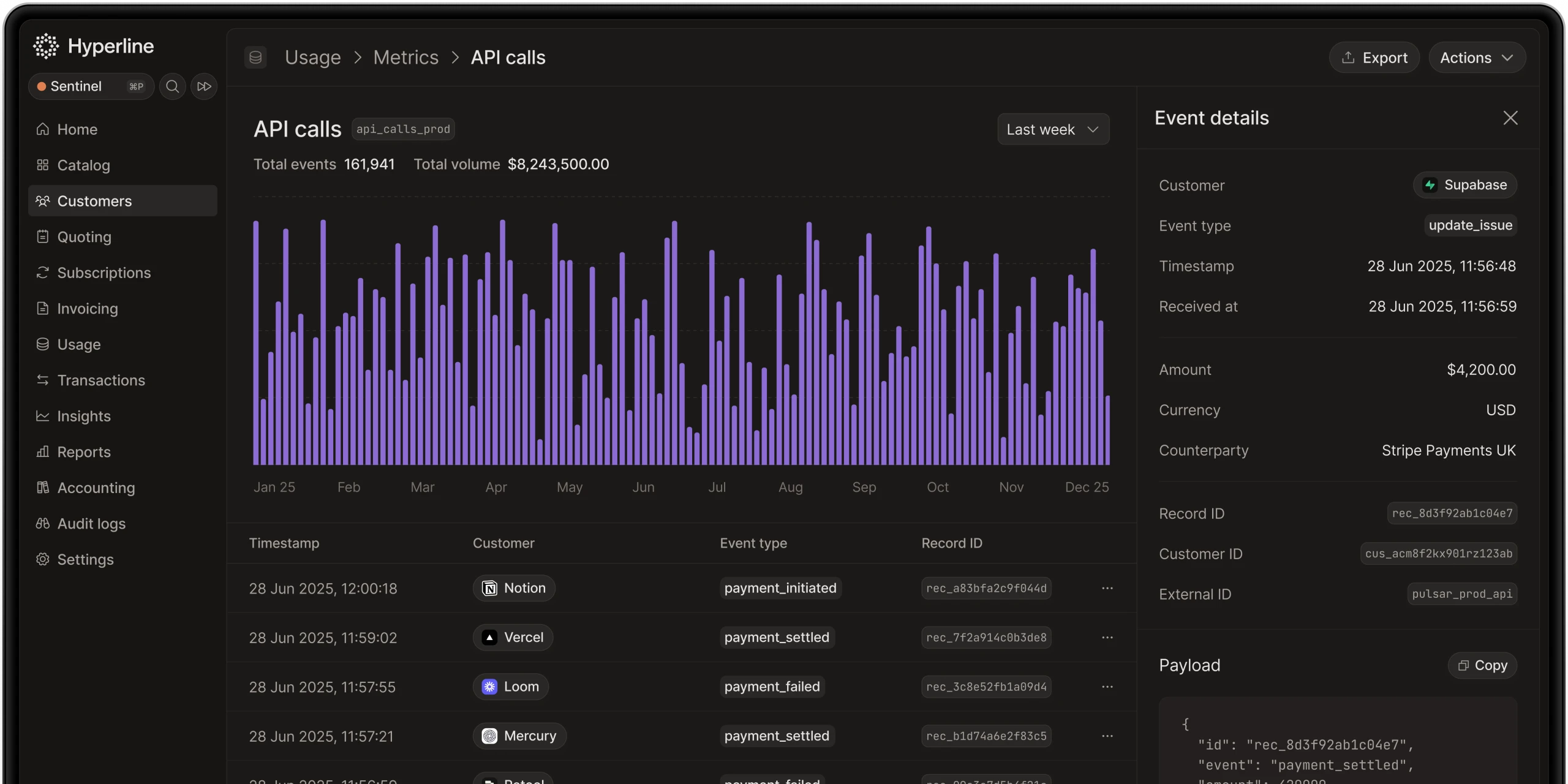
The key advantage of Hyperline is flexibility combined with speed. Instead of requiring months of implementation and external integrators, businesses can configure Hyperline quickly and adapt it as their pricing evolves. The platform's usage-native architecture means it can ingest raw usage data through database connectors, APIs, or CSV files and automatically calculate the right amount to invoice for each customer.
Multiple customer reviews point out that the unified data view and ability to manage billing without leaving their CRM is a decisive factor for choosing Hyperline over competitors. The platform appeals particularly to B2B SaaS companies generating between €3 million and €10 million in revenue, though it's built to scale with larger volumes as well.
Solution comparison
In customer feedback, users consistently praise Hyperline's native CRM integration as a standout feature. The bi-directional sync with Salesforce and HubSpot means sales teams can create quotes that automatically convert to invoices, finance teams can track revenue without chasing data across systems, and leadership can forecast with confidence based on real-time data.
Another differentiator is payment orchestration. Rather than locking customers into a single payment provider, Hyperline acts as an orchestrator, connecting with Stripe, GoCardless, Mollie, Airwallex, and other payment processors. This gives businesses flexibility to use multiple payment providers depending on geography or payment method, without juggling between different interfaces.
The platform also excels at handling complex pricing scenarios that competitors struggle with. Usage-based billing with pre-paid credits, hybrid models combining subscription and consumption, tiered pricing with custom discounts, all of these can be configured without engineering resources. For technical teams that want deeper control, Hyperline provides comprehensive API access and real-time webhooks.
Integration considerations
Integration is at the heart of a successful billing strategy. Hyperline's approach to integration differs from traditional billing platforms in several important ways.
First, the platform offers native bi-directional sync with popular CRMs. With Salesforce, you can manage customers, quotes, subscriptions, and invoices with effortless data transfer and no technical setup required. Hyperline also provides a dedicated component that integrates directly into your CRM, allowing business teams to use Hyperline's full-featured UI without leaving their primary workspace.
Second, Hyperline connects seamlessly with accounting software including Pennylane, Xero, QuickBooks, and Exact Online. Invoices push automatically to your accounting system, streamlining reconciliation and month-end close processes.
Third, the platform integrates with payment providers as an orchestrator rather than forcing a single choice. Instead of managing multiple payment processor dashboards, Hyperline provides one interface to handle Stripe, GoCardless, Airwallex, Mollie, and bank transfer payments.
For companies with usage-based billing, Hyperline offers direct database connectors to pull usage data automatically from BigQuery, PostgreSQL, MongoDB, and other data sources. This usage-native architecture means your billing stays synchronized with actual consumption without manual data exports.
IT teams appreciate the extensibility of Hyperline's APIs and webhooks, which allow the platform to connect with proprietary tools and trigger updates across systems whenever billing events occur. The platform also integrates with tools like Segment for event tracking, Zapier for custom workflows, Slack for notifications, and analytics platforms like ChartMogul and Fincome for revenue analysis.
Why Hyperline excels at modern billing challenges
Among the many options for billing automation, Hyperline consistently stands out for specific reasons that matter to growing B2B SaaS companies.
The platform was designed from the ground up for flexible, complex pricing models. While competitors often force businesses to compromise on their ideal pricing strategy, Hyperline supports any model, from simple subscriptions to sophisticated usage-based billing with multiple dimensions. This flexibility means your billing platform can evolve with your go-to-market strategy rather than constraining it.
Implementation speed is another major advantage. Traditional billing platforms require 3-6 months of implementation work, often involving external consultants and significant engineering resources. Hyperline can be configured in days, not months, with most customers able to start billing without writing any code. For teams that need deeper customization, the clean API documentation and real-time webhooks make technical integration straightforward.
The platform also brings unique advantages for European companies. Based in France, Hyperline handles all client data in accordance with GDPR and EU regulations. Security is maintained at enterprise-grade levels with SOC 2 Type II and ISO 27001:2022 certification. For businesses prioritizing data sovereignty, this European foundation provides peace of mind that competitors headquartered outside the EU cannot match.
Revenue recognition is built into Hyperline rather than being an expensive add-on. The platform automates the entire revenue recognition process, helping companies stay compliant with accounting standards and close their books faster. Finance teams can break down revenue by plan, product, or billing period using advanced reports without waiting on other teams or chasing data across multiple systems.
Payment orchestration represents another area where Hyperline outperforms traditional solutions. Rather than being locked into a single payment processor, businesses can use multiple providers based on geography, payment method, or business need. Hyperline manages the complexity, providing a unified interface and ensuring payment status updates flow correctly to all connected systems.
Making billing work seamlessly for your business
Evaluating billing software isn't just about feature checklists. It's about how well the system fits your existing workflows, your team's capacity, and your long-term growth plans.
The Hyperline billing platform offers a compelling combination of flexibility, speed, and native integration. The platform supports any pricing model, from simple subscriptions to complex usage-based billing. It integrates directly with the CRMs your team already uses, eliminating the need for manual data transfers and providing a single source of truth for revenue operations. Implementation takes days rather than months, with no need for external integrators or extensive engineering resources.
Competitors like Salesforce Billing, Zuora, and Chargebee offer valid alternatives depending on your environment. Salesforce Billing makes sense if you're already deeply invested in the Salesforce ecosystem and can justify the higher costs and longer implementation timeline. Zuora works well for large enterprises with dedicated implementation resources. Chargebee provides a simpler solution for companies with straightforward subscription models.
However, if you're a B2B SaaS company looking for flexibility, speed of implementation, and native CRM integration without compromise, Hyperline presents a strong case. The platform's usage native architecture, payment orchestration capabilities, and European data compliance create advantages that competitors struggle to match.
For professionals tasked with making these choices, the priority should be clear: choose the platform that makes billing seamless, scalable, and sustainable. Choose a solution that reduces manual work, eliminates data silos, and grows with your business. Choose technology that empowers finance teams to focus on strategy rather than spending their days reconciling data and fixing errors.
Hyperline delivers on these requirements by combining modern architecture with practical business value. The result is billing that works the way it should, automated, accurate, and always up to date.
Where this fits in Hyperline
Frequently asked questions
LedgerUp is focused on the post-signature handoff: getting from a signed contract to a first invoice quickly. It does not include native CPQ, and its global e-invoicing and revenue recognition depth are limited compared to a full quote-to-cash platform, so teams that scale into hybrid pricing or larger, multi-country contracts typically re-evaluate.
Usually not on its own. Oracle CPQ brings enterprise-grade catalog and pricing-rule capabilities for organizations operating at significant scale, but implementation timelines and total cost of ownership are heavy for a mid-market SaaS company evaluating it from scratch, unless the business is already committed to the Oracle CX or ERP ecosystem.
Hyperline is the strongest fit for B2B SaaS companies with usage-based, tiered, or hybrid pricing that need CPQ, billing, and revenue recognition unified in one platform instead of three separate systems. For simple, seat-based pricing already running on Salesforce, or if the only need is post-signature contract handoff automation like LedgerUp provides, a different platform is a better starting point.
It varies widely by platform and by how much configuration a business needs. Enterprise-grade, highly configurable platforms like Zuora, Oracle CPQ, or Salesforce Revenue Cloud commonly run several months. Platforms built around a narrower, more opinionated setup, including Hyperline's roughly two-month target, tend to move faster because there's less to configure from scratch.
It depends on pricing complexity. Simple, flat subscription pricing can run acceptably on separate best-of-breed tools connected by integrations. Once pricing includes usage-based or hybrid components, or deal sizes require approval workflows and e-signature, the reconciliation cost of stitched-together tools tends to outweigh the flexibility of picking each piece independently.
Yes. Hyperline connects to Stripe, GoCardless, Mollie, Airwallex, and bank transfers. It automates payment matching and reminders.
As SaaS companies grow, billing needs become more complex. HubSpot CPQ has limits: no quote-to-invoice automation, little pricing flexibility, basic reporting, manual revenue recognition, and no advanced subscription support.
No, Hyperline links your product usage data with your billing and accounting systems to keep them in sync and running automatically.