HubSpot and Hyperline: automate billing and align sales with finance
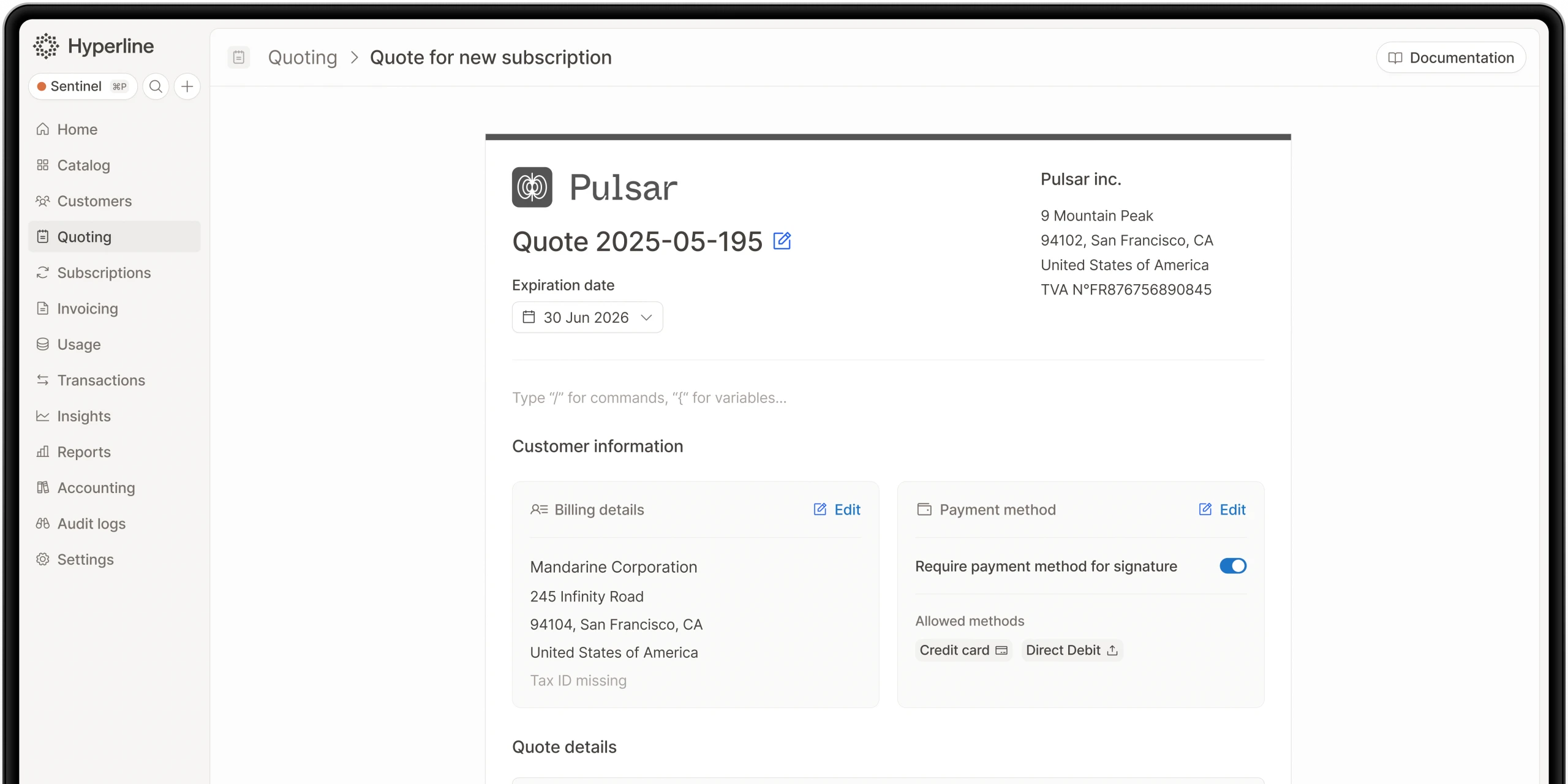
Modern SaaS companies rely on HubSpot to manage leads, deals, and customer relationships. But when billing lives outside the CRM, sales and finance lose alignment. Manual data entry slows down revenue recognition, and quotes often become disconnected from invoices.Hyperline connects HubSpot directly to its billing platform, creating a unified workflow between CRM, invoicing, and payments. Every closed deal instantly becomes an invoice, and every payment syncs back into HubSpot. The result is a single, automated revenue process.
The problem: disconnected CRM and billing systems
In many companies, HubSpot handles customer data while billing happens in a separate platform. That disconnect creates inefficiency and data errors. Finance and sales often work from different versions of the truth, one tracking deals, the other tracking payments.
Common issues include:
-
Duplicate data entry between systems
-
Manual invoice creation
-
Inconsistent customer records
-
Delayed reporting and forecasting
These manual workflows slow down cash flow and make it harder to scale.
The solution: Hyperline’s HubSpot billing integration
Hyperline’s HubSpot integration bridges the gap between sales and finance. It turns HubSpot into the central hub of the revenue process by automating how deals, customers, and invoices flow between both systems.
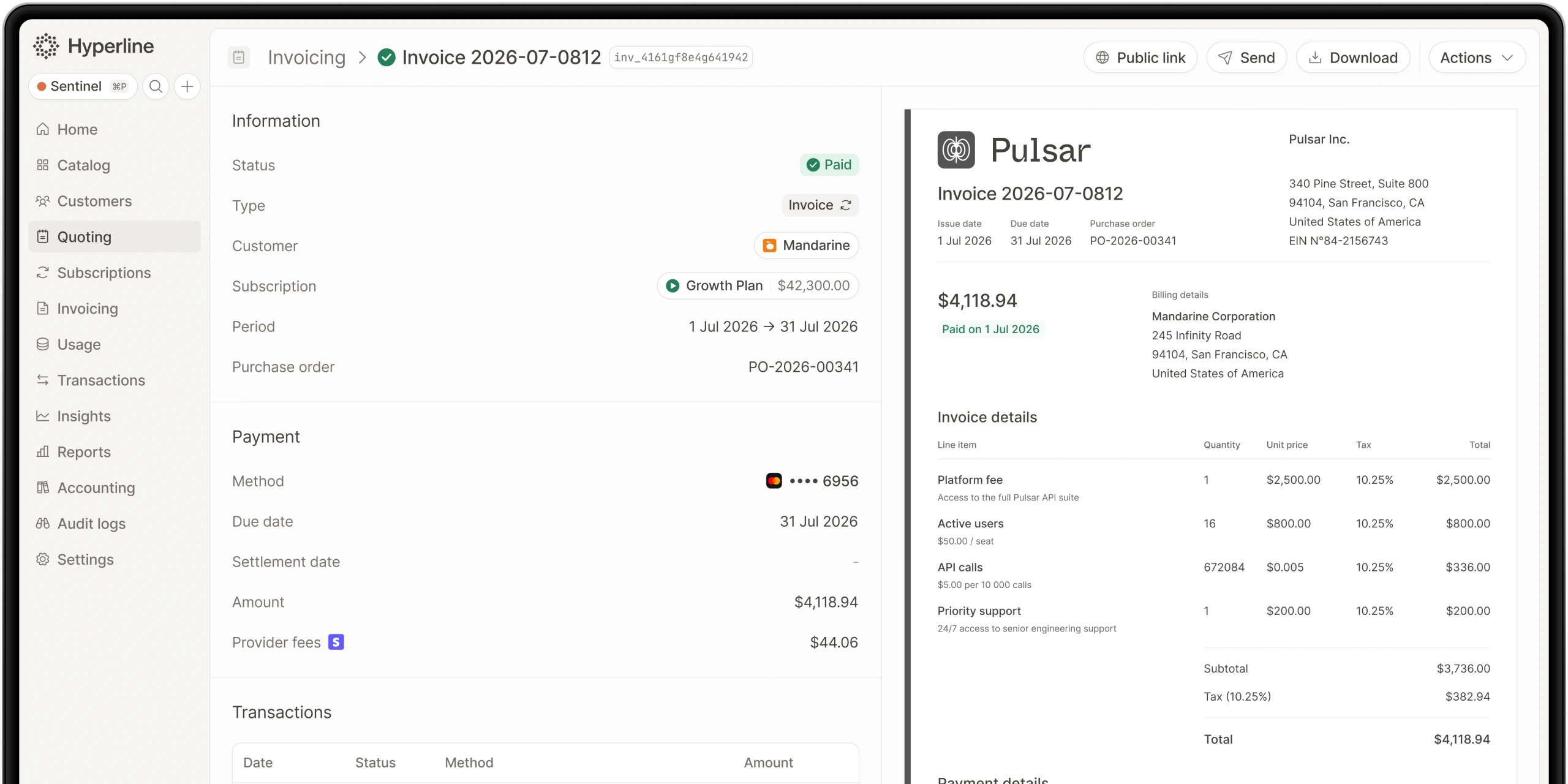
When a deal moves to Closed Won in HubSpot, Hyperline automatically:
-
Generates an invoice
-
Syncs customer and subscription details
-
Updates payment status in real time
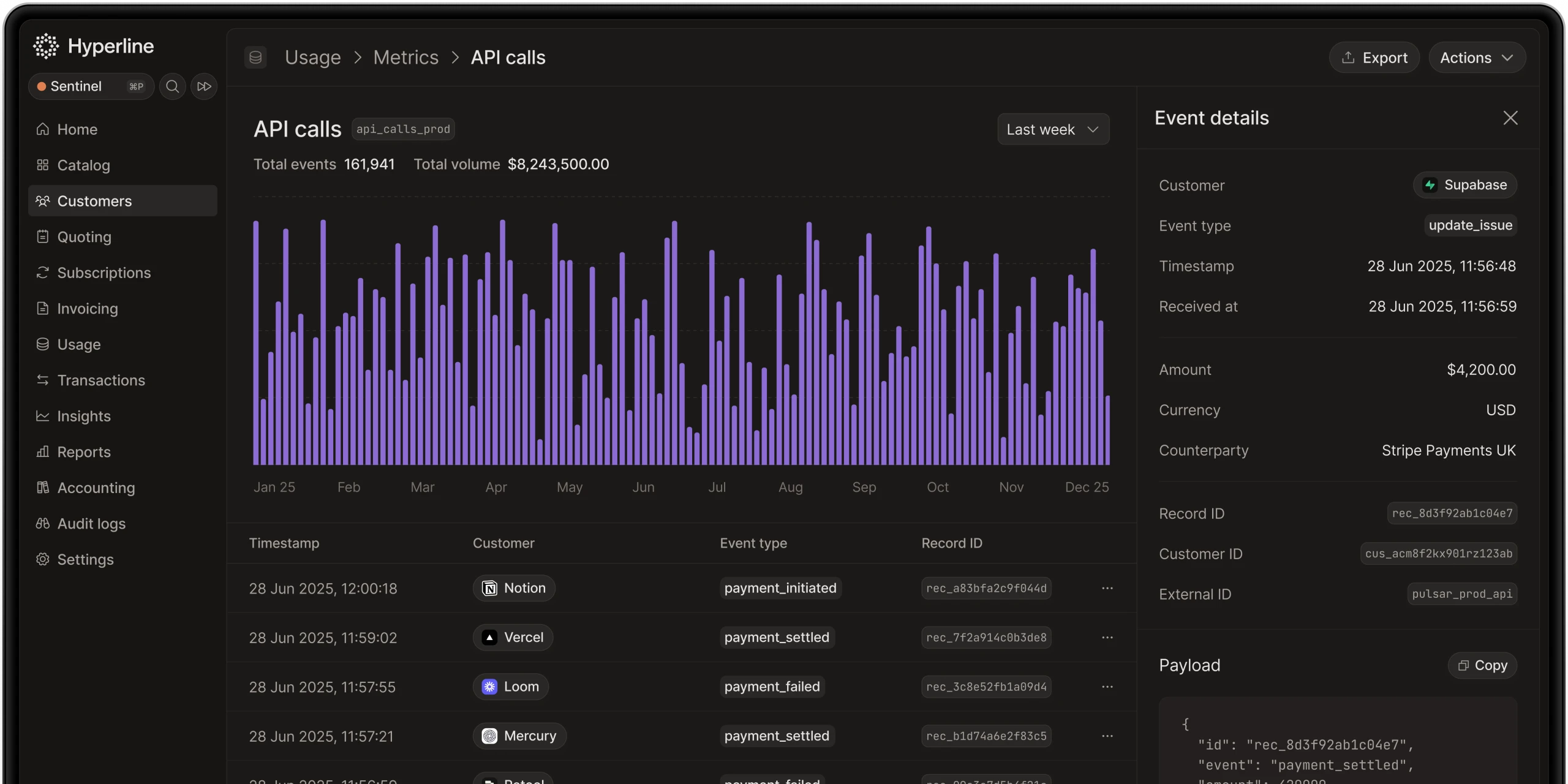
This connection also supports complex SaaS models such as recurring billing and usage-based billing, giving finance teams visibility without manual reconciliation.
How it works
The integration is simple but powerful.
-
A sales rep closes a deal in HubSpot.
-
Hyperline automatically creates and sends the invoice.
-
Payments and subscriptions sync back into HubSpot.
-
Sales and finance share one up-to-date revenue view.
No CSV exports, no duplicate data, no delays, just a smooth quote-to-cash process from one connected platform.
Benefits for SaaS companies
By connecting HubSpot and Hyperline, SaaS businesses gain a shared, automated view of their revenue operations.
Faster billing cycles
Invoices are issued instantly when deals close, accelerating cash collection.
Cleaner data
Customer and subscription details stay aligned across systems, reducing human error.
Better visibility
Both sales and finance access real-time data on invoices, payments, and renewals.
Higher productivity
Automation frees teams from manual reconciliation and reporting.
With Hyperline, HubSpot evolves from a CRM into a complete revenue control center.
Why choose Hyperline with HubSpot
Hyperline was built for revenue operations. The HubSpot integration extends CRM functionality with end-to-end billing automation, no middleware or spreadsheets required.
You can:
-
Manage recurring and usage-based billing models
-
Generate multi-currency invoices
-
Automate renewals and credits
-
Track MRR, ARR, and other revenue metrics
Hyperline gives SaaS companies a connected, scalable quote-to-cash infrastructure that keeps HubSpot at the heart of operations.
Getting started
Connecting HubSpot to Hyperline takes just a few minutes. Simply go to Integrations in Hyperline, select HubSpot, authorize data access, and map your customer fields. Once everything is set up, invoices are automatically synced when deals are closed.
From that point, HubSpot becomes your central workspace while Hyperline powers all billing and revenue logic in the background.
Where this fits in Hyperline
Frequently asked questions
LedgerUp is focused on the post-signature handoff: getting from a signed contract to a first invoice quickly. It does not include native CPQ, and its global e-invoicing and revenue recognition depth are limited compared to a full quote-to-cash platform, so teams that scale into hybrid pricing or larger, multi-country contracts typically re-evaluate.
As SaaS companies grow, billing needs become more complex. HubSpot CPQ has limits: no quote-to-invoice automation, little pricing flexibility, basic reporting, manual revenue recognition, and no advanced subscription support.
It depends on pricing complexity. Simple, flat subscription pricing can run acceptably on separate best-of-breed tools connected by integrations. Once pricing includes usage-based or hybrid components, or deal sizes require approval workflows and e-signature, the reconciliation cost of stitched-together tools tends to outweigh the flexibility of picking each piece independently.
No. Conga CPQ is built for configuration depth on multi-line, rule-heavy quotes, historically tied closely to Salesforce. Billing and usage metering live outside the product, so it typically functions as the quoting layer in front of a separate billing system rather than a complete quote-to-cash platform on its own.
No. DealHub is a sales-side CPQ and contract lifecycle management tool, strong at quote building, redlining, and e-signature. Billing, usage metering, and revenue recognition are not native, so teams pair it with a separate billing platform and manage the handoff between the two.
Hyperline is a billing platform for B2B SaaS. It automates quote-to-cash, supports usage-based pricing, manages revenue recognition, connects with HubSpot, and gives real-time revenue data.
Each platform is scored against five consistent criteria: best fit (the buyer situation it actually suits), strongest part of quote-to-cash (where it genuinely leads), evidence reviewed (public pricing pages, product documentation, and G2 category listings), and watch-out (the limitation buyers run into first). Vendor claims that aren't verifiable against a public source are described qualitatively rather than repeated as fact.
Teams struggle with incomplete revenue reports, manual invoice creation, hard-to-manage contracts, weak accounting links, and too much work in spreadsheets.