Revenue leakage in usage-based pricing: how SaaS teams diagnose, plug, and prevent it
A field-tested guide to identifying and closing the gaps where usage-based SaaS revenue silently slips away, from raw events to collected payments.
Most SaaS teams obsess over winning new revenue. The unsexy truth is that protecting the revenue you have already earned often delivers a bigger margin lift than any acquisition campaign, and usage-based companies are the most exposed.
In a flat per-seat model, leakage is rare: the price is signed in the contract, the invoice runs once a month, and reconciliation is trivial. In a usage-based model, every API call, token, second of compute, or row of data pulled is a billable event. Multiply that by thousands of customers and millions of monthly events, and a 1% silent loss in your metering pipeline translates into hundreds of thousands of dollars unbilled per year.
Industry benchmarks put usage-based revenue leakage between 1% and 7% of recognized revenue, with the upper range hitting AI infrastructure and high-frequency API products. Most of it is invisible until a customer notices, and by then you have usually been losing for months.
This guide walks through where leakage actually originates in a usage-based stack, how to detect it before it becomes material, and the operational steps SaaS finance and RevOps teams can take to close every gap. We then cover how Hyperline removes the most common failure points by design.
TL;DR
Revenue leakage in usage-based pricing is rarely caused by one big issue. It is the cumulative effect of small gaps, a missed metering event here, an outdated entitlement there, a failed payment that never gets retried, compounding silently across millions of transactions.
The pattern repeats across SaaS companies:
- Pipelines drop or duplicate events when traffic spikes
- Pricing rules drift between the contract, the CRM, and the billing engine
- Manual handoffs between teams introduce reconciliation lag
- Customers cannot see what they are being billed for, so they dispute or churn
The fix is not a new tool. It is a discipline: instrument the entire revenue chain end-to-end, set explicit accuracy targets, and remove every manual step that introduces drift.
This guide breaks down:
- The six failure modes that account for most usage-based leakage
- A seven-stage operational framework to close each gap
- How Hyperline implements that framework natively, from raw event ingestion to collection and audit
Where revenue actually leaks in a usage-based SaaS
Metering blind spots: events that never reach the billing system
In any usage-based product, the meter is the source of truth. When events drop, get duplicated, or arrive out of order, every downstream system inherits that error.
The most frequent root causes are: retries without idempotency keys (the same event gets stored twice and the customer gets double-charged), back-pressure failures during traffic peaks (events get queued, then dropped on restart), and clock skew between event producers (events arrive in the wrong billing period).
The cost compounds at scale. A 0.5% drop rate on 200 million monthly events is a million billable units lost every month, and the absence of an alert on the meter itself means nobody is looking.
Pricing drift: when the rate book and the billing engine disagree
When a sales rep negotiates a custom rate, a finance team rolls out a new pricing tier, or a product team launches a new feature, those changes need to land in three places at once: the CRM, the contract, and the billing engine. In most companies, only one of the three gets updated immediately.
The result is what finance teams call rate-book drift: a customer signs a 0.04 USD per token rate, but the billing engine still applies the 0.05 USD legacy rate, or the opposite. Either side loses money. Neither side notices for weeks.
The cure is a versioned rate catalog where every price change ships with an effective date, an applicability scope (which customers, which products), and an audit trail. Any change that bypasses the catalog is a leak in the making.
Stack fragmentation: when finance, sales, and engineering see different numbers
In most early-stage SaaS, finance lives in spreadsheets, RevOps in the CRM, and engineering in the product database. Each system has its own definition of a billable event and its own customer ID format.
When the same customer is referenced as cust_4821 in the product, AcmeCorp Inc. in the CRM, and Acme Corp in the invoicing tool, even a perfectly accurate meter feeds the wrong totals. By the time someone runs a reconciliation, the discrepancy has compounded across a quarter.
Late-stage detection: finding the problem after the customer does
If your team learns about a billing error from a support ticket or a churned account, your detection cadence is broken. By the time a paying customer flags an invoice, every other customer with the same issue has likely already silently absorbed it, or worse, started planning their exit.
Continuous reconciliation runs the same usage event through two independent paths (raw meter and billing engine) and surfaces any divergence above a threshold within minutes, not weeks.
Invisible billing: when customers cannot reconcile their own usage
If your customers cannot open a dashboard and verify their usage line by line, every invoice over a certain size becomes a negotiation. They send back questions. Your finance team spends hours producing reports. Some accept the invoice with a discount. Some leave.
B2B SaaS billing studies consistently show that customers who get real-time usage visibility dispute roughly half as often, settle invoices faster, and expand more aggressively than customers who only get an opaque PDF at month-end.
Failed collections: earning revenue and never receiving it
The last leak is the most preventable. Cards expire, banks decline, mandates lapse, and if the only response is a generic payment-failed email, between 5% and 20% of those declines turn into involuntary churn that should have been recovered.
A modern dunning workflow combines smart retry timing (avoiding the same day or weekend that originally failed), proactive card-update prompts before expiry, and graduated reminders that escalate without burning the relationship.
A seven-stage framework for leak-proof usage billing
1. Make event ingestion deterministic, not eventually-consistent
Every event entering your meter needs three guarantees: a unique idempotency key (so retries do not multiply), a reception timestamp distinct from the event's own timestamp (so out-of-order events still land in the correct period), and a signed payload (so events cannot be tampered with downstream).
Adopt append-only event storage. Never delete a record. Corrections are new events that reference the original ID, which preserves the audit trail and lets you replay any billing cycle from scratch.
2. Resolve identity and entitlements before pricing kicks in
Raw events arrive with technical identifiers. Before they can be priced, they need to be tied to a customer record, a subscription, a plan, and the entitlements active at the moment of the event.
Set up a quarantine path for any event that fails identity resolution. Quarantined events are recoverable; events priced against the wrong customer often are not, because the invoice has already been sent.
3. Centralize pricing in a versioned, queryable catalog
Every price, every commit, every overage rate, and every discount belongs in one source of truth that ships with version history. The catalog is queried at billing time, never hard-coded, and exposes a clear API for sales tooling, the customer portal, and the billing engine to consume.
When you ship a price change, the catalog records who changed what, when, and for which customer cohort. A customer signed under v3 of a rate stays on v3 until you actively migrate them.
4. Eliminate manual steps from rating and invoice generation
Anywhere a human exports usage to a spreadsheet, calculates a number, and pastes it into an invoice, leakage is statistically inevitable. The fix is to push as much of the rating and invoicing pipeline into code as possible: the meter aggregates, the catalog rates, the engine drafts the invoice, and the human only reviews exceptions.
This unlocks two further benefits: real-time invoice previews (customers can see exactly where they stand mid-cycle) and same-day month-end close (instead of week-long reconciliation marathons).
5. Detect drift continuously with paired-system reconciliation
Pick three numbers and watch them every day:
- Capture completeness: percentage of raw meter events that successfully reach the billing engine. Anything under 99.5% is a red flag.
- Pricing latency: time elapsed between an event's reception and its appearance on a draft invoice. Over 24 hours and customers will start seeing inconsistencies in their dashboard.
- Invoice drift: dollar variance between draft invoices and the same period's recomputed totals when the catalog is replayed from scratch. Over 0.5% and someone has hand-edited an invoice that should not have been touched.
Run the comparison automatically every night. Set Slack or PagerDuty alerts on the thresholds. Treat any breach as an incident, not a backlog item.
6. Treat revenue protection as a cross-functional discipline, not a finance task
Leakage prevention requires sales (who negotiate the rates), finance (who closes the books), engineering (who runs the meter), and customer success (who hears the disputes first) to share one operational view.
The companies that catch leakage earliest tend to run a weekly revenue integrity huddle: 30 minutes, three numbers (capture completeness, pricing latency, invoice drift), one decision per anomaly. No slides, no debate about whose number is right, only one shared dashboard.
7. Audit aggressively, refactor what does not pay rent
A quarterly audit looks at every leakage incident surfaced in the last 90 days, classifies it by stage of the framework above, and asks whether the underlying cause has been removed or merely patched. If the same root cause has triggered three incidents, that piece of the pipeline gets rewritten, not retried.
Most teams underinvest here. The audit is what turns a one-off fix into permanent leak immunity.
How Hyperline closes each leak point
Hyperline was built around the assumption that usage-based revenue is too high-stakes to be assembled from disconnected tools. Each layer is designed to plug a specific class of leak.
Idempotent, real-time event ingestion
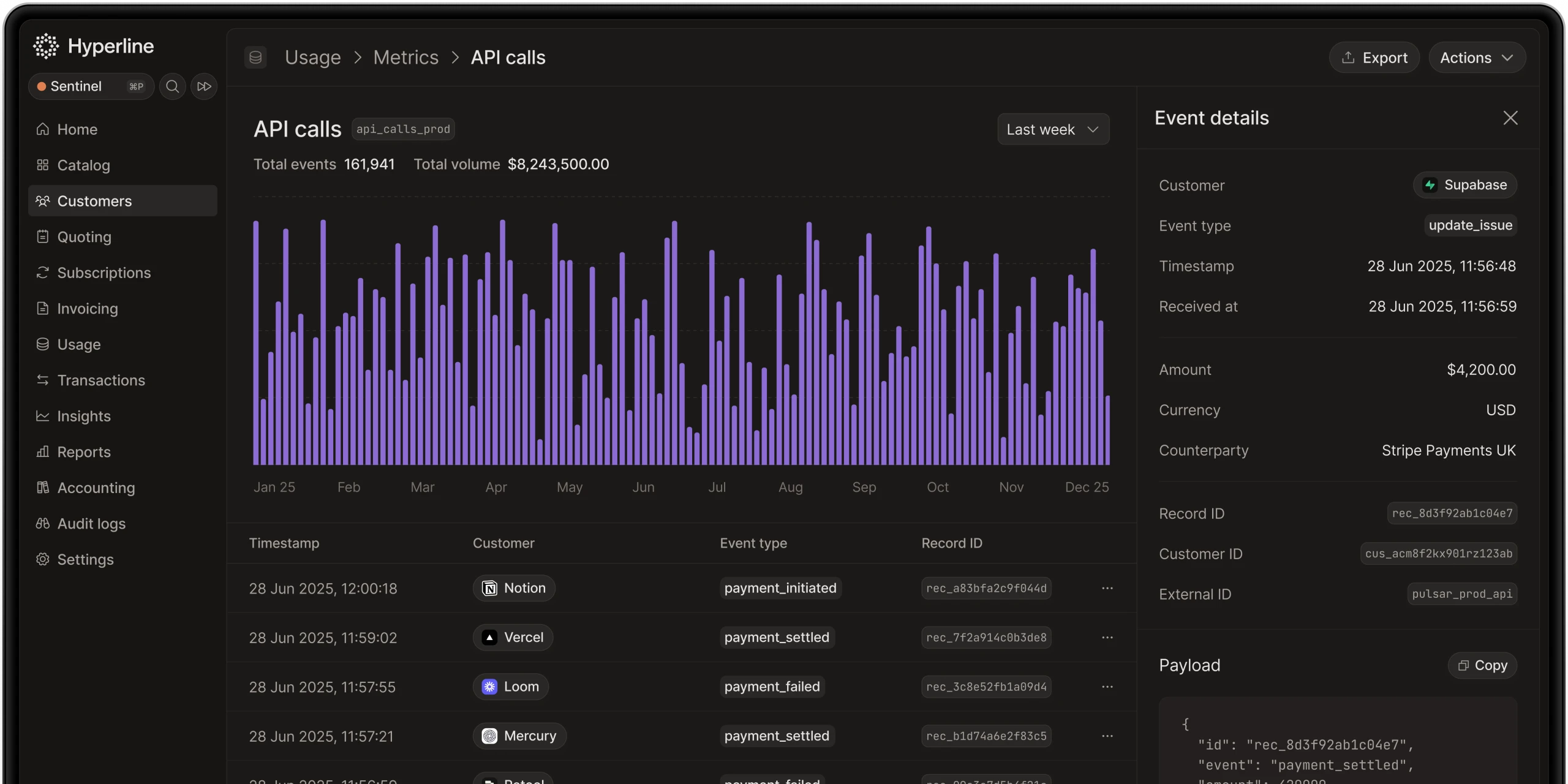
Hyperline's metering API enforces idempotency keys on every event, distinguishes event time from reception time natively, and accepts events through HTTPS APIs, database connectors, or batch CSV uploads. The pipeline handles billions of events per month without dropping or duplicating.
Built-in identity resolution and entitlement enforcement
Customer mapping happens at ingestion, not at invoicing. Entitlements (caps, soft limits, prepaid credit wallets, rollover rules) are configured per plan and enforced in real time, with optional notifications at 50%, 80%, and 100% of any threshold.
Versioned pricing catalog
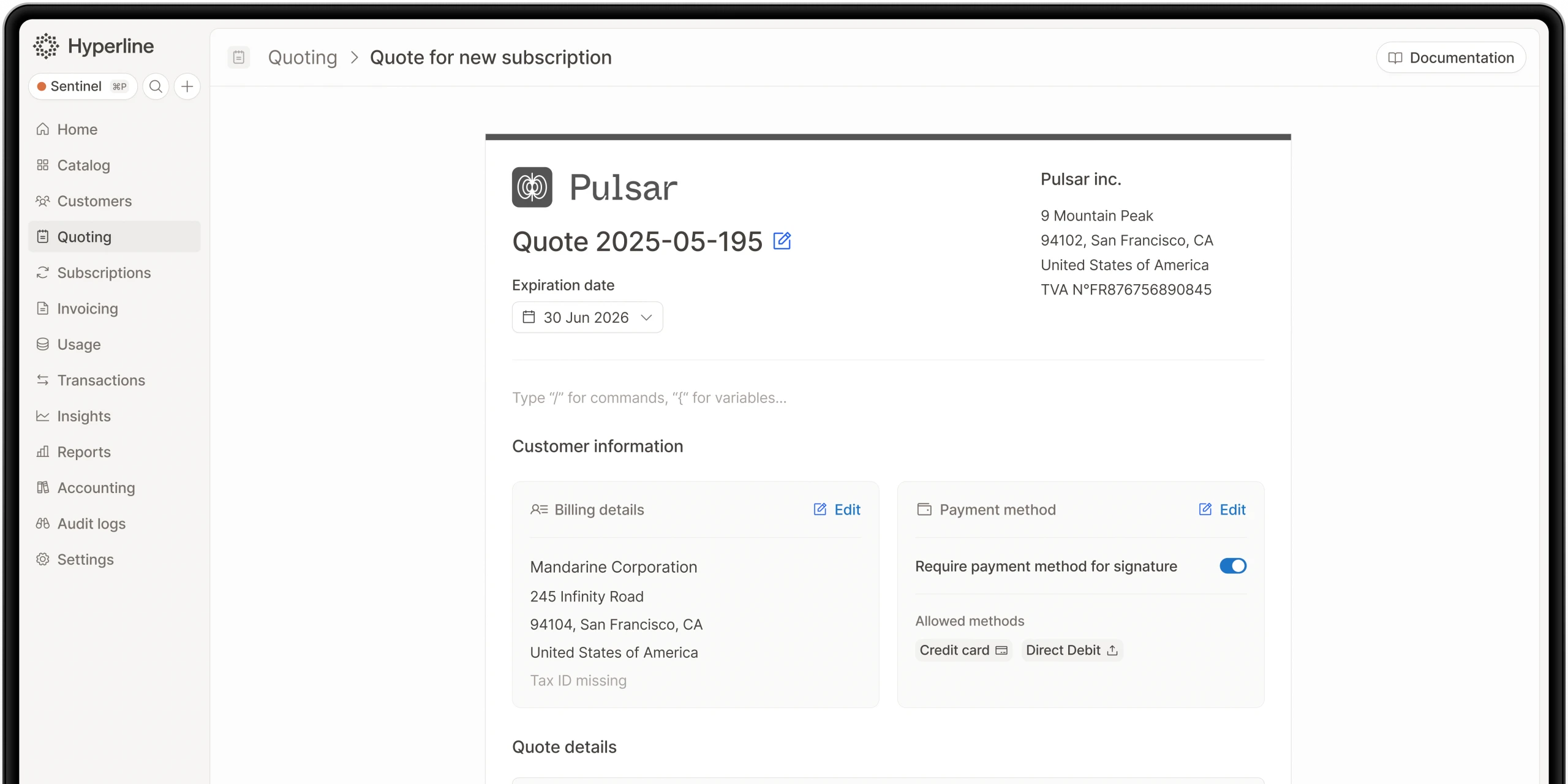
Every price, every contract, and every commit lives in a catalog with full version history. A customer signed at v2 of your rate stays on v2 until you migrate them explicitly. Sales tooling, the customer portal, and the billing engine all read from the same source.
Real-time customer dashboards and invoice previews
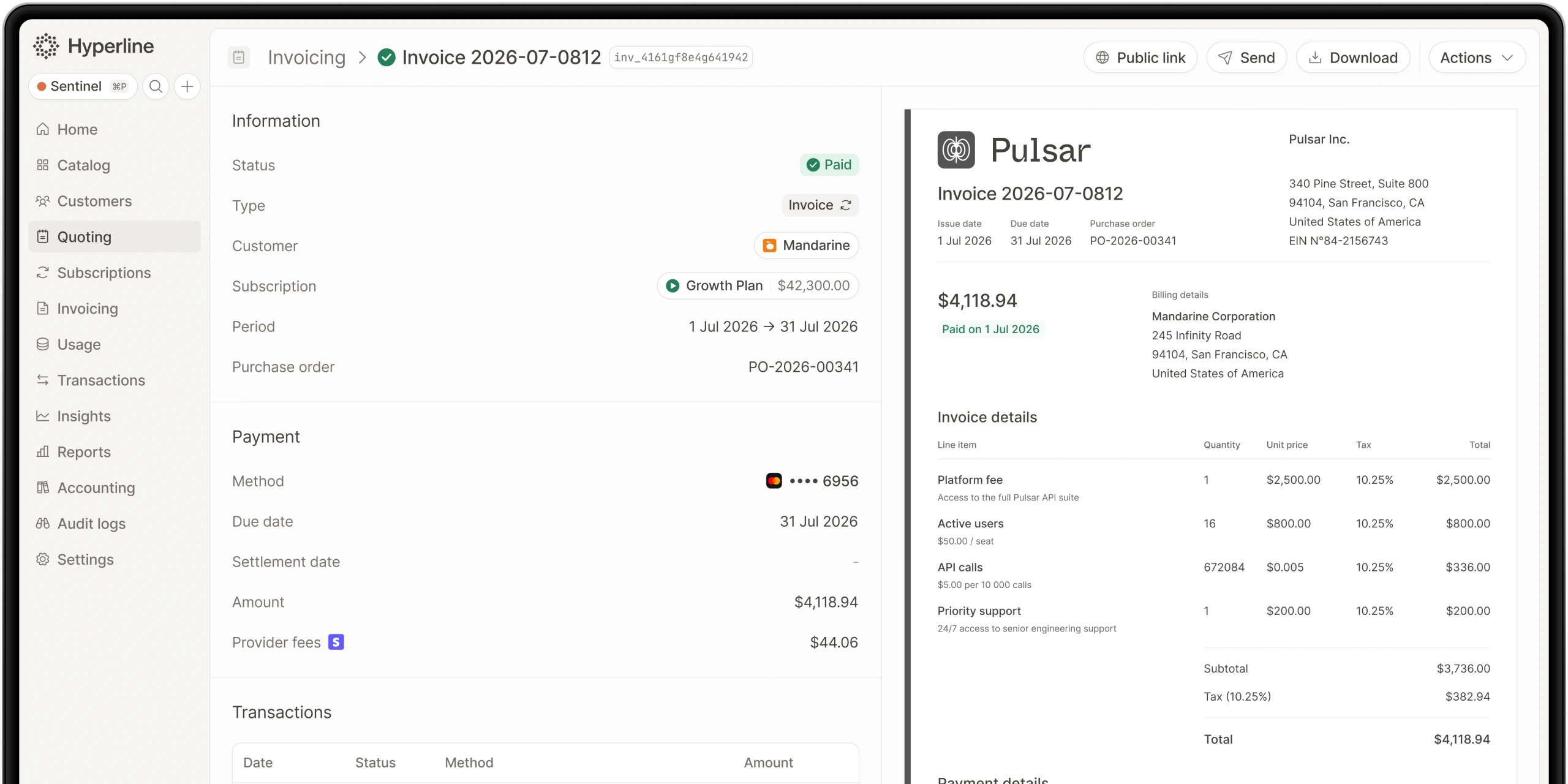
Customers see their usage as it happens, with a continuously updated invoice preview. Internal teams see the same numbers, eliminating the their-invoice-does-not-match-my-CRM tickets.
Automated dunning across major payment providers
Out-of-the-box integrations with Stripe, Mollie, GoCardless, and Airwallex handle smart retries, card-update reminders, and graduated dunning sequences without dev work.
Pre-built integrations with the rest of your stack
Native connectors to CRMs (HubSpot, Salesforce, Attio), ERPs, data warehouses (Snowflake, BigQuery), and analytics platforms keep your numbers consistent across every system that touches revenue.
No-code pricing experiments
New rates, new bundles, and pricing migrations ship through configuration, not code. The product team runs experiments without blocking engineering.
Time saved
Customers using Hyperline report up to 90% less time spent on billing operations and same-day month-end close, freeing finance and engineering to focus on the work that actually grows the business.
Frequently asked questions
How is revenue leakage different from bad debt or churn?
Bad debt is invoiced revenue that the customer refuses or fails to pay. Churn is revenue that disappears because the customer leaves. Revenue leakage sits upstream of both: it is the value you delivered but never invoiced for, or invoiced incorrectly. It does not show up in your churn report or your AR aging, which is why most teams underestimate how much of it they have.
What is a realistic leakage rate for a usage-based SaaS?
Most companies running a manual or semi-automated usage-based stack lose somewhere between 1% and 7% of recognized revenue to leakage. The figure correlates with event volume (the more events, the more places they can drop), pricing complexity (tiered or hybrid pricing leaks more than flat rates), and the number of teams that touch the rate book.
Where should a finance team start if they suspect leakage but cannot prove it?
Run a one-month back-test: pick 10 customers across your top revenue tier, pull every billable event for the last 30 days from your raw meter, recompute their invoices from the rate catalog independently, and compare the recomputed totals to the invoices you actually sent. If the variance exceeds 0.5%, you have measurable leakage and a starting point for root-cause analysis.
Can leakage be eliminated entirely?
In a high-volume usage-based stack, perfect zero leakage is not a realistic target. The realistic target is sub-0.1% drift, surfaced within 24 hours, with every event traceable to its source. At that level, leakage stops being a structural problem and becomes a daily operational signal.
Where this fits in Hyperline
Frequently asked questions
For low-frequency usage add-ons, batch processing is often fine. For consumption that drives a meaningful share of revenue, especially high-frequency events like API calls or AI token usage, batch cycles limit visibility into what a customer currently owes and make anomalies harder to catch before they hit an invoice.
Salesforce Revenue Cloud's strength is CPQ configurability inside the Salesforce ecosystem. Usage-based and consumption billing is a comparatively newer layer than its quoting core, and the platform generally requires meaningful Salesforce admin and implementation investment to configure well for hybrid pricing.
Teams struggle with incomplete revenue reports, manual invoice creation, hard-to-manage contracts, weak accounting links, and too much work in spreadsheets.
It varies widely by platform and by how much configuration a business needs. Enterprise-grade, highly configurable platforms like Zuora, Oracle CPQ, or Salesforce Revenue Cloud commonly run several months. Platforms built around a narrower, more opinionated setup, including Hyperline's roughly two-month target, tend to move faster because there's less to configure from scratch.
Yes. Hyperline connects to Stripe, GoCardless, Mollie, Airwallex, and bank transfers. It automates payment matching and reminders.
As SaaS companies grow, billing needs become more complex. HubSpot CPQ has limits: no quote-to-invoice automation, little pricing flexibility, basic reporting, manual revenue recognition, and no advanced subscription support.
No. Chargebee processes usage through batch imports applied on the next invoice cycle rather than true real-time metering, a limitation reviewers note directly on G2. Platforms built around usage-based and hybrid pricing from the start, like Hyperline, meter events as they happen instead.
No. DealHub is a sales-side CPQ and contract lifecycle management tool, strong at quote building, redlining, and e-signature. Billing, usage metering, and revenue recognition are not native, so teams pair it with a separate billing platform and manage the handoff between the two.