Billing platform comparison guide: why Hyperline leads for modern SaaS
Modern billing platforms remove manual effort by automating the entire quote-to-cash cycle and connecting CRM, payments, and accounting into one smooth workflow. The right system can cut billing time by up to 90%, improving cash flow and freeing teams to focus on growth rather than administrative tasks. Hyperline provides a flexible, no-code solution that supports any pricing model, from simple subscriptions to complex usage-based billing, with native CRM integration.
Choosing the right billing system is one of the most important technology decisions finance and IT leaders can make
If billing runs smoothly, payments flow in, reports are accurate, and customers get a consistent experience. If it doesn't, reconciliation errors pile up, cash flow slows, and teams spend their days fixing problems instead of growing the business. While several billing platforms exist, Hyperline has emerged as a leading choice for B2B SaaS companies looking to automate their entire quote-to-cash process. This guide takes a closer look at what makes a modern billing platform effective and how Hyperline addresses the most common billing challenges.
Platform capabilities
Modern billing platforms are designed to connect billing with sales, service, and customer management
Instead of having invoices live in a separate system, billing should integrate seamlessly with the tools teams already use. This makes the entire order-to-cash cycle more transparent and reduces manual work.
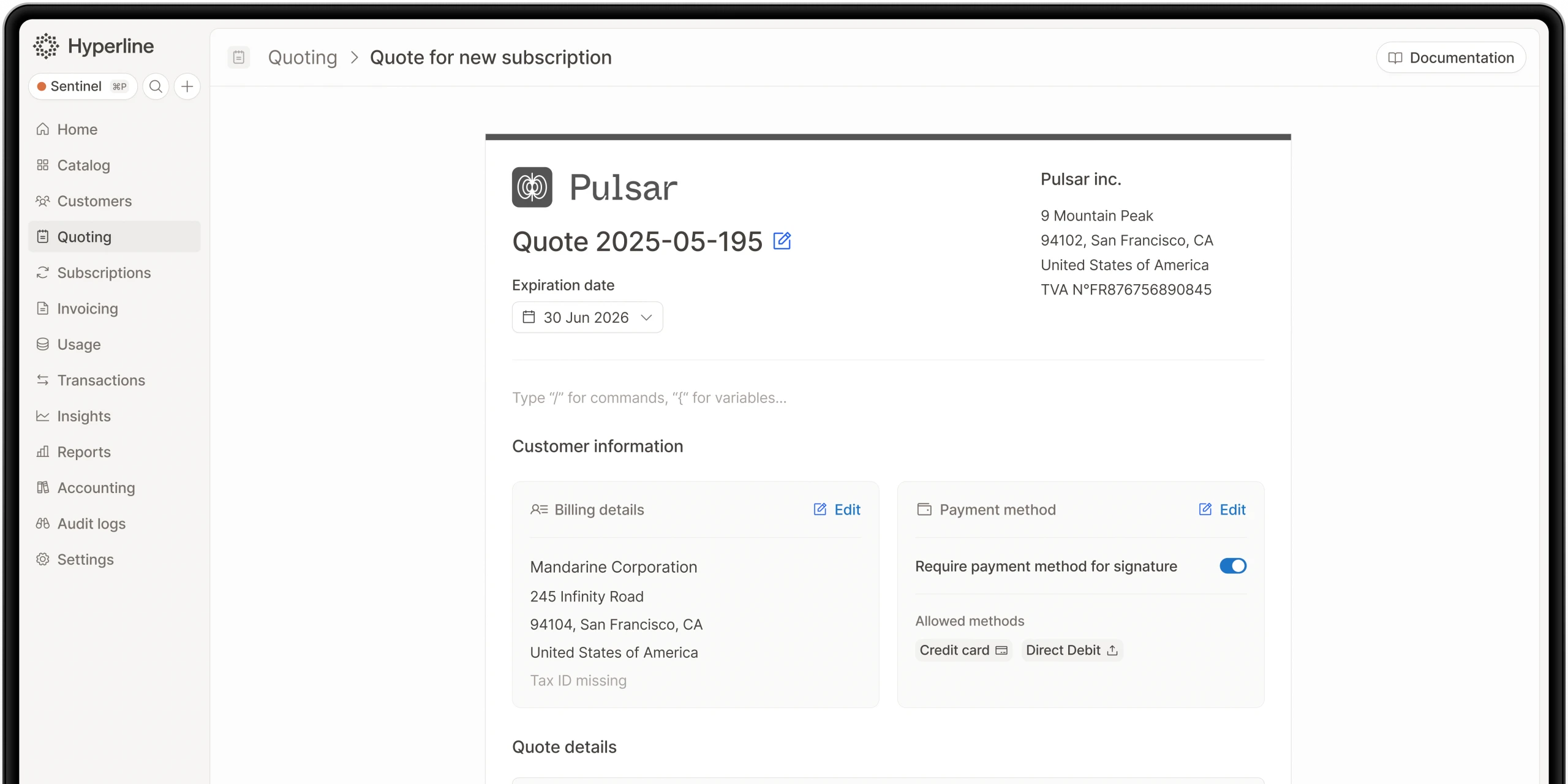
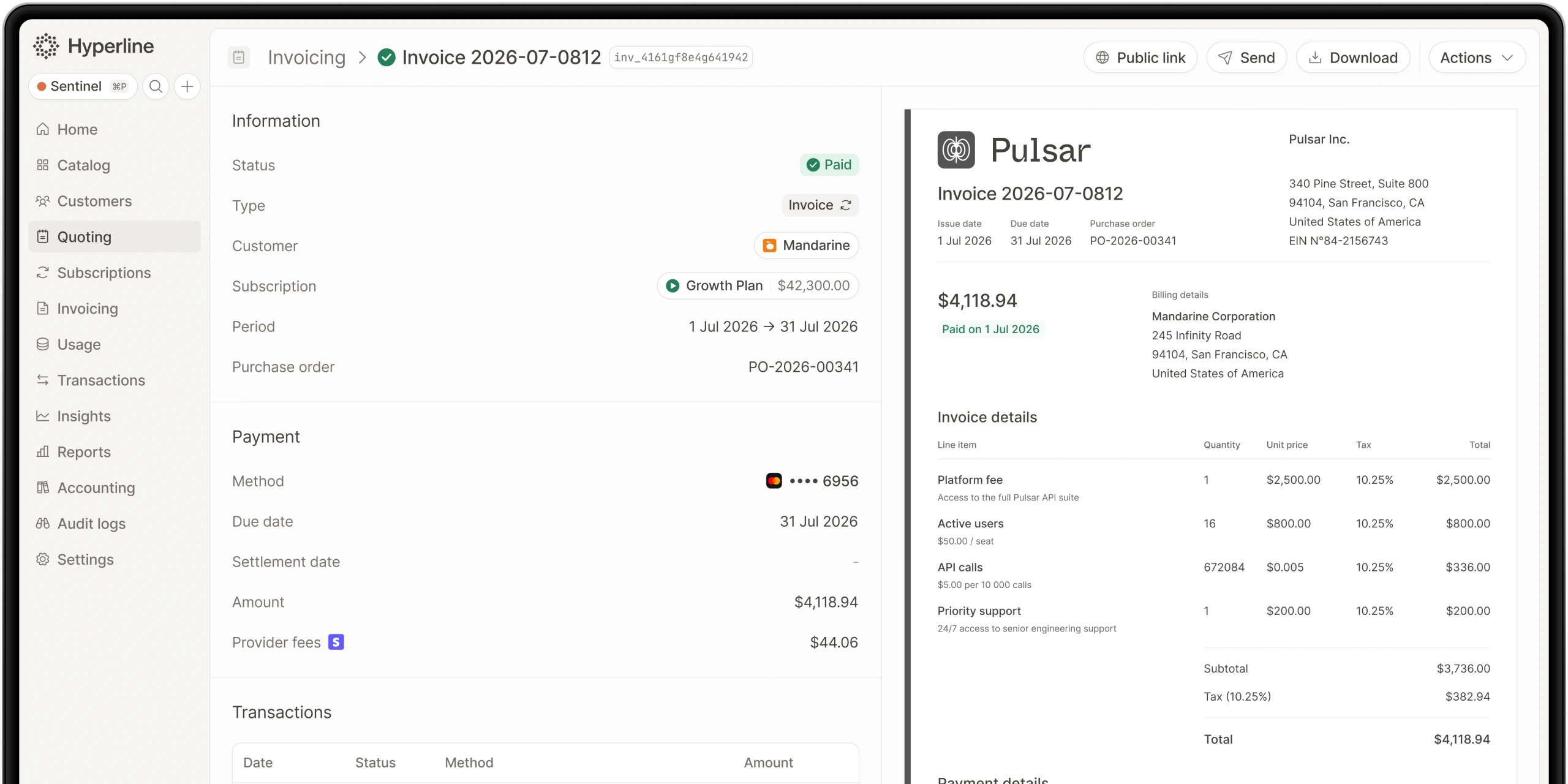
Core capabilities include automated invoicing, subscription billing, and recurring payments. For businesses running complex revenue models, platforms should support advanced revenue recognition tools and compliance reporting. Finance teams need customizable workflows for discounts, approvals, or contract amendments. Dashboards should allow leadership to see cash flow, accounts receivable, and recurring revenue in one place.
Hyperline was built specifically to address these needs for B2B SaaS companies. The platform connects billing to CRMs like Salesforce and HubSpot, ERPs, payment providers including Stripe, Mollie, GoCardless, and Airwallex, analytics platforms, and data warehouses. Everything stays in sync, automated, accurate, and always up to date. One of Hyperline's standout features is its ability to handle any pricing model without requiring code, from flat fees and per-seat billing to usage-based pricing with pre-paid credits, tiered prices, or custom agreements.
Pricing models
Understanding billing platform pricing is important because costs vary based on how your business is structured
Different platforms follow different pricing approaches, and it's essential to understand what you're paying for and the value you receive.
Compared to legacy billing solutions, Hyperline offers flexible pricing that scales with your business. The platform can be tested for free in test mode, allowing teams to explore capabilities before committing. This transparency contrasts with some competitors where pricing structures can be opaque or where features are locked behind expensive add-ons.
What sets Hyperline apart is the combination of affordability and comprehensive functionality. While platforms like Salesforce Billing require significant upfront investment and technical resources, Hyperline can be set up without a single line of code. The platform reduces the time spent on billing by up to 90%, eliminating the need for external integrators. For companies generating between €3 and €10 million in revenue, which represents the majority of Hyperline's customer base, this combination of flexibility and ease of use creates substantial value.
ROI analysis
When evaluating billing software, return on investment goes beyond licensing costs
With modern billing platforms like Hyperline, ROI comes from time saved and errors avoided. Automating invoicing reduces the hours staff spend on manual data entry. Faster invoice-to-cash cycles improve cash flow. Built-in revenue recognition capabilities reduce compliance risk and help companies close their books faster.
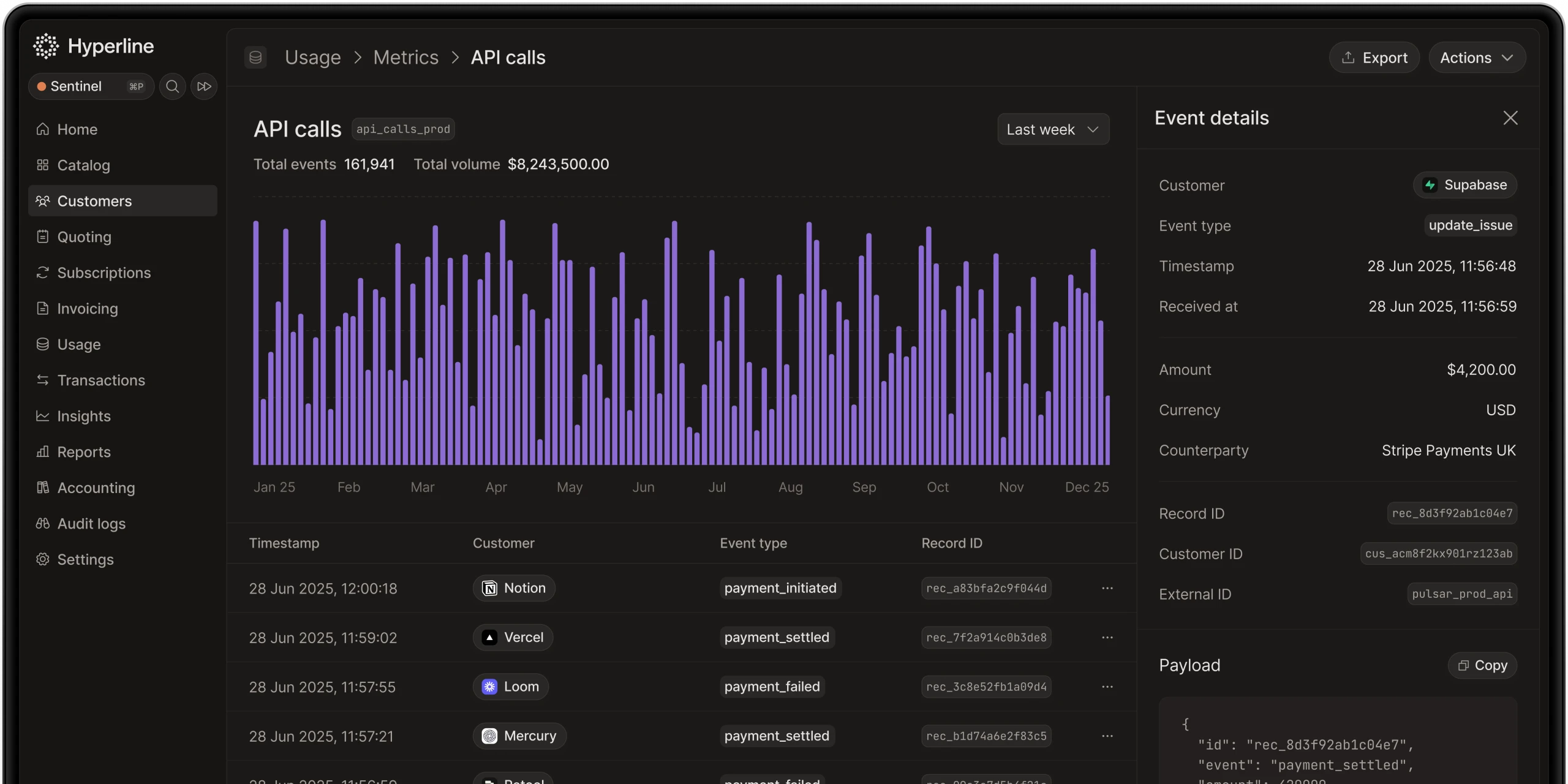
Consider a company managing recurring contracts with both subscription and usage-based components. Without strong integration, finance teams might spend days reconciling payments between systems, checking that everything is correct, and handling exceptions. With Hyperline, companies automate these processes entirely. The platform ingests raw usage data through database connectors, APIs, or CSV files, runs calculations automatically, and generates accurate invoices based on consumption.
Real customer results demonstrate this value. Companies using Hyperline report that weekly billing reviews have become unnecessary because the platform handles operations automatically. As one customer stated, "Switching to Hyperline had a bigger impact than expected, we finally have control over billing from a finance perspective." Another noted, "We used to have a weekly billing review with my finance team, but Hyperline made it totally useless."
For many finance leaders, the decision comes down to reducing complexity. If billing is disconnected, reports are incomplete and audits become stressful. Hyperline provides one reliable place to see all billing data, creating a single source of truth that connects finance, sales, engineering, and leadership teams.
Competitor overview
Before committing to a billing platform, it helps to understand how different solutions compare
Here's a brief overview:
Salesforce Billing: Excellent for companies heavily invested in the Salesforce ecosystem, but requires significant technical resources and can be time-consuming to customize. Best for enterprise organizations with dedicated implementation teams.
Chargebee: A legacy billing platform that supports subscription management, but many users report complexity in the interface and poor customer support. Configuration can be time consuming, especially for complex pricing models.
Zuora: Offers strong subscription billing capabilities but is primarily focused on larger enterprises. Implementation often requires external integrators and significant technical resources.
Stripe Billing: Developer-focused solution that requires coding expertise to configure properly. While powerful, it demands significant engineering time to handle complex pricing structures and lacks the intuitive interface that non-technical teams need.
Hyperline's advantage lies in its combination of flexibility, ease of use, and comprehensive functionality. The platform was built by Lucas Bédout, former VP of Engineering at Spendesk, who experienced firsthand the billing challenges that high-growth companies face. Unlike competitors that require engineering resources or external integrators, Hyperline empowers non-technical teams to manage the end-to-end billing process autonomously with very fast setup and a high level of flexibility.
Solution comparison
When comparing billing platforms, several factors matter most to finance and operations teams
Integration capabilities: Hyperline seamlessly syncs CRM accounts, quotes, subscriptions, and invoices without manual work or technical setup. The platform provides widgets that integrate directly into Salesforce and HubSpot, allowing teams to manage subscriptions using Hyperline's interface within their existing CRM. This bi-directional sync ensures data flows automatically in both directions.
Ease of implementation: Unlike platforms that require weeks or months of development time, Hyperline can be configured and deployed in hours or days. Companies like ScorePlay, a sports-tech platform for media management, chose Hyperline because standard plans couldn't cover their highly modular enterprise deals. Their RevOps team runs billing directly, without engineering time.
Pricing flexibility: Hyperline supports any pricing model, from simple subscriptions to complex hybrid approaches combining flat fees, usage-based components, tiered pricing, and custom deals. Companies can adjust pricing with a single click, making it easy to experiment and iterate on pricing strategies.
Revenue recognition: The platform fully automates revenue recognition and integrates compliance features to help companies adhere to accounting standards like ASC 606 and IFRS 15. This automation helps businesses close books faster and maintain financial transparency.
Customer experience: Hyperline provides hosted pages including customer portals and checkout pages that enable end-users to make payments, update payment methods, add credit to wallets, and download past invoices autonomously. Companies report that these features significantly enhance the end-user experience while reducing support burden.
Integration considerations
Integration is at the heart of a successful billing strategy
Modern billing platforms must connect seamlessly with CRMs, ERPs, accounting systems, payment providers, and data warehouses to eliminate manual work and maintain data accuracy.
Hyperline was designed with integration as a core principle. The platform connects with leading tools across the entire revenue stack:
CRMs: Native integrations with Salesforce, HubSpot, and Attio
Payment providers: Stripe, Mollie, GoCardless, and Airwallex for credit card, direct debit, and bank transfer payments
Accounting software: QuickBooks, Xero, Pennylane, and NetSuite for invoice processing and payment reconciliation
Data sources: Direct connections to PostgreSQL, MongoDB, BigQuery, and Snowflake for usage data ingestion
Analytics tools: Integration with platforms like ChartMogul for revenue analytics
Workflow automation: Slack notifications for real-time alerts and Zapier for custom integrations
For IT teams, Hyperline offers clean APIs, real-time webhooks, and clear documentation that enable quick implementation without extensive development work. The platform acts as a payment orchestrator, providing a unified interface to interact with multiple payment providers rather than requiring teams to juggle different systems.
Why Hyperline is the right choice for modern SaaS billing
Evaluating billing software isn't just about feature checklists
It's about how well the system fits your existing workflows, your team's capacity, and your long-term growth plans. Hyperline offers the right blend of capabilities for B2B SaaS companies at any stage.
For early-stage companies: Hyperline enables you to start billing customers without writing code, allowing technical teams to focus on product development. The free test mode lets you explore the platform before committing, and the quick setup means you can launch with professional billing from day one.
For growing companies: As you scale from 200 to 300+ customers, Hyperline's automation becomes increasingly valuable. The platform reduces the daily operational burden of billing, automatically handling tasks that would otherwise require manual checking and correction. This scalability extends to supporting companies generating between €3 and €10 million in revenue, with proven capability to handle larger volumes.
For enterprise organizations: Hyperline provides the flexibility needed for complex enterprise agreements while maintaining ease of use for operational teams. The platform supports custom pricing, contract amendments, multiple currencies, sophisticated tax handling through integrations like Anrok, and comprehensive reporting for financial planning.
The platform's security and compliance credentials matter too. As a European company, Hyperline handles all client data in accordance with GDPR and EU regulations. The platform is SOC 2 Type II and ISO 27001:2022 certified, ensuring enterprise-grade security.
Perhaps most importantly, Hyperline is backed by Index Ventures with $14 million in funding and has been consistently recognized for exceptional customer support. The team works closely with every customer to support account setup, providing live chat, scheduled calls with solution engineers, assistance with data migrations, and for enterprise customers, dedicated onboarding managers and Slack channels for priority support.
Companies like Praiz, Lokki, Malou, ScorePlay, and Formance have chosen Hyperline to power their billing operations. They report that the platform has transformed billing from a headache into something that simply works, allowing them to focus on what truly matters: growing their business.
Making your billing decision
For professionals tasked with choosing billing platforms, the priority should be clear
Select a solution that eliminates manual work, integrates seamlessly with existing tools, provides flexibility for pricing iteration, and enables non-technical teams to operate autonomously. Hyperline delivers on all these requirements while maintaining the simplicity and transparency that modern finance teams expect.
Whether you're implementing your first billing system or replacing a legacy platform that no longer serves your needs, Hyperline provides a comprehensive solution that scales with your business. The platform's combination of powerful automation, flexible pricing support, native integrations, and exceptional customer service makes it the modern standard for B2B SaaS billing.
Where this fits in Hyperline
Frequently asked questions
LedgerUp is focused on the post-signature handoff: getting from a signed contract to a first invoice quickly. It does not include native CPQ, and its global e-invoicing and revenue recognition depth are limited compared to a full quote-to-cash platform, so teams that scale into hybrid pricing or larger, multi-country contracts typically re-evaluate.
Hyperline is the strongest fit for B2B SaaS companies with usage-based, tiered, or hybrid pricing that need CPQ, billing, and revenue recognition unified in one platform instead of three separate systems. For simple, seat-based pricing already running on Salesforce, or if the only need is post-signature contract handoff automation like LedgerUp provides, a different platform is a better starting point.
It depends on pricing complexity. Simple, flat subscription pricing can run acceptably on separate best-of-breed tools connected by integrations. Once pricing includes usage-based or hybrid components, or deal sizes require approval workflows and e-signature, the reconciliation cost of stitched-together tools tends to outweigh the flexibility of picking each piece independently.
As SaaS companies grow, billing needs become more complex. HubSpot CPQ has limits: no quote-to-invoice automation, little pricing flexibility, basic reporting, manual revenue recognition, and no advanced subscription support.
Teams struggle with incomplete revenue reports, manual invoice creation, hard-to-manage contracts, weak accounting links, and too much work in spreadsheets.
Yes. Hyperline connects to Stripe, GoCardless, Mollie, Airwallex, and bank transfers. It automates payment matching and reminders.
Salesforce Revenue Cloud's strength is CPQ configurability inside the Salesforce ecosystem. Usage-based and consumption billing is a comparatively newer layer than its quoting core, and the platform generally requires meaningful Salesforce admin and implementation investment to configure well for hybrid pricing.
Each platform is scored against five consistent criteria: best fit (the buyer situation it actually suits), strongest part of quote-to-cash (where it genuinely leads), evidence reviewed (public pricing pages, product documentation, and G2 category listings), and watch-out (the limitation buyers run into first). Vendor claims that aren't verifiable against a public source are described qualitatively rather than repeated as fact.