Best Recurring Billing Software for B2B SaaS in 2026
Recurring billing software automates invoicing, payments, and revenue recognition for B2B SaaS companies. Here are the 7 best platforms in 2026.
Managing subscriptions manually does not scale. As your B2B SaaS company grows, billing complexity increases exponentially: multiple pricing models, failed payments, revenue recognition compliance, and dozens of customer-specific contracts. Recurring billing software automates this entire process, from invoice generation to payment collection and financial reconciliation.
This guide covers the best recurring billing software for B2B SaaS companies in 2026, what to look for when choosing one, and why your choice matters beyond just sending invoices.
What Is Recurring Billing Software?
Recurring billing software is a platform that automates the collection of payments on a scheduled basis, whether monthly, annually, or based on usage. For B2B SaaS companies, it handles:
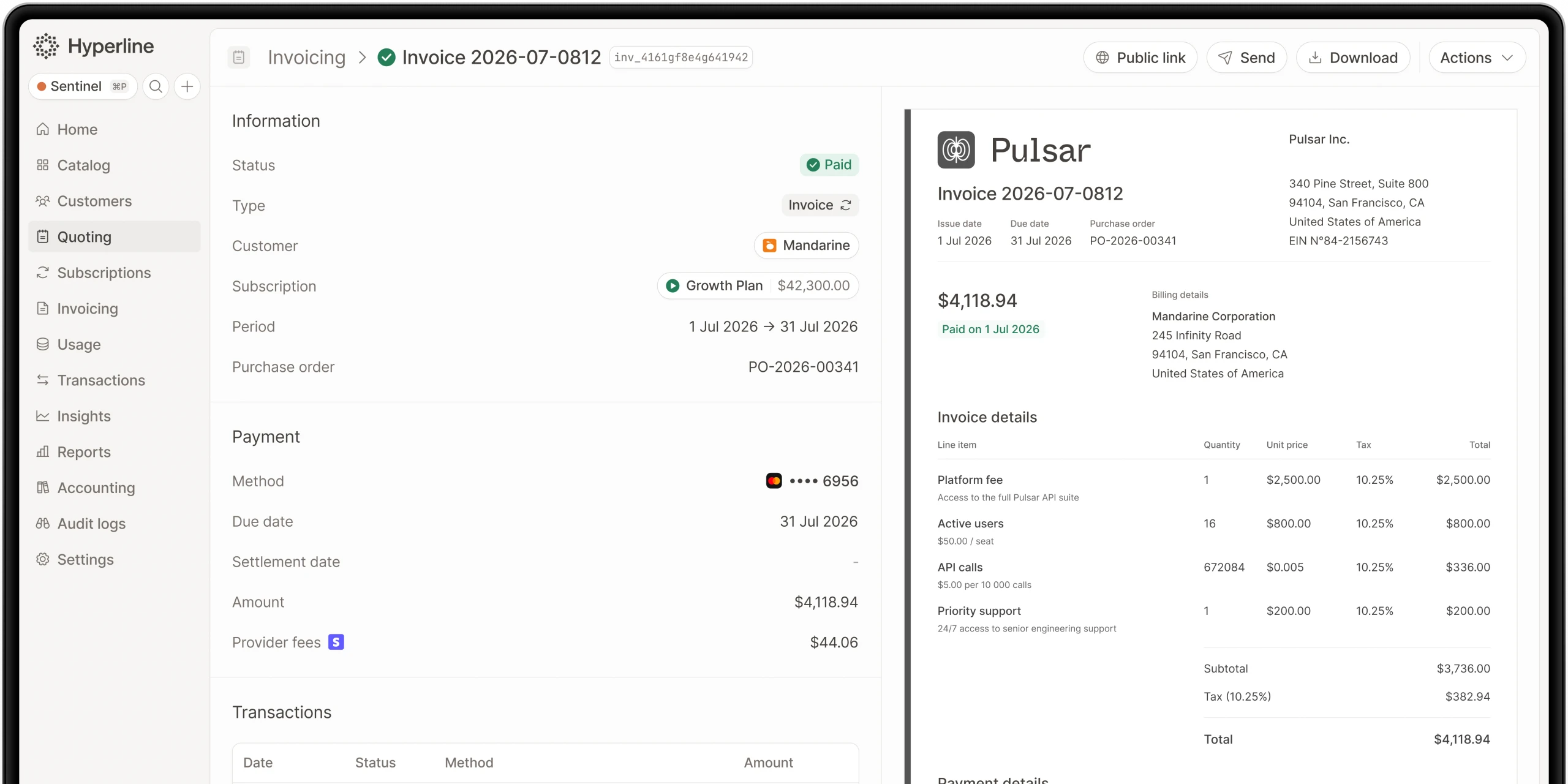
- Automated invoice generation and delivery
- Payment collection across multiple gateways
- Support for complex pricing models (tiered, seat-based, usage-based, hybrid)
- Dunning management for failed payments
- Revenue recognition in line with ASC 606 and IFRS 15
- Real-time metrics tracking (MRR, ARR, churn, NRR)
Without a dedicated billing platform, finance teams spend hours each month on manual reconciliation, custom invoices, and chasing failed payments. At scale, this creates serious revenue leakage and compliance risk. For a deeper look at how companies manage this, see our guide on SaaS subscription management software.
The 7 Best Recurring Billing Software for B2B SaaS
1. Hyperline
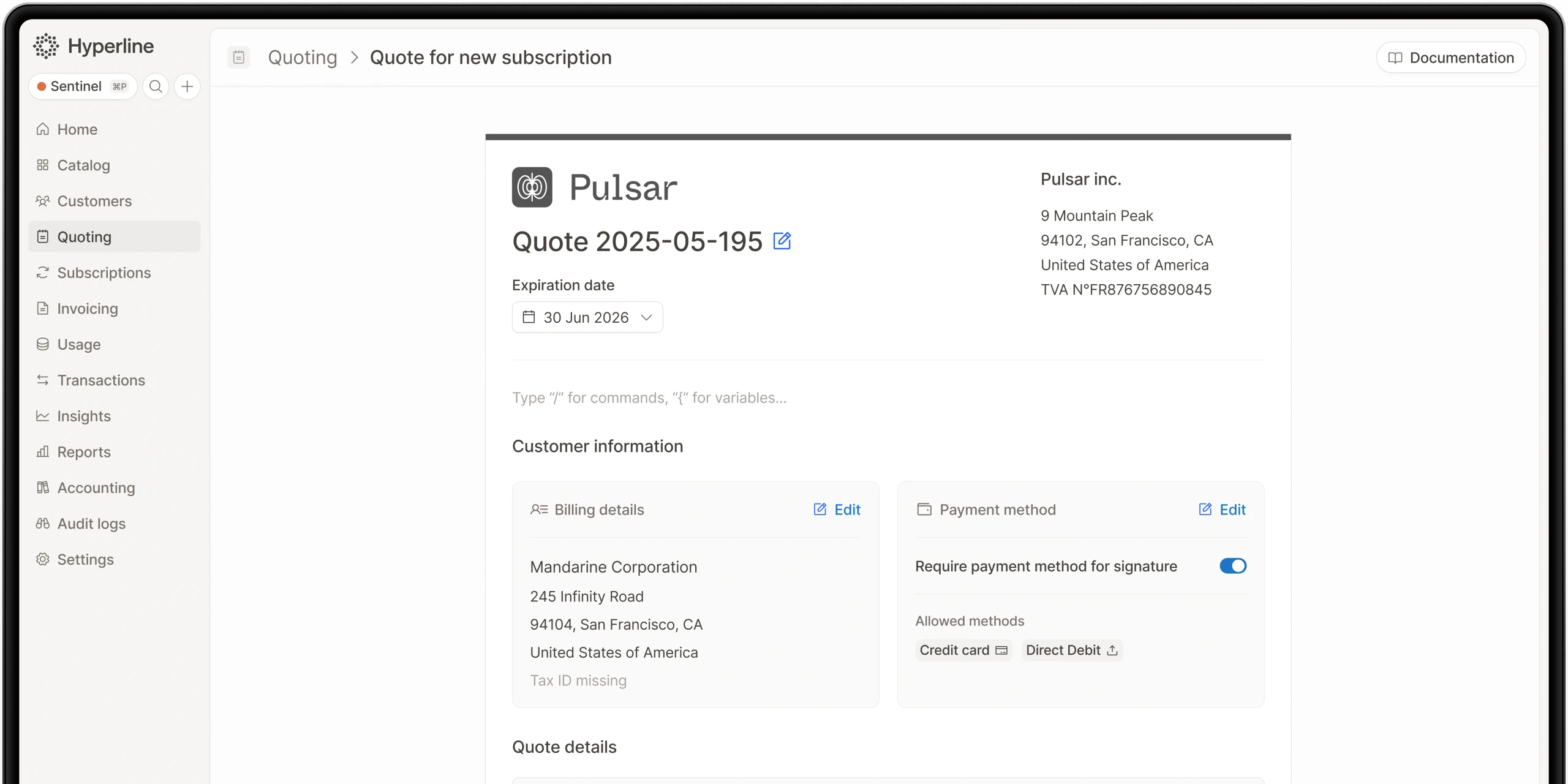
Hyperline is built for B2B SaaS companies that need to automate the entire quote-to-cash process, not just invoicing. It handles CPQ (Configure Price Quote), billing, payment collection, and revenue recognition in a single platform.
Key features:
- Supports flat fees, usage-based, tiered, and complex enterprise pricing models
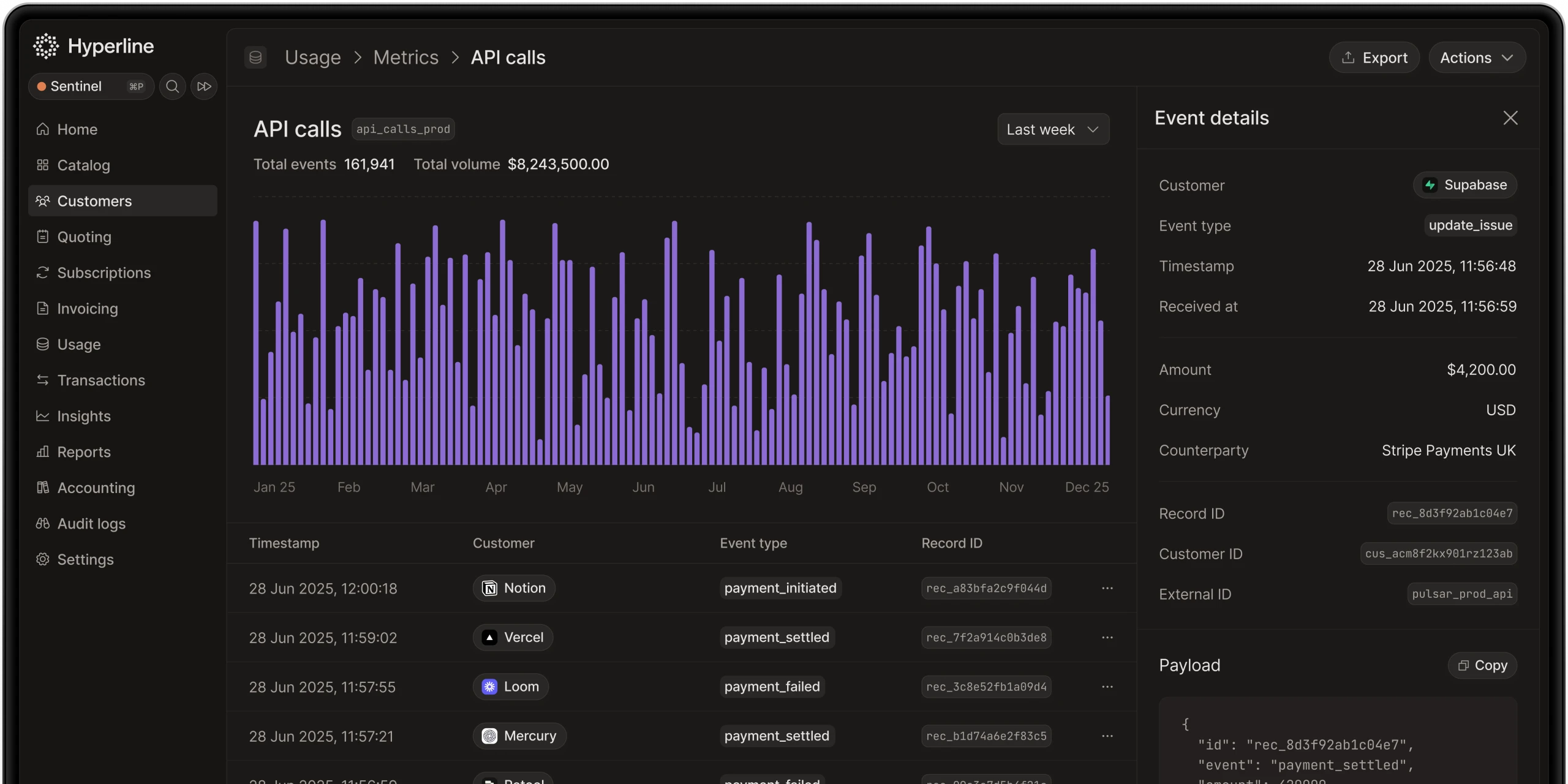
- Real-time usage metering and pay-as-you-go billing automation
- E-invoicing certified in 80+ countries with compliance for 100+ nations
- AI-powered smart retries and real-time payment alerts
- Connects with CRMs, ERPs, payment providers, and data warehouses
- 99.99% uptime, SOC2 and ISO27001 certified, GDPR compliant
Why it stands out: Hyperline eliminates the need for multiple point solutions. Finance teams report eliminating 80% of manual billing work after implementation, with 99.9% reconciliation accuracy across 500M+ invoices processed. For companies transitioning from product-led to enterprise sales, Hyperline handles the full quote-to-cash complexity without custom development.
Best for: B2B SaaS companies with complex pricing, enterprise contracts, or multi-country operations.
2. Stripe Billing
Stripe Billing is the developer-first choice for companies that need maximum flexibility and global reach. It supports tiered, metered, seat-based, and custom billing models, with payment processing in 135+ currencies across 20+ gateways.
Key features:
- Flexible billing model support
- Stripe Tax for automated tax calculation globally
- Comprehensive API for custom billing logic
- Strong reporting and analytics
Pricing: 0.7% of billing volume (pay-as-you-go) or monthly plans from $620 to $5,750.
Best for: Tech-forward companies with developer resources who need a highly customizable billing API.
Limitation: Transaction-based pricing can become expensive at scale, and Stripe alone does not cover revenue recognition or CPQ. See our full Hyperline vs. Stripe Billing comparison for a detailed breakdown.
3. Recurly
Recurly focuses on subscription lifecycle management with strong churn reduction tools. It supports fixed, usage-based, one-time, and hybrid billing models, and connects with 20+ payment gateways.
Key features:
- Churn analysis and automated dunning workflows
- Multi-gateway payment routing
- Flexible billing model support
- Revenue analytics
Pricing: Starter plan free for 3 months, then $249/month. Enterprise tiers are custom.
Best for: SaaS companies with high subscriber volumes and a focus on reducing involuntary churn.
4. Younium
Younium is purpose-built for B2B SaaS companies managing complex contracts. It covers subscription management, automated billing, dunning, and multi-currency support, with deep integrations into Salesforce, HubSpot, and NetSuite.
Key features:
- Advanced contract and subscription management
- No-code self-service portal
- Multi-currency and automated tax calculations
- Support for product-led, sales-led, and hybrid growth models
Pricing: Custom pricing.
Best for: Mid-market B2B SaaS with complex contract structures and enterprise CRM/ERP dependencies.
5. Paddle
Paddle operates as a Merchant of Record, meaning it takes full legal responsibility for global tax compliance, VAT, GST, and sales tax on your behalf. This is a fundamentally different model from other billing tools.
Key features:
- Full tax compliance handled end-to-end
- Fraud prevention and chargeback management
- Global coverage with enterprise ERP integrations (SAP, NetSuite)
Pricing: 5% + 50 cents per transaction.
Best for: SaaS companies selling globally who want to offload all tax and compliance complexity.
Limitation: Transaction fees become significant at high revenue volumes.
6. Zoho Billing
Zoho Billing is the accessible entry point for smaller SaaS companies already using the Zoho ecosystem. It covers automated subscription billing, usage-based pricing, and dunning management.
Key features:
- Integration with Zoho Books, CRM, Stripe, and PayPal
- Usage-based pricing support
- Dunning and payment retry automation
Pricing: From $29/month (Standard) to $69/month (Premium).
Best for: Early-stage SaaS companies with simple billing needs and existing Zoho infrastructure.
Limitation: Not designed for complex enterprise contracts or multi-entity scenarios.
7. BlueSnap
BlueSnap (by Payroc) covers the full accounts receivable automation cycle, from quote to cash, with global payment support across 200 regions and native ERP integrations (Oracle NetSuite, Sage Intacct).
Key features:
- Subscription lifecycle and recurring billing automation
- Intelligent payment routing across banks
- Global reach with localized payment methods
Pricing: Custom pricing.
Best for: Enterprise companies with complex AR processes and global operations.
How to Choose the Right Recurring Billing Software
1. Map your pricing model complexity
If you only charge flat monthly fees, most tools will do the job. If you combine seat-based, usage-based, and contract-specific pricing, you need a platform built for that complexity. Hyperline and Younium are designed for this; Stripe Billing can handle it with engineering effort.
2. Assess compliance requirements
If you operate in multiple countries, revenue recognition (ASC 606 / IFRS 15) and local tax compliance are non-negotiable. Look for platforms that automate this rather than passing the burden to your finance team. Hyperline covers 80+ countries for e-invoicing; Paddle removes the problem entirely as a Merchant of Record.
3. Check integration depth
Your billing platform needs to connect cleanly with your CRM, ERP, payment gateway, and data warehouse. A gap in any of these creates manual reconciliation work. Verify native integrations rather than relying on generic Zapier connections.
4. Look at the full quote-to-cash cycle
Many tools cover billing but not CPQ or revenue recognition. For B2B SaaS companies managing enterprise deals, the ability to go from contract negotiation to invoice to recognized revenue in a single platform eliminates significant operational overhead. Hyperline is one of the few platforms that covers this full cycle. See our breakdown of the best quote-to-cash software in 2026.
5. Consider scalability costs
Stripe per-transaction fees, Paddle 5% Merchant of Record fee, and Recurly volume tiers all affect unit economics at scale. Model your billing costs at 2x and 5x current revenue before committing.
Frequently Asked Questions
Q: What is the difference between recurring billing software and payment processing?
A: Payment processing (Stripe, Braintree) handles the transaction itself. Recurring billing software manages the full lifecycle: subscription creation, invoice generation, payment scheduling, dunning for failed payments, and revenue reporting. Most billing platforms sit on top of a payment processor.
Q: Do I need recurring billing software if I already use Stripe?
A: Stripe Billing handles billing logic, but it does not cover CPQ, revenue recognition, or complex contract management. Companies with enterprise deals or multi-country compliance requirements typically add a dedicated billing platform like Hyperline on top of or instead of Stripe Billing.
Q: What is dunning management in subscription billing?
A: Dunning management is the automated process of recovering failed payments. When a card declines, dunning workflows trigger a sequence of retry attempts, customer notifications, and escalation steps before canceling a subscription. Good dunning management directly reduces involuntary churn.
Q: How does usage-based billing work with recurring billing software?
A: Usage-based billing requires real-time metering of consumption data (API calls, seats, storage, etc.) and translation of that usage into invoice line items at the end of each billing period. Platforms like Hyperline and Stripe Billing support this natively with usage ingestion APIs and automated invoice calculation. Learn more in our guide on what is usage-based billing.
Q: What is revenue recognition and why does it matter for SaaS?
A: Revenue recognition is the accounting process of recording revenue when it is earned, not when cash is received. Under ASC 606 and IFRS 15, SaaS companies must recognize subscription revenue over the service period. Automated revenue recognition in billing software ensures compliance and accurate financial reporting without manual journal entries.
Bottom Line
The best recurring billing software for your B2B SaaS company depends on your pricing complexity, compliance needs, and growth stage. For companies managing enterprise contracts, usage-based pricing, and multi-country operations, Hyperline offers the most complete quote-to-cash automation in a single platform. For developer-first teams with simpler needs, Stripe Billing remains a strong foundation.
The cost of under-investing in billing infrastructure is measurable: revenue leakage from failed payments, compliance risk from manual recognition, and engineering time spent building what dedicated platforms already do.
Where this fits in Hyperline
Frequently asked questions
Usually not on its own. Oracle CPQ brings enterprise-grade catalog and pricing-rule capabilities for organizations operating at significant scale, but implementation timelines and total cost of ownership are heavy for a mid-market SaaS company evaluating it from scratch, unless the business is already committed to the Oracle CX or ERP ecosystem.
LedgerUp is focused on the post-signature handoff: getting from a signed contract to a first invoice quickly. It does not include native CPQ, and its global e-invoicing and revenue recognition depth are limited compared to a full quote-to-cash platform, so teams that scale into hybrid pricing or larger, multi-country contracts typically re-evaluate.
Hyperline is the strongest fit for B2B SaaS companies with usage-based, tiered, or hybrid pricing that need CPQ, billing, and revenue recognition unified in one platform instead of three separate systems. For simple, seat-based pricing already running on Salesforce, or if the only need is post-signature contract handoff automation like LedgerUp provides, a different platform is a better starting point.
As SaaS companies grow, billing needs become more complex. HubSpot CPQ has limits: no quote-to-invoice automation, little pricing flexibility, basic reporting, manual revenue recognition, and no advanced subscription support.
It depends on pricing complexity. Simple, flat subscription pricing can run acceptably on separate best-of-breed tools connected by integrations. Once pricing includes usage-based or hybrid components, or deal sizes require approval workflows and e-signature, the reconciliation cost of stitched-together tools tends to outweigh the flexibility of picking each piece independently.
Salesforce Revenue Cloud's strength is CPQ configurability inside the Salesforce ecosystem. Usage-based and consumption billing is a comparatively newer layer than its quoting core, and the platform generally requires meaningful Salesforce admin and implementation investment to configure well for hybrid pricing.
Billing software converts an existing subscription or contract into invoices. Quote-to-cash software covers the full process before and after that: configuring a quote, getting it approved and signed, billing it correctly (including usage-based components), collecting payment, and recognizing revenue. A billing tool can be one part of a quote-to-cash stack; on its own, it isn't the whole thing.
Yes. Hyperline connects to Stripe, GoCardless, Mollie, Airwallex, and bank transfers. It automates payment matching and reminders.